OPPO Find X9系列

Search documents
博主称华为Mate80系列销量超310万,小米17系列超350万
Guan Cha Zhe Wang· 2026-02-25 14:08
Group 1 - The core point of the articles highlights the sales performance of various smartphone brands, with Xiaomi 17 series leading at approximately 3.5 million units sold, followed by Huawei Mate 80 series at about 3.1 million units [1] - The sales figures for sub-brands include REDMI K90 at approximately 1.1 million units and iQOO 15 at around 0.76 million units, indicating a competitive landscape among different brands [1] - The cumulative sales of the iPhone 17 series reached approximately 20.9 million units, showcasing Apple's strong market presence [1] Group 2 - In terms of market share, Huawei leads with 18.3%, closely followed by Apple at 18.2%, indicating a tight competition at the top [2] - OPPO and vivo both hold a market share of 16.3%, with OPPO including OnePlus and Realme, while Xiaomi and Honor have market shares of 14.1% and 12.8% respectively, ranking them 5th and 6th [2] - The data reflects a highly competitive smartphone market, with several brands vying for consumer attention and market share [2]


华为破了vivo的金身
3 6 Ke· 2026-01-23 03:52
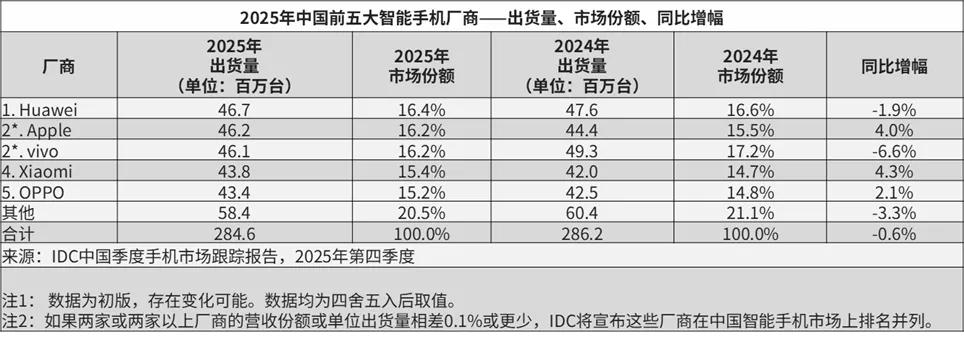
Core Viewpoint - The Chinese smartphone market has experienced significant changes in rankings, with Huawei regaining the top position in market share after several years, despite a slight decline in overall shipment volume [1][4]. Market Overview - In 2025, the total shipment volume of smartphones in China is projected to be 285 million units, reflecting a year-on-year decrease of 0.6% [1][4]. - The competitive landscape is intensifying, with major brands closely contending for market share [3][4]. Key Players and Market Share - The top five smartphone manufacturers in China for 2025 are: 1. Huawei: 46.7 million units, 16.4% market share, down 1.9% from 2024 2. Apple: 46.2 million units, 16.2% market share, up 4.0% from 2024 3. Vivo: 46.1 million units, 16.2% market share, down 6.6% from 2024 4. Xiaomi: 43.8 million units, 15.4% market share, up 4.3% from 2024 5. OPPO: 43.4 million units, 15.2% market share, up 2.1% from 2024 [2]. Vivo's Market Position - Vivo has dropped from first to third place in market share, with a significant year-on-year decline in shipment volume [2][11]. - The brand's strategy of releasing a high number of models (81 in 2025) is under scrutiny as the market shifts towards high-end devices [11][12]. Industry Trends - The smartphone market is transitioning from an incremental growth phase to a saturated market, with a notable increase in the share of high-end devices priced above 4,000 RMB [12][13]. - The competition is expected to intensify in 2026, particularly due to rising costs in components like memory [5][23]. User Experience and Brand Loyalty - Vivo's user retention rate is lower than competitors like Huawei and Apple, indicating potential issues with customer satisfaction [22]. - The brand has faced criticism regarding user experience, particularly in areas such as camera performance and software functionality [16][21]. Future Outlook - Vivo needs to enhance its focus on high-end market segments to remain competitive, especially as the overall market is expected to decline further in 2026 [14][23].

华为登顶,吃了谁的蛋糕?
Xin Lang Cai Jing· 2026-01-22 20:13
Core Insights - Huawei has regained the top position in the Chinese smartphone market with a shipment of 46.7 million units and a market share of 16.4% in 2025, although this is significantly lower than its peak of 124.9 million units and 38.3% market share in 2020 [2][3][6] - The competition among the top three manufacturers—Huawei, Apple, and Vivo—is intense, with their shipment volumes closely aligned, indicating a highly competitive market landscape [4][7] - Despite Huawei's return to the top, its shipment volume has decreased by approximately 2% year-on-year, reflecting a broader market decline [5][6] Shipment and Market Share - In 2025, the top five smartphone manufacturers in China by shipment volume are: 1. Huawei: 46.7 million units (16.4%) 2. Apple: 46.2 million units (16.2%) 3. Vivo: 46.1 million units (16.2%) 4. Xiaomi: 43.8 million units (15.4%) 5. OPPO: 43.4 million units (15.3%) [3][6] - The overall smartphone market in China saw a slight decline, with total shipments of 284.4 million units in 2025, down 0.6% from 2024 [6] Activation vs. Shipment - Huawei's activation volume ranks fifth, significantly lower than its shipment volume, indicating potential inventory issues with a gap of over 3 million units between shipments and activations [10][12] - In contrast, other brands like Vivo, Apple, and OPPO have activation volumes closely matching their shipment volumes, suggesting healthier inventory management [12][10] Competitive Landscape - The competition is not only between Huawei and Apple but also includes Vivo, which has maintained a strong presence in the market, and Xiaomi, which has shown positive growth [30][34] - OPPO has also demonstrated resilience, achieving a year-on-year shipment growth of nearly 30% in 2025, indicating a robust competitive strategy [34] Product Strategy and Pricing - Huawei's successful return is attributed to its strong product lineup, including the Mate 70 and Pura 80 series, which have seen significant sales despite the absence of advanced 3nm chips [21][24] - The company has strategically reduced prices on key models, with reductions exceeding 800 yuan, making its products more competitive in a market where other brands have raised prices [27][29] Future Outlook - The smartphone market in 2026 is expected to face challenges, including rising storage costs and a potential decline in overall shipments, which could reshape the competitive dynamics [36][38] - The ability of manufacturers to adapt to these changes and maintain product appeal will be crucial for sustaining market positions in the coming years [38]
“广货群侠”多强大?广东这五大品牌征服了全球
21世纪经济报道· 2026-01-20 10:29
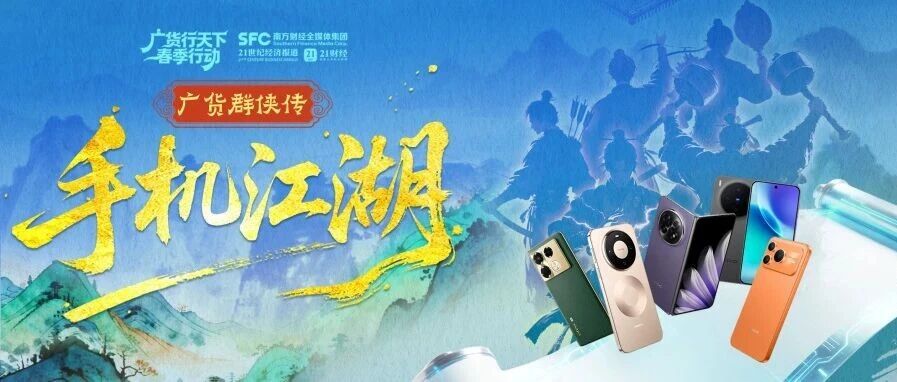
Core Viewpoint - The article emphasizes the competitive landscape of the smartphone industry, highlighting Guangdong's dominance as a major manufacturing hub and innovation center, with significant contributions from local brands like Huawei, OPPO, vivo, and Honor [1][13]. Industry Overview - Guangdong is recognized as the most important smartphone industry cluster in China, leading in scale, production, and export, with one in three smartphones sold globally originating from this region [13]. - The smartphone market is characterized by rapid technological advancements and intense competition, with major players continuously innovating to maintain their market positions [1]. Company Highlights - **Huawei**: Utilizes its advanced Kirin chips and Kunlun glass, with the HarmonyOS enabling seamless connectivity. In 2025, Huawei's smartphone shipments reached 4.67 million units, capturing 16% of the market share in China [3]. - **OPPO**: Focuses on imaging, AI, communication, and fast charging technologies. By November 2025, the global activation of the OPPO Reno series surpassed 10 million, and the Find X9 series sold over 1 million units within 10 days of its domestic launch [5]. - **vivo**: Specializes in professional imaging technology, launching the X300 series with a focus on high-quality mobile photography. Currently, vivo serves over 100 million users globally [7]. - **Honor**: Launched the Honor Power2 in January 2026, featuring a 10,080mAh battery to address battery life concerns. In 2025, Honor's smartphone shipments exceeded 71 million units, with over 30% of sales coming from international markets [9]. Technological Evolution - Over the past 30 years, Guangdong's smartphone technology has evolved from self-developed feature phones to the emergence of autonomous brands in the smartphone era, achieving breakthroughs in fast charging, imaging, full-screen displays, and 5G technology [16].
IDC 2025: OPPO第四季度国内双位数增长,安卓唯一
Xin Lang Cai Jing· 2026-01-14 06:23
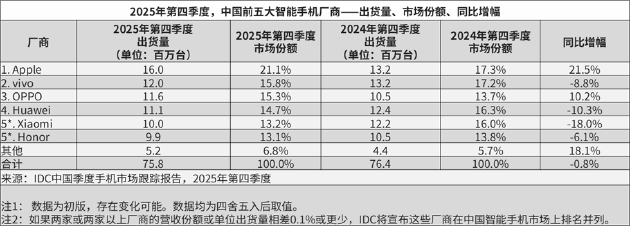
Core Insights - The global smartphone market is expected to reach a total shipment of 1.26 billion units in 2025, reflecting a year-over-year growth of 1.9%, indicating a continued recovery trend in the market [1] - In the fourth quarter of 2025, global smartphone shipments reached 336.3 million units, marking a 2.3% increase compared to the previous year [3][8] Group 1: Global Market Performance - The fourth quarter of 2025 saw a total shipment of 336.3 million smartphones, with Apple leading the market with a share of 24.2% and shipments of 81.3 million units, up 4.9% year-over-year [3][8] - Samsung followed with a market share of 18.2%, achieving a significant year-over-year growth of 18.3% with shipments of 61.2 million units [3][8] - The overall smartphone market in China experienced a slight decline of 0.8% in shipments, totaling approximately 75.8 million units in the fourth quarter [7] Group 2: Company-Specific Insights - OPPO was the only major Android brand in China to achieve double-digit growth in the fourth quarter of 2025, with a year-over-year increase of 10.2%, resulting in shipments of 11.6 million units [2][7] - OPPO's strong performance is attributed to the successful launch of competitive new products, particularly the OPPO Find X9 series, which sold 1 million units within 10 days of its domestic launch [5][9] - The OPPO Reno series has seen significant activation numbers, nearing 100 million units in China and over 130 million globally, maintaining a leading position in the competitive $400–$600 price segment [6][9]
智能手机的2025:厮杀、阵痛与价值重塑
投中网· 2026-01-09 01:50
Core Viewpoint - The Chinese smartphone market in 2025 is experiencing a shift from a "quantity" competition to a "quality" battle, driven by fierce competition and changing consumer behavior [5][9]. Market Performance - In the first half of 2025, the market was pessimistic due to saturation and rational consumer decisions, but by the fourth quarter, smartphone sales increased by 11% year-on-year, with Apple iPhone sales up by 29% [6][7][8]. - The top five smartphone manufacturers in Q3 2025 saw a slight decline in overall shipments, with a total of approximately 68.4 million units shipped, down 0.6% year-on-year [13][14]. Competitive Landscape - The competition is characterized by a struggle within a defined market boundary, with limited growth opportunities and increasingly difficult user acquisition [11][12]. - Vivo led the market with 11.8 million units shipped, followed closely by Apple with 10.8 million units, and Huawei with 10.4 million units [14]. Strategic Shifts - Apple adopted a disruptive strategy of "increasing volume while lowering prices," significantly impacting the mid-to-high-end market of domestic brands [15]. - Domestic brands like Xiaomi and OPPO are focusing on high-end markets, launching products priced above 6000 yuan to differentiate themselves [17]. Technological Evolution - The focus of competition has shifted from hardware specifications to user experience, particularly in imaging technology, where brands are emphasizing software capabilities over mere hardware [19][20]. - AI technology is becoming a practical solution in smartphones, with features like automatic scene recognition and enhanced photography being integrated into devices [22]. User Experience Innovations - New features addressing specific user pain points, such as motion sickness modes, are emerging, reflecting a deeper understanding of consumer needs [23]. - The average smartphone replacement cycle has extended from 24 months in 2020 to 36 months in 2024, indicating a shift in consumer behavior towards longer device usage [25]. Future Directions - The smartphone industry is expected to rely more on internal innovation and structural changes, with major players moving towards vertical integration to enhance product differentiation and profit margins [26]. - The foldable smartphone market is evolving, with multiple manufacturers entering, suggesting a potential for new applications and high-value markets [26]. Conclusion - The 2025 smartphone market represents a duality of challenges and opportunities, with competition now focused on enhancing user experience and addressing specific pain points, indicating a need for brands to build emotional connections with consumers [27][28].

苹果官网没有“国补”了
Guan Cha Zhe Wang· 2026-01-05 06:37
Group 1 - The new round of "national subsidies" policy has been implemented for 2026, with subsidy rates similar to last year, including smart glasses for the first time [1] - The subsidy is set at 15% of the selling price, with a maximum of 500 RMB for products priced under 6000 RMB [1] - Apple's official website has not updated its support for national subsidies beyond 2025, and the subsidy activity interface is no longer visible [1][5] Group 2 - In JD and Taobao platforms, certain regions still offer national subsidies for the iPhone 17, with specific provinces confirmed to be eligible [5] - There has been ongoing debate about whether Apple should benefit from national subsidies, with criticisms regarding its pricing strategies to meet subsidy thresholds [7] - As of December 21, the iPhone 17 series sold approximately 14.86 million units in the Chinese market, dominating sales compared to local brands [7]

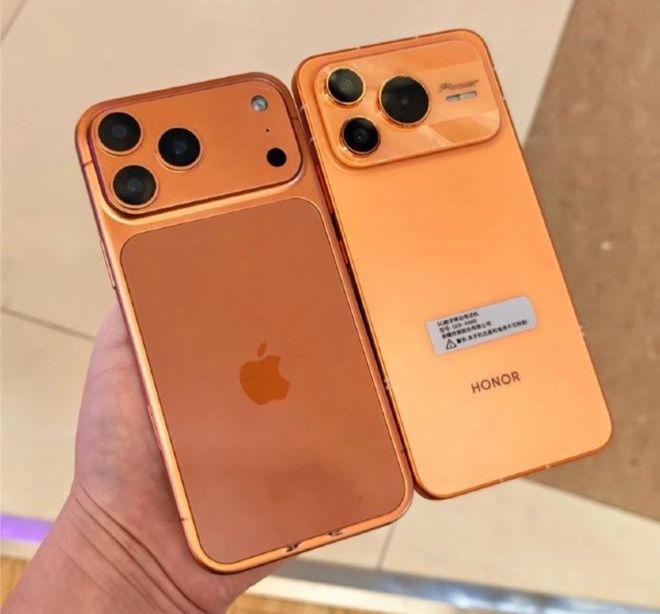
荣耀新机高度“撞脸”iPhone引热议
Guan Cha Zhe Wang· 2025-12-31 05:56
Group 1 - The new Honor Power 2 smartphone has sparked discussions due to its design similarities with the iPhone 17 Pro Max, particularly in the rear camera module and color options [1][4] - The Honor Power 2 features a 6.79-inch 1.5K LTPS display, MediaTek Dimensity 8500 Elite processor, a 16MP front camera, a 50MP main camera with a 5MP secondary camera, and a large 10,080mAh battery with 80W fast charging, expected to be priced around 2,000 yuan [4] - There is a divided opinion among consumers regarding the design; some prioritize performance and value over originality, while others express concerns about the lack of distinctiveness in design affecting brand reputation [8] Group 2 - As of December 21, the iPhone 17 series has sold approximately 14.86 million units in the Chinese market, while Honor's Magic 8 series has sold about 454,000 units, indicating a significant gap in market performance [9] - Other domestic brands have also seen varying sales figures, with OPPO Find X9 series at approximately 747,500 units, vivo X300 series at about 973,600 units, Huawei Mate 80 series at around 1.23 million units, and Xiaomi 17 series at approximately 2.69 million units [9]
年终报道∣智能手机的下一次变革,已被AI启动?
Zhong Guo Ji Jin Bao· 2025-12-21 08:05
Core Insights - The smartphone industry in 2025 is significantly influenced by AI, marking a shift from hardware-centric innovations to AI-driven functionalities [2][3] - AI is transitioning from a mere tool to a core operational component in smartphones, with companies like Honor and Apple leading this change [4][5] - The introduction of AI phones, such as the Doubao AI phone, has sparked discussions about the potential for AI to replace human operations in mobile tasks [6][7] Group 1: Industry Trends - AI has become the central theme in smartphone launches, with major brands emphasizing AI capabilities in their new models [3][4] - The average smartphone replacement cycle has extended to approximately 51 months, indicating a shift from smartphones being seen as fast-moving consumer goods to durable goods [3] - The introduction of AI at the system level is seen as a foundational change, with expectations that by 2026, edge AI models will become standard in the industry [5] Group 2: Market Dynamics - The Doubao AI phone has generated significant market interest, with its price skyrocketing in the second-hand market, indicating a strong consumer demand for AI-driven experiences [6][7] - However, the current AI applications in smartphones have not yet reached a "killer app" status, as they lack comprehensive user understanding and personalization [6] - The competition is shifting from hardware specifications to AI system capabilities and ecosystem integration, with companies needing to focus on long-term user value [11][12] Group 3: Regulatory and Ecosystem Challenges - The rise of AI phones has led to restrictions from various applications, limiting their functionality on devices like the Doubao AI phone [8][9] - There is a potential conflict between AI-driven operations and existing app ecosystems, which may lead to a reevaluation of app monetization and user engagement strategies [10] - The industry is facing a need for clearer regulations and communication between AI phone manufacturers and app developers to ensure a balanced ecosystem [9][10]

年终报道∣智能手机的下一次变革,已被AI启动?
中国基金报· 2025-12-21 07:59
Core Viewpoint - The smartphone industry is undergoing a significant transformation driven by AI, shifting from hardware-centric innovations to AI as a core operational component [3][5][15]. Group 1: AI's Role in Smartphones - AI has transitioned from being a marketing buzzword to a fundamental aspect of smartphone operation, with manufacturers emphasizing AI's integration into the user experience [3][5]. - Major brands like Apple, Vivo, and Honor are focusing on developing AI capabilities that operate at the system level, indicating a shift towards AI as essential infrastructure for future smartphones [6][10]. - The introduction of the Doubao AI phone exemplifies this shift, showcasing AI's potential to perform tasks autonomously, thus redefining user interaction with smartphones [9][10]. Group 2: Market Dynamics and Consumer Behavior - The global smartphone replacement cycle is lengthening, with the average annual replacement rate dropping to 23.7% by 2024, indicating a shift from smartphones as fast-moving consumer goods to durable goods [5]. - The Doubao AI phone has generated significant market interest, with its price skyrocketing in the second-hand market, reflecting consumer demand for innovative experiences rather than just hardware specifications [9][12]. - The competition is evolving from hardware specifications to AI system capabilities and ecosystem integration, as companies seek to meet consumer demands for streamlined interactions [15][16]. Group 3: Challenges and Ecosystem Impact - Despite the excitement around AI, there are concerns about the lack of "killer applications" that fully leverage AI's capabilities in smartphones, limiting its current effectiveness [8][12]. - The introduction of AI-driven smartphones has led to disruptions in existing app ecosystems, with some applications restricting access to AI operations, highlighting the tension between innovation and established app functionalities [12][13]. - The shift towards AI as an operational entity may necessitate a reevaluation of app monetization strategies and user engagement models, as AI could change how users interact with applications [13][16].