
RWA代币化产品

Search documents
Web3行业研究:加密市场受国际冲突影响转冷,Coinbase开放股票交易
SINOLINK SECURITIES· 2026-03-01 12:24
Investment Rating - The report suggests a cautious approach in the current cryptocurrency market due to low market sentiment [3][30]. Core Insights - The cryptocurrency market has experienced a downturn, with Bitcoin closing at $65,882, down 3.1% week-over-week, and Ethereum at $1,931, down 1.9% [9][10]. - The total market capitalization of cryptocurrencies decreased by 5.2% to $2.21 trillion [9][18]. - The Fear and Greed Index for cryptocurrencies is at 14, indicating extreme fear in the market [10][11]. - Global events, such as the US-Iran conflict and lower-than-expected GDP forecasts for Q4 2025, have contributed to the market's decline [9][10]. Global Policy and Industry News - Hong Kong is set to establish a digital bond platform to support tokenized bond issuance and settlement, with a total of HKD 10 billion (approximately $1.28 billion) in tokenized government bonds issued by Q4 2025 [23]. - WisdomTree has received SEC approval for a tokenized money market fund that allows 24/7 trading and instant settlement [22]. - The UK Gambling Commission is evaluating the feasibility of allowing cryptocurrency for betting payments, aligning with the development of a regulatory framework for digital assets [24]. - TruStage is piloting a digital currency linked to the US dollar for credit unions, expected to launch in H1 2026 [22]. Company News - Coinbase has opened stock trading to all US users and partnered with Yahoo Finance for asset research and trading execution [26]. - MARA is collaborating with Starwood Capital to develop AI-focused data centers [26]. - Citibank plans to launch institutional-grade Bitcoin custody services by 2026 [26]. - Morgan Stanley has applied for a national trust bank charter to offer digital asset custody and staking services [27]. - SoFi, a US chartered bank, now supports deposits on the Solana network [27]. - The Hong Kong Securities and Futures Commission has approved two tokenized products from Derlin Holdings, marking a significant step in real-world asset tokenization [29].

香港放行首个地产RWA项目
Sou Hu Cai Jing· 2026-02-28 00:51
Core Viewpoint - The first real-world asset (RWA) tokenization project in Hong Kong has gained significant attention, as it aims to enhance asset liquidity and trading efficiency while providing a regulatory framework for the integration of traditional commercial real estate and digital finance [2][3]. Group 1: Project Overview - The first RWA project in Hong Kong was approved in late February 2023, focusing on "offshore assets issued offshore" and accelerating commercialization [2]. - The project involves two RWA tokenization products by Derin Holdings, including the tokenization of a limited partnership fund holding the Derin Building in Central Hong Kong and another fund investing in private equity projects [3]. - The Derin Building, located in a prime commercial area, was purchased for over HKD 280 million in 2023, with a unit price exceeding HKD 25,300 per square meter [4]. Group 2: Regulatory and Market Context - The approval of the RWA project is seen as a significant step for Hong Kong's regulatory framework, which is designed to ensure investor protection and operational sustainability [5]. - Recent regulatory guidelines from the People's Bank of China and other departments have provided a clearer definition of RWA tokenization, allowing for the issuance and trading of tokenized assets [6]. - Hong Kong's regulatory environment is viewed as favorable for the development of digital assets, positioning the region as a global hub for RWA and attracting quality assets and professional investors [7][8]. Group 3: Industry Implications - The project serves as a practical case for the Hong Kong Securities and Futures Commission to test the applicability of existing licensing systems and tokenization guidelines in real-world scenarios [5]. - The successful implementation of RWA tokenization in Hong Kong could provide valuable insights for mainland China and other regions in developing their own regulatory frameworks [8]. - The collaboration between Derin Holdings and regulatory bodies highlights the potential for Hong Kong to act as a bridge between domestic and international markets in the realm of digital finance [8].

人民币稳定币境外发行被禁
Di Yi Cai Jing· 2026-02-08 13:09
Core Viewpoint - The recent regulatory measures in China represent the strictest oversight in the history of virtual currencies, emphasizing that any activities related to virtual currencies are illegal financial activities, particularly banning the issuance of RMB-pegged stablecoins abroad [1][2][8] Regulatory Framework - The People's Bank of China and eight other departments issued a notification reiterating that virtual currency-related activities are illegal, specifically prohibiting any entity or individual from issuing RMB-pegged stablecoins abroad without approval [2][3] - The China Securities Regulatory Commission (CSRC) released guidelines defining the tokenization of real-world assets (RWA) and established a regulatory principle of "strict prohibition domestically, strict regulation abroad" [1][5] Impact on Stablecoin Market - The new regulations are expected to disrupt the entire supply chain of stablecoin issuance, circulation, and trading, particularly affecting existing RMB-pegged stablecoins that lack compliance and transparency [3][8] - Analysts suggest that major domestic companies may become more cautious and may not pursue stablecoin licenses in the future due to the stringent regulatory environment [3][8] RWA Tokenization - The notification provides a clear definition of RWA tokenization, which involves converting ownership and income rights of assets into tokens using cryptographic technology [6][7] - Domestic issuance of RWA is explicitly prohibited, and any related activities are considered illegal financial activities [6][7] Compliance and Oversight - The guidelines introduce a "filing system" for RWA tokenization, requiring domestic entities to file with the CSRC before engaging in related activities, ensuring compliance with regulatory standards [7] - The regulatory framework aims to prevent regulatory arbitrage while allowing compliant RWA models to develop within a controlled environment [7][9] Collaborative Regulatory Approach - The recent policies establish a comprehensive regulatory system that emphasizes collaboration among various departments to effectively manage and mitigate risks associated with virtual currencies [8][9] - The focus is on maintaining financial sovereignty and security by clearly prohibiting the circulation of virtual currencies and strictly controlling the issuance of stablecoins, especially those pegged to the RMB [8][9]
人民币稳定币境外发行被禁
第一财经· 2026-02-08 12:45
Core Viewpoint - The article discusses the recent stringent regulations imposed on the virtual currency sector in China, emphasizing the prohibition of offshore issuance of RMB-pegged stablecoins and the strict control over virtual currency activities, marking a significant shift in regulatory stance [3][4][5]. Regulatory Framework - On February 6, the People's Bank of China and eight other departments issued a notice reiterating that virtual currency-related activities are illegal financial activities, explicitly banning any unit or individual from issuing RMB-pegged stablecoins abroad [3][6]. - The China Securities Regulatory Commission (CSRC) released guidelines for the regulation of asset-backed securities tokens issued overseas, defining the tokenization of real-world assets (RWA) and establishing a "strictly prohibited domestically, strictly regulated abroad" principle [3][10]. Impact on Stablecoin Market - The new regulations are expected to disrupt the entire stablecoin industry chain, particularly affecting the issuance, circulation, and trading of stablecoins linked to the RMB, which have been operating without compliance [7][10]. - Analysts suggest that the regulations will lead to a cautious approach from major domestic enterprises regarding stablecoin licenses, potentially halting applications for such licenses in the future [7][10]. RWA Tokenization Regulations - The notice defines RWA tokenization as the conversion of ownership and income rights of assets into tokens using cryptographic technology, with domestic issuance of RWA being explicitly prohibited [10][11]. - The guidelines require domestic entities to file with the CSRC before engaging in RWA activities abroad, ensuring compliance with regulatory standards [11]. Long-term Regulatory Strategy - The recent regulatory policies aim to establish a long-term regulatory framework that includes central coordination, local implementation, and inter-departmental collaboration to combat illegal financial activities related to virtual currencies [14][15]. - The emphasis is on maintaining the status of the RMB as a legal currency and preventing potential risks associated with virtual currencies, while still allowing for controlled financial innovation [15].

史上最严虚拟货币监管落地,人民币稳定币境外发行被禁
Di Yi Cai Jing· 2026-02-08 11:54
Core Viewpoint - The recent regulatory measures by the People's Bank of China and eight other departments represent the strictest regulations in the history of virtual currency, aiming to eliminate illegal issuance of stablecoins linked to the RMB and to reinforce the prohibition of virtual currency-related activities as illegal financial activities [1][9]. Group 1: Regulatory Framework - The new regulations explicitly prohibit any entity or individual from issuing RMB-linked stablecoins abroad without approval, reinforcing the principle of "strictly prohibited domestically, strictly regulated abroad" [3][6]. - The guidelines for the issuance of asset-backed securities tokens (RWA) have been established, marking a significant regulatory framework for the tokenization of real-world assets [6][8]. Group 2: Impact on the Market - The regulations are expected to disrupt the entire supply chain of stablecoin issuance, circulation, and trading, particularly affecting existing RMB-linked stablecoins that lack compliance and transparency [4][9]. - The issuance of stablecoin licenses in Hong Kong is under scrutiny, with 36 applications received, emphasizing the importance of risk management capabilities of applicants [5]. Group 3: Future Implications - The regulations may lead to a cautious approach from major domestic enterprises regarding stablecoin licenses, as the issuance of virtual currencies by overseas holding companies remains a topic of discussion [4][9]. - The regulatory framework aims to balance strict oversight with the need for financial innovation, allowing compliant RWA models to develop while preventing regulatory arbitrage [8][10].
RWA 并非概念,而是已落地的资产数字化赛道
Sou Hu Cai Jing· 2025-12-10 09:49
Core Insights - The global RWA market is expected to double to $17.3 billion by 2025, supported by Hong Kong policies, with both state-owned and private enterprises actively participating [1] - RWA technology allows for the tokenization of real assets, enabling ordinary individuals to invest in quality assets with low entry barriers [3] Group 1: Definition and Mechanism - RWA refers to issuing "digital certificates" for real assets, transforming traditional assets like real estate and government bonds into tradable tokens via blockchain technology [3] - Each token corresponds to the income generated by the real asset, making it an asset-inclusive tool [3] Group 2: Practical Applications - Real Estate: Investment thresholds significantly lowered, with some projects allowing participation from as low as $1,000 [5] - Supply Chain Finance: Financing costs for SMEs reduced by approximately 30%, with a significant decrease in risks related to warehouse receipts [5] - Energy Assets: Real-time tracking of photovoltaic power generation on the blockchain, with automatic distribution of income to token holders [5] - Financial Assets: Participation in debt-related asset configurations starting from $1,000, with issuance cycles shortened to 72 hours [6] Group 3: Key Advantages - Low Entry Barriers: Traditional high barriers for quality assets are broken, allowing ordinary individuals to share in core asset returns [8] - Efficient Settlement: 24/7 processing capabilities enhance transaction efficiency, especially for cross-border trades [8] - Cost Reduction: Financing costs can be reduced by 30%-60% due to the replacement of some intermediary roles with smart contracts [8] - Strong Compliance: The implementation of Hong Kong's Stablecoin Regulation and orderly progress of pilot projects in Hainan enhance the compliance framework [8] Group 4: Opportunities and Market Trends - Investment Threshold Optimization: The minimum investment for some compliant projects has been reduced from HKD 8 million to HKD 2,100 [9] - Market Expansion: More asset types, including intellectual property and commodities, are gradually being included in the tokenization scope [9] - Increased Compliance Services: Several brokers in Hong Kong are actively applying for relevant business qualifications, leading to a growing supply of compliant services [9] - The RWA industry is accelerating, with policy support, capital investment, and industry practices driving growth, and the global market is projected to exceed $16 trillion by 2030 [12]
国富量子(00290) - 有关自愿性公告 与金涌投资有限公司之战略合作之补充公告
2025-09-15 10:49
有關 香港交易及結算所有限公司及香港聯合交易所有限公司對本公告之內容概不負責, 對其準確性或完整性亦不發表任何聲明,並明確表示,概不對因本公告全部或任 何部分內容而產生或因倚賴該等內容而引致之任何損失承擔任何責任。 GoFintech Quantum Innovation Limited 國富量子創新有限公司 (前稱 GoFintech Innovation Limited 國富創新有限公司) (於開曼群島註冊成立之有限公司) 網址:https://290.com.hk (股份代號:290) 自願性公告 與金涌投資有限公司之戰略合作 之補充公告 茲提述國富量子創新有限公司(「本公司」)日期為二零二五年八月二十六日有關(其 中包括)戰略合作之自願性公告(「該公告」)。除另有界定外,本公告所用詞彙與 該公告所界定者具有相同涵義。 本公司謹此向本公司股東及潛在投資者提供有關戰略合作之補充資料。 戰略合作 — RWA代幣化產品及RWA項目 鑒於本公司與金涌投資簽署之戰略合作備忘錄僅構成合作之指示性框架,擬開展 之RWA 代幣化產品及RWA 項目目前仍在考量及評估中。於本公告日期,該等產品 及項目可能包括符合以下條件的 ...
“房产上链”卷土重来!有人喊你3000元当合伙人,暴富机遇还是陷阱?
第一财经· 2025-09-14 05:43
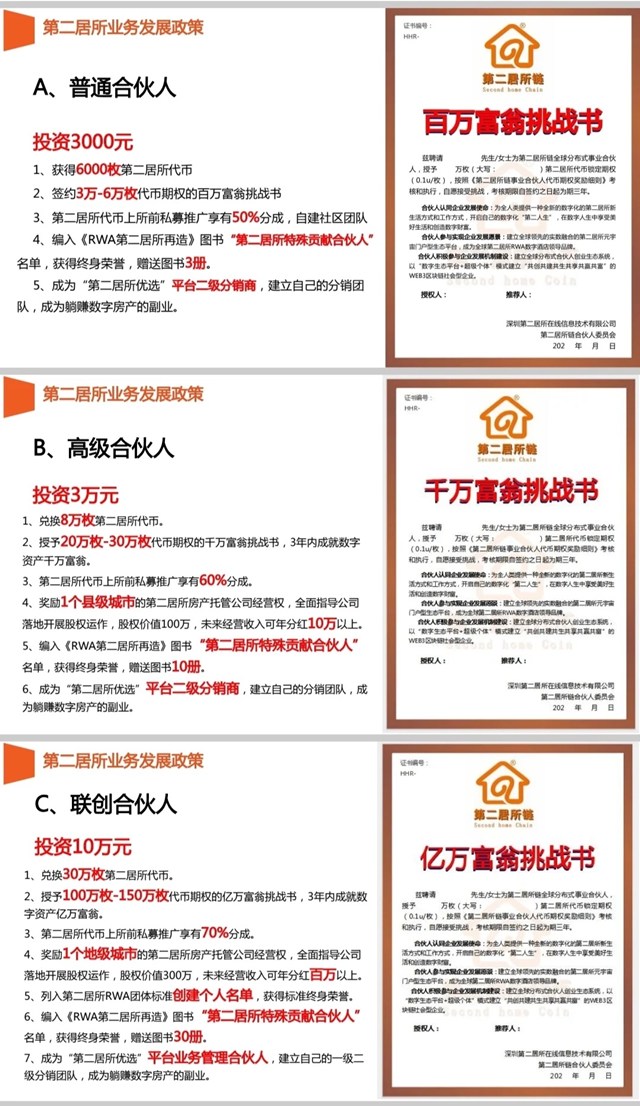
Core Viewpoint - The article discusses the emerging concept of "RWA tokenization" in the real estate sector, which is being promoted as a new investment opportunity with high returns, despite warnings from industry experts about potential risks and regulatory concerns [1][4][15]. Group 1: RWA Tokenization Overview - "RWA tokenization" refers to the process of converting real-world assets, such as real estate, into digital tokens on a blockchain, allowing for fractional ownership and investment [15]. - The market for RWA is projected to grow significantly, with estimates suggesting it could reach $16 trillion by 2030 and $30 trillion by 2034 [15]. - The concept is gaining traction in various regions, with examples of successful implementations in places like Dubai and Japan, where regulatory frameworks are being established to support such initiatives [20][21]. Group 2: Investment Opportunities and Promotions - Promoters of RWA tokenization are advertising high returns, claiming that investments as low as 3,000 yuan can yield significant profits, such as 10,000 yuan in annual dividends [6][7]. - Various partnership tiers are being offered, with escalating investment amounts leading to greater rewards and potential ownership of property management rights [7][8]. - The promotion of RWA tokenization is being conducted through social media platforms, targeting individuals looking for new investment avenues [5][6]. Group 3: Regulatory Concerns and Risks - Experts caution that any investment promising guaranteed returns should be approached with skepticism, as many such schemes may be fraudulent or illegal [4][14][17]. - In mainland China, the regulatory environment remains cautious, with past announcements prohibiting unauthorized token issuance and financing activities [16]. - The legal status of RWA tokenization in China is unclear, as current laws require real estate ownership changes to be registered through official channels, complicating the legitimacy of tokenized assets [16][23]. Group 4: Market Trends and Developments - Some Chinese companies are exploring RWA tokenization in Hong Kong, where regulations are more favorable, indicating a potential shift in investment strategies [22][23]. - The article highlights the importance of due diligence for investors, emphasizing the need for legal documentation and regulatory compliance before engaging in RWA projects [23].

“房产上链”卷土重来!有人喊你3000元当合伙人 暴富机遇还是陷阱?
Di Yi Cai Jing· 2025-09-14 03:44
Core Viewpoint - The emergence of "RWA tokenization" as a new concept in real estate financial products is gaining traction on social media, with claims of significant wealth opportunities, but experts warn of potential risks and regulatory concerns [1][10][12]. Group 1: RWA Tokenization Concept - "RWA tokenization" refers to the process of converting real-world assets into digital tokens on the blockchain, aiming to enhance liquidity for traditionally illiquid assets like real estate [10][11]. - The market for RWA is projected to grow significantly, with estimates suggesting it could reach $16 trillion by 2030 and $30 trillion by 2034 [11]. Group 2: Investment Opportunities and Claims - Promoters of RWA tokenization claim that investing in real estate tokens can yield high returns, such as a promise of over 100,000 yuan in annual dividends for a 30,000 yuan investment [1][2]. - Various investment tiers are presented, with claims that investing 100,000 yuan could lead to becoming a billionaire in digital assets within three years [2]. Group 3: Regulatory Environment - In mainland China, the regulatory stance on RWA tokenization remains cautious, with previous announcements banning unauthorized token issuance and financing activities [11][12]. - Experts caution that RWA products marketed as "real estate income rights" may be considered illegal fundraising or financial fraud under current laws [12]. Group 4: Global Trends and Local Developments - Internationally, there is a growing trend towards supporting RWA tokenization, with examples from Dubai and Japan showcasing successful implementations [13][14][15]. - In Hong Kong, the government is actively promoting RWA tokenization, with recent legislative changes aimed at facilitating this market [15][16].
“房产上链”卷土重来!有人喊你3000元当合伙人,暴富机遇还是陷阱?
Di Yi Cai Jing· 2025-09-14 03:30
Core Viewpoint - The emergence of "RWA tokenization" in real estate financial products raises concerns about regulatory evasion and high-return promises, which should be approached with caution [1][13][15]. Group 1: RWA Tokenization Concept - "RWA tokenization" refers to the process of converting real-world assets into digital tokens on the blockchain, aimed at enhancing liquidity for traditionally illiquid assets like real estate [13][14]. - The market for RWA is projected to grow significantly, with estimates suggesting it could reach $16 trillion by 2030 and $30 trillion by 2034 [14]. Group 2: Investment Opportunities and Risks - Promotional claims suggest that investing in RWA tokenized real estate could yield substantial returns, such as a 10x return on a $3,000 investment [2][3]. - However, experts warn that such high-return promises are often indicative of potential scams or illegal fundraising activities, especially in regions where RWA is not officially sanctioned [15][16]. Group 3: Regulatory Landscape - In mainland China, the regulatory environment remains cautious, with past announcements prohibiting unauthorized token issuance and fundraising activities [14][15]. - In contrast, Hong Kong has begun to explore RWA tokenization within a regulatory framework, indicating a more open approach to digital asset development [18][19]. Group 4: Global Trends and Case Studies - Internationally, there have been successful examples of RWA tokenization, such as in Dubai, where a real estate tokenization project sold out in under two minutes, attracting global investors [17]. - Japan is also advancing in this area, with financial institutions converting real estate into blockchain tokens under a legal framework that ensures the validity of ownership transfers [18].