
SST系统

Search documents
泰永长征:公司目前销售给中达电通的产品为1U型断路器,该产品适配于运营商基站
Mei Ri Jing Ji Xin Wen· 2026-02-04 01:16
Core Viewpoint - The company clarified that the claims regarding its products being sold to Delta Electronics for Google's NV project are inaccurate, stating that it currently sells 1U circuit breakers to Zhongda Electric, which are suitable for operator base stations [1]. Group 1 - The company is currently selling 1U circuit breakers to Zhongda Electric [1]. - The products mentioned in the inquiry, related to Google's data center SST systems, are not accurate [1]. - Future expansions into components like cores and power modules are not confirmed by the company [1].
光模块、PCB--真真假假的消息
傅里叶的猫· 2025-12-22 16:02
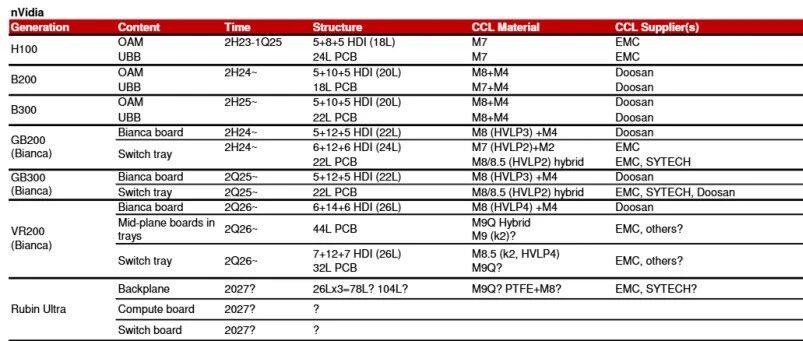
PCB - There are two rumors regarding PCB: the first is that the Rubin switch tray's PCB material system is confirmed to be upgraded from the original M9 resin + second-generation fiberglass cloth to a higher-performance M9 resin + Q cloth solution, which could increase the demand for Q cloth by 6 million to 15 million meters, with stockpiling potentially reaching over 20 million meters [2] - The second rumor involves Google considering upgrading its TPU V8 to EM896K3 (Q-glass M9), but confirmation from industry sources regarding the Rubin switch tray's upgrade to M9 + Q cloth has not been established yet [2][3] Optical Modules - Tianfu's optimistic profit forecast for next year is at 80 million, but the current estimate remains at 60 million or slightly above, with a projected 60% quarter-on-quarter growth in 200G EML supply, equating to 1.6T shipments [6] - There are concerns regarding the compatibility of Tianfu's production line with Lumentum's chips, indicating a need for further adjustments to meet the 200G EML demand [6] Power Industry - A significant power outage occurred in San Francisco, affecting approximately 130,000 households and businesses, which is about one-third of the Pacific Gas and Electric Company's customers in the city [7] - The outage was attributed to overloaded core substation equipment, highlighting the strain on California's power grid due to the rapid increase in data center construction, with over 320 data centers expected by November 2025 [8] - The average age of key power equipment in California is around 40 years, with a significant portion nearing or exceeding their service life, contributing to the vulnerability of the power grid [8]

AI出海链依旧火热,HRSG仍在持续
傅里叶的猫· 2025-12-08 04:08
Group 1 - The article discusses the logic and marginal changes of AI computing hardware going overseas, highlighting that the market is currently performing well, particularly in AI computing-related sectors [1] - The power export market has shifted from SST to gas turbines and HRSG recently, indicating a change in focus within the industry [3][4] - The article emphasizes the strong performance of core targets in the gas turbine market, suggesting a positive outlook for these companies [4] Group 2 - The article notes that only three companies—Siemens Energy, GE, and Mitsubishi Heavy Industries—are currently capable of producing gas turbines, with a significant demand for these products due to electricity shortages in the U.S. [5] - Gas turbines are highlighted for their flexibility and efficiency, with the cost of electricity generation from large gas turbines being only $70-80 per megawatt hour, which remains competitive even with price increases [6][7] - The gas turbine market is entering a golden period of supply-demand balance, with strong demand driven by electrification, energy security needs, and explosive growth in data centers. Global gas turbine orders are expected to exceed production capacity until at least the early 2030s [7] Group 3 - HRSG prices are currently between $5-5.5 million per unit, with expectations to rise to $6-7 million per unit by early next year, driven by a 50% supply-demand gap [7] - The article provides insights into various companies in the domestic Google supply chain, detailing their products, market shares, and expected orders for 2026 [10][11]

伊顿收购宝德--SST导入液冷方案?
傅里叶的猫· 2025-11-04 14:02
Core Viewpoint - Eaton announced the acquisition of Boyd's thermal management business for $9.5 billion, reflecting a significant shift in the competitive landscape of AI data center infrastructure, with a valuation premium of 22.5 times [1] Group 1: Company Overview - Eaton, founded in 1911 and listed on the NYSE in 1923, is a global intelligent power management company with projected sales of $24.9 billion in 2024 and operations in over 170 countries, employing more than 92,000 people [2] - The company focuses on improving quality of life and environmental quality through reliable, efficient, safe, and sustainable power management technologies, with applications in critical infrastructure such as data centers, power grids, and transportation [2] - Eaton has over 150 patents and has been recognized as one of Fortune's "World's Most Admired Companies" for seven consecutive years [2] Group 2: Transaction Details - The acquisition addresses two structural changes in AI data centers: the upgrade of technology architecture and the merging of traditional separated zones, requiring a shift from decentralized supply to system collaboration [3] - Eaton's strengths lie in the backend infrastructure (gray area), while Boyd excels in the IT equipment end (white area), making their combination a perfect fit for the industry's demand for "white-gray integration" [5] Group 3: Strategic Value of the Acquisition - The proliferation of 800V DC architecture has made complete power chain solutions a competitive necessity, allowing Eaton to move beyond high-voltage distribution to a full chain capability covering power access, distribution, chip power, and heat dissipation [6] - Boyd's strategic position within NVIDIA's ecosystem enhances Eaton's market access, enabling cross-selling opportunities and collaborative design for next-generation AI servers [7] - Boyd's projected revenue of $1.5 billion from liquid cooling in 2026 represents 12% of the current global liquid cooling market, positioning Eaton to capitalize on market growth [8]
AI电源行业专家交流
2025-10-21 15:00
Summary of SST System Industry Conference Call Industry Overview - The conference focused on the SST (Solid State Transformer) system industry, discussing its cost structure, market trends, and competitive landscape in both domestic and overseas markets [1][2][3]. Key Points and Arguments Cost Structure of SST Systems - The cost composition of SST systems includes rectifier modules (40%-50%), high-frequency transformers (approximately 25%), control and distribution (15%), energy storage (11%), and structural cooling (8%) [1][2]. - Current single watt cost of SST systems is around 5 RMB, with total system costs reaching 8-10 million RMB. By 2028, costs are expected to drop to below 1 RMB per watt, with total system costs around 2 million RMB, but large-scale application is anticipated only by 2030 [1][4]. Price Trends and Market Dynamics - There is a significant price disparity between domestic and overseas SST systems, particularly in North America, where prices are expected to remain around 4-5 RMB per watt until 2027-2028, with limited reduction [5]. - Domestic market competition is intense, with expectations that prices could fall below 1 RMB per watt by 2030 [5]. Technical Standards and Design Differences - North America tends to adopt higher input voltage SST systems (35 kV or 20 kV), which enhances renewable energy integration efficiency but also increases costs. Differences in design standards between North America and China contribute to cost variations [6][8]. - Domestic companies can enter the SST supply chain by exporting components like high-frequency transformers and rectifier modules, capturing growth opportunities despite slower rack power increases compared to North America [9]. Market Opportunities and Challenges - Companies like Jinpan and Sungrow, which have comprehensive system integration capabilities, are better positioned to enter the SST supply chain [3][16]. - The domestic market's ability to reduce SST product prices significantly is attributed to lower value differences compared to overseas products, reflecting market maturity and demand [23]. Future Prospects - The SMT (Solid State Transformer) AC-DC hybrid system market is expected to grow faster than the data center market due to lower energy continuity and stability requirements, making it more cost-sensitive [24]. - The demand for silicon carbide (SiC) in charging stations and data centers is increasing, but the complex production process may lead to supply constraints and price increases [26]. Additional Important Insights - The integration capabilities of domestic companies lag behind those of leading overseas firms like Delta, Schneider, and Eaton, which have dedicated departments for each segment of the SST system [22]. - The competitive landscape in the HVDC (High Voltage Direct Current) sector shows that traditional power distribution companies in China have advantages, but emerging electronic companies are rapidly advancing [18]. This summary encapsulates the critical insights from the SST system industry conference call, highlighting the cost structures, market dynamics, technical standards, and future prospects within the industry.