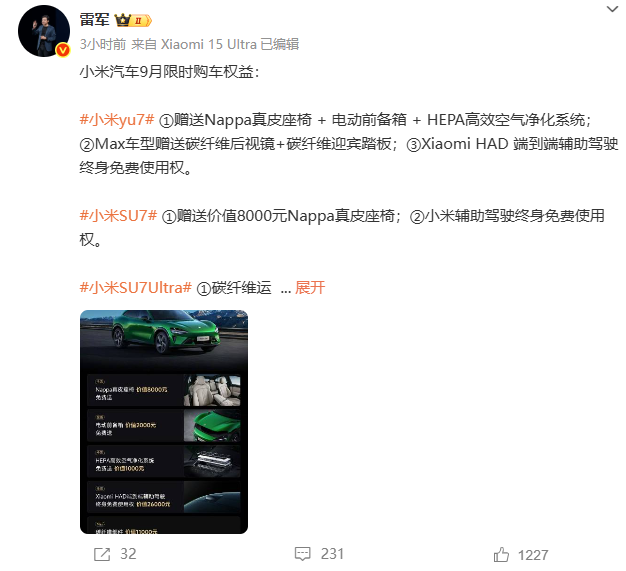
SU7 Ultra)

Search documents
小米汽车,真撑得起门面?
虎嗅APP· 2025-11-20 00:24
Core Viewpoint - The article emphasizes that Xiaomi's growth is under pressure due to the tightening of subsidies and increased competition in its traditional business, particularly in smartphones and IoT, while the automotive business shows potential but faces challenges ahead [11][12][24]. Overall Performance - Xiaomi Group reported total revenue of 113.1 billion RMB for Q3 2025, a year-on-year increase of 22.3%, primarily driven by the automotive business [6][27]. - Traditional business (smartphones and AIoT) revenue grew only 1.6% year-on-year, indicating weak performance in hardware sales [27][30]. - Gross margin improved to 22.9%, supported by the automotive business, while smartphone margins declined due to intensified competition [30][31]. Automotive Business - The automotive segment generated 29 billion RMB in revenue, with a shipment of 109,000 units and an average selling price of 260,000 RMB [6][35]. - The automotive business achieved a gross margin of 25.5%, although it slightly decreased from the previous quarter due to a reduction in the share of high-margin models [38][39]. - The core operating profit for the automotive business was 680 million RMB, marking its first profitable quarter [7][67]. Smartphone Business - Xiaomi's smartphone revenue was 46 billion RMB, down 3.1% year-on-year, reflecting the impact of subsidy reductions and increased competition [42][44]. - Smartphone shipments increased by 0.5% year-on-year, but the average selling price fell by 3.6% due to a higher proportion of low-cost models sold [44][46]. - The smartphone gross margin dropped to approximately 11.1%, influenced by rising component costs and market competition [48][23]. IoT Business - The IoT segment reported revenue of 27.6 billion RMB, a year-on-year increase of 5.6%, significantly lower than previous quarters due to subsidy reductions affecting large appliances [51][18]. - The gross margin for IoT products was 22.9%, benefiting from a higher proportion of sales in more profitable categories [52][53]. Internet Services - Internet services revenue reached 9.4 billion RMB, growing 10.8% year-on-year, primarily driven by advertising services [56][60]. - Advertising revenue was 7.2 billion RMB, up 16.1%, while value-added services saw a slight decline [56][66]. Overseas Market - Overseas revenue was 40.1 billion RMB, a slight decrease of 0.2%, with internet services growing by 19.1% to 3.3 billion RMB [60][62]. - Hardware sales in overseas markets continued to show weakness, reflecting a challenging demand environment [60]. Profitability - The core operating profit for the quarter was 6.7 billion RMB, with a core operating profit margin of 5.9%, impacted by declining smartphone margins and increased expenses [67][66]. - Traditional business core operating profit was approximately 6.03 billion RMB, while the automotive segment contributed 680 million RMB [67][66].


小米:补贴退了,汽车真撑得起门面?
3 6 Ke· 2025-11-19 04:05
Overall Performance - Xiaomi Group reported total revenue of 113.1 billion, a year-on-year increase of 22.3%, primarily driven by the automotive business, while traditional business (smartphones and AIoT) revenue grew only 1.6% [1][21] - Gross margin improved to 22.9%, supported by the increased contribution from the automotive sector, although smartphone margins declined due to intensified competition [1][24] Automotive Business - The automotive segment generated revenue of 29 billion, with a shipment of 109,000 units and an average selling price of 260,000 [1][26] - Automotive gross margin rose to 25.5%, slightly below market expectations, primarily due to a decrease in the proportion of high-margin models [1][29] - The automotive business achieved a core operating profit of 6.8 billion, marking its first profitable quarter [1][5] Smartphone Business - Smartphone revenue was 46 billion, down 3.1% year-on-year, with a shipment volume increase of 0.5% but a decline in average selling price by 3.6% [2][31] - The smartphone gross margin fell to 11.1%, impacted by rising storage costs and increased market competition [2][37] - In the domestic market, smartphone shipments declined by 1.8%, while overseas shipments grew by 2.7% [2][33] IoT Business - IoT revenue reached 27.6 billion, a year-on-year increase of 5.6%, significantly lower than previous quarters due to a decline in demand for large appliances [3][39] - The slowdown in IoT growth was attributed to the tightening of subsidies, which previously boosted sales [12][14] Internet Services - Internet services revenue was 9.4 billion, up 10.8% year-on-year, primarily driven by advertising revenue [4][42] - Advertising services generated 7.2 billion, reflecting a 16.1% increase, while value-added services saw a slight decline [4][42] Profitability - Core operating profit was 6.7 billion, with adjusted net profit reported at 11.3 billion [5][51] - Traditional business core profit was approximately 60.3 billion, while the automotive segment contributed 6.8 billion to the overall profit [5][51] Market Outlook - The company faces challenges in both traditional and automotive sectors, with concerns over future demand and competition [7][30] - The automotive business is currently in a "supply exceeds demand" situation, with a significant backlog of orders expected to be consumed by mid-next year [10][30]

雷军的敌人越来越多?两位网络大V,同时向小米开炮
Sou Hu Cai Jing· 2025-09-18 23:15
Core Viewpoint - Xiaomi's automotive division is facing significant public relations challenges, with recent quality complaints escalating into broader questions about the brand's values and integrity [1][3][5]. Group 1: Quality Issues - A prominent social media influencer reported a persistent noise issue in the Xiaomi YU7 vehicle, which he could not resolve despite multiple attempts at repair [3]. - The influencer's complaints were echoed by many other YU7 owners, indicating that the issue is widespread rather than isolated [3]. Group 2: Brand Perception - Another influencer publicly declared he would no longer use Xiaomi products, citing a fundamental disagreement in values rather than a direct criticism of Xiaomi's values [5]. - The discussion around product quality has shifted to a broader critique of Xiaomi's brand values, intensifying the scrutiny on the company and its leadership [5][13]. Group 3: Previous Incidents - The company has faced several negative incidents, including a serious traffic accident involving the Xiaomi SU7 that resulted in fatalities, prompting regulatory scrutiny [8]. - There were also controversies regarding the functionality of the carbon fiber hood and the quality of components in the YU7, which were perceived as misleading [8][11]. Group 4: Competitive Environment - The competitive landscape in the automotive industry is intensifying, with rival brands potentially leveraging Xiaomi's negative press to attract customers [15]. - Speculation exists regarding possible "black public relations" efforts from competitors to exploit Xiaomi's vulnerabilities in the market [15]. Group 5: Impact of Public Relations - Xiaomi's reliance on marketing and public attention has become a double-edged sword, as negative news can amplify public scrutiny and damage brand reputation [17]. - Despite the popularity of models like the SU7 and YU7, the company faces significant challenges in brand building and image restoration moving forward [17].
雷军公布小米汽车9月限时购车权益,送Nappa真皮座椅、辅助驾驶终身免费使用权……
Qi Lu Wan Bao· 2025-09-01 09:55
Core Insights - Xiaomi's founder and CEO Lei Jun announced limited-time purchase benefits for Xiaomi cars in September, including lifetime free use of assisted driving for models YU7, SU7, and SU7 Ultra [1] Group 1: Product Offerings - The Xiaomi Yu7 includes Nappa leather seats, an electric front trunk, and a HEPA high-efficiency air purification system, along with lifetime free use of Xiaomi HAD end-to-end assisted driving [3] - The Xiaomi SU7 offers Nappa leather seats valued at 8000 yuan and lifetime free use of assisted driving [3] - The Xiaomi SU7 Ultra features a carbon fiber sports steering wheel, carbon fiber center console trim, and carbon fiber front seat back panels, along with five years of free basic maintenance and lifetime free use of assisted driving [3] Group 2: Sales Performance - Xiaomi's official Weibo account reported that by August 2025, the delivery volume of Xiaomi cars is expected to exceed 30,000 units [3]