存储涨价

Search documents
珠海冠宇:存储涨价抑制消费电池需求-20260331
HTSC· 2026-03-31 13:30
Investment Rating - The report has downgraded the investment rating of the company to "Accumulate" [5][6]. Core Views - The company's revenue for 2025 reached 14.41 billion RMB, a year-on-year increase of 24.86%, while the net profit attributable to shareholders was 0.472 billion RMB, up 9.60% year-on-year. However, the net profit fell short of expectations due to rising storage prices, increased raw material costs, and foreign exchange losses [1][5]. - The company maintains a strong position in the laptop battery sector and is accelerating the introduction of mobile phone batteries to major clients like Apple. Adjustments in accounting depreciation policies have released profits, but the impact of rising storage prices on consumer battery demand and increased costs have led to a revision in revenue growth expectations [5][6]. Summary by Sections Financial Performance - In Q4 2025, the company reported revenue of 4.089 billion RMB, a year-on-year increase of 35.2% but a quarter-on-quarter decrease of 3.2%. The net profit attributable to shareholders was 0.085 billion RMB, down 47.8% year-on-year and 68.6% quarter-on-quarter [2]. - The company shipped approximately 100 million consumer battery cells in Q4, with a net profit per cell of about 1.3-1.4 RMB. The decline in profitability was attributed to reduced demand due to storage price increases and rising raw material costs [2]. Business Segments - In the consumer battery segment, the company achieved revenue of 6.341 billion RMB in laptop products, remaining stable year-on-year, with a sales volume increase of 2.5%. In mobile phone products, revenue reached 4.493 billion RMB, up 38.2% year-on-year, with a sales volume increase of 42.0% [11]. - The company's dynamic storage business, particularly in automotive and drone applications, saw significant growth, with revenue from the Zhejiang subsidiary reaching 2.265 billion RMB, a year-on-year increase of 130.7%. The company has secured contracts with major automotive manufacturers and maintained deep cooperation with clients like DJI in the drone sector [4][11]. Profitability and Forecasts - The report anticipates a downward revision of the company's net profit forecasts for 2026 and 2027 to 0.820 billion RMB and 1.069 billion RMB, respectively, reflecting a reduction of 50% and 51% from previous estimates [5][14]. - The expected average PE ratio for comparable companies in 2026 is 18 times, while the company is assigned a PE of 24 times for the same year, with a target price set at 17.28 RMB, down from 35.04 RMB [5][14].

珠海冠宇(688772):存储涨价抑制消费电池需求
HTSC· 2026-03-31 11:31
Investment Rating - The report downgrades the investment rating of Zhuhai Guanyu to "Accumulate" due to the impact of rising storage prices on consumer battery demand and increased costs from raw materials [5][6]. Core Views - The company reported a revenue of 14.41 billion RMB for 2025, a year-on-year increase of 24.86%, with a net profit attributable to shareholders of 0.472 billion RMB, up 9.60% year-on-year. However, the net profit fell short of expectations due to rising storage prices, raw material costs, and foreign exchange losses [1][5]. - The consumer battery segment is facing challenges due to increased storage prices, which are suppressing demand, while the automotive and drone battery segments are showing strong growth [4][5]. Summary by Sections Financial Performance - In Q4 2025, the company achieved a revenue of 4.089 billion RMB, with a year-on-year increase of 35.2% but a quarter-on-quarter decrease of 3.2%. The net profit attributable to shareholders was 0.085 billion RMB, down 47.8% year-on-year and 68.6% quarter-on-quarter [2]. - The company shipped approximately 100 million consumer battery cells in Q4, with a net profit per cell of about 1.3-1.4 RMB, indicating a decline in profitability due to reduced demand and increased costs [2]. Business Segments - The consumer battery segment, including laptops and mobile phones, saw stable performance, with laptop revenue at 6.341 billion RMB and mobile phone revenue at 4.493 billion RMB, reflecting growth of 2.5% and 42.0% respectively [11]. - The automotive and drone battery segment, particularly through its subsidiary Zhejiang Guanyu, reported a revenue of 2.265 billion RMB, a significant year-on-year increase of 130.7%, driven by partnerships with major automotive manufacturers and drone companies [4][11]. Future Projections - The report revises the revenue growth forecast for consumer batteries down to 12.76 billion RMB and 13.85 billion RMB for 2026 and 2027, respectively, due to rising costs and reduced demand [14]. - Conversely, the revenue forecast for the automotive and energy storage segment is revised upward to 3.329 billion RMB and 4.161 billion RMB for 2026 and 2027, respectively, reflecting positive trends in demand [14]. Valuation - The target price for the company is set at 17.28 RMB, down from a previous estimate of 35.04 RMB, with a projected PE ratio of 24 times for 2026 [5][6].
存储涨价后续:TCL华星/友达/海信/荣耀/小米等集体回应!
WitsView睿智显示· 2026-03-27 03:25
Core Insights - The current surge in storage prices is primarily driven by the explosive demand from AI servers and high-performance computing (HPC), leading to a significant imbalance in supply and demand within the semiconductor industry [2][7] - From September 2025, DRAM and NAND spot prices have increased by over 300%, with projections for Q1 2026 indicating a 90-95% increase in DRAM contract prices and a 55-60% increase in NAND contract prices [3][5] - The rising storage costs are reshaping the cost structures of end products such as smartphones, TVs, and laptops, prompting a rebalancing of strategies across the industry [8][12] Group 1: Price Increases and Cost Structure Changes - The price increases for DRAM and NAND Flash are expected to significantly impact the bill of materials (BOM) costs for various consumer electronics [8][9] - For smartphones, the BOM cost share of storage has risen from approximately 10-15% to 30-40%, while for laptops, it has increased from around 15% to over 30% [11][12] - The overall impact on laptop pricing could lead to an increase of over 30% due to storage price hikes alone, with potential total price increases nearing 40% when factoring in CPU price rises [12][13] Group 2: Industry Responses and Strategies - Various manufacturers are responding to the cost pressures with differentiated strategies, including price adjustments and product redesigns [14][20] - Smartphone brands like OPPO and vivo have announced price increases for certain models, while others are exploring options to reduce costs without lowering prices [21][22] - TV manufacturers, such as Hisense, view the impact of storage price increases as manageable due to the lower BOM cost share of storage compared to other components [18][19] Group 3: Market Outlook and Demand Projections - The overall demand for smartphones, TVs, and laptops is expected to decline due to rising storage prices and a softening macroeconomic environment, with smartphone production potentially decreasing by 10-15% year-over-year [23][24][26] - The TV market is projected to see a slight decline in shipments, with an estimated reduction of 0.6% to around 195 million units [30][31] - The laptop market is forecasted to experience a 9.4% decrease in shipments, influenced by rising costs and supply chain uncertainties [34] Group 4: Long-term Implications - The ongoing price increases are likely to lead to a long-term shift in the industry towards higher-end and differentiated products, potentially accelerating the exit of smaller brands from the market [44][45] - Companies will need to enhance their supply chain management capabilities and optimize product structures to adapt to the new cost dynamics [45]






小米集团-W:存储影响长于预期,关注AI商业化进展-20260325
HTSC· 2026-03-25 07:45
Investment Rating - The report maintains a "Buy" rating for the company with a target price of 43 HKD [7][19]. Core Insights - The company reported FY2025 revenue of 457.3 billion RMB, a year-on-year increase of 25.0%, and a Non-GAAP net profit of 39.2 billion RMB, up 43.8% year-on-year. The 4Q25 revenue was 116.9 billion RMB, with a year-on-year growth of 7.3%, while Non-GAAP net profit for the quarter was 6.3 billion RMB, down 23.7% year-on-year [1][5]. - Management indicated that the storage price increase cycle may last longer and be more significant than previously expected, potentially extending into 2027, which is a more pessimistic outlook compared to earlier reports [1]. - The company has made significant advancements in AI, with the MiMo-V2-Pro model ranking among the top globally and the AI Agent "MiKe" entering beta testing, although commercialization is still in its early stages [3]. - The automotive segment achieved its first annual operating profit, delivering 411,082 vehicles, a 200.4% increase year-on-year, with the new SU7 model performing exceptionally well [4]. Summary by Sections Financial Performance - FY2025 revenue reached 457.3 billion RMB, with a 25.0% year-on-year increase. Non-GAAP net profit was 39.2 billion RMB, reflecting a 43.8% increase year-on-year. The 4Q25 revenue was 116.9 billion RMB, up 7.3% year-on-year, while Non-GAAP net profit for the quarter was 6.3 billion RMB, down 23.7% year-on-year [1][5]. Smartphone/IoT/Internet Business - In 4Q25, the smartphone and AIoT segment generated revenue of 79.7 billion RMB, a decrease of 13.7% year-on-year, with a gross margin of 20.0%. Smartphone revenue was 44.3 billion RMB, with a shipment of 37.7 million units, down 11.6% year-on-year. IoT revenue was 24.6 billion RMB, down 20.3% year-on-year, but the annual IoT revenue reached a record high of 123.2 billion RMB [2]. AI Development - The company launched several AI models, including MiMo-V2-Pro, MiMo-V2-Omni, and MiMo-V2-TTS, establishing a comprehensive AI technology foundation. The MiMo-V2-Pro model has the highest usage on the OpenRouter platform, priced significantly lower than competitors [3]. Automotive Business - The automotive segment achieved its first annual operating profit with a delivery of 411,082 vehicles, exceeding the initial target of 300,000 units. The new SU7 model saw strong demand, with over 15,000 orders within 34 minutes of launch [4]. Profit Forecast and Valuation - The report maintains Non-GAAP net profit forecasts of 34.5 billion RMB for 2026 and 45.4 billion RMB for 2027, introducing a forecast of 57.1 billion RMB for 2028. The target price of 43 HKD corresponds to a 32x PE ratio for 2026 [5][19].
供给荒叠加涨价潮,资金借道ETF抢筹存储芯片
第一财经· 2026-03-18 12:25
Core Viewpoint - The storage chip sector in A-shares has experienced a collective surge due to price hikes announced by domestic cloud computing giants and potential exacerbation of the "storage shortage" from Samsung's strike [3][4]. Group 1: Market Performance - As of March 18, 2026, stocks such as Fudan Microelectronics (688385.SH) and Guoke Micro (300672.SZ) hit the daily limit, while Baiwei Storage (688525.SH) and Demingli (001309.SZ) rose by 9.46% and 5.65% respectively, reaching historical highs [3]. - The China Securities Chip Industry Index increased by 2.56%, and the Shanghai Stock Exchange Sci-Tech Innovation Board Chip Design Theme Index rose by 2.17% [3]. - The total trading volume of 27 chip-related ETFs exceeded 5.1 billion yuan, with seven ETFs surpassing 100 million yuan in trading volume [3]. Group 2: Supply Chain Dynamics - Samsung Electronics, holding a 43% market share in the storage chip market and 60% in DRAM products, is facing potential production disruptions due to a planned strike from May 21 to June 7, 2026 [4]. - The fluctuation in Samsung's production capacity is expected to impact the supply chain rhythm for consumer electronics, servers, and AI hardware, particularly affecting DRAM and NAND flash chip production [4]. Group 3: Investment Trends - In the past week, 27 chip ETFs saw a net inflow of over 1.3 billion yuan, with most ETFs experiencing net inflows, except for one [4]. - Year-to-date, the total net inflow for these ETFs reached 1.94 billion yuan, with the E Fund Sci-Tech Innovation Board Chip ETF leading with a net inflow of 2.06 billion yuan [5]. Group 4: Industry Outlook - The storage chip industry is entering a super cycle driven by AI, with expectations of sustained price increases as domestic manufacturers follow suit with price hikes [8]. - The demand for HBM (High Bandwidth Memory) is particularly acute, with predictions that global AI server chip sales will reach 169 billion dollars in 2026, a 55% year-on-year increase [8]. - UBS forecasts a structural reset in the net asset return rate (ROE) for the storage industry, predicting an average ROE of 36% for major players like Samsung, SK Hynix, and Micron from 2026 to 2030 [9].



OPPO后,又一手机厂商宣布涨价
第一财经· 2026-03-16 03:44
Core Viewpoint - The smartphone market is experiencing its largest collective price increase in nearly five years due to rising global semiconductor and storage costs, with major companies like vivo and OPPO adjusting their retail prices accordingly [1]. Group 1: Price Adjustments - Vivo announced a retail price adjustment effective March 18, 10:00 AM, citing significant increases in global semiconductor and storage costs [1]. - OPPO also declared a price increase for certain models starting from March 16, 12:00 AM [1]. Group 2: Market Trends - The smartphone market is projected to face a significant downturn, with Counterpoint Research estimating a 12% year-on-year decline in global smartphone shipments in 2026, dropping to under 1.1 billion units, the lowest level since 2013 [1]. - The price of mobile-grade LPDDR4/5 is expected to reach nearly three times the level of Q3 2025 by Q2 2026, indicating a substantial increase in component costs [1].

国产芯片公司集体涨价10%起,11只半导体股净利预增超100%
2 1 Shi Ji Jing Ji Bao Dao· 2026-02-26 01:21
Group 1 - New Energy Technology (605111) announced a price increase of at least 10% for MOSFET products due to rising costs of upstream raw materials and key precious metals, effective from March 1, 2026 [1] - Domestic chip companies, including Hongwei Technology, are also raising prices for core products like IGBT and MOSFET devices by approximately 10% starting March 1, 2026, due to manufacturing cost increases [2] - Major international players like Infineon and domestic firms such as China Resources Microelectronics and Silan Microelectronics are following suit with similar price hikes for various semiconductor products [2] Group 2 - The current price increase trend is driven by strong downstream demand, particularly in sectors like AI data centers, new energy vehicles, energy storage, and industrial control, with AI servers showing significant growth [3] - A total of 173 semiconductor stocks in the A-share market have been identified, with 124 having released performance forecasts, and 46 stocks expecting net profit increases, including companies like Zhenlei Technology and Baiwei Storage, with some projecting over 100% profit growth [4] - The semiconductor industry is anticipated to reach record sales in 2025, with the price increase trend spreading from memory chips to power, analog, and MCU sectors, highlighting structural investment opportunities in AI computing and semiconductor equipment [4]


小米集团-W(1810.HK):存储涨价影响短期盈利 汽车业务规模效应渐显
Ge Long Hui· 2026-02-10 20:47
Core Viewpoint - The rising prices of DRAM and NAND storage are expected to negatively impact global consumer electronics demand and brand gross margins, leading to a forecasted decline in Xiaomi's overall gross margin and net profit in Q4 2025 [1][2]. Business Segments Summary Automotive Business - In Q4 2025, Xiaomi's automotive revenue is projected to reach 37.2 billion RMB, representing a year-on-year increase of 123% and a quarter-on-quarter increase of 28% [1][3]. - The gross margin for the automotive segment is expected to be around 21.6%, influenced by a decrease in the delivery proportion of the SU7 Ultra model [3]. - For 2026, the company aims to deliver 650,000 vehicles, exceeding its target of 550,000 units, supported by new model launches [2][3]. Smartphone Business - Xiaomi's smartphone shipment is expected to decline to 37.8 million units in Q4 2025, a year-on-year decrease of 11.5% [1][4]. - The gross margin for smartphones is anticipated to drop by 2.6 percentage points to approximately 8.5% due to rising memory prices [1][4]. - For 2026, smartphone shipments are projected to decrease by 10% to 148 million units, but the average selling price (ASP) is expected to improve by about 5% due to product mix enhancements [4]. IoT and Internet Business - The IoT segment's revenue in Q4 2025 is estimated to be around 25.2 billion RMB, with a gross margin expected to remain high at 22.2% despite a year-on-year decline of 19% due to subsidy reductions [1][4]. - Internet business revenue is projected to grow by 2% to 9.5 billion RMB, maintaining a gross margin of 76.9% [1][4]. - For FY26, IoT revenue is expected to increase by 5% year-on-year to 130.5 billion RMB, driven mainly by overseas demand [4]. Financial Forecast and Valuation - The company has revised its revenue forecasts downward for 2025-2027 by 3.1%, 9.5%, and 11.5%, respectively, and has also reduced its Non-GAAP net profit estimates for the same period by 9.1%, 21.4%, and 19.4% [4]. - The target price has been adjusted to 47 HKD from 53.8 HKD, based on a sum-of-the-parts valuation method, corresponding to a 29 times PE for 2026 [2][4].
存储涨价负面效应初现
财联社· 2026-02-07 09:30
Group 1 - The rising prices of storage components are negatively impacting traditional industries, particularly in South Korea, where companies face significant increases in server costs, with prices rising from 30 million KRW to 90 million-100 million KRW [2] - The delivery times for server equipment have extended from 2-3 weeks to 2-3 months, disrupting internal project timelines for companies [2] - Hospitals in South Korea are also experiencing price increases for personal computers by 2-3 times and server prices rising by 30%-50% [2] Group 2 - Consumer electronics manufacturers, including Apple, are facing cost pressures due to rising memory prices, with Samsung increasing prices by over 80% and SK Hynix approaching 100% [3] - Apple has identified memory as a "cost pressure" in its financial discussions, indicating significant impacts on its product pricing strategy [3] - Analyst Ming-Chi Kuo notes that Apple's strong bargaining power may not reflect the broader memory demand trends among other manufacturers [3] Group 3 - The shift of major manufacturers towards high-margin products like HBM is leading to a continuous reduction in supply for consumer-grade storage chips, exacerbating the supply-demand gap and driving prices higher [4] - The cost pressures from rising memory prices are expected to extend to consumers, with potential price increases for gaming consoles like the Nintendo Switch 2 by 15% to offset memory costs [4] - PC manufacturers, such as ASUS, are adjusting product prices due to supply shortages, with expectations of relief not occurring until the second half of 2027 [4]

非洲手机之王传音即将退位?利润腰斩 50元手机扛不住存储涨价
Xin Lang Ke Ji· 2026-02-05 08:53
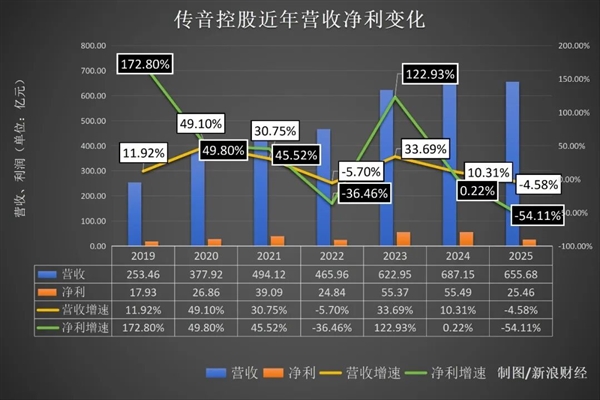
Core Viewpoint - Transsion Holdings is expected to experience a decline in both revenue and net profit in 2025, with net profit projected to be halved, marking the worst performance since its IPO in 2019 [1][5][6]. Financial Performance - The company forecasts a revenue of approximately 65.568 billion yuan for 2025, a decrease of about 31.47 billion yuan or 4.58% year-on-year [2]. - The expected net profit for 2025 is around 2.546 billion yuan, down by approximately 30.03 billion yuan or 54.11% compared to the previous year [2][5]. Market Competition - Transsion remains the market leader in Africa, but faces increasing competition from Xiaomi and Honor, which have shown growth rates of 34% and 158% respectively in the third quarter of 2025 [1][8]. - The overall smartphone market is experiencing sluggish growth, particularly in emerging markets, with a projected global smartphone shipment growth of only 2% in 2025 [7][8]. Cost Pressures - The company attributes its poor performance to rising storage prices, which have increased by over 40% due to demand from AI data centers, impacting product costs and gross margins [7][8]. - Transsion's average smartphone price in 2025 is reported to be 332.1 yuan, with feature phones averaging only 50.1 yuan, indicating a focus on the low-end market [9][10]. Diversification Efforts - To mitigate risks, Transsion is exploring new business areas such as mobility and energy storage, although these segments currently contribute only 8.8% to total revenue [12][14]. - The company has established a mobility division and is expanding into electric two-wheelers and energy storage products, but these initiatives are still in early stages and have not yet significantly impacted overall revenue [11][12].