SemiCab平台

Search documents
突发暴跌!全线大跳水!发生了什么?
天天基金网· 2026-02-13 08:11
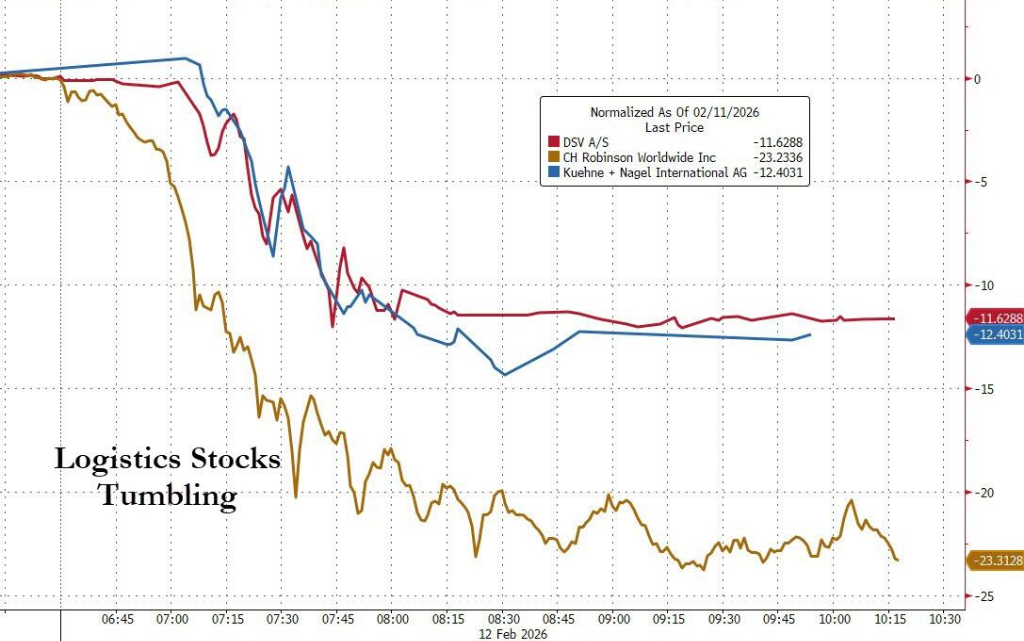
Core Viewpoint - The logistics sector has become the latest victim of "AI panic trading," following significant declines in software and financial sectors, with major logistics stocks experiencing sharp drops in both US and European markets [2][5][7]. Market Impact - On February 12, the Russell 3000 Trucking Index fell by 7.8%, with Robinson Global Logistics (CHRW) dropping over 14% and Expeditors International (EXPD) declining over 13% [2][5]. - In the A-share market, several transportation stocks also saw significant declines, with China COSCO Shipping Energy Transportation (中远海能) down over 8% and China Merchants Energy Shipping (招商南油) down nearly 7% [4][5]. Triggering Events - The sell-off was triggered by the announcement from Algorhythm Holdings (RIME) regarding its AI logistics platform, SemiCab, which reportedly increased freight volumes by 300% to 400% without adding operational staff [5][6]. - Algorhythm's stock surged by 79% during trading but closed with a nearly 30% increase, despite its market capitalization remaining below $10 million [6]. Broader Market Context - The current AI "super cycle" is reshaping global industry dynamics, intertwining technological benefits with market anxieties [3]. - Analysts noted that the panic selling is not limited to tech stocks but affects all sectors associated with AI news, leading to a "sell first, think later" mentality [7][8]. Sector Performance - The logistics sector's decline is part of a broader trend where financial services and real estate stocks also faced sell-offs due to AI-related announcements [7]. - Major US stock indices, including the Nasdaq, S&P 500, and Dow Jones, experienced declines, with the Nasdaq dropping 2% [8].





A股蛇年收官三大指数跌超1%,半导体、存储芯片大涨,港股AI双雄市值突破2000亿港元
2 1 Shi Ji Jing Ji Bao Dao· 2026-02-13 07:30
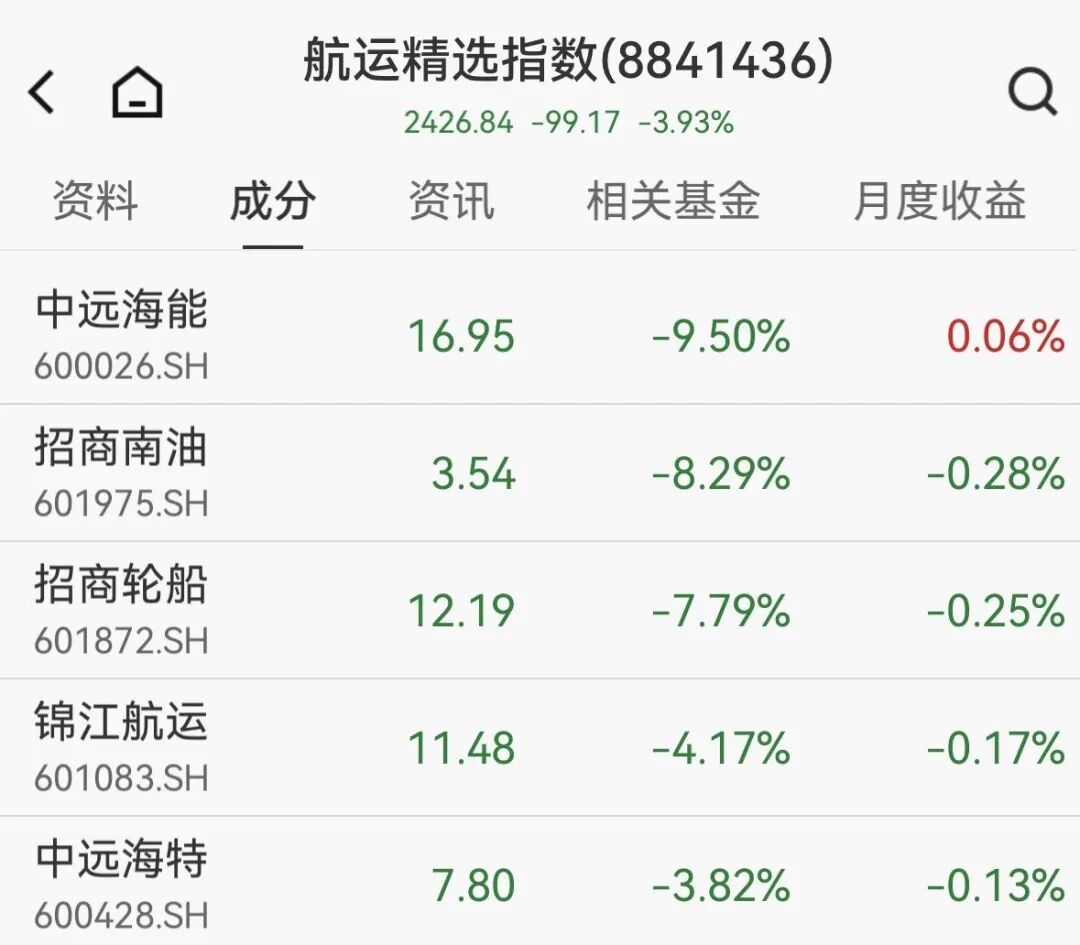
Market Overview - On February 13, A-shares saw a collective decline across major indices, with the Shanghai Composite Index dropping by 1.26%, the Shenzhen Component Index by 1.28%, and the ChiNext Index by 1.57% [1] - The total trading volume in the Shanghai, Shenzhen, and Beijing markets approached 2 trillion yuan, a decrease of 161.8 billion yuan from the previous day, with over 3,800 stocks declining [1] Sector Performance - The film and theater, paper, semiconductor equipment, and intelligent cockpit sectors showed the highest gains, while the photovoltaic equipment, minor metals, steel, port shipping, oil and gas extraction and services, glyphosate, rare earth permanent magnets, and chemical sectors experienced the largest declines [1] Semiconductor and Storage Chip Sector - The semiconductor and storage chip sectors demonstrated resilience, benefiting from the AI wave, with companies like Deep Technology (000021) hitting the daily limit and others like Northern Huachuang (002371) and Jiangbolong (301308) also seeing gains [2] Shipping Sector - Shipping stocks experienced significant declines, with companies such as COSCO Shipping Energy (600026), China Merchants Nanyou (601975), China Merchants Jinling (601872), and Jinjiang Shipping (601083) all opening lower [2][3] - The drop in these stocks was primarily influenced by a sharp decline in logistics stocks in the US market, where the Russell 3000 Trucking Index fell over 9% [4] AI Companies in Hong Kong - In the Hong Kong market, AI companies MiniMax and Zhiyuan both saw their market capitalizations exceed 200 billion HKD [5] - MiniMax launched its new generation text model MiniMax M2.5, which significantly improved its programming capabilities, while Zhiyuan introduced its flagship model GLM-5, which also achieved notable advancements in performance [7]

A股蛇年收官三大指数跌超1%,半导体、存储芯片大涨,港股AI双雄市值突破2000亿港元
21世纪经济报道· 2026-02-13 07:26
Market Overview - On February 13, the A-share market saw a collective decline in the three major indices, with the Shanghai Composite Index falling by 1.26%, the Shenzhen Component Index by 1.28%, and the ChiNext Index by 1.57% [1][2] - The total trading volume in the Shanghai, Shenzhen, and Beijing markets was nearly 2 trillion yuan, a decrease of 161.8 billion yuan compared to the previous day, with over 3,800 stocks declining [1] Sector Performance - In terms of sector performance, the film and television, paper-making, semiconductor equipment, and intelligent cockpit sectors saw the largest gains, while the photovoltaic equipment, small metals, steel, port shipping, oil and gas extraction and services, glyphosate, rare earth permanent magnets, and chemical sectors experienced the largest declines [3] Semiconductor and Storage Chip Sector - The semiconductor and storage chip sectors showed resilience, benefiting from the AI wave, with stocks like Deep Technology hitting the daily limit and companies such as Northern Huachuang and Jiangbolong seeing significant gains [5] - The storage chip and semiconductor equipment sectors performed well despite the overall market downturn [4] Shipping Sector - The shipping stocks collectively plummeted, with companies like COSCO Shipping Energy, China Merchants Jinling, and China Merchants Shipping experiencing significant declines [5][6] - This decline was primarily influenced by a sharp drop in logistics stocks in the US market, where the Russell 3000 Trucking Index fell over 9% [7] AI and Technology Developments - In the Hong Kong market, AI companies MiniMax and Zhizhu both saw their market capitalizations exceed 200 billion HKD, reflecting strong investor interest [8] - MiniMax launched its new generation text model MiniMax M2.5, which showed significant improvements in programming capabilities, while Zhizhu introduced its flagship model GLM-5, which also demonstrated enhanced performance [11]

突发,暴跌!全线大跳水!AI恐慌交易,接连引爆!
券商中国· 2026-02-13 06:12
Core Viewpoint - The logistics sector has become the latest victim of "AI panic trading," following significant declines in software and financial sectors, with major logistics stocks experiencing sharp drops in both US and European markets [1][4][6]. Group 1: Market Reactions - On February 12, the Russell 3000 Trucking Index fell by 7.8%, with Robinson Global Logistics (CHRW) dropping over 14% and Expeditors International (EXPD) declining over 13% [1][4]. - In the A-share market, several transportation stocks also saw significant declines, with China Ocean Shipping Energy (中远海能) down over 8% and China Merchants South Oil (招商南油) down nearly 7% [1][3]. - The sell-off in logistics stocks was primarily influenced by the overnight plunge in US and European logistics stocks [4][6]. Group 2: AI Impact - The recent sell-off was triggered by Algorhythm Holdings' announcement that its SemiCab platform could increase freight volume by 300% to 400% without adding operational staff, leading to a surge in its stock price by nearly 79% at one point [4][5]. - Algorhythm's CEO emphasized that the logistics industry has been historically limited by human resources, and their platform aims to break this dependency by embedding intelligence directly into freight operations [5]. Group 3: Broader Market Context - Analysts noted that the current AI "super cycle" is reshaping global industry dynamics, intertwining technological benefits with market anxieties [2][6]. - The panic selling is not limited to technology stocks; any sector associated with AI news is experiencing similar reactions, indicating a broader market trend of fear and uncertainty [7][8]. - The ongoing turmoil in the market has not yet significantly impacted discussions on monetary policy, but prolonged volatility could change this [8].

引爆美股“黑色星期四”的导火索,是这家市值600万美元的“小公司”
美股IPO· 2026-02-13 03:27
Core Viewpoint - The announcement by Algorhythm Holdings regarding its AI logistics platform has triggered significant panic in the logistics sector, leading to a sharp decline in stock prices across the industry, reflecting deep-seated fears about AI's potential to disrupt traditional business models [3][5][10]. Group 1: Market Reaction - The logistics sector experienced a severe sell-off, with the Russell 3000 trucking index dropping by 6.6%, and major players like CH Robinson and Landstar System seeing declines of 15% and 16% respectively [3][5]. - The sell-off marked the worst single-day performance for the sector since April of the previous year, indicating a broader market shift from enthusiasm for AI to fear of its disruptive potential [5][10]. - The Nasdaq 100 index fell by 2%, and there were significant declines in gold, silver, and cryptocurrencies, suggesting a widespread risk-off sentiment in the market [5][10]. Group 2: Company Background and Transformation - Algorhythm Holdings, previously known as The Singing Machine Company, announced its transition to an AI logistics company, claiming its SemiCab platform could increase freight volume by 300% to 400% without adding staff [8][9]. - The CEO, Gary Atkinson, attributed the shift to the impact of tariffs on imports of karaoke equipment from China, which harmed the original business model [8]. - Despite reporting quarterly sales of less than $2 million and a net loss of nearly $3 million, the company's stock surged by 82% following the announcement, highlighting the extreme market reaction [8][9]. Group 3: Analyst Perspectives - Analysts noted that the current market sentiment represents a fundamental shift, with even traditionally resilient sectors like transportation now vulnerable to AI-related fears [7][11]. - Concerns have emerged that AI could eliminate the intermediary role of trucking brokers, which has led to significant declines in their stock prices [11][12]. - Some analysts argue that the market's reaction is disproportionate to the actual risks, suggesting that the sell-off may reflect an overreaction rather than a rational assessment of the situation [12][13].

600万美元市值“小虾米”掀翻物流巨头:AI恐慌传导至货运板块 罗素3000货运指数暴跌6.6%
美股IPO· 2026-02-13 03:27
Core Viewpoint - The logistics sector in the U.S. experienced a significant sell-off due to fears surrounding the disruptive potential of AI, triggered by a small company, Algorhythm Holdings, which recently transitioned from a karaoke business to an AI logistics platform [1][2][5]. Group 1: Market Reaction - The Russell 3000 freight index plummeted by 6.6% following the announcement of Algorhythm's AI platform, with major logistics companies like Robinson Logistics and Landstar Transportation seeing declines of 15% and 16% respectively [2][5]. - The market's panic reached a level described as a "Category 5 hurricane," indicating a fundamental shift in sentiment from previous enthusiasm for AI technology to fear of its potential impacts [5][6]. - The sell-off extended beyond logistics, affecting pharmaceutical distribution stocks like McKesson and Cardinal Health, which both fell approximately 4% [2]. Group 2: Algorhythm Holdings - Algorhythm Holdings, formerly known as The Singing Machine Company, rebranded in 2024 to focus on AI logistics, claiming its SemiCab platform could increase freight capacity by 300%-400% without additional staffing [9][10]. - Despite reporting revenues of less than $2 million and a net loss of nearly $3 million for the quarter ending September 30, the company's stock surged by 30% to $1.08 following the announcement, with intraday gains reaching 82% [10]. Group 3: Broader Implications - The AI panic has led to a reevaluation of various sectors, including real estate and software, with fears that AI could disrupt traditional business models across industries [5][6]. - Analysts have noted that the market's reaction may be an overreaction, with some suggesting that the actual risks posed by AI are being exaggerated [11]. - The ongoing turmoil in the stock market has not yet translated into macroeconomic impacts, but there are concerns that prolonged fear could influence Federal Reserve policy discussions [12][13].

600万美元市值“小虾米”掀翻物流巨头:AI恐慌传导至货运板块 罗素3000货运指数暴跌6.6%
智通财经网· 2026-02-13 00:55
Core Viewpoint - The logistics sector in the U.S. experienced a significant sell-off due to fears surrounding the disruptive impact of AI, triggered by a small company, Algorhythm Holdings, which recently transitioned from a karaoke business to an AI logistics platform [1][3][4]. Group 1: Market Reaction - The Russell 3000 freight index dropped by 6.6%, with Robinson Logistics falling by 15% and reaching an intraday low of 24% [1]. - The sell-off marked the worst single-day decline for the logistics sector since the trade war-induced market crash in April [1]. - The Nasdaq 100 index also fell by 2%, reflecting a broader market retreat amid rising risk aversion [3]. Group 2: Company Specifics - Algorhythm Holdings, previously known as The Singing Machine Company, reported revenues of less than $2 million and a net loss of nearly $3 million for the quarter ending September 30 [6]. - The company claims its SemiCab platform can increase freight volume by 300% to 400% without needing to hire additional staff [6]. - Following the announcement of its AI logistics platform, Algorhythm's stock surged by 30% to $1.08, with an intraday peak increase of 82% [6]. Group 3: Broader Industry Implications - Concerns about AI's disruptive potential have spread beyond logistics to various sectors, including real estate, software, and private credit, leading to widespread market declines [3][4]. - Analysts suggest that the market's reaction may be an overreaction, with some arguing that the actual risks posed by AI are being exaggerated [8]. - The fear surrounding AI's impact is now seen as a fundamental shift in market sentiment, moving from enthusiasm to panic [3][9]. Group 4: Future Outlook - There is speculation about which sector might be the next to experience an "AI panic sell-off," indicating a pervasive anxiety among investors [8]. - The ongoing turmoil in the market could potentially influence the Federal Reserve's monetary policy discussions if the volatility persists [9]. - A significant number of S&P 500 companies are now citing AI as a material risk factor in their earnings reports, highlighting the urgency for boards and management to address associated risks [9][10].
引爆美股“黑色星期四”的导火索,是这家市值600万美元的“小公司”
Hua Er Jie Jian Wen· 2026-02-13 00:48
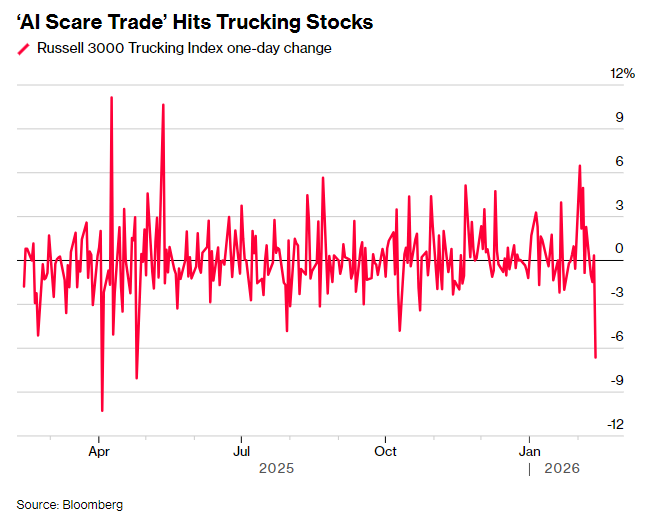
Core Viewpoint - The logistics sector in the U.S. experienced a significant sell-off due to fears surrounding AI's potential to disrupt traditional industries, triggered by a small company, Algorhythm Holdings Inc., claiming its AI logistics platform could increase freight volume by 300% to 400% without adding operational staff [1][4][5]. Group 1: Market Reaction - The Russell 3000 trucking index fell by 6.6%, with major players like CH Robinson Worldwide Inc. dropping 15% and Landstar System Inc. declining by 16% [1][3]. - The sell-off marked the worst single-day performance for the logistics sector since April of the previous year, spreading to pharmaceutical distributors and European markets, with McKesson Corp. and Cardinal Health Inc. both down around 4% [3]. - The Nasdaq 100 index also fell by 2%, indicating a broader market retreat from AI enthusiasm to fear of its disruptive potential [3]. Group 2: Company Background - Algorhythm Holdings, previously known as The Singing Machine Company Inc., announced its transition to an AI logistics company, driven by losses in its original business due to tariffs on imports [4]. - Despite reporting quarterly sales of less than $2 million and a net loss of nearly $3 million, Algorhythm's stock surged by 82% following the announcement, ultimately closing up 30% at $1.08 [4]. Group 3: Industry Sentiment - The logistics sector is the latest to be impacted by AI panic, following similar trends in real estate, software, and private credit sectors [5]. - Analysts noted a fundamental shift in market sentiment, with traditional industries previously seen as "AI-resistant" now facing significant declines [7]. - Concerns center around AI potentially eliminating the intermediary role of truck brokers, leading to substantial losses in the sector [6]. Group 4: Analyst Perspectives - Some analysts argue that the market's reaction is disproportionate to the actual risks, suggesting that the sell-off reflects an emotional response rather than a rational assessment of the situation [8]. - Barclays analysts defended companies like CH Robinson, indicating that the market's reaction does not align with the underlying risks [8]. - There is a consensus that while AI's long-term impact is significant, the immediate stock market reactions are often exaggerated and emotional [8].