nubia M153

Search documents
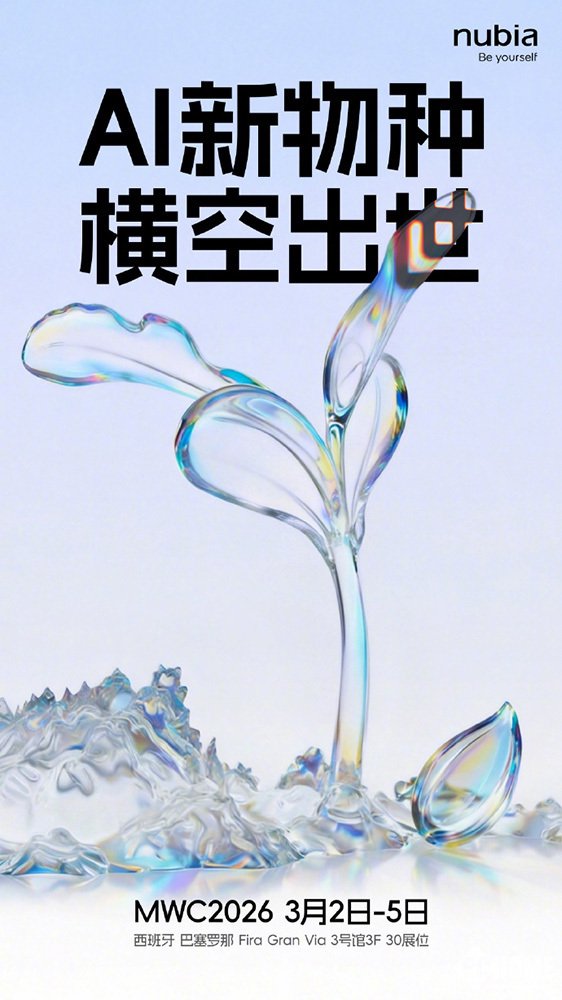
新一代豆包手机 努比亚官宣MWC推出AI新物种
Xin Lang Cai Jing· 2026-02-26 01:47
Core Viewpoint - Nubia announced the launch of an "AI new species" smartphone during MWC 2026, speculated to be the next generation of the Doubao phone [1][6] Group 1: Product Announcement - Nubia will unveil a pioneering AI smartphone at MWC 2026, although specific details remain undisclosed [1][6] - The Nubia M153, a test phone developed in collaboration with ByteDance's Doubao team, was released in December 2025, featuring a preview version of the Doubao mobile assistant [1][6] Group 2: AI Integration - The Nubia M153 integrates the AI assistant deeply into the system's core, enabling complex cross-application operations without needing to open apps [3][8] - Users can execute tasks through voice commands, allowing seamless interaction without disrupting current usage [3][8] Group 3: Security and Privacy Concerns - The AI-driven operation method raises significant security and privacy concerns, leading to restrictions on financial applications [5][9] - The direct operation from the system's core challenges existing business models of various applications, resulting in some applications being banned [5][9] - Nubia and ByteDance are expected to address these issues, with potential solutions anticipated to emerge during MWC 2026 [5][9]

正联合多家车企一起造车?字节跳动否认:传言不实
Jin Rong Jie· 2026-01-07 06:10
Core Viewpoint - ByteDance has denied rumors regarding plans to enter the automotive industry through a partnership with a car manufacturer, stating that there are no such plans in place [1]. Group 1 - ByteDance responded to multiple media outlets, including "Science and Technology Innovation Board Daily" and "The Paper," clarifying that the rumors about collaborating with a car company to produce vehicles are untrue [1]. - The speculation originated from comments made by Sun Shaojun, the founder of CarFans, who claimed that ByteDance was in talks with a certain car manufacturer for a joint venture in vehicle production [1]. - Previously, ByteDance collaborated with ZTE to launch the nubia M153, which featured the Doubao mobile assistant technology [1].

继豆包AI手机后 字节跳动被曝将跨界联合某车企造车
Ge Long Hui· 2026-01-07 04:28
Core Viewpoint - ByteDance is in discussions with an unnamed automotive company to collaborate on vehicle manufacturing, although no further details or official responses have been released yet [1] Group 1 - The founder of Chefans, Sun Shaojun, confirmed the ongoing negotiations between ByteDance and a car manufacturer [1] - ByteDance previously collaborated with ZTE to launch the nubia M153 smartphone, which features the Doubao mobile assistant technology [1] - There are reports that ByteDance is also pursuing AI smartphone partnerships with hardware manufacturers such as Vivo, Lenovo, and Transsion [1]
腾讯、阿里、字节、百度等千亿重注AI
2 1 Shi Ji Jing Ji Bao Dao· 2025-12-30 02:27
Core Insights - AI has become the central theme in China's technology industry throughout 2025, viewed as a key driver for the next productivity revolution and business model iteration [2] - Major internet companies like Tencent, Alibaba, and ByteDance are intensifying their focus on AI, with significant investments and strategic moves to secure their positions in the market [2][4] Investment Trends - Alibaba announced a three-year investment plan of 380 billion yuan for cloud and AI hardware infrastructure, which is more than its total investment over the past decade [4] - ByteDance plans to increase its capital expenditure to 150 billion yuan in 2025, marking an 88% year-on-year increase, with expectations to further raise it to 160 billion yuan in 2026 [4] - Tencent's capital expenditure is projected to reach around 100 billion yuan in 2025, with a 386% year-on-year increase in Q4 2024 [5] Financial Performance - Alibaba's cloud revenue grew by 34% year-on-year in Q3 2025, with AI-related product revenue maintaining triple-digit growth for nine consecutive quarters [5] - Tencent's marketing services revenue increased by 21% year-on-year, driven by improvements from AI-driven advertising platforms [5][10] - Baidu's AI business revenue grew over 50% year-on-year, becoming a core growth engine despite a decline in total revenue [5] AI Integration in Business - Major companies are integrating AI into their core business lines to enhance operational efficiency and create new growth engines [8][9] - Alibaba's AI tools improved operational efficiency for 500,000 merchants during the "Double 11" shopping festival, with an average efficiency increase of 1.5 times [9] - AI is transforming advertising from traditional methods to intelligent advertising, enhancing user engagement and return on investment [10] New Market Opportunities - The competition for AI-native applications is emerging as a new growth area, with companies vying to establish the next "super entrance" in the AI era [12] - The market is witnessing the rise of AI hardware, such as smart glasses, with significant growth in shipments and market share in China [14] - The introduction of AI-integrated smartphones represents a new direction in user interaction and data aggregation [14] Future Outlook - The competition among major players in AI applications, hardware, and native applications is still in its early stages, with the potential for significant developments in user engagement and commercial viability [15]




2025中国科技新风向:大厂千亿重注AI
2 1 Shi Ji Jing Ji Bao Dao· 2025-12-29 23:15
Core Insights - AI has become the central theme in China's technology industry throughout 2025, viewed as a key driver for the next productivity revolution and business model iteration [1] - Major internet companies like Tencent, Alibaba, and ByteDance are intensifying their focus on AI, with significant investments and strategic moves to secure their positions in the market [1][2] Investment and Financials - Alibaba announced a three-year investment plan of 380 billion yuan for cloud and AI hardware infrastructure, which is more than its total investment over the past decade [2] - ByteDance plans to invest 150 billion yuan in 2025, marking an 88% year-on-year increase, with expectations to further increase spending to 160 billion yuan in 2026 [2] - Tencent's capital expenditure surged by 386% year-on-year to 36.58 billion yuan in Q4 2024, with projections for 2025 spending to reach around 100 billion yuan [3] - Baidu has invested over 100 billion yuan in AI since the generative AI wave began in March 2023, with plans for continued R&D investment [3] Revenue Growth and Early Signals - Alibaba Cloud's revenue grew by 34% year-on-year in Q3 2025, with AI-related product revenue maintaining triple-digit growth for nine consecutive quarters [3] - Tencent's marketing services revenue increased by 21% year-on-year, driven by AI improvements in its advertising platform [3] - Baidu's AI business revenue grew over 50% year-on-year, becoming a core growth engine despite a decline in total revenue [3] AI Integration in Business - Major companies are integrating AI into their core business lines to enhance operational efficiency and create new growth engines [6][7] - Alibaba's AI tools improved operational efficiency for 500,000 merchants by an average of 1.5 times during the 2025 "Double 11" shopping festival [7] - Tencent's marketing revenue growth is attributed to AI-driven advertising, which enhances targeting and revenue per thousand impressions [8] New Market Opportunities - The competition for AI-native applications is emerging as a new growth area, with companies vying to establish the next "super entrance" in the AI era [9] - The market has formed a competitive landscape with ByteDance's Doubao and Tencent's Yuanbao leading in user engagement [10] - Hardware innovations, such as AI smart glasses and AI-integrated smartphones, are seen as potential new interaction points for users [11] Future Outlook - The AI market is still in its early stages, with ongoing competition among companies to establish user loyalty and commercial viability [12]
2025中国科技新风向:大厂千亿重注AI 竞逐超级入口
2 1 Shi Ji Jing Ji Bao Dao· 2025-12-29 11:38
Core Insights - AI has become the central theme in China's technology sector throughout 2025, viewed as a key driver for the next productivity revolution and business model iteration [1] - Major internet companies like Tencent, Alibaba, and ByteDance are intensifying their focus on AI, with significant investments and strategic moves to secure their positions in the market [1][2] Investment Trends - Alibaba announced a three-year investment plan of 380 billion yuan for cloud and AI hardware infrastructure, which is more than its total investment over the past decade [2] - ByteDance plans to invest 150 billion yuan in 2025, marking an 88% year-on-year increase, with expectations to further increase spending to 160 billion yuan in 2026 [2] - Tencent's capital expenditure surged by 386% year-on-year to 36.58 billion yuan in Q4 2024, with projections for 2025 spending to reach around 100 billion yuan [3] Financial Performance - Alibaba's cloud revenue grew by 34% year-on-year in Q3 2025, with AI-related product revenue maintaining triple-digit growth for nine consecutive quarters [3] - Tencent's marketing services revenue increased by 21% year-on-year, driven by AI improvements in its advertising platform [3] - Baidu's AI business revenue grew over 50% year-on-year, becoming a core growth engine despite a decline in total revenue [3] AI Integration in Business - Major companies are embedding AI into their core business lines to enhance operational efficiency and create new growth engines [6][7] - Alibaba's AI tools improved operational efficiency for 500,000 merchants by an average of 1.5 times during the 2025 "Double 11" shopping festival [7] - Tencent's AI-driven advertising has led to a 21% increase in marketing service revenue, showcasing the shift from traditional to intelligent advertising [8] New Market Opportunities - The competition for AI-native applications is emerging as a new growth area, with companies vying to establish the next "super entrance" in the AI era [9][10] - The market for AI applications is evolving, with significant user engagement reported for products like ByteDance's Doubao and Tencent's Yuanbao [10] - The global smart glasses market saw a 64.2% year-on-year increase in shipments in the first half of 2025, indicating strong potential for AI hardware [11] Future Outlook - The competition among companies in AI applications, hardware, and native applications is still in its early stages, with the need for validation of user engagement and business models [12]
2025中国科技新风向:大厂千亿重注AI,竞逐超级入口
2 1 Shi Ji Jing Ji Bao Dao· 2025-12-29 11:13
Core Insights - AI has become the central theme in China's technology industry throughout 2025, viewed as a key driver for the next productivity revolution and business model iteration [1] - Major internet companies like Tencent, Alibaba, and ByteDance are intensifying their focus on AI, with significant investments and strategic moves to secure their positions in the market [1][3] Investment Trends - Alibaba announced a substantial investment of 380 billion yuan over three years for cloud and AI hardware infrastructure, which is more than its total investment in the past decade [3] - ByteDance plans to increase its capital expenditure to 150 billion yuan in 2025, marking an 88% year-on-year growth, with expectations to further raise it to 160 billion yuan in 2026 [3] - Tencent's capital expenditure surged by 386% to 36.58 billion yuan in Q4 2024, with projections for 2025 to reach around 100 billion yuan [4] Financial Performance - Alibaba's cloud revenue grew by 34% year-on-year in Q3 2025, with AI-related product revenue maintaining triple-digit growth for nine consecutive quarters [4] - Tencent's marketing services revenue increased by 21% in Q3 2025, driven by improvements from AI-driven advertising platforms [4][7] - Baidu's AI business revenue grew over 50% year-on-year, becoming a core growth engine despite a decline in overall revenue [4] AI Integration in Business - Major companies are embedding AI into their core business lines to enhance operational efficiency and create new growth avenues [6] - Alibaba's AI tools improved operational efficiency for 500,000 merchants during the "Double 11" shopping festival, with average efficiency gains of 1.5 times [7] - Tencent's advertising revenue growth is attributed to AI-driven precision targeting, enhancing the effectiveness of ad placements [9] New Market Opportunities - The competition for AI-native applications is intensifying, with companies vying to establish new "super entry points" in the AI era [10] - The market has seen the emergence of leading AI applications, with ByteDance's Doubao and Tencent's Yuanbao gaining significant user bases [10] - The hardware sector is also evolving, with AI smart glasses and phones being developed to serve as new interaction points for users [12] Future Outlook - The AI landscape is still in its early stages, with ongoing competition among companies to validate user engagement and commercial viability [13] - The integration of AI into both enterprise and consumer applications is expected to blur the lines between the two, driving further innovation and growth [11]

中兴努比亚倪飞谈豆包手机助手:行业太久没给用户带来颠覆式创新,AI手机发展势不可逆【附智能手机行业市场分析】
Qian Zhan Wang· 2025-12-10 02:27
Core Insights - ByteDance's AI model Doubao has launched the "Doubao Phone Assistant" technical preview, integrated into the Nubia M153 smartphone, which sold out within a day at a price of 3499 yuan, with resale prices on second-hand platforms reaching up to 9999 yuan, indicating a premium of over 6500 yuan [2] - The Doubao Phone Assistant represents a significant technological breakthrough by embedding AI capabilities directly into the operating system, allowing for cross-app automation tasks through natural language commands, thus transforming the role of AI from a supportive tool to an active agent [2] Group 1: Product Launch and Market Response - The Nubia M153, featuring the Doubao Phone Assistant, sold out rapidly, showcasing strong market demand and consumer interest in innovative AI applications in smartphones [2] - Resale prices on platforms like Xianyu indicate a high perceived value and demand for the device, with some listings reaching up to 9999 yuan, reflecting a significant markup [2] Group 2: Industry Trends and Innovations - The smartphone industry has not seen disruptive innovation for a long time, and the development of AI smartphones is seen as an irreversible trend, with a focus on open collaboration to enhance user experience [3][5] - The high-end smartphone market in China, defined as devices priced over 4000 yuan, has seen its market share increase to over 27% in 2023, up by 3.7 percentage points from 2022, indicating a growing consumer demand for premium devices [7] Group 3: Future Market Projections - The Chinese smartphone market is expected to experience a new wave of upgrades driven by economic recovery and the rise of AI and foldable smartphones, with projections estimating the market size to reach 15,367 billion yuan by 2029, reflecting a compound annual growth rate of approximately 9.2% [8]


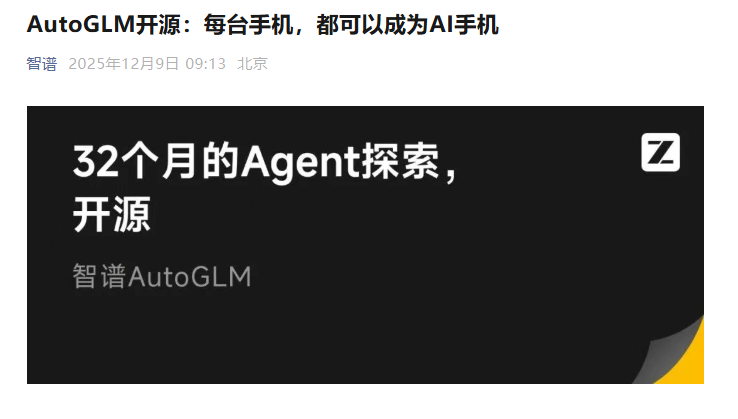
智谱开源“会使用手机的模型”,智能体能否保障个人隐私安全?
Zhong Guo Zheng Quan Bao· 2025-12-09 04:39
Core Insights - The core focus of the news is the announcement by Zhipu that it has open-sourced its core AI Agent model, AutoGLM, which aims to enable AI to perform mobile operations effectively, marking a significant advancement in AI capabilities [1][2]. Group 1: AutoGLM Development and Features - AutoGLM is designed to help users perform tasks on mobile applications, such as placing orders on food delivery apps and managing notifications [1]. - The model is set to be released on October 25, 2024, and is recognized as the first AI Agent with "Phone Use" capabilities [1]. - In 2025, Zhipu plans to launch AutoGLM 2.0, which will utilize algorithms like MobileRL, ComputerRL, and AgentRL to enhance the model's accuracy and generalization by conducting reinforcement learning across thousands of virtual device environments [1]. Group 2: Industry Context and Privacy Concerns - Zhipu is a leading AI large model company incubated by Tsinghua University, with a focus on developing next-generation cognitive intelligence models [2]. - The industry is shifting towards more practical AI agents that can not only communicate with users but also take actionable steps based on user input [2]. - Privacy and network security concerns are significant, particularly regarding the need for user authorization for screen reading permissions, which raises fears about personal information leakage and potential misuse by malicious entities [2][3]. Group 3: Competitive Landscape and Challenges - Recently, Doubao announced a technical preview of its mobile assistant, which has garnered market attention and led to a surge in ZTE's stock price [2]. - Users reported issues with the Doubao mobile assistant, including app crashes and login failures, which may be linked to the need for system-level permissions [3]. - Doubao has stated that while its assistant requires screen reading capabilities, it does not store user screen content in the cloud, aiming to ensure user privacy [3]. - Zhipu has opted for a cloud-based deployment for AutoGLM to allow for action replay, auditing, and intervention, thereby isolating sensitive data [3].
掀桌!豆包被“围攻”后,智谱把手机Agent开源,让人人皆可打造AI手机
Hua Er Jie Jian Wen· 2025-12-09 03:42
Core Viewpoint - The open-sourcing of AutoGLM by Zhipu AI marks a significant shift in the mobile industry, enabling the creation of AI agents that can operate smartphones similarly to human users, thus democratizing access to advanced AI technology [4][9][19]. Group 1: Open-Sourcing of AutoGLM - Zhipu AI has officially open-sourced its core AI Agent model, AutoGLM, which has been in development for 32 months and possesses the capability to operate mobile devices [1][4]. - The open-sourcing is seen as a "table-turning" move, allowing hardware manufacturers and developers to create personalized AI assistants that can interact with various applications [4][9]. - AutoGLM supports over 50 high-frequency Chinese applications, enabling automated operations similar to the recently launched "Doubao phone" [4][8]. Group 2: Industry Context and Reactions - The announcement comes after the launch of the "Doubao phone" by ByteDance and Nubia, which caused significant disruption in the tech industry and prompted major companies to implement defensive measures against its capabilities [6][8]. - The "Doubao phone" was able to perform complex tasks across applications, leading to a swift market response and concerns over privacy and data control from major internet companies [8][9]. Group 3: Technical Innovations - AutoGLM's development involved creating a framework that allows AI to understand and interact with mobile interfaces, marking a significant evolution from previous systems [12][15]. - The model utilizes Android Debug Bridge (ADB) commands combined with visual models to perform human-like operations, making it difficult for app developers to implement effective defenses [15][18]. - Zhipu AI has addressed privacy concerns by allowing data to remain on the user's device, thus countering arguments from major companies about potential data breaches [18]. Group 4: Implications for the Mobile Industry - The open-sourcing of AutoGLM is expected to reshape the mobile industry, similar to how autonomous driving has transformed the automotive sector, providing a new competitive edge for hardware manufacturers [20]. - Major internet companies face challenges as users can bypass traditional app interfaces, potentially disrupting their established flow of traffic and revenue [23]. - Individual developers are empowered to create specialized AI agents, leading to a more diverse ecosystem of applications and services [24]. Group 5: Conclusion - The open-sourcing of AutoGLM signifies a fundamental shift in user and developer control over mobile technology, indicating the decline of closed ecosystems and the rise of a new era in intelligent mobile interactions [28].