
Xin Hua Cai Jing

Search documents
每日机构分析:1月28日
Xin Hua Cai Jing· 2026-01-28 15:30
Group 1: Precious Metals and Currency Trends - Gold prices have reached a record high, surpassing $5,300, with a year-to-date increase of over 20%, driven by a crisis of confidence in the US dollar [2] - Silver prices continue to rise, supported by a weaker dollar, as investors shift from sovereign bonds and currency assets to hard assets [1] - The strong inverse correlation between gold and the dollar is highlighted, with market participants adopting defensive positions ahead of potential changes in Federal Reserve leadership [2] Group 2: European Market Outlook - Citigroup strategists indicate that the strengthening euro may overshadow European stock markets, as ongoing geopolitical tensions and tariff uncertainties weaken short-term investment prospects [2] - A 10% appreciation of the euro against the dollar could lead to a 2% reduction in earnings per share for European companies, particularly impacting sectors like commodities, food and beverage, healthcare, luxury goods, and automotive [2] Group 3: Consumer Confidence and Economic Indicators - German consumer confidence has shown a notable recovery, with the GfK index rising from -26.9 in January to -24.1 in February, exceeding market expectations [3] - Despite the recovery, analysts remain cautious about the sustainability of this trend, predicting only moderate growth in consumer spending [3] Group 4: Japanese Yen and Monetary Policy - Japanese retail investors have significantly reduced bullish bets on the yen, which may limit its appreciation, with a notable reduction of ¥8.57 billion (approximately $561 million) in net short positions against the dollar [3] - Analysts from Daiwa Securities suggest that the Bank of Japan may raise policy rates between April and June due to fiscal expansion and concerns over rising prices [4] - Moody's analysts note that while there was speculation about official intervention following the yen's sharp rise, no early indicators of such actions have been observed [4][5]
中国贸促会:加快建设世界一流调解、仲裁机构
Xin Hua Cai Jing· 2026-01-28 15:30
Group 1 - The China Council for the Promotion of International Trade (CCPIT) aims to accelerate the establishment of world-class mediation and arbitration institutions, focusing on sustainable development in international commercial dispute prevention and resolution [1] - CCPIT will enhance services related to patent and trademark applications for Chinese and foreign enterprises, expanding intellectual property dispute resolution and overseas rights protection services [1] - The organization plans to host various high-profile legal and arbitration forums, including the Global Commercial Law Conference in 2026 and the China-Singapore International Commercial Dispute Resolution Forum [1] Group 2 - In terms of expanding high-level opening-up, CCPIT will organize significant business events such as the APEC Business Leaders Summit and support Chinese enterprises in participating in international exhibitions [2] - The organization is preparing for the 2027 World Expo in Belgrade, Serbia, and aims to enhance trade and investment promotion activities, including the Global Trade and Investment Promotion Summit in 2026 [2] - CCPIT will focus on building a modern industrial system by promoting the Chain Expo as a platform for international enterprise exchange and cooperation, while also increasing training on regional and bilateral free trade agreements [2]
税收数据显示:“十四五”期间我国经济高质量发展扎实推进 数实经济加快融合
Xin Hua Cai Jing· 2026-01-28 15:30
Group 1: High-Quality Development - The "14th Five-Year Plan" period has seen solid progress in high-quality development in China, with 2025 marking a year of significant achievements in economic advancement [1] - The sales revenue of the equipment manufacturing industry has grown at an average annual rate of 9.1%, consistently outpacing the average growth rate of the manufacturing sector, indicating steady advancement towards high-end manufacturing [1] - In 2025, the sales revenue of the equipment manufacturing industry is expected to increase by 7.4%, accounting for 47.7% of the manufacturing sector, a rise of 4.7 percentage points from 2021 [1] Group 2: Innovation Industries - The sales revenue of high-tech industries has grown at an average annual rate of 13.9%, reflecting a rapid pace of development in innovation sectors [2] - In 2025, high-tech industries are projected to see a year-on-year revenue growth of 13.9%, with high-tech manufacturing and services growing by 10.1% and 16.6% respectively [2] - The "Artificial Intelligence +" initiative is accelerating, with significant growth in smart consumer devices (32.4%), integrated circuit manufacturing (19.2%), and robotics manufacturing (24%) [2] Group 3: Digital Economy Integration - The core industries of the digital economy have experienced an average annual revenue growth of 10.5%, with enterprise procurement of digital technologies growing at an average rate of 11.2%, indicating a continuous acceleration in the digitalization process [2] - In 2025, the sales revenue of core digital economy industries is expected to grow by 9.4%, while enterprise procurement of digital technologies is projected to increase by 9.6%, with manufacturing seeing a 10.4% growth [2] Group 4: Green Transition - The new energy vehicle industry has maintained a leading advantage, with sales revenue growing at an average annual rate of 49.5%, while clean energy generation has seen a 13.9% annual growth [2] - In 2025, the new energy vehicle manufacturing sector is expected to grow by 14.3%, and the clean energy generation sector is projected to see a 17.3% increase, accounting for 38.5% of total electricity production revenue, up by 6.9 percentage points from 2021 [2] Group 5: Unified Market Development - The proportion of inter-provincial trade sales to total sales has increased from 38.6% in 2021 to 41% in 2025, indicating accelerated progress towards a unified national market [2] - By 2025, the number of tax-related entities engaged in cross-provincial sales is expected to account for 57.6% of total sales entities [2]
资管一线 | 震荡不改长期逻辑,商业航天板块火箭、材料等方向或存机遇
Xin Hua Cai Jing· 2026-01-28 15:26
Core Viewpoint - The commercial aerospace sector has become a focal point in the capital market due to breakthroughs in reusable rocket technology, accelerated low-orbit satellite networking, and favorable national policies. Despite recent market fluctuations, the long-term growth logic of the industry remains intact, with multiple catalysts expected in 2026 [1][2]. Market Dynamics - The A-share commercial aerospace sector has shown significant volatility, with a cumulative increase of over 55% from December 2025 to January 12, 2026, followed by a decline of over 4% by January 20, indicating a struggle between valuation and performance [2][3]. - The recent strong performance is attributed to a key breakthrough in large reusable liquid rocket technology and supportive policies, including the National Space Administration's action plan for high-quality development in commercial aerospace [2][3]. Investment Opportunities - Despite short-term fluctuations, industry experts remain optimistic about the long-term growth of the commercial aerospace sector, expecting it to benefit from policy, technology, and capital catalysts in 2026. Key investment opportunities are identified in specific sub-sectors [4][5]. - Four main areas of focus include: 1. Rocket technology, where cost reductions are expected to drive demand [5] 2. Core materials, particularly titanium, which is essential for aerospace applications [5] 3. 3D printing technology, which is anticipated to see increased usage as aerospace models evolve [5] 4. Companies in the SpaceX supply chain, which may experience earlier performance releases compared to domestic counterparts [5] Future Trends - The commercial aerospace industry is still in its early stages, with significant potential for growth. Key areas of interest include core components with technological barriers and potential asset consolidation opportunities [6]. - The deployment of low-orbit satellite constellations is expected to create market demand in communication, navigation, and IoT applications, although the commercialization of new models like space computing is still in exploratory phases [6].
四川首只量子科技产业基金落地成都 规模10亿元
Xin Hua Cai Jing· 2026-01-28 15:26
Group 1 - Chengdu Xingjin Industrial Investment Co., Ltd. and Sichuan Industrial Fund signed an agreement to establish Sichuan's first quantum technology industry fund with a scale of 1 billion yuan [1] - The fund will focus on key areas such as standardized management, quality project investment, cutting-edge results transformation, industrial chain recruitment, and application scenario incubation to provide precise financial support for innovative projects and key enterprises in the quantum technology field [1] - The "Quantum Corridor" plan and "Ten Major Quantum Technology Application Scenarios" were released, outlining the development space and implementation path for the quantum technology industry [1] Group 2 - The "Quantum Corridor" spans approximately 4 kilometers along the East-West direction of Jiaozi Financial Street, aiming to create a core industrial carrier for quantum technology in Western China [1] - The core structure includes a "R&D Core Area - Manufacturing Gathering Area - Integration Demonstration Area" to promote the development of the entire industrial chain and establish a leading area for quantum technology innovation applications [1] - The "Ten Major Quantum Technology Application Scenarios" focus on quantum encryption, computing, and precision measurement, covering areas such as "Quantum + Energy" and "Quantum + Finance," while extending to urban governance, public services, and industrial upgrades [1] Group 3 - Six quantum technology companies signed intention agreements to settle in the Quantum Technology Building, including Sichuan Tianfu Quantum Technology Co., Ltd. and Shanghai Turing Intelligent Computing Quantum Technology Co., Ltd. [2] - The Quantum Technology Building is located in Chengdu Financial City Phase III (Jinjiang District) and is planned to have four functional sections: Chain Leader Area, Innovation Source Area, Incubation and Cultivation Area, and Public Technology Service Area, creating a full-chain industrial support system [2] - Jinjiang District has incorporated quantum technology into six major future industries, collaborating deeply with top institutions like the University of Science and Technology of China to focus on core technology breakthroughs, application scenario implementation, and industry-academia-research collaboration [2]
货币市场日报:1月28日
Xin Hua Cai Jing· 2026-01-28 15:20
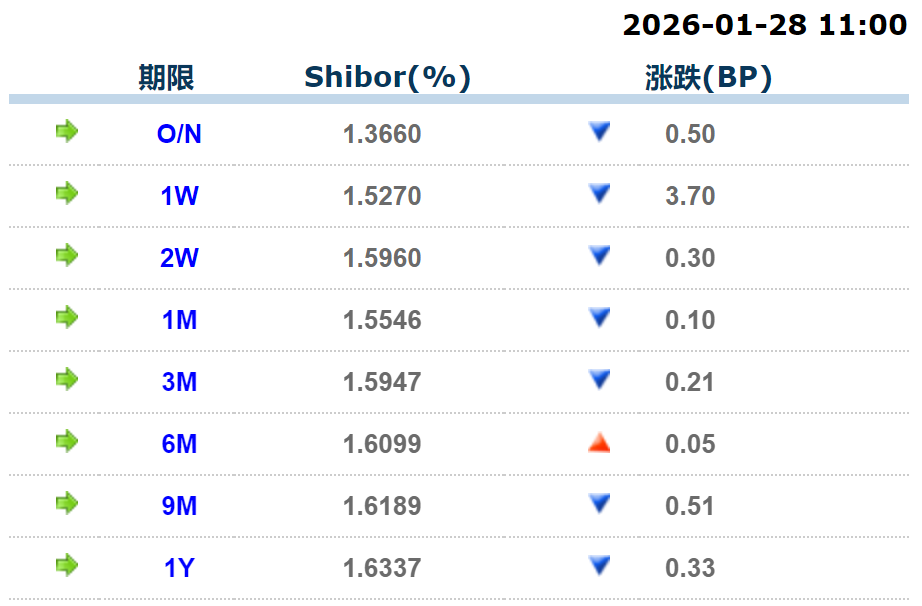
新华财经北京1月28日电人民银行28日开展3775亿元7天期逆回购操作,操作利率1.40%,与前次持平;鉴于当日有3635亿元逆回购到期,公开市场 实现净投放140亿元。 上海银行间同业拆放利率(Shibor)短期品种全线走低。具体来看,隔夜Shibor下跌0.50BP,报1.3660%;7天Shibor下跌3.70BP,报1.5270%;14天 Shibor下跌0.30BP,报1.5960%。 上海银行间同业拆放利率(1月28日) | | 期限 | Shibor(%) | 涨跌(BP) | | --- | --- | --- | --- | | 1 | O/N | 1.3660 | 0.50 | | 中 | 1W | 1.5270 | 3.70 | | 1 | 2W | 1.5960 | 0.30 | | → | 1 M | 1.5546 | 0.10 | | ゃ | 3M | 1.5947 | 0.21 | | 1 | 6M | 1.6099 | 0.05 | | 1 | 9M | 1.6189 | 0.51 | | | 1Y | 1.6337 | 0.33 | 来源:全国银行间同业拆借中心 银行间质押式 ...

2026年置换债披露发行规模超3000亿元 部分省份2026年额度已用完
Xin Hua Cai Jing· 2026-01-28 15:03
Core Viewpoint - The issuance of local government refinancing special bonds for replacing existing implicit debts has exceeded 300 billion yuan as of January 28, 2024, with a significant focus on long-term bonds of 10 years or more [1][2] Group 1: Bond Issuance and Structure - As of January 28, 2024, the disclosed scale of local government refinancing special bonds for replacing existing implicit debts has surpassed 300 billion yuan [1] - The bond issuance plan for 2024 to 2026 includes an annual allocation of approximately 2 trillion yuan for replacement bonds, with 2026 being the final year of the three-year replacement plan [1] - Multiple provinces have disclosed plans for issuing refinancing special bonds for 2026, with a total disclosed plan scale of 302.79 billion yuan and an issued scale of approximately 259.25 billion yuan [1] Group 2: Regional Highlights - Provinces such as Jiangsu, Shandong, and Zhejiang have taken the lead in issuing bonds, becoming key players in the current debt reduction policy [1] - Xinjiang has been allocated 64.8 billion yuan for replacing existing implicit debts from 2024 to 2026, with an annual distribution of 21.6 billion yuan, and all related bonds have been issued as of January 28, 2024, with terms of 20 and 30 years [1] Group 3: Market Implications - The rapid advancement of replacement bonds in 2026 is expected to reduce local government interest burdens and optimize debt structures, while also providing fiscal space for major project construction and social welfare support [2] - The first quarter of 2024 is anticipated to see local bond issuance exceed 2 trillion yuan, with refinancing special bonds accounting for nearly half, highlighting the dual goals of "stabilizing growth" and "preventing risks" [2] - As the issuance of replacement bonds concludes, the market anticipates a shift from "scale reduction" to "mechanism construction" for local debt, further promoting the transformation of urban investment platforms and sustainable fiscal development [2]
2026年全国税务工作会议:扛牢主责主业夯实高质量发展财力根基
Xin Hua Cai Jing· 2026-01-28 15:03
Core Viewpoint - The national tax work conference emphasizes the importance of enhancing tax governance efficiency and ensuring high-quality development through effective tax collection and compliance measures, while preparing for the "15th Five-Year Plan" period [1][2]. Group 1: Tax Revenue and Collection - In 2025, the tax authorities collected a total of 33.1 trillion yuan in various taxes and fees, with tax revenue amounting to 17.8 trillion yuan, reflecting a year-on-year growth of 2.7% [1]. - During the "14th Five-Year Plan" period, the tax authorities cumulatively collected over 156 trillion yuan in taxes and fees, accounting for approximately 80% of total fiscal revenue, and provided over 10 trillion yuan in tax reductions and refunds to support business growth [1]. Group 2: Strategic Goals for the "15th Five-Year Plan" - The tax system aims to promote high-quality modernization of tax practices, enhance governance capabilities, and ensure compliance through a comprehensive approach to tax law enforcement and digital transformation [2]. - Key objectives include maintaining a reasonable macro tax burden, improving taxpayer compliance, and reinforcing the foundational role of taxation in national governance [2]. Group 3: Tax System Reform and Compliance - The tax authorities will focus on reforming the tax system to support high-quality development and social equity, including the smooth implementation of the value-added tax law and optimizing tax structures [3]. - There will be an emphasis on strengthening tax compliance and creating a market-oriented, law-based, and international tax environment, including the promotion of the "Spring Breeze Action" for taxpayer convenience [4]. Group 4: Governance and Organizational Structure - The tax authorities are committed to strengthening political responsibility and ensuring effective governance within the tax system, including the cultivation of professional talent and support for grassroots tax officials [5]. - Continuous efforts will be made to enhance the structure of tax bureaus and implement mechanisms for selecting and training young talent to invigorate the workforce [5].
2025年12月末四川省金融机构各项贷款余额同比增长10.5%
Xin Hua Cai Jing· 2026-01-28 14:50
Group 1 - The core viewpoint of the news is that Sichuan Province's financial institutions have shown significant growth in both loans and deposits, with loan balances reaching 12.9983 trillion yuan and deposits at 14.6344 trillion yuan by the end of December 2025, indicating a robust financial environment [1][2] - By the end of December 2025, the loan balance in Sichuan Province increased by 10.5% year-on-year, surpassing the national growth rate by 4.3 percentage points, with a total increase of 1.2398 trillion yuan for the year [1] - The deposit balance also grew by 9.1% year-on-year, slightly above the national average by 0.1 percentage points, with an annual increase of 1.2202 trillion yuan [1] Group 2 - Financial support for key sectors and weak links has been precise and effective, with loans in the "Five Major Articles" area reaching 4.4455 trillion yuan by the end of November 2025, reflecting a year-on-year growth of 15.0% [1] - Infrastructure sector long-term loans increased by 9.2% year-on-year, with an annual increase of 235 billion yuan, accounting for 23.8% of the total long-term loan increment [1] - The manufacturing sector also saw a 10.7% year-on-year growth in long-term loans, slightly above the overall loan growth rate in the province [1] Group 3 - In the inclusive finance sector, small and micro loans in Sichuan Province grew by 11.8% year-on-year, with loans to small enterprises under 10 million yuan increasing by 20.5% [2] - Household consumption loans (excluding housing loans) rose by 11.6%, exceeding the overall loan growth rate by 1.1 percentage points [2] - The weighted average interest rates for newly issued corporate loans and inclusive small micro loans were 3.96% and 3.92%, respectively, both at historically low levels [2]
2025年四川810个省重点项目完成投资10428.6亿元
Xin Hua Cai Jing· 2026-01-28 14:48
突出科学谋划与接续储备。今年初,四川印发实施《2026年四川省重点项目名单》,科学编制2026年四 川省加快前期工作重点项目名单,不断巩固全省重点项目滚动接续良好态势。抢抓"十五五"规划编制政 策机遇,坚持国家所需与四川所能相结合,持续加强项目谋划储备和向上对接争取,力争更多重大工程 项目纳入国家"十五五"规划,不断提升四川发展能级和位势,为推动全省经济社会高质量发展提供坚实 项目基础。 四川省发展改革委相关负责人表示,下一步将会同各地各部门,紧扣"十五五"时期发展重点,进一步优 化项目投资结构,持续完善"天府项目通"平台功能,充分发挥重大项目调度机制作用,加快修订出台 《四川省重点项目管理办法》,不断健全四川省重点项目全生命周期服务管理体系,全力推动省重点项 目早开快建。 (文章来源:新华财经) 新华财经成都1月28日电(记者袁波)记者28日从四川省发展改革委获悉,2025年,四川省扎实开展项 目攻坚行动,推动810个省重点项目完成投资10428.6亿元,年度投资完成率达133.2%。 其中,282个基础设施项目完成投资4528.5亿元,年度投资完成率129.1%;447个产业项目完成投资 5414.8亿元 ...