
Xin Hua Cai Jing

Search documents
离岸观澜 | 2026年首批离岸央票正式起息 八年累计发行额已超1.2万亿元
Xin Hua Cai Jing· 2026-02-27 07:57
Core Viewpoint - The People's Bank of China successfully issued offshore central bank bills in Hong Kong, marking the eighth year of regular issuance, with a total issuance exceeding 1.2 trillion yuan over the years [1][2]. Group 1: Issuance Details - The first batch of offshore central bank bills for 2026 was issued on February 27, with a total issuance of 500 billion yuan, including 300 billion yuan for 3-month bills at a rate of 1.53% and 200 billion yuan for 1-year bills at a rate of 1.47%, the lowest in nearly a year [1][2]. - The issuance reflects a continued decline in rates, with the 3-month and 1-year bill rates dropping over 100 basis points compared to similar products at the beginning of 2025 [2]. Group 2: Market Implications - The ongoing decline in offshore central bank bill rates alleviates financing cost pressures for Chinese enterprises abroad, providing a clear pricing anchor for various RMB financial products [3]. - The issuance of these bills is seen as a routine measure to stabilize the foreign exchange market and signal steady exchange rate policies, thereby preventing abnormal cross-border capital flows [2][3]. Group 3: Development of Offshore RMB Market - The issuance enhances the offshore RMB yield curve, contributing to the development of high-credit-quality financial products in Hong Kong and reinforcing its status as an international financial center [4]. - The Hong Kong government plans to double the total quota for RMB business funding to 200 billion yuan, facilitating broader use of RMB in trade and cross-border activities [5]. Group 4: Future Outlook - Experts suggest that the issuance of offshore central bank bills will enrich investment options in the offshore market, improving asset allocation stability and safety for investors amid global trade uncertainties [5]. - The collaboration between central bank bills and other financial instruments like government bonds will further refine the offshore RMB yield curve, providing a pricing anchor for RMB internationalization [5].
机构白皮书:高科技行业对核心技术人才的竞争已进入“刚需”阶段
Xin Hua Cai Jing· 2026-02-27 07:54
Group 1 - The high-tech industry is projected to have the highest salary adjustment rate of 4.9% by 2025, driven by competition for core technical talent in key areas like artificial intelligence and semiconductors [1] - First-tier cities, particularly Shanghai (12,742 CNY/month) and Beijing (12,518 CNY/month), show significant salary advantages, reflecting the strong support of high-tech industries and high-level talent density [1] - New first-tier cities like Hangzhou (10,165 CNY/month) and Nanjing (9,624 CNY/month) are rapidly closing the salary gap with Guangzhou, indicating the growing influence of the Yangtze River Delta economic circle [1] Group 2 - Integrated circuit design engineers in first-tier cities have an average annual salary of 400,591 CNY, while cloud computing architects earn close to 500,000 CNY (491,253 CNY), highlighting the high value of these positions [2] - The manufacturing and automotive industries are expected to have salary adjustment rates of 4.3% and 4.1% respectively by 2025, with traditional "blue-collar" jobs transitioning to "digital craftsmen" [2] - The pharmaceutical and health industry maintains a salary adjustment rate of 4.4% in 2025, driven by aging trends and biotechnological innovations, with key positions like bioinformatics engineers earning 293,820 CNY in first-tier cities [2] Group 3 - The financial industry is projected to have a lower salary adjustment rate of 3.0% in 2025, influenced by stricter regulations and market volatility, with a further decline to 2.9% expected in 2026 [3] - Despite an increase in disposable income for urban residents (4.2% growth in 2025), consumer willingness is becoming more rational, reflected in the consumer goods industry's salary adjustment rate of 3.7%, slightly below the industry average [3] - The salary gap between first-tier and non-first-tier cities remains around 30%, indicating a concentration of high-end consumer resources in first-tier cities [3]
科创板收盘播报:科创综指涨0.36% 软件服务股涨幅靠前
Xin Hua Cai Jing· 2026-02-27 07:40
Core Points - The ChiNext 50 Index and the ChiNext Composite Index opened lower on February 27, with declines of 1.20% and 1.06% respectively, but later showed a rebound, closing with gains of 0.15% and 0.36% [1] - On the same day, 327 stocks in the ChiNext board rose, accounting for approximately 54.14% of the total, with notable gains in software service stocks such as Puyuan Information and Yuntian Lifefly, which hit the daily limit [1] - The total trading volume for the ChiNext board was approximately 2,591.83 billion yuan, with an average turnover rate of 3.04% [2] Trading Performance - The ChiNext 50 Index accumulated a rise of 1.20% and the ChiNext Composite Index rose by 2.24% over the week from February 24 to 27 [2] - The stock with the highest trading volume was Cambrian, with a total of 14.32 billion yuan, while Hanbang Technology had the lowest at 775.64 million yuan [3] - The stock with the highest turnover rate was Electric Science Blue Sky at 37.74%, while Haohai Biological had the lowest at 0.15% [4] Individual Stock Highlights - Puyuan Information, Yuntian Lifefly, and World achieved the highest gains, while Shengmei Shanghai saw a significant decline of 8.11% [2]
收评:A股2月收官!沪指月线3连阳 有色板块掀涨停潮
Xin Hua Cai Jing· 2026-02-27 07:40
Market Overview - On the last trading day of the month, A-shares showed mixed performance with the Shanghai Composite Index rising by 0.39% to 4162.88 points, while the Shenzhen Component Index fell by 0.06% to 14495.09 points, and the ChiNext Index dropped by 1.04% to 3310.30 points [1] - The total trading volume in Shanghai, Shenzhen, and Beijing reached 2.51 trillion yuan, a slight decrease of 504 billion yuan compared to the previous trading day [1] - For the month, the Shanghai Composite Index gained 1.09%, marking three consecutive months of gains, while the Shenzhen Component Index rose by 2.04%, and the ChiNext Index declined by 1.08% [1] Sector Performance - The sectors that performed well included small metals, rare earths, precious metals, energy metals, non-ferrous metals, coal, and electricity [1] - Conversely, the sectors that saw declines included glass fiber, components, and electronic chemicals [1] Stock Highlights - Over 3200 stocks in the market experienced price increases, with nearly 100 stocks hitting the daily limit [3] Institutional Insights - Dongfang Securities suggests that the next investment focus in A-shares should be on mid-cap blue chips, moving away from the previous high-growth tech and low-volatility dividend strategies [4] - CITIC Securities anticipates that insurance companies will continue to benefit from a highly regulated and competitive environment, with market share concentration expected to increase among the top seven companies [4] - Galaxy Securities remains optimistic about the semiconductor and related components investment opportunities, particularly in domestic AI infrastructure and the rising prices of storage chips [4] Regulatory Developments - The People's Bank of China announced a reduction in the foreign exchange risk reserve ratio for forward foreign exchange sales from 20% to 0%, effective March 2, 2026, to support foreign exchange market development [5] Supply Chain Issues - There is a significant shortage of rare earth elements, particularly yttrium and scandium, affecting U.S. aerospace and semiconductor suppliers, with yttrium prices having increased by approximately 60% since November 2025 [6] - Some manufacturers of coatings that require yttrium have had to temporarily halt production due to the shortage [6]
国家能源局:截至1月底我国电动汽车充电基础设施总数达2069.8万个
Xin Hua Cai Jing· 2026-02-27 07:02
Core Insights - The National Energy Administration of China reported that as of January 2026, the total number of electric vehicle charging facilities reached 20.698 million, representing a year-on-year growth of 49.6% [1] Summary by Category Overall Charging Infrastructure - The total number of electric vehicle charging infrastructure (guns) in China reached 20.698 million, with a year-on-year increase of 49.6% [1] Public Charging Facilities - Public charging facilities accounted for 4.801 million guns, showing a year-on-year growth of 31.2% [1] - The total rated power of public charging facilities reached 226 million kilowatts, with an average power of approximately 47.01 kilowatts [1] Private Charging Facilities - Private charging facilities comprised 15.897 million guns, reflecting a year-on-year increase of 56.1% [1] - The installed electricity capacity for private charging facilities reached 138 million kilovolt-amperes [1]
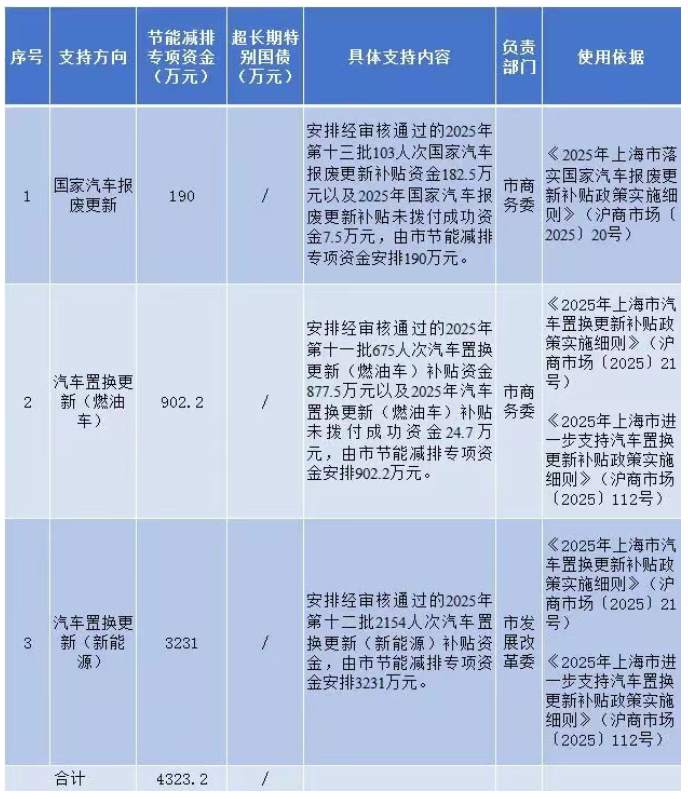
上海市2026年节能减排专项资金和超长期特别国债安排计划(第三批)发布
Xin Hua Cai Jing· 2026-02-27 06:57
Core Insights - Shanghai has announced its 2026 energy conservation and emission reduction special fund and ultra-long-term special government bond arrangement plan, allocating a total of 43.232 million yuan to support the national automobile scrapping and replacement program, including both fuel and new energy vehicles [1] Group 1: Funding Allocation - The special fund for energy conservation and emission reduction amounts to 43.232 million yuan [2] - Specific allocations include 1.825 million yuan for the 2025 national automobile scrapping subsidy, 8.775 million yuan for fuel vehicle replacement subsidies, and 32.31 million yuan for new energy vehicle replacement subsidies [2] Group 2: Support Details - The funding is aimed at supporting the scrapping and replacement of vehicles, with a focus on both fuel and new energy vehicles [1][2] - The allocations are based on approved applications for subsidies from previous years, indicating a structured approach to funding distribution [2]

【环球财经】伦敦股市26日上涨
Xin Hua Cai Jing· 2026-02-27 06:02
Market Performance - The London Stock Exchange's FTSE 100 index closed at 10,846.70 points on the 26th, up by 40.29 points, representing a gain of 0.37% [1] - All major European stock indices experienced gains on the same day [1] Top Gainers - The top five gainers in the London stock market included: - Houghton Mifflin Harcourt Group, with a stock price increase of 10.75% - London Stock Exchange Group, up by 9.06% - Relx Group, rising by 4.55% - Experian, increasing by 4.36% - Reckitt Benckiser, up by 4.31% [1] Top Losers - The top five losers in the London stock market included: - Hikma Pharmaceuticals, with a stock price decrease of 16.89% - Fresnillo, a precious metals producer, down by 5.13% - Antofagasta, a mining company, down by 4.38% - Anglo American, down by 3.55% - Metinvest, down by 3.45% [1] Other European Indices - The CAC 40 index in Paris closed at 8,620.93 points, up by 61.86 points, a gain of 0.72% [1] - The DAX index in Frankfurt closed at 25,289.02 points, up by 113.08 points, representing a gain of 0.45% [1]
【财经分析】贵金属市场节后高开进入高位震荡 向上趋势能否持续?
Xin Hua Cai Jing· 2026-02-27 06:01
新华财经北京2月27日电(记者王小璐)在迎来马年首个交易日股期联动上涨后,贵金属市场涨势逐渐 放缓,步入高位震荡格局。 春节期间,国际贵金属价格走出"先抑后扬",节后国内市场一度强势跟涨,多重因素博弈下,贵金属这 波行情能走多远?2026年的长期价值又是否依然稳固? 王露晨指出,贵金属近期的涨势能否持续主要关注中东地缘情况,如果美伊间通过谈判能够达成一致, 则短期内黄金的风险溢价或将暂时消退。以对美股为代表的风险资产偏好的提升是否能够持续也值得观 察,若再次出现负面冲击和抛售潮,流动性问题仍可能在短期内拖累金银走势。 景川则提示,近期贵金属市场面临一定风险。由于前期快速拉升导致过度杠杆和过热,一旦利多因素钝 化、大型机构调整仓位,或将引发回调风险。如果美联储降息节奏不及预期、美元指数阶段性反弹也会 对金银价格形成压制。 尽管短期波动在所难免,但市场对2026年全年的贵金属价格仍保持乐观态度。 马年首个交易日,国内贵金属市场呈现股期双涨的态势。据统计,近三个交易日,A股市场贵金属行业 指数累计上涨6.23%,多只金银个股上涨。 回顾春节假期期间的国际贵金属市场,行情并非一帆风顺,而是呈现典型的"V"字走势。 对 ...
【环球财经】俄罗斯石化公司西布尔2025年净利率同比上涨4.5%
Xin Hua Cai Jing· 2026-02-27 05:58
新华财经莫斯科2月27日电(记者包诺敏)俄罗斯石化行业领军企业西布尔公司26日发布的财报显示, 依据国际财务报告准则(IFRS),该公司2025年净利润实现同比增长4.5%,达约2050亿卢布。 西布尔公司财报还披露,该公司2025年的投资项目融资额达峰值,投资额约4830亿卢布。 (文章来源:新华财经) 财报显示,该公司2025年营收同比下降10.4%,降至约1.049万亿卢布,而2024年公司营收约为1.170万 亿卢布。 据西布尔公司称,营收下降的主要因素是国际石化产品价格下跌,卢布对美元走强,以及俄罗斯国内多 个行业合成材料消费量下降等。 ...
巴西媒体热议中国“功夫机器人”:资本市场改革为科技跃升注入动能
Xin Hua Cai Jing· 2026-02-27 05:58
Core Viewpoint - The development of humanoid robots in China, exemplified by the "Kung Fu Robot" showcased during the Spring Festival Gala, reflects significant advancements in motion control, artificial intelligence, and precision manufacturing, highlighting the interconnectedness of capital market reforms, RMB internationalization, and technological innovation in China [1][2]. Group 1: Financial Structure and Support - Humanoid robots are capital-intensive and require long R&D cycles, making "patient capital" essential to navigate the innovation process [1]. - The growth of Chinese tech companies is closely linked to structural reforms in the capital market, which have improved direct financing and reduced reliance on traditional bank credit, creating a stable financing environment for high-tech industries [1][2]. - Strengthening the financing function of hard technology in the capital market provides institutional support for high-risk, long-term projects, with visible results like the robots on stage [2]. Group 2: Market Performance and Valuation - In the context of positive interaction between technological innovation and capital support, sectors related to robots, automation, and AI in the Chinese stock market are performing actively, with stock valuations expected to rise by approximately 30% to 70% by 2025 [2]. - The current round of financial reforms emphasizes "functional opening," supporting innovation while maintaining financial stability, leading to a shift in capital allocation towards robotics, automation, semiconductors, AI applications, and advanced materials [2]. Group 3: RMB Internationalization and Global Impact - RMB internationalization plays a crucial role in reducing transaction costs and enhancing exchange rate predictability, which benefits tech companies by internalizing financing risks and broadening the base of long-term investors [3]. - The leap in Chinese robotics technology is not just a technical event but also reflects the coordinated advancement of financial market reforms, RMB internationalization, and strategic investments in robotics, AI, and sustainable development [3]. - The trend has significant implications for Brazil, as China's growing technological strength may reshape global value chains and increase the use of RMB in bilateral trade, thereby reducing exchange rate costs [3].
