Si Chuan Ri Bao

Search documents
若尔盖国家公园创建任务总体完成 创建期间四川完成生态修复23.25万公顷
Si Chuan Ri Bao· 2025-10-15 06:36
Core Viewpoint - The establishment of the first batch of national parks in China marks its fourth anniversary, with significant progress made in the creation of the Ruoergai National Park, which is crucial for ecological protection in the upper reaches of the Yellow River [1] Group 1: National Park Establishment - The Ruoergai National Park candidate area is located at the intersection of Sichuan, Gansu, and Qinghai provinces, playing a strategic role in the ecological safety of the Yellow River basin [1] - The park features the world's largest and best-preserved high-altitude cold peat swamp, contributing to rich biodiversity and significant water supply (annual water storage capacity of nearly 10 billion cubic meters) [1] - The creation of the Ruoergai National Park was initiated by Sichuan in early 2020 to strengthen the ecological barrier in the upper reaches of the Yellow River [1] Group 2: Creation Process - The establishment of national parks follows a two-phase process: creation and approval, which includes selecting areas, submitting applications, conducting assessments, and obtaining expert validation [1] - In early 2022, Sichuan and Gansu jointly submitted the creation plan for Ruoergai National Park, which was later included in the national park layout in November [1] - The implementation of the "Ruoergai National Park Creation Work Promotion Plan" was initiated following the approval process [1]
省级水网先导区建设三年行动方案发布 到2027年新增供水能力12亿立方米
Si Chuan Ri Bao· 2025-10-15 06:36
Core Viewpoint - The Sichuan Provincial Water Resources Department has issued a three-year action plan aimed at enhancing water supply capacity and irrigation efficiency by 2027, with specific targets for water resource management and infrastructure development [1][2]. Group 1: Water Supply Capacity and Irrigation - The plan aims to increase water supply capacity by 1.2 billion cubic meters and expand effective irrigation area by 1.6 million acres by 2027 [1]. - The rural tap water coverage is targeted to reach 93%, and soil conservation rate is expected to improve to 80.5% [1]. Group 2: Key Focus Areas - The action plan focuses on five main areas: enhancing water resource allocation and supply security, strengthening flood control measures, improving water ecological protection, advancing smart water network engineering, and modernizing water management capabilities [1][2]. - Significant projects include the initiation of the "Yin-Da-Ji-Min" project and the construction of various irrigation districts and reservoirs, such as the Tizi Kou and Xiang Jia Ba irrigation districts [2]. Group 3: Smart Water Network Development - The plan emphasizes the integration of smart technology in water network projects, including the development of digital twin systems for major irrigation and reservoir projects [2]. - The initiative aims to enhance the intelligence of existing water infrastructure, including urban water supply systems and flood control measures [2]. Group 4: Provincial Water Network Strategy - The provincial water network strategy aims to optimize the layout, structure, and functionality of the water network, ensuring interconnectedness and coordinated management to enhance water security [3].
“第一笔启动金”“梦想试验田”“陪伴式支持”……成都出台十条措施全周期支持人才发展
Si Chuan Ri Bao· 2025-10-15 06:34
Core Viewpoint - Chengdu has introduced ten measures aimed at attracting and gathering talent to accelerate the construction of a high-level talent hub, focusing on urban strategy, industrial development, and the needs of employers [2][4]. Group 1: Talent Attraction and Support - The measures emphasize strengthening financial support for innovation and entrepreneurship, with a focus on attracting top talent and teams [3][4]. - Chengdu plans to select approximately 300 industry-leading talents and 600 skilled craftsmen annually, encouraging local universities to optimize their academic programs in line with key industrial developments [5][6]. - A comprehensive support system for innovation and entrepreneurship funding is being established, including a "seed, startup, growth" lifecycle approach [6]. Group 2: Evaluation and Performance - The city aims to evaluate talent based on contributions rather than academic credentials, with plans to support at least 300 key employers in conducting independent talent evaluations annually [5]. - There will be no less than 600 slots available for local departments to evaluate high-level talents based on their performance contributions [5]. Group 3: Resource Allocation and Services - Chengdu is creating a "dream test field" in industrial parks, providing over 20,000 square meters of free office space and at least 1,000 application scenarios each year [6]. - The city offers tailored support for entrepreneurial talents, including financial assistance and reduced housing costs for young talents relocating to Chengdu [6].

四川:两个家蚕新品种试养情况良好
Si Chuan Ri Bao· 2025-10-15 06:15
Core Viewpoint - The collaboration between Sichuan San Tai Silkworm Seed Farm and Yibin Agricultural Science Institute aims to enhance the sericulture industry through the introduction of new silkworm varieties and innovative breeding methods, which are expected to increase production and income for local farmers [1] Group 1: New Silkworm Varieties - The "Xianbai No. 1" silkworm variety shows healthy and uniform body structure, with a single cocoon yield reaching 40 kilograms and a fresh cocoon layer weight of 12.5 grams [1] - The selling price per kilogram of "Xianbai No. 1" is 5 yuan higher than conventional varieties, leading to an estimated income increase of about 12% for farmers using the same amount of mulberry leaves [1] Group 2: Innovative Breeding Methods - The "Yile No. 1" variety employs an innovative breeding model of "1-2 age feed + mulberry leaves after 3 age," which reduces labor costs while increasing cocoon yield by 5% and improving mulberry leaf utilization by 10% [1] - This method significantly enhances the resistance of silkworms during the high-temperature summer period, with an expected income increase of over 15% for silkworm farmers [1]
第十四届中国艺术节将在四川成都开幕 看巴山蜀水艺彩纷呈
Si Chuan Ri Bao· 2025-10-15 00:35
Core Viewpoint - The 14th China Arts Festival, commencing in Chengdu, Sichuan, is a significant recognition of the province's flourishing cultural and artistic development, providing an important opportunity for high-quality artistic growth through cultural tourism integration [1][9]. Group 1: Artistic Achievements - Sichuan has focused on creating artistic masterpieces, leading to a notable increase in the quality and quantity of artistic works, including awards such as the 12th China Acrobatics Golden Chrysanthemum Award for the magic show "Encounter" and the 13th China Quyi Peony Award for performance [2]. - A total of 37 projects from Sichuan have been selected for national arts fund support in 2025, showcasing the province's diverse artistic capabilities across various genres [3]. Group 2: Cultural Tourism Integration - Sichuan has successfully integrated cultural and tourism sectors, promoting experiences like "traveling with performances," which has become a popular trend among tourists [5]. - The province has launched initiatives such as the "China Has Sichuan Opera" micro-documentary series and various online promotions, reaching over 30 million viewers, thereby enhancing the visibility of Sichuan opera [5][6]. Group 3: Institutional Reforms - The province has implemented reforms in state-owned cultural institutions to enhance resource allocation and operational mechanisms, fostering a more dynamic environment for artistic creation [7][8]. - Sichuan has established a robust framework for nurturing talent in traditional arts, with 28 national and provincial-level inheritors of Sichuan opera, contributing to the preservation and development of this cultural heritage [8]. Group 4: Upcoming Opportunities - The 14th China Arts Festival will serve as a platform to showcase Sichuan's artistic achievements, featuring performances like "Dreaming Back to Dongpo" and "The Three Kingdoms" dance drama, while promoting local cultural characteristics [9][10]. - Sichuan aims to leverage the festival to enhance the synergy between performing arts and tourism, creating new travel routes that connect performance venues with cultural attractions [9].
可控核聚变产业发展计划发布,聚变科创城启动,一批核能与核技术标志性成果亮相 展现硬“核”实力 四川打出“聚变”组合拳
Si Chuan Ri Bao· 2025-10-15 00:28
Core Insights - The "World Fusion Energy Group" held its second ministerial meeting and the 30th International Conference on Fusion Energy in Chengdu, highlighting advancements in controllable nuclear fusion and the launch of the Fusion Innovation City [1][4] Group 1: Nuclear Fusion Developments - Chengdu is positioning itself as a global hub for controllable nuclear fusion technology, with the launch of a development plan aimed at establishing a research and industrial cluster [4][5] - The plan includes the establishment of the Fusion Innovation City, which will focus on technology research, industrial development, and international collaboration in the fusion energy sector [4][5] - Key facilities and projects include the "Chinese Circulation No. 3" and the International Atomic Energy Agency's fusion research and training collaboration center [4] Group 2: Nuclear Technology Innovations - A range of innovative nuclear technologies were showcased, including a plasma high-temperature melting system capable of reaching temperatures above 5000 degrees Celsius for hazardous waste treatment [2] - The China Nuclear Power Research and Design Institute presented a modular small reactor design, which is easier to assemble and occupies one-third the space of traditional power plants, suitable for urban heating and seawater desalination [2] - The e-FLASH radiotherapy device developed by Zhongjiu Flash Medical Technology Co. is undergoing clinical trials, promising faster and more efficient cancer treatment [3] Group 3: Nuclear Medical Industry Growth - A new policy initiative titled "Further Promote High-Quality Development of the Nuclear Medical Industry" was introduced, featuring 24 measures to support industry upgrades and expand application demands [6] - Chengdu aims to establish three nuclear drug bases, while Luzhou focuses on nuclear diagnostic applications, and Deyang is developing a nuclear power equipment industrial park with a total investment of 40 billion yuan [6]
水利投资规模持续攀升,我省奋战四季度——冲刺七百亿
Si Chuan Ri Bao· 2025-10-15 00:28
Core Insights - Sichuan province is experiencing a significant surge in water conservancy investment, with a target of 700 billion yuan for the year, marking a historic high in water infrastructure development [6][7][8] - The province completed 566 billion yuan in various water conservancy investments in the first three quarters, ranking fifth nationally and showing a 16% year-on-year increase [5][8] - Major projects like the Tingzikou Irrigation District and Qingyu Reservoir are accelerating construction, contributing to job creation and economic growth [7][8][10] Investment and Construction Progress - The province has established a robust mechanism for project supervision and task allocation to ensure timely completion of water conservancy projects [9][10] - The Tingzikou Irrigation District project has seen a cumulative investment of 103 billion yuan, with construction progressing two months ahead of schedule [5][7] - A total of 693 billion yuan in water conservancy funds has been raised, nearing the annual target [10][11] Future Planning and Project Pipeline - Sichuan has 58 large and medium-sized water conservancy projects included in the national strategic implementation plan, with a total investment scale of 2,946 billion yuan [11][12] - The province is focusing on project reserves to ensure sustained investment growth, with plans for future projects totaling 1,546 billion yuan [11][12] - Financial policies from regulatory bodies are increasingly supporting water conservancy projects, enhancing investment confidence [13] Economic Impact - Water conservancy projects have created 113,000 jobs and contributed over 90 billion yuan to the province's GDP in the first eight months of the year [8][10] - The construction of major water projects is expected to stimulate the upstream and downstream industrial chains, further driving economic growth [7][8]
中国长城资产管理股份有限公司四川省分公司与许彪文债权转让通知暨债务催收联合公告
Si Chuan Ri Bao· 2025-10-14 22:30
Core Points - The announcement details the transfer of debt rights from China Great Wall Asset Management Co., Ltd. Sichuan Branch to Xu Biaowen, including all related agreements and obligations [1][2] - Xu Biaowen is now the assignee of the rights and is requesting all debtors and guarantors listed in the asset list to fulfill their repayment obligations immediately [1][2] Summary by Sections Debt Transfer Agreement - China Great Wall Asset Management Co., Ltd. Sichuan Branch has signed a debt transfer agreement with Xu Biaowen, transferring all rights related to the listed debtors and guarantors [1] - The asset list includes principal and interest balances as of November 20, 2020, and any changes in amounts should be based on actual figures as of the announcement date [2] Obligations of Debtors and Guarantors - Debtors and guarantors are required to pay interest according to the loan and guarantee contracts, as well as relevant regulations from the People's Bank of China [2] - In cases where debtors or guarantors undergo name changes, restructuring, or lose their civil subject qualifications, relevant parties must ensure obligations are fulfilled or assume liquidation responsibilities [2] Additional Notes - The list of guarantors includes "guarantors, mortgagors, and pledgers" [2] - Any discrepancies between the announcement and the signed debt transfer agreement will be governed by the agreement's content [2]


四川4家建设主体入选
Si Chuan Ri Bao· 2025-10-14 22:15
Group 1 - The Ministry of Industry and Information Technology has announced the first batch of national-level manufacturing digital transformation promotion centers, with 62 entities selected nationwide, including four from Sichuan, ranking third among all provinces [1] - The selected entities in Sichuan are Chengdu Industrial Investment Group Co., Ltd., Dongfang Electric Corporation Dongfang Turbine Co., Ltd., Sichuan Changhong Electronics Holding Group Co., Ltd., and Sichuan Jiuzhou Investment Holding Group Co., Ltd. [1] - The manufacturing digital transformation promotion center serves as a key platform for promoting the "smart transformation and digital upgrade" of the manufacturing industry, with Chengdu Industrial Investment Group responsible for operating the Sichuan Smart and Green Development Promotion Center [1] Group 2 - Dongfang Electric Corporation Dongfang Turbine Co., Ltd. is the first in the industry to achieve a four-level certification for both intelligent manufacturing capability and digital transformation maturity [2] - Sichuan Changhong Electronics Holding Group Co., Ltd. focuses on the electronic information manufacturing industry, leveraging over 60 years of industry experience to enhance digital technology applications across the entire industry chain [2] - Sichuan Jiuzhou Investment Holding Group Co., Ltd. is developing a comprehensive digital transformation service capability across four sectors: electronic components, smart terminals, IoT devices, and industrial models, aiming to serve the Chengdu-Chongqing region and nationwide [2]


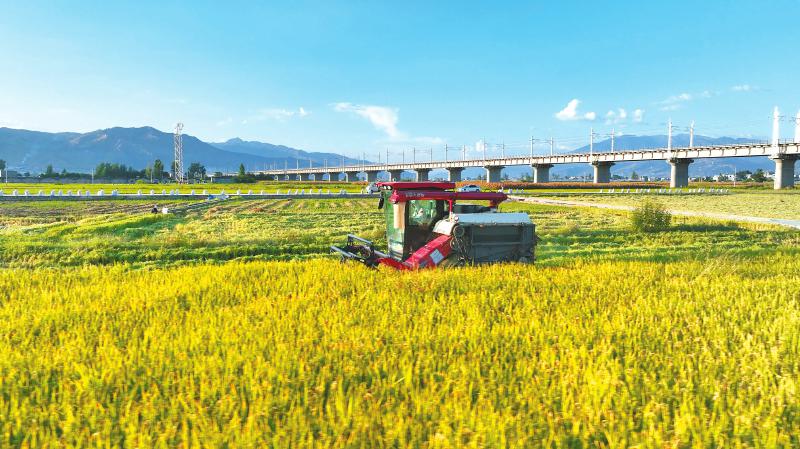
凉山强“粮”技 粮仓添新粮
Si Chuan Ri Bao· 2025-10-14 06:45
Agriculture Production - The total area for the small spring grain planting reached 1.337 million acres, with a total output of 322,600 tons, an increase of 6,400 tons compared to last year, representing a growth of over 2% [4] - The large spring grain planting task of 6.06 million acres has been fully implemented, including 815,000 acres of rice, 2.9 million acres of corn, and 196,200 acres of potatoes [4][5] - In the Anning River Valley, the average yield of the "Luoji Xiang No. 2" rice variety reached 597.19 kg per acre, an increase from 566.05 kg last year, while the hybrid rice "Dian He You 615" achieved a yield of 816 kg per acre [4] Fruit Production - The planting area for pomegranates in Huili reached 400,000 acres, with an annual output of 800,000 tons and a comprehensive annual output value exceeding 7 billion yuan [6][7] - The total area for apples in Yanyuan reached 432,000 acres, with an expected annual output of 750,000 tons and a comprehensive annual output value of 4 billion yuan [7][8] - The promotion of dwarfing and dense planting technology for apples is underway, with plans to complete the transformation and new planting of 80,000 acres within five years [8] Agricultural Development Initiatives - Liangshan has established 16 modern agricultural industrial parks, forming a "5+2+2+N" agricultural industry development system [3] - The region is focusing on enhancing agricultural productivity through policy support, technological empowerment, and project-driven initiatives [4]