
Jin Rong Shi Bao

Search documents
这家银行选举新任董事长!
Jin Rong Shi Bao· 2025-12-08 06:51
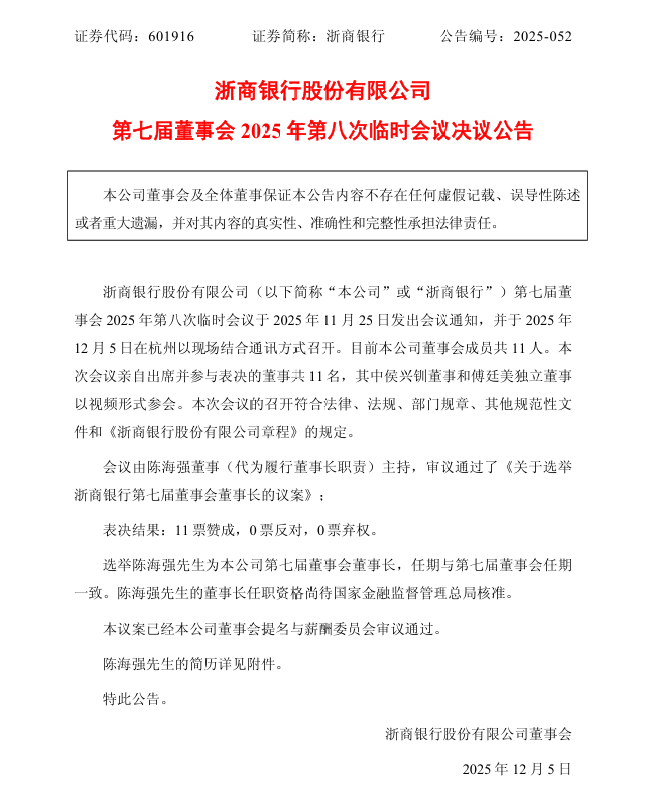
12月5日,浙商银行(601916)发布的公告显示,该行于当天召开第七届董事会2025年第八次临时会 议,会上审议通过了《关于选举浙商银行第七届董事会董事长的议案》。 根据公告,浙商银行选举陈海强为该公司第七届董事会董事长,任期与第七届董事会任期一致。陈海强 的董事长任职资格尚待国家金融监督管理总局核准。 《金融时报》记者注意到,今年7月,陆建强因到龄辞去浙商银行董事长、执行董事等职务。同日,浙 商银行发布了董事会决议公告,由执行董事、行长陈海强代为履行董事长、董事会战略与可持续发展委 员会主任委员及法定代表人职责,直至选举产生新任董事长且其任职资格获国家金融监督管理总局核准 之日止。 11月17日,浙商银行发布了关于提名董事长的提示性公告,根据中共浙江省委决定,陈海强出任浙商银 行党委书记,提名陈海强任浙商银行董事长。 公开资料显示,陈海强于1974年10月出生,曾任国家开发银行杭州分行副主任科员,招商银行宁波北仑 支行行长、宁波分行党委委员、行长助理、副行长,浙商银行宁波分行党委书记、行长,杭州分行党委 书记、行长,浙商银行行长助理,浙商银行党委委员、副行长、首席风险官,浙商银行党委副书记。 根据公告,截 ...


金融业如何抢占绿色新赛道?
Jin Rong Shi Bao· 2025-12-08 05:22
Group 1 - The core issue is how China can leverage financial tools to promote the green transformation of the energy resources sector to achieve its "dual carbon" goals during the critical period of the 14th Five-Year Plan [1][4] - The global energy landscape is undergoing significant restructuring, with the green energy revolution presenting opportunities for China to seize technological and industrial leadership [2] - The "dual carbon" target is expected to generate a massive investment demand ranging from 138 trillion to 500 trillion yuan, indicating vast opportunities for the financial sector to support green projects [2] Group 2 - The National Energy Administration's "2025 Energy Work Guidance" outlines 21 key tasks, providing clear investment guidance for financial institutions to enhance energy security and promote green low-carbon transformation [2] - Challenges persist, including a reliance on fossil fuels and the need for precise financial support to avoid abrupt withdrawal of investments that could disrupt energy supply [2] - There is a pressing need for long-term capital investment in key low-carbon technologies, such as Carbon Capture, Utilization, and Storage (CCUS), to support research and demonstration projects [2] Group 3 - Financial support for the industry transition should focus on precision, innovation, and risk management, with banks encouraged to track international developments in green finance and enhance their professional capabilities [3] - Commercial banks should expand green financing, innovate financial products like green funds and transition bonds, and promote digital transformation in green finance using technologies like IoT and AI [3] - Establishing a robust climate risk identification and management system is essential, including conducting climate risk stress tests to mitigate potential unforeseen events [3] Group 4 - Achieving the "dual carbon" goals in the energy resources sector is a systematic project requiring collaboration among policies, technology, and finance [4] - Financial institutions should seize opportunities for green transformation, improve service systems, and innovate financial tools to support the development of a green, low-carbon, and circular economy [4] - The support from China's financial system will be a crucial driving force for the green transformation of the energy resources sector amid accelerating global climate governance [4]
任正非:AI重在应用 年轻人要勇敢“摸高”
Jin Rong Shi Bao· 2025-12-08 04:20
12月5日,ICPC(即International Collegiate Programming Contest 国际大学生程序设计竞赛)北京总部官 网发布消息,披露了华为技术有限公司董事、CEO任正非11月14日与ICPC主席、教练及获奖选手座谈 会的纪要。 在上海华为练秋湖研发中心贝壳图书馆,任正非阐释了他关于AI的未来、AI人才培养等问题的看法。 人工智能重在应用 "AI重在应用,不重在发明,发明AI只是一家IT公司,应用AI是会强大一个国家。"谈及AI的未来时, 任正非说:"IT公司对人类的贡献就2%,AI在产业上的贡献会占到98%,例如驾驶、矿山开采、炼钢、 水利、玻璃、医疗……,它贡献的价值巨大。所以,人工智能应该是无处不在,如何去应用它,是主要 的课题。" "人工智能促使生产性的进步,这是3、5年后我们就能体会到的。人工智能的发展速度太快,我们公司 研究是着眼在未来3-5年,大模型、大数据、大算力如何在工农业、科技产业上应用,着眼于在大模型 上解决一些在生产与消费中的实际问题。"任正非说,例如要把大模型用在高炉里,通过数据算出炉 温,提前两小时预判铁水硅含量。还可以用在矿山里,让矿工在地面操作机 ...
信托行业再添增资案例
Jin Rong Shi Bao· 2025-12-08 03:35
Core Insights - The trust industry in China is experiencing a significant increase in capital raising activities, with multiple companies announcing plans to boost their registered capital in November 2025 [1][2] Group 1: Capital Raising Activities - Shaanxi International Trust Co., Ltd. announced a plan to raise up to 3.8 billion yuan through a private placement of A-shares, with the funds aimed at supplementing the company's capital [1] - Suzhou Trust has increased its registered capital from 1.2 billion yuan to 3 billion yuan, with the registration change completed on November 18 [1] - By late November 2025, five other trust companies, including Jilin Trust and Northern Trust, have also received regulatory approval for their capital increase plans [1][2] Group 2: Characteristics of Capital Increases - The capital increase trend in 2025 is marked by a shift towards smaller regional trust companies, with all approved increases coming from firms with local state-owned backgrounds [2] - The methods of capital increase are diverse, including cash injections and private placements, as exemplified by Shaanxi International Trust's 3.8 billion yuan plan [2] - There is a notable continuity in capital increases, with Dongguan Trust completing its third increase in four years, highlighting a long-term commitment to enhancing capital strength [2] Group 3: Regulatory and Market Context - Stricter regulatory policies are driving trust companies to bolster their capital, as the 2023 regulations emphasize capital requirements in their core rating modules [3] - The need for business transformation is a key internal driver for capital increases, as the industry faces a concentration of assets among leading firms while many smaller companies struggle [3] - The shift towards high-quality development in the trust industry necessitates a focus on core business areas such as asset service trusts and family trusts, which require stronger capital bases [3][4] Group 4: Competitive Landscape - In a competitive environment where "the strong get stronger," capital strength is crucial for differentiating between leading and smaller trust companies [4] - Leading firms leverage their capital to expand into high-value-added services, while smaller firms seek to improve their regulatory ratings and business scope through capital increases [4] - Future strategies for trust companies should integrate capital supplementation with business structure optimization, professional capability enhancement, and risk management improvements to seize opportunities in industry transformation [4]

激发消费新动能 驱动增长强引擎
Jin Rong Shi Bao· 2025-12-08 03:35
如今,从旗袍、汉服等新中式服饰持续"破圈",到地方特色及文创等国货"潮品"在海外畅销,可以看到 新的消费场景不断刷新人们的体验。而这背后正是我国居民消费结构从生存型向享受型的转变。今年3 月,中共中央办公厅、国务院办公厅印发《提振消费专项行动方案》,提出"深化线上线下 (300959)、商旅文体健多业态消费融合,创新多元化消费场景",未来应以政策引导激发多元活力。 在笔者看来,未来应重点推动"两大融合",一是商旅文体融合,支持各地将体育赛事、非遗体验等纳入 消费场景,推动景区门票经济向"二次消费"转型;二是国货与文化融合,培育一批具有国际竞争力的国 潮品牌,推动"国风消费"从小众潮流走向大众市场。同时要聚焦"银发经济""Z世代消费"等新热点,针 对性完善消费场景设施,精准满足不同群体的个性化、多元化需求。 推动消费提质扩容,不仅需要"能消费"的能力、"敢消费"的底气、"愿消费"的热情,更需要良好消费环 境的支撑,这需要深化改革,把政策和体制机制的"篱笆"扎得更牢,构建让消费者安心、放心的消费生 态。一方面要健全产品服务质量标准体系,强化企业信用约束,探索动态合规监管模式,筑牢消费安全 底线;另一方面要升级消费 ...
转型金融支持资源枯竭型城市高质量发展探析 以吉林省白山市为例
Jin Rong Shi Bao· 2025-12-08 03:35
党的二十大报告指出,推动经济社会发展绿色化、低碳化是实现高质量发展的关键环节。白山市作为吉 林典型资源型城市,依托"一山两江"加快培育绿色产业和战略性新兴产业,2025年上半年,农林牧渔业 总产值增长4.8%、林业产值增长20%,资源型产业升级见效,但经济总量仍居全省末位,"资源富集但 效益转化不足"矛盾突出,面临资源枯竭与环境约束压力。在此背景下,转型金融与绿色金融成为重要 工具。2023年《关于推动转型金融规范发展的指导意见》明确,转型金融支持高碳行业低碳转型、传统 产业升级,与绿色金融互补。对白山市而言,绿色金融守护长白山(603099)生态,转型金融激活特色 产业高附加值潜力。本文以白山市为实证,剖析转型金融支持资源型城市高质量发展的逻辑与梗阻,围 绕"理论辨析—机制解构—问题梳理—路径设计"展开,提供兼具理论性与操作性的参考。 转型金融与绿色金融的联系与区别分析 (一)转型金融与绿色金融的内在联系 一是目标协同:共同服务"双碳目标+经济转型"双任务。二者均以"低碳发展"为核心,且目标均指向两 大核心任务:实现碳达峰碳中和;推动资源依赖型经济向绿色创新型经济转型。二是工具协同:形 成"全产业覆盖"的金 ...
中银香港直接参与 上海清算所利率衍生品集中清算
Jin Rong Shi Bao· 2025-12-08 03:35
Core Viewpoint - Bank of China Hong Kong has successfully participated in direct clearing of interest rate derivatives at the Shanghai Clearing House, enhancing cross-border investment and risk management efficiency [1] Group 1: Business Operations - The recent operations involve direct trading and direct clearing of interest rate derivatives, including RMB interest rate swaps, standard bond forwards, and standard interest rate swap proprietary clearing [1] - The direct clearing model allows transactions completed on the interbank local currency trading platform to be settled directly at the Shanghai Clearing House [1] Group 2: Strategic Positioning - As one of the most globalized Chinese banks, Bank of China leverages its advantages as a global custodian and RMB clearing bank to coordinate domestic and international institutions [1] - The bank actively supports central clearing of interest rate derivatives and financial connectivity innovations, relying on Hong Kong's offshore RMB business hub status [1]

自由贸易账户功能升级 多家银行快速响应
Jin Rong Shi Bao· 2025-12-08 03:32
Core Viewpoint - The implementation of the "Trial Measures for Upgrading the Functions of Free Trade Accounts in the Shanghai Free Trade Pilot Zone" aims to enhance the level of cross-border trade and investment liberalization and facilitation in China [1] Group 1: Policy Implementation - The trial measures were officially implemented on December 5, with participation from major Chinese banks such as ICBC, Agricultural Bank of China, Bank of China, China Construction Bank, and foreign banks like HSBC and Citibank [1] - The Agricultural Bank of China quickly established a dedicated service team to support pilot enterprises in adapting to the new policy and enhancing cross-border financial services [1] Group 2: Key Features of the Policy - The most significant breakthrough of the upgraded free trade account is the transition from "separate account management" to "integrated management of domestic and foreign currencies" [2] - The new policy allows enterprises to complete free conversion and allocation of domestic and foreign currency funds within a unified account management framework, significantly simplifying operational processes [2] - The policy enhances the efficiency of fund utilization, particularly in cross-border fund pool management and cross-border dual-currency fund pools [2] Group 3: Impact on Enterprises - Zhongman Petroleum, a high-tech enterprise in Shanghai, successfully completed its first transaction under the new policy, highlighting the importance of the upgrade in optimizing cross-border fund allocation [2] - The policy is expected to provide financial support for China's high-end engineering technology services and equipment manufacturing to expand globally [2] Group 4: Selection Criteria for Pilot Enterprises - The selection of pilot enterprises focuses on multinational corporate groups, prioritizing those registered in the new area, including state-owned, private, and foreign enterprises [3] - The selection process adheres to strict policy standards, emphasizing overall operational capability, business duration, financial performance, and compliance records [3] Group 5: Foreign Bank Participation - HSBC announced its participation as one of the first foreign banks to open upgraded free trade accounts for multinational enterprises in the Shanghai Free Trade Zone [3] - The new policy is seen as a significant step in China's high-level financial opening, expected to create a multiplier effect for the liberalization and facilitation of cross-border trade and investment [3]






国家医保局发布医保商保“双目录” 19种药品纳入首版商保创新药目录
Jin Rong Shi Bao· 2025-12-08 03:32
Core Insights - The 2025 National Basic Medical Insurance, Maternity Insurance, and Work Injury Insurance Drug Catalog, along with the first version of the Commercial Health Insurance Innovative Drug Catalog, will be officially implemented on January 1, 2026 [1][2] Group 1: National Medical Insurance Drug Catalog - The 2025 update adds 114 new drugs, including 50 innovative drugs, while removing 29 drugs that are either not clinically available or can be replaced by better alternatives [1] - The total number of drugs in the catalog increases to 3,253, comprising 1,857 Western medicines and 1,396 traditional Chinese medicines [1] - New drugs included address significant medical needs, such as treatments for triple-negative breast cancer, pancreatic cancer, lung cancer, rare diseases, and chronic conditions like diabetes and autoimmune diseases [1] Group 2: Commercial Health Insurance Innovative Drug Catalog - The catalog includes 19 drugs from 18 innovative pharmaceutical companies, featuring advanced therapies such as CAR-T, TCE therapies, and bispecific antibodies [2] - The catalog emphasizes three key characteristics: support for innovation, focus on critical areas like Alzheimer's and pediatric rare diseases, and the distinction between basic medical insurance and commercial insurance [2] Group 3: Future Directions - The National Medical Insurance Administration aims to clarify the boundaries of basic medical insurance and promote the complementary development of commercial health insurance, establishing a multi-tiered medical security system [3] - Future policies will be refined to enhance management and ensure the effective implementation of the drug catalogs, ultimately improving the clinical medication needs of insured individuals [3]
以高质量发展规划为引领 迈向现代化强国新征程
Jin Rong Shi Bao· 2025-12-08 02:43
Core Viewpoint - The national development plan is a strategic framework for guiding China's modernization efforts, emphasizing the importance of long-term planning in governance and economic development [1][2][3]. Group 1: National Development Planning - The 20th Central Committee's Fourth Plenary Session emphasized the strategic guiding role of national development planning as a key component of the governance system [1][2]. - The "Suggestions" for the 15th Five-Year Plan provide a top-level design for the next five years, focusing on high-quality development and comprehensive planning [2][9]. - The planning process involves a systematic approach that integrates various levels of governance, ensuring that local and regional plans align with national objectives [6][7]. Group 2: Historical Context and Evolution - Since the founding of New China, the Communist Party has implemented 14 Five-Year Plans, adapting to changing development goals from industrialization to modernization [4][8]. - The transition from "Five-Year Plans" to "Five-Year Planning" marked a significant reform in the planning system, aligning it with the socialist market economy [8][10]. - The 20th National Congress established the goal of building a modern socialist country, requiring three Five-Year Plans to achieve this vision by 2035 [9][10]. Group 3: Strategic Advantages and Challenges - The political leadership of the Communist Party is identified as a fundamental guarantee for the successful formulation and implementation of development plans [5][6]. - The current international landscape presents both opportunities and challenges, with geopolitical tensions and economic uncertainties affecting domestic development [9][10]. - The focus on leveraging China's unique advantages, such as its large market and complete industrial system, is crucial for overcoming obstacles to modernization [10].