Zhong Guo Zi Ran Zi Yuan Bao

Search documents
追问地球之巅 记我国珠峰高程测量历程
Zhong Guo Zi Ran Zi Yuan Bao· 2025-05-30 01:48
Core Viewpoint - The article commemorates the 50th anniversary of China's first accurate measurement of Mount Everest's height, highlighting the achievements in surveying and mapping under the leadership of the Communist Party of China, and the spirit of dedication and hard work among Chinese surveyors [1][2]. Group 1: Historical Context - The first measurement of Mount Everest's height by Chinese surveyors took place on May 27, 1975, marking a significant milestone in the history of global surveying [2][3]. - Prior to 1975, China relied on foreign measurements, using 8882 meters as the height of Everest, which was based on external observations [3][4]. Group 2: Measurement Techniques and Challenges - The 1975 measurement involved a large team of over 400 individuals, including climbers, surveyors, and scientists, who conducted extensive preparatory work at various altitudes [4][5]. - The surveyors faced extreme conditions, including high altitudes and harsh weather, which tested their physical and mental endurance [5][6]. Group 3: Technological Advancements - The article discusses the evolution of surveying technology in China, noting significant advancements in measurement techniques and equipment over the years, particularly leading up to the 2005 and 2020 measurements [8][12]. - The 2020 measurement utilized advanced satellite positioning technology and was conducted in collaboration with Nepal, showcasing China's growing capabilities in surveying and mapping [13][16]. Group 4: Recent Developments - The latest measurement announced in December 2020 confirmed Mount Everest's height as 8848.86 meters, reflecting the continuous efforts and improvements in China's surveying methodologies [16]. - The article emphasizes the importance of these measurements not only for scientific accuracy but also for fostering international cooperation and showcasing China's technological prowess [12][16].
在荆楚大地播撒极地科学火种
Zhong Guo Zi Ran Zi Yuan Bao· 2025-05-29 08:41
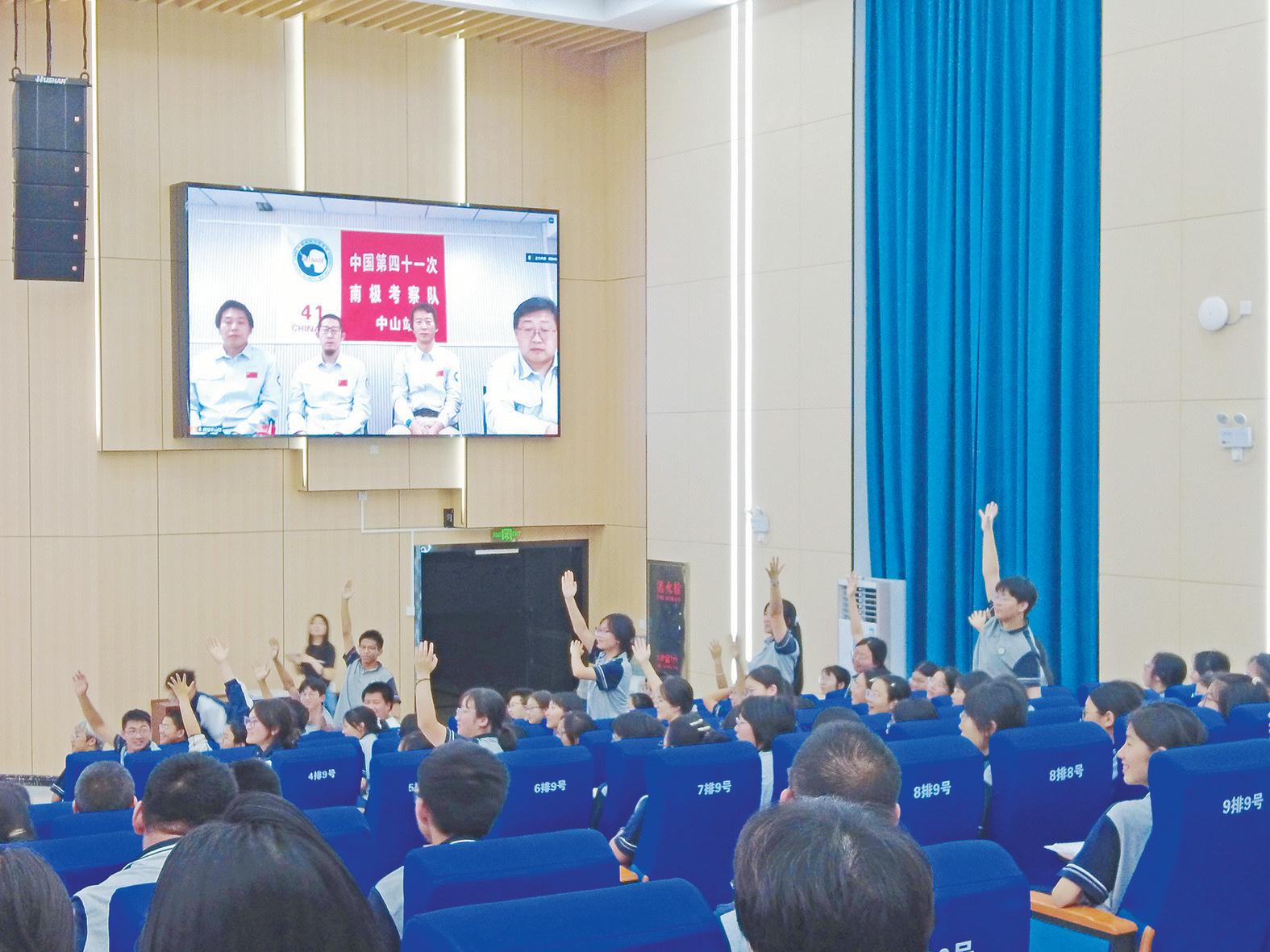
Core Viewpoint - The event "Polar Knowledge into Campus" aims to promote polar science education and inspire interest in polar research among students in Hubei province through lectures and real-time video connections with Antarctic researchers [5][21]. Group 1: Event Overview - The event took place from May 21 to 22, 2025, with the theme "Understanding, Protecting, and Utilizing the Polar Regions" [5]. - It involved experts visiting several schools, including Wuhan University and high schools in Jiangling and Enshi, to deliver lectures and provide polar science books [5][21]. - The initiative was organized by the National Oceanic Administration's Polar Research Office, with participation from various governmental and educational institutions [5]. Group 2: Expert Contributions - Three experts participated: He Fang, Su Duo Wu, and Zhang Sheng Kai, all of whom have extensive experience in polar research [7][14]. - He Fang shared insights on polar space environments and their impact on daily life, emphasizing the need for interdisciplinary collaboration in polar research [12]. - Su Duo Wu discussed gravity measurement in Antarctica, highlighting the challenges faced in extreme conditions and the importance of precise gravity data for earthquake prediction and geological studies [13]. - Zhang Sheng Kai focused on the application of remote sensing in polar research, showcasing the use of China's BeiDou satellite navigation system in enhancing research accuracy [14]. Group 3: Student Engagement - Students actively engaged with experts, asking questions that demonstrated their curiosity and desire to learn about polar science [12][13][14]. - The event included a video link to the Antarctic Zhongshan Station, allowing students to witness real-time conditions and experiences of researchers in extreme environments [16][17]. - The interaction fostered a sense of connection between students and polar research, inspiring them to consider careers in science and exploration [18][22]. Group 4: Impact and Future Aspirations - The event aimed to ignite a passion for science among students, particularly those from rural and less accessible areas [21][22]. - It served as a platform for students to envision their future contributions to scientific research and environmental protection [21][22]. - The organizers expressed hope that such initiatives would encourage more youth to pursue careers in polar science and environmental stewardship [22].

“保障专员是企业贴心人”
Zhong Guo Zi Ran Zi Yuan Bao· 2025-05-29 08:41
Group 1 - The Jiangsu Guoxin Binhai Port 2×1000 MW efficient clean coal power generation project has been fully completed and put into operation with a total investment of approximately 8.8 billion yuan [1] - The project is a key energy supply project for the province during the 14th Five-Year Plan, facing complex historical issues regarding sea usage and requiring adjustments to accommodate new projects [1][2] - The Jiangsu Provincial Marine Law Enforcement Supervision Center played a crucial role in facilitating the project by addressing historical illegal sea usage issues and expediting the sea usage change process [2] Group 2 - The center implemented a major project sea usage service guarantee mechanism, coordinating efforts to resolve historical illegal sea usage problems and accelerating the completion of sea usage changes [2] - Over several months, the center conducted multiple site visits and meetings to ensure timely progress, resulting in the successful adjustment of the sea usage range and the project's advancement to the sea usage approval stage [2] - The project achieved a record for the fastest construction of similar units in the country, with the fourth unit completing a 168-hour full-load trial run on April 15 [2]
林业“标准地”,“浙”里如何建?
Zhong Guo Zi Ran Zi Yuan Bao· 2025-05-29 03:47
近日,浙江省林业局印发《浙江省关于开展林业"标准地"建设的指导意见》(以下简称《意见》),提 出通过深化集体林权制度改革,重塑林业用地"双向供给"模式,促进林地资源高效利用,提高亩均产出 效益,带动村集体和农民收入持续增加。 对于如何建设林业"标准地",《意见》要求科学合理选地、推动连片流转、规范主体招引、加强基础建 设、强化监管服务。各类经营主体要根据实际需求设置林业"标准地"项目主体招引指标区间,公开发布 林业"标准地"信息,积极开展招引工作。招引单位负责对报名的意向主体进行审查、对接工作。林 业"标准地"依法取得者与招引单位签订集体林权流转合同和投资建设协议,约定控制性指标。 《意见》综合考量林业功能定位、经营方式和市场需求等情况,设置了林业"标准地"的基础指标、招引 指标、经济指标和共富指标等准入条件,构建了推动林业高质量发展的林业"标准地"控制性指标体系, 促进林业生产要素高效配置、顺畅流动,形成与绿色生产力相适应的林业新型生产关系,让集体林业链 真正循环起来,进一步提升林业的综合效益。 《意见》明确,林业"标准地"是依托林业资源,在尊重农民意愿、保障农民利益且林地规模化流转的基 础上,设置控制性指 ...
湖南明确今年地灾防治6项重点任务
Zhong Guo Zi Ran Zi Yuan Bao· 2025-05-29 01:43
Core Viewpoint - The Hunan Provincial Natural Resources Department has issued the "2025 Geological Disaster Prevention Plan," outlining the goals, main tasks, and prevention measures for geological disaster management in the province for the current year [1] Group 1: Overall Situation - The overall situation of geological disaster prevention in Hunan is severe, with disasters likely to occur during the flood season [1] - Key areas for disaster prevention include northern Hunan, which is at risk from continuous rainfall, and southern and eastern regions, which need to guard against typhoons and heavy rain [1] Group 2: Key Tasks - The plan outlines six key tasks, including the establishment of a comprehensive disaster prevention system focused on risk control to minimize disaster losses [2] - It emphasizes the need for updated surveys of disaster risk points and areas, along with the development of categorized risk control measures [2] - The plan calls for the enhancement of the disaster monitoring network and the construction of additional meteorological stations to improve early warning capabilities [2] - It includes the implementation of micro-governance for 3,000 disaster risk points and significant engineering projects for 20 critical disaster areas [2] - The plan highlights the importance of technological advancements in disaster prevention, including the development of an AI model for precise disaster warnings [2] - It aims to establish a dual control system for disaster risk management, clarifying responsibilities and improving regulatory mechanisms [2] Group 3: High-Risk Areas - The plan identifies 53 counties and districts as high-risk areas for landslides, collapses, and mudslides, and 27 areas for ground subsidence [3] - It emphasizes the need to focus on registered disaster risk points in high, medium, and low-risk areas, particularly in rural housing and densely populated locations such as schools and hospitals [3] - The plan calls for enhanced prevention efforts in areas prone to extreme rainfall, including new disaster risk points and critical infrastructure like transportation and water conservancy projects [3]
自然资源部调研组:长三角示范区生态保护修复一体化的探索与启示
Zhong Guo Zi Ran Zi Yuan Bao· 2025-05-28 06:47
Core Viewpoint - The integration of the Yangtze River Delta is a significant strategy personally planned and promoted by President Xi Jinping, with the Yangtze River Delta Ecological Green Integrated Development Demonstration Zone serving as a crucial tool for implementing this strategy [1][3]. Group 1: Institutional Innovation and Collaboration - The demonstration zone has created replicable and promotable experiences in ecological protection and restoration, achieving a model of co-consultation, co-management, co-construction, sharing, and win-win outcomes [3][17]. - Over five years, 52 institutional innovation results have been promoted nationwide, showing significant achievements in collaborative governance, spatial planning, and green innovation development [7][17]. - A "Council + Executive Committee" governance model has been established, breaking down regional barriers and enhancing cross-regional cooperation in ecological protection [9][17]. Group 2: Spatial Planning and Land Management - The Yangtze River Delta Ecological Green Integrated Development Demonstration Zone's spatial planning covers an area of approximately 2,413 square kilometers, with a unified control system for land use and ecological protection [10][24]. - The overall planning aims to achieve "negative growth" in construction land, reducing the planned construction land area by 15.7 square kilometers, promoting a transformation in urban development models [10][11]. - The region has been designated as a pilot for comprehensive land remediation, ensuring no reduction in arable land while improving quality and ecological conditions [11][12]. Group 3: Ecological Restoration and Environmental Protection - The demonstration zone has implemented a unified ecological environment protection system, enhancing cross-border ecological system management, particularly in the Yuan Lake area [13][14]. - The collaborative governance of the Tai Pu River has led to significant improvements in water quality, with the river's ecological environment being restored through joint efforts [22]. - The establishment of a unified ecological environment quality assessment mechanism has addressed the challenges of fragmented governance in cross-border river basins [14][19]. Group 4: Economic Development and Innovation - The region is positioning itself as a world-class ecological and livable destination, with significant investments in high-tech industries, including Huawei's research center [15][24]. - The number of specialized and innovative enterprises has increased from 248 to 1,294 since 2019, indicating a growing vitality in innovation and development [15]. - The integration of ecological tourism and cultural resources is being leveraged to enhance economic development in the region [14][25]. Group 5: Data-Driven Governance - A unified spatial data foundation has been established to support integrated governance, enhancing decision-making and management capabilities [26][28]. - The launch of a cross-provincial "smart brain" platform facilitates data sharing and supports various sectors, including environmental protection and urban planning [27][28]. - The platform enables real-time monitoring and management of ecological indicators, contributing to the overall quality of development in the demonstration zone [28].

去年全国非油气地质勘查投入超二百二十九亿元 连续四年实现正增长
Zhong Guo Zi Ran Zi Yuan Bao· 2025-05-28 02:53
Core Insights - The 2024 National Non-Oil and Gas Geological Exploration Statistical Annual Report indicates a total investment of 22.957 billion yuan in geological exploration, marking a 14.4% year-on-year increase and achieving positive growth for four consecutive years [1] Investment Sources - Central government funding amounts to 5.901 billion yuan, accounting for 25.7% of the total, with a year-on-year increase of 27.7% - Local government funding totals 9.201 billion yuan, representing 40.1% of the total, with an 8.2% year-on-year increase - Social funding reaches 7.855 billion yuan, making up 34.2% of the total, with a 13.1% year-on-year increase [1] Investment Allocation - Mineral exploration receives 13.917 billion yuan, which is 60.6% of the total, with an 18.4% year-on-year increase - Basic geological surveys are allocated 2.656 billion yuan, accounting for 11.6% of the total, with a 19.5% year-on-year increase - Hydrological, environmental geological, and geological disaster evaluation and assessment receive 4.122 billion yuan, representing 17.9% of the total, with a 7.6% year-on-year increase [1] Regional Investment - The top five provinces for funding are Xinjiang, Inner Mongolia, Sichuan, Gansu, and Yunnan [1] Mineral Exploration Projects - A total of 4,068 mineral exploration projects are planned for 2024, reflecting a 7.3% year-on-year increase - The drilling workload is expected to reach 10.19 million meters, which is a 12.5% year-on-year increase [1] Exploration Rights and Areas - As of the end of 2024, there are 11,681 valid non-oil exploration rights, a 3.8% increase from the end of 2023 - The registered exploration area is 134,100 square kilometers, up 7.2% from the previous year - In 2024, 518 new non-oil exploration rights were registered, covering an area of 6,745.6 square kilometers [2] New Mineral Discoveries - In 2024, 150 new mineral sites were discovered, including 49 large, 54 medium, and 47 small sites - The top five mineral types discovered are construction granite, ordinary fluorite, lithium ore, gold, and iron ore [2] Geological Technology Advances - The first domestically designed and built deep-sea drilling vessel, "Dream," has been officially commissioned - Advances include the theoretical technology system for exploring hidden super-large eruptive sedimentary manganese ore and new discoveries of magma carbonate rocks and high-value rare earth mineralization belts in Inner Mongolia [2]
法治看点|“两高”关于破坏黑土地资源刑事案件司法解释重点内容解析
Zhong Guo Zi Ran Zi Yuan Bao· 2025-05-28 02:24
黑土地作为耕地中的"大熊猫",是保障国家粮食安全的重要资源。我国东北黑土区是北半球仅有的 三大黑土区之一,在粮食生产和生态屏障方面发挥着关键作用。然而,近年来,盗挖、滥挖、污染黑土 地等违法行为屡禁不止,严重威胁黑土地的可持续利用。2022年出台的黑土地保护法为黑土地的可持续 利用和保护提供了坚强的法治保障。为严厉打击破坏黑土地犯罪,加强黑土地保护,"两高"发布了《最 高人民法院 最高人民检察院关于办理破坏黑土地资源刑事案件适用法律若干问题的解释》(以下简称 《解释》)。《解释》的出台,为自然资源执法相关工作提供了更为明确的法律依据和指导,对有效遏 制破坏黑土地行为意义重大。 01 《解释》主要内容解析及对自然资源执法实践的指导作用 一是细化行为认定标准,织密违法犯罪法网。《解释》第一条以列举加兜底的方式,将非法占用黑 土地用于建房、建窑等工程建设、挖砂采石等资源开采,以及违规排放污染物、堆放废弃物导致黑土地 严重污染等行为,明确界定为非法占用耕地、改变用途并造成毁坏。这一规定兼顾了传统法律表述,又 将近年来出现的挖湖造景等新型破坏方式纳入规制范畴,构建起覆盖工程建设、资源开采、污染排放等 多领域、多角度的认 ...
法治时评|“降”入罪门槛“升”责罚力度
Zhong Guo Zi Ran Zi Yuan Bao· 2025-05-28 02:24
细读黑土地保护法,出现了3次"从重处罚"。第三十一条规定,违法将黑土地用于非农建设"从重处 罚";第三十二条规定,盗挖、滥挖黑土"从重处罚";第三十五条规定,造成黑土地污染、水土流失"从 重处罚"。这3个条款分别针对违法占用、盗挖滥挖、污染流失等破坏黑土地资源的3种严重情形,提出 了从重处罚的原则性规定。至于如何"从重","两高"的司法解释作了细化规定。总体来说,依据刑法第 三百三十八条、第三百四十二条、第三百四十三条等法条,入罪门槛进一步降低,责罚力度进一步升 档。最高法、最高检、公安部相关部门负责人在解读司法解释、发布有关典型案例时,也用3个"严 惩"再次表明了态度:严惩盗挖、滥挖,严惩以合法形式掩盖盗挖泥炭土行为,严惩污染黑土地犯罪行 为。 就违法占地而言,"两高"的司法解释调低了非法占用农用地罪的入罪面积标准;就计算方式而言, 破坏黑土的体积也成为入罪要件。此外,根据司法解释,既打击盗采黑土的上游,也打击窝藏、转移、 收购、代为销售的下游,事前通谋的则以共同犯罪论处;对非法开采属于矿产资源黑土的,以非法采矿 罪定罪论处;对排放、倾倒或者处置有毒有害废物、物质而严重污染黑土地的,以污染环境罪定罪处 罚; ...
以科创之力守护自然资源——浙江省地矿科技有限公司科创成果巡礼与展望
Zhong Guo Zi Ran Zi Yuan Bao· 2025-05-28 01:56
Core Viewpoint - Zhejiang Geological Technology Co., Ltd. (Zhejiang Geotech) is a comprehensive technology enterprise focusing on natural resources, emphasizing technological innovation and high-quality development through various research and service projects [11][12][24]. Company Overview - Zhejiang Geotech, headquartered in Hangzhou, is a subsidiary of Zhejiang Provincial Natural Resources Group, with seven secondary companies and 13 operational departments [11]. - The company engages in a wide range of services including geological disaster research, mineral resource exploration, geographic information services, and environmental monitoring [11][12]. Technological Innovation - In 2024, the company aims to enhance technological innovation by integrating resources and building innovation platforms, having established 13 innovation platforms including the National High-tech Enterprise and National Technology-based SMEs [14]. - The company is involved in multiple national and provincial projects, focusing on geological disaster prevention, ecological restoration, and carbon sink economy [15]. Research and Development Achievements - In 2024, the company invested over 13.54 million in technological innovation, with a 27.17% increase in R&D funding, resulting in 2 invention patents, 15 utility model patents, and 38 published papers [16]. - The company has received various awards, including 12 quality engineering awards at provincial and national levels [16]. Social Responsibility - The company actively participates in ecological civilization initiatives, contributing to the application for international wetland city status and conducting environmental monitoring projects [18]. - In 2024, it provided over 4,000 free gem identification services and conducted numerous public awareness campaigns on disaster prevention [22]. Future Development Plans - Zhejiang Geotech plans to strengthen its core business and competitive advantages, focusing on specialized and innovative development paths in areas like land remediation and marine geology [24][25]. - The company aims to become a leading comprehensive high-tech enterprise, contributing to China's modernization efforts [25].