
Guo Jia Tong Ji Ju

Search documents
国家统计局:1—11月份计算机、通信和其他电子设备制造业利润同比增长15.0%
Guo Jia Tong Ji Ju· 2025-12-27 01:41
Core Insights - The National Bureau of Statistics reported profit changes across various industries from January to November, highlighting significant growth in several sectors while others faced declines [1] Industry Performance Summary - The computer, communication, and other electronic equipment manufacturing industry saw a profit increase of 15.0% year-on-year [1] - The electricity and heat production and supply industry experienced a profit growth of 11.8% [1] - The non-ferrous metal smelting and rolling processing industry reported an 11.1% increase in profits [1] - The automobile manufacturing industry achieved a profit growth of 7.5% [1] - The agricultural and sideline food processing industry grew by 4.8% [1] - The general equipment manufacturing industry also saw a profit increase of 4.8% [1] - The specialized equipment manufacturing industry reported a profit growth of 4.6% [1] - The electrical machinery and equipment manufacturing industry experienced a 4.2% profit increase [1] - The petroleum, coal, and other fuel processing industry reduced its losses year-on-year [1] - The non-metallic mineral products industry faced a decline of 4.6% [1] - The chemical raw materials and chemical products manufacturing industry saw a decrease of 6.9% [1] - The textile industry reported a decline of 8.2% [1] - The oil and gas extraction industry experienced a significant decline of 13.6% [1] - The coal mining and washing industry faced a drastic decline of 47.3% [1]
国家统计局:1—11月份制造业实现利润总额50317.9亿元 增长5.0%
Guo Jia Tong Ji Ju· 2025-12-27 01:40
Group 1 - The mining industry reported a total profit of 789.63 billion yuan from January to November, representing a year-on-year decline of 27.2% [1] - The manufacturing sector achieved a total profit of 5,031.79 billion yuan, showing a year-on-year growth of 5.0% [1] - The electricity, heat, gas, and water production and supply industry realized a total profit of 805.44 billion yuan, with a year-on-year increase of 8.4% [1]
国家统计局:1—11月份规模以上工业企业利润保持增长
Guo Jia Tong Ji Ju· 2025-12-27 01:38
1—11月份规模以上工业企业利润保持增长 装备制造业利润带动作用明显。1—11月份,规模以上装备制造业利润同比增长7.7%,拉动全部规模以 上工业企业利润增长2.8个百分点,是对规模以上工业企业利润增长拉动作用最强的板块。从行业看, 装备制造业的8个大类行业中有7个行业利润实现同比增长,其中,铁路船舶航空航天、电子行业利润两 位数增长,增速分别达27.8%、15.0%;汽车行业利润增长7.5%,较1—10月份加快3.1个百分点;通用设 备、专用设备、电气机械行业利润继续增长,增速分别为4.8%、4.6%、4.2%。 高技术制造业利润增速加快。1—11月份,规模以上高技术制造业利润同比增长10.0%,较1—10月份加 快2.0个百分点,增速高于全部规模以上工业平均水平9.9个百分点。从行业看,"人工智能+"行动深入实 施带动相关设备制造行业利润向好,电子工业专用设备制造行业利润同比增长57.4%,其中半导体器件 专用设备制造、电子元器件与机电组件设备制造行业利润分别增长97.2%、46.0%;航空航天产业快速 发展推动行业利润增长较快,航空、航天器及设备制造行业利润同比增长13.3%,其中航天相关设备制 造、航 ...
2025年1-11月份全国规模以上工业企业利润增长0.1%
Guo Jia Tong Ji Ju· 2025-12-27 01:35
11月末,规模以上工业企业应收账款28.40万亿元,同比增长5.5%;产成品存货6.92万亿元,增长 4.6%。 1—11月份,规模以上工业企业每百元营业收入中的成本为85.50元,同比增加0.18元;每百元营业收入 中的费用为8.39元,同比减少0.06元。 11月末,规模以上工业企业每百元资产实现的营业收入为74.4元,同比减少2.4元;人均营业收入为 186.5万元,同比增加5.7万元;产成品存货周转天数为20.5天,同比增加0.6天;应收账款平均回收期为 70.4天,同比增加3.7天。 11月份,规模以上工业企业利润同比下降13.1%。 1—11月份,全国规模以上工业企业实现利润总额66268.6亿元,同比增长0.1%(按可比口径计算,详见 附注二)。 1—11月份,规模以上工业企业中,国有控股企业实现利润总额20083.6亿元,同比下降1.6%;股份制企 业实现利润总额49565.6亿元,下降0.4%;外商及港澳台投资企业实现利润总额16355.3亿元,增长 2.4%;私营企业实现利润总额19319.9亿元,下降0.1%。 1—11月份,采矿业实现利润总额7896.3亿元,同比下降27.2%;制造业 ...
var title1 = '2025年1—11月份全国规模以上工业企业利润增长0.1%'; var title2 = ''; var title3 = '';
Guo Jia Tong Ji Ju· 2025-12-27 01:35
1—11月份,全国规模以上工业企业实现利润总额66268.6亿元,同比增长0.1%(按可比口径计算,详见 附注二)。 1—11月份,规模以上工业企业中,国有控股企业实现利润总额20083.6亿元,同比下降1.6%;股份制企 业实现利润总额49565.6亿元,下降0.4%;外商及港澳台投资企业实现利润总额16355.3亿元,增长 2.4%;私营企业实现利润总额19319.9亿元,下降0.1%。 1—11月份,采矿业实现利润总额7896.3亿元,同比下降27.2%;制造业实现利润总额50317.9亿元,增 长5.0%;电力、热力、燃气及水生产和供应业实现利润总额8054.4亿元,增长8.4%。 1—11月份,主要行业利润情况如下:计算机、通信和其他电子设备制造业利润同比增长15.0%,电 力、热力生产和供应业增长11.8%,有色金属冶炼和压延加工业增长11.1%,汽车制造业增长7.5%,农 副食品加工业增长4.8%,通用设备制造业增长4.8%,专用设备制造业增长4.6%,电气机械和器材制造 业增长4.2%,石油、煤炭及其他燃料加工业同比减亏,非金属矿物制品业下降4.6%,化学原料和化学 制品制造业下降6.9%,纺 ...

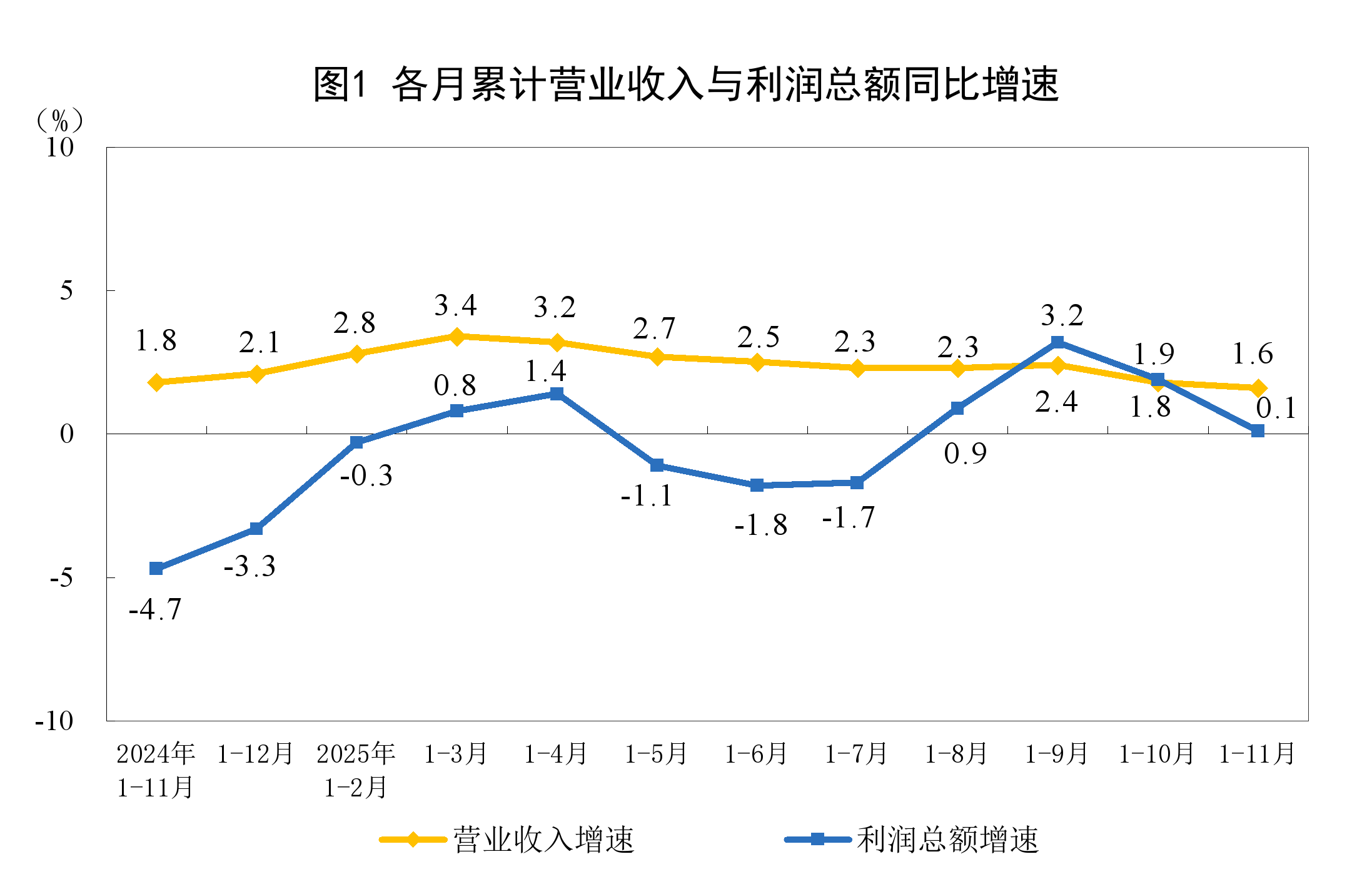
国家统计局:2025年1—11月份全国规模以上工业企业利润增长0.1%
Guo Jia Tong Ji Ju· 2025-12-27 01:31
Core Insights - The National Bureau of Statistics reported that the profits of large-scale industrial enterprises in the country increased by 0.1% from January to November 2025 [1] Group 1 - The profit growth of 0.1% indicates a stagnation in profit levels for large-scale industrial enterprises [1]
2026年国家统计局主要统计信息发布日程表
Guo Jia Tong Ji Ju· 2025-12-26 09:37
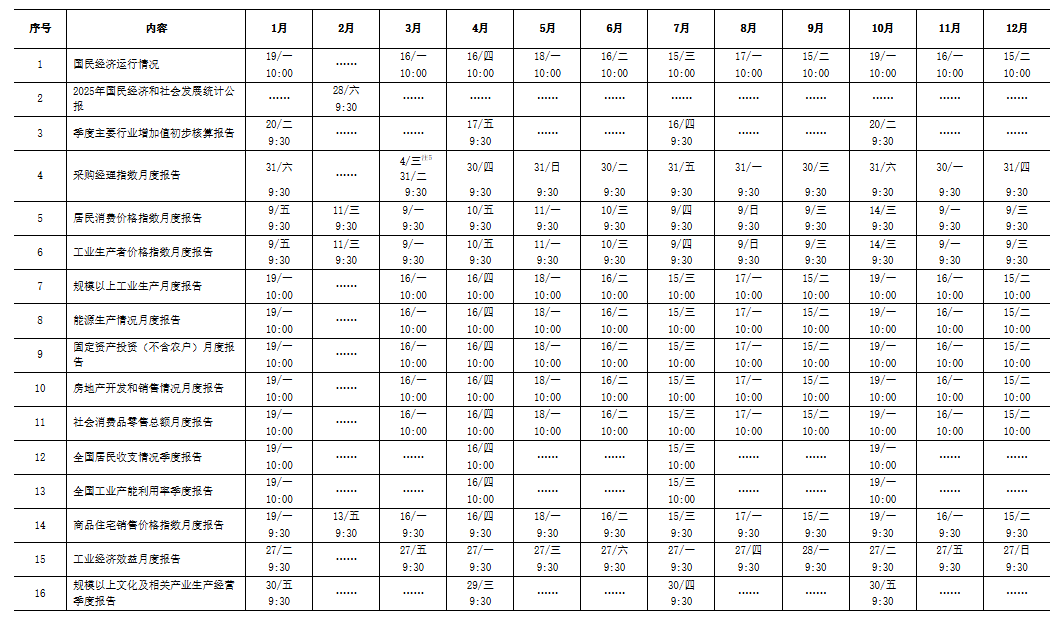
2026年国家统计局主要统计信息发布日程表。 | 序号 | 内容 | 1月 | 2月 | 3月 | 4月 | 5月 | 6月 | 7月 | 9月 | 11月 | 12月 | 8月 | 10月 | | | | | | | | | | | | | | --- | --- | --- | --- | --- | --- | --- | --- | --- | --- | --- | --- | --- | --- | --- | --- | --- | --- | --- | --- | --- | --- | --- | --- | --- | --- | | 19/- | 16/- | 16/ 16 | 18/- | 16/二 | 15/三 | 17/- | 15/ 二 | 19/- | 16/- | 15/二 | 国民经济运行情况 | 1 | | 10:00 | 10:00 | 10:00 | 10:00 | 10:00 | 10:00 | 10:00 | 10:00 | 10:00 | 10:00 | 10:00 | | | 2025年国民经济和社会发展统计公 | 28/六 | 2 | ****** | * ...
var title1 = '加速构建协同发展格局'; var title2 = '2024年京津冀区域协同发展指数继续提升'; var title3 = '';
Guo Jia Tong Ji Ju· 2025-12-26 08:37
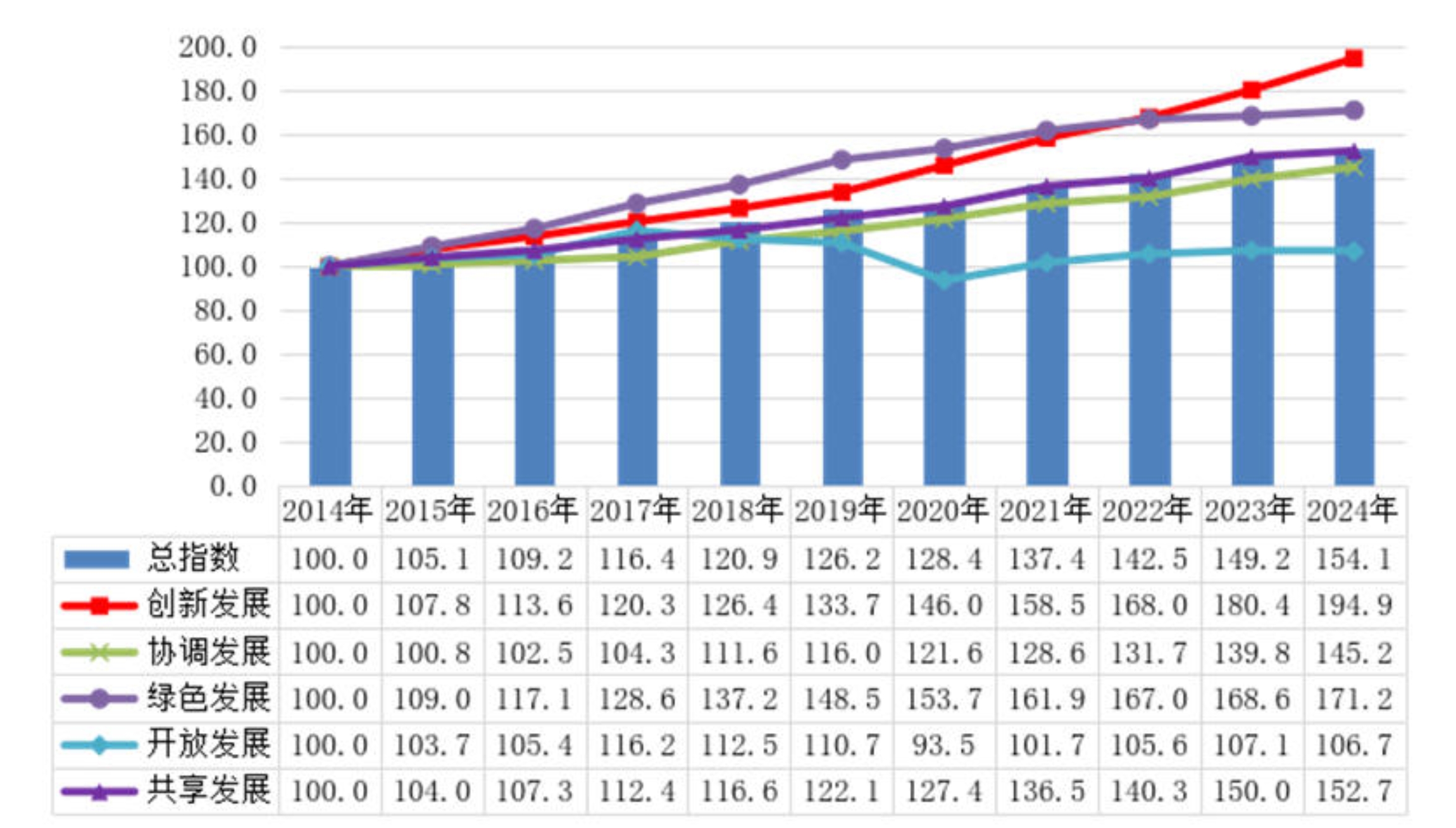
Core Insights - The article highlights the progress and achievements in the coordinated development of the Beijing-Tianjin-Hebei region, emphasizing innovation, coordination, green development, openness, and shared growth as key areas of focus for 2024 [2][3]. Innovation Development - The innovation development index reached 194.9, an increase of 14.5 from 2023, indicating significant growth in innovation input and output [3]. - The region's R&D expenditure intensity was 4.22%, with Beijing leading at 6.58%, showcasing its strong original innovation capabilities [3]. - The number of patents granted reached 355,000, a 2.9% increase, with the number of effective invention patents per ten thousand people growing by 15.7% to 74.3 [3][4]. Coordination Development - The coordination development index improved to 145.2, up by 5.4 from the previous year, reflecting enhanced cross-regional industrial collaboration [5]. - The added value of high-tech manufacturing industries grew by 9.6%, 8.9%, and 11.2% in Beijing, Tianjin, and Hebei, respectively [5]. - Urbanization rate in the region reached 71.2%, with a reduction in the income disparity between urban and rural residents to 2.51 [5]. Green Development - The green development index increased to 171.2, a rise of 2.6, indicating ongoing improvements in ecological conditions [6]. - Average PM2.5 concentrations decreased to 30.5 µg/m³ in Beijing, 38.1 µg/m³ in Tianjin, and 37.7 µg/m³ in Hebei, with respective reductions of 4.7%, 8.0%, and 2.3% [6]. - The proportion of water quality at or above Class III in national surface water monitoring points reached 82.6%, an increase of 2.2 percentage points [6]. Open Development - The open development index slightly declined to 106.7, down by 0.4, amid global trade challenges [8]. - The total import and export value for the region was 5.03 trillion yuan, a 0.1% increase, with high-tech product exports growing significantly [8]. - International cargo throughput reached 820 million tons, a 10.6% increase, and international passenger throughput saw a substantial recovery [8]. Shared Development - The shared development index rose to 152.7, an increase of 2.7, reflecting improvements in public services and infrastructure [9]. - The operational mileage of railways and highways exceeded 11,000 kilometers, facilitating better connectivity within the region [9]. - Per capita disposable income for residents in the region increased nominally by 4.5%, 4.5%, and 5.4% in Beijing, Tianjin, and Hebei, respectively [9].
var title1 = '2024年长三角区域发展指数稳步提升'; var title2 = '区域高质量发展行稳致远'; var title3 = '';
Guo Jia Tong Ji Ju· 2025-12-26 08:37
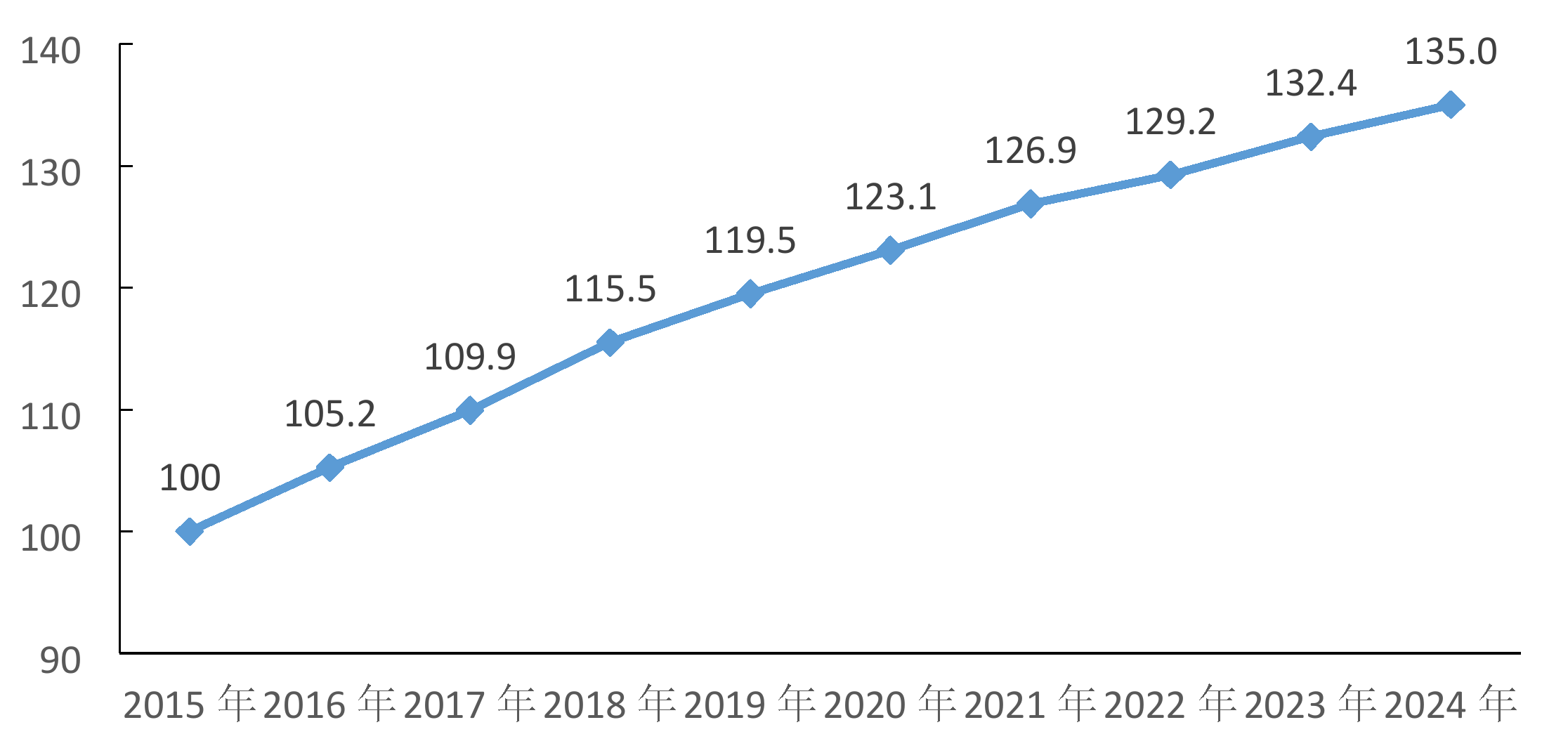
Core Insights - The Yangtze River Delta (YRD) region is solidifying its role as a strong growth engine and a model for high-quality development, with significant advancements in technological and industrial innovation, high-level openness, ecological protection, and improved public welfare in 2024 [1] Economic Development - The YRD's economic demonstration index increased to 129.8 in 2024, reflecting a 2.4 increase from 2023 and an average annual increase of 2.3 since 2018 [2] - The region's GDP reached 33.17 trillion yuan, 1.5 times that of 2018, accounting for 24.7% of the national total, a slight increase of 0.1 percentage points from 2023 [2] Innovation and R&D - The innovation co-construction index rose to 160.6 in 2024, an increase of 8.2 from 2023, with an average annual growth of 6.4 since 2018 [3] - R&D investment in the region reached 1.12 trillion yuan, a 10.5% increase from 2023, representing 30.9% of the national total [3] - The number of new invention patents reached nearly 300,000, with a per capita rate of over 12 patents, 1.6 times that of 2018 [3] Infrastructure and Coordination - The coordination index remained stable at 131.0 in 2024, with an average annual increase of 4.4 since 2018 [4] - The region's railway operating mileage exceeded 15,000 kilometers, a 43.6% increase since 2018, with high-speed rail accounting for over half of the total [4] Environmental Protection - The green co-protection index reached 163.8 in 2024, up 6.3 from 2023, with an average annual increase of 5.6 since 2018 [5] - The average proportion of good air quality days in 41 cities was 84.5%, a 0.8 percentage point increase from 2023 [5] Trade and Openness - The openness index was 106.6 in 2024, with the region's total import and export volume exceeding 16 trillion yuan, accounting for 36.5% of the national total [7] - The region's foreign direct investment share increased from 43.9% in 2023 to 46.3% in 2024, despite a 23.3% year-on-year decline in actual foreign investment [7] Public Welfare and Services - The public welfare index grew to 130.4 in 2024, a 0.9 increase from 2023, with an average annual increase of 3.1 since 2018 [8] - The average disposable income per capita reached 57,137 yuan, a nominal increase of 5.2% year-on-year [8]
2025年全国棉花产量实现增长 ——国家统计局农村司司长魏锋华解读棉花生产情况
Guo Jia Tong Ji Ju· 2025-12-26 08:02
Core Insights - The national cotton planting area in China for 2025 is projected to be 44.687 million acres, an increase of 2.113 million acres or 5.0% from the previous year [1] - The average yield per acre is expected to be 148.6 kg, up by 3.8 kg or 2.6% year-on-year, marking six consecutive years of growth [1] - Total cotton production is forecasted to reach 6.641 million tons, an increase of 477,000 tons or 7.7% compared to last year [2] Group 1: Cotton Planting Area - The cotton planting area in Xinjiang is 38.875 million acres, an increase of 2.156 million acres or 5.9% from the previous year, making it the primary cotton production region in China [1] - Other cotton-producing regions, such as the Yangtze River and Yellow River basins, are experiencing a decline in planting area due to lower comparative benefits and adjustments in planting structure [1] Group 2: Cotton Yield - The yield in Xinjiang is projected to be 158.6 kg per acre, an increase of 3.7 kg or 2.4% year-on-year, supported by favorable weather conditions and improved agricultural practices [1] - The Yangtze River basin's yield is expected to be 74.0 kg per acre, an increase of 0.8 kg or 1.1%, while the Yellow River basin's yield is forecasted to be 82.7 kg per acre, a decrease of 1.0 kg or 1.2% due to adverse weather during the harvest period [1] Group 3: Cotton Production - Xinjiang's cotton production is expected to reach 6.165 million tons, an increase of 479,000 tons or 8.4% from the previous year [2] - Cotton production in the Yangtze River basin is projected to be 220,000 tons, a decrease of 2,000 tons or 0.7%, while the Yellow River basin's production is expected to be 203,000 tons, a decrease of 3,000 tons or 1.5% [2]