WitsView睿智显示

Search documents
6月电视面板价格下调,笔电面板需求乐观
WitsView睿智显示· 2025-06-20 18:12
Group 1: TV Panel Market - The demand for TV panels has shown a clear weakening trend since June, with brands adopting a more conservative purchasing attitude due to unclear terminal demand in the second half of the year and rising inventory levels [2][3] - Some brand clients have begun to request special pricing or MDF from panel manufacturers, who are showing slight flexibility in pricing due to the evident decrease in demand [3] - Price forecasts for June indicate a decline of $1 for 43-inch, 50-inch, and 55-inch panels, while 65-inch and 75-inch panels are expected to drop by $1 to $2 [3] Group 2: Monitor Panel Market - The demand for monitor panels has peaked, with brand clients showing signs of adjusting their orders, influenced by the weakening demand for TV panels [4] - Despite panel manufacturers hoping for slight price increases, most brand clients are resistant to continued price hikes in June, leading to an expectation of stable prices for monitor panels [4] Group 3: Laptop Panel Market - Brands are becoming more optimistic about the demand for laptop panels in the second half of the year, leading to an increase in orders [5] - The pricing trend for laptop panels is expected to remain stable, although there are emerging issues with memory shortages and significant price increases that could impact future order placements by brand clients [6]

夏普推出A2尺寸ePoster彩色电子纸显示屏
WitsView睿智显示· 2025-06-20 09:05
6月19日, 夏普公司宣布推出全新A2尺寸彩色电子纸显示器ePoster 系列 EP-CA22。 图片来源: 夏普 EP-CA22搭载由元太科技开发的最新电子纸平台 Spectra™ 62。通过融合夏普独有的色彩再现 与图像处理技术,ePoster实现了鲜艳的彩色显示与平滑的渐变过渡,文字亦可清晰地呈现。 因 此, ePoster适用于商业、公共场所的广告和信息展示、餐饮店菜单牌等多种用途。 #夏普 #电子纸 EP-CA22 分辨率高达2160 × 3060像素,像素间距为0.194毫米,能清晰呈现图像与文字。 在输入接口方面,该设备配备了两个USB Type-C端口,一个用于数据传输及供电,另一个仅用 于供电。 其 内建16GB存储空间,其中14GB为可用容量,方便用户存储大量静态内容。 ▶ 关于集邦 网络连接方面,EP-CA22支持IEEE802.11 a/b/g/n/ac标准的无线局域网(Wi-Fi),同时兼容 蓝牙5.2,支持GAP与SPP两种通信协议,具备良好的无线数据传输能力。 在电源设计方面,EP-CA22使用专用的AC适配器,支持AC100V、50/60Hz电源输入,并转换 为9V直流电输出。 ...

韩媒:苹果iPad Pro的OLED DDI供应链新增一家企业
WitsView睿智显示· 2025-06-20 09:05
Core Viewpoint - LX Semicon has successfully entered the OLED DDI supply chain for Apple's iPad Pro, indicating a strategic move to diversify its sales channels amid increasing competition and performance pressure from LG Display's supply chain diversification [1][3]. Group 1: Company Overview - LX Semicon specializes in the design and development of display driver chips (DDI), power management chips (PMIC), and timing controllers (T-Con) [1]. - The company was formerly part of LG Group and became independent in 2021, leveraging its long-term partnership with LG Display for continuous growth [1]. - In 2024, LX Semicon is projected to achieve sales of 1.8656 trillion Korean won and an operating profit of 167.1 billion Korean won [1]. Group 2: Market Dynamics - Since 2024, LX Semicon has faced pressure to diversify its sales channels as LG Display begins sourcing DDI products from Taiwanese company Novatek [1][3]. - The company is expanding its market share with Chinese display manufacturer BOE while striving to enter the OLED DDI supply chain for Apple's iPad Pro [1][3]. - LX Semicon will compete with Samsung Electronics for the OLED DDI supply related to iPad Pro, a market previously dominated by Samsung [3]. Group 3: Future Outlook - The shipment volume of OLED panels for Apple's iPad Pro is expected to slightly increase in 2025 compared to the previous year [3]. - If LX Semicon successfully integrates into the supply chain, it could capture a portion of the market share, thereby enhancing its revenue [3].


面板最新价格(2025年6月)
WitsView睿智显示· 2025-06-20 09:05
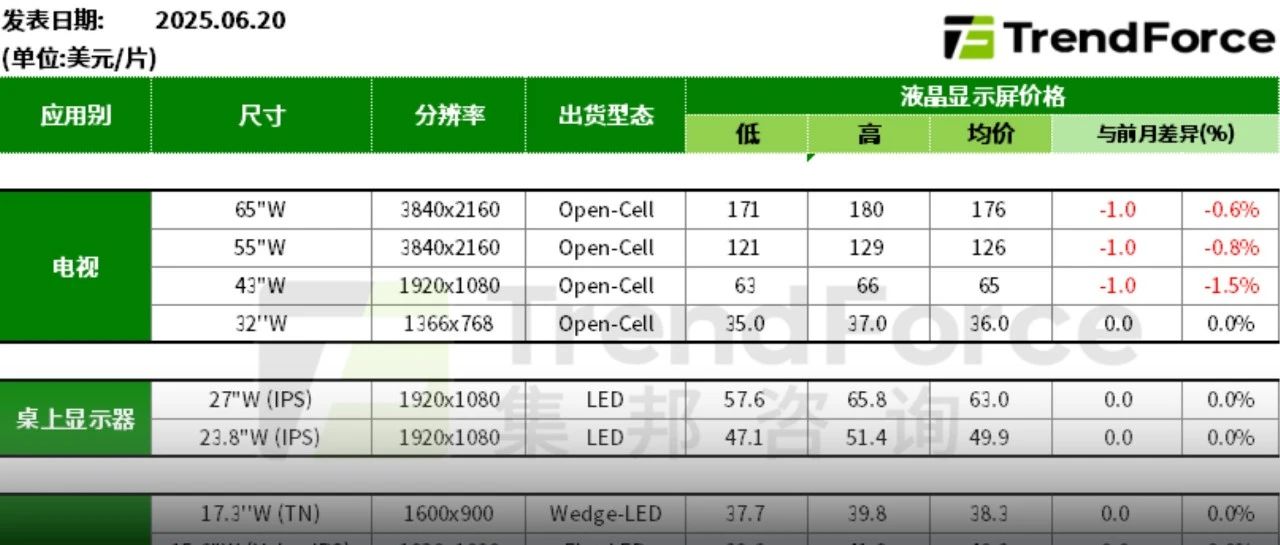
Core Viewpoint - The report indicates a slight decrease in television panel prices in June 2025, while prices for monitor and laptop panels remain stable [1][3]. Television Panels - The average price for a 65-inch television panel is $176, down by $1 or 0.6% from the previous month, with a range between $171 and $180 [3]. - The average price for a 55-inch television panel is $126, also down by $1 or 0.8%, with a range from $121 to $129 [3]. - The average price for a 43-inch television panel is $65, reflecting a decrease of $1 or 1.5%, with prices ranging from $63 to $66 [4]. - The average price for a 32-inch television panel is $36, with a minimum of $35 and a maximum of $37 [5]. Monitor Panels - Prices for monitor panels remain unchanged compared to the previous month [6]. - The average price for a 27-inch IPS panel is $63, with a range from $57.6 to $65.8 [7]. - The average price for a 23.8-inch IPS panel is $49.9, with prices ranging from $47.1 to $51.4 [8]. Laptop Panels - Prices for laptop panels have remained stable compared to the previous month [9]. - The average price for a 17.3-inch TN panel is $38.3, with a minimum of $37.7 and a maximum of $39.8 [9]. - The average price for a 15.6-inch Value IPS panel is $40.3, consistent with the previous month, with a range from $38.6 to $41.9 [9]. - The average price for a 14.0-inch TN panel is $26.9, with prices ranging from $26.4 to $28.1 [9]. - The average price for an 11.6-inch TN panel is $25.1, with a minimum of $24.2 and a maximum of $26.5 [9].

2027年款iphone或采用新型LTPO OLED
WitsView睿智显示· 2025-06-19 09:50
Core Viewpoint - The article discusses the potential adoption of LTPO3 technology in the 2027 iPhone model, which could significantly reduce screen power consumption, and mentions the upcoming production of Apple's first foldable iPhone [1][2][4]. Group 1: LTPO Technology - Apple is considering the use of LTPO3 technology in the 2027 iPhone, which is expected to lower screen power consumption [1][2]. - The decision regarding the adoption of LTPO3 technology is anticipated to be made in the third quarter of this year, with Samsung Display and LGD as potential suppliers [2]. - The 2027 iPhone Air model is predicted to be the first to utilize LTPO3 technology due to its lower battery capacity requirements [4]. Group 2: Foldable iPhone Production - The first foldable iPhone is expected to begin production by Foxconn in late Q3 or early Q4 of 2025 [4]. - Samsung Display will supply the display panels for Apple's foldable iPhone, with plans to produce 7 to 8 million foldable panels in 2026 [4].

韩媒:京东方正在推进半导体玻璃基板业务
WitsView睿智显示· 2025-06-19 09:50
Core Viewpoint - BOE is advancing its semiconductor glass substrate business, leveraging its existing glass substrate technology from the display sector to expand into the semiconductor field [1][3]. Group 1: Business Development - BOE has recently ordered semiconductor glass substrate equipment, including automatic optical inspection (AOI) and electroless copper plating equipment [2]. - The AOI equipment will be supplied by Onto Innovation, a U.S. company, while other equipment will be sourced from domestic suppliers [3]. - The purpose of the equipment is to establish a research and development testing line for glass-based packaging technology, aimed at verifying the process technology for glass-based integrated circuit (IC) packaging substrates and achieving industrialization [3]. Group 2: Technical Advantages - Semiconductor glass substrates are smoother and thinner than traditional substrates, allowing for finer circuits and better performance in high-performance, high-integration semiconductor applications [3]. - The development of semiconductor glass substrates is challenging due to the material's properties, as even minor cracks can have significant negative impacts [3]. Group 3: Market Positioning - Industry insiders indicate that BOE's interest in the semiconductor glass substrate business has been rumored since the second half of last year, and the business is now in the equipment supplier selection phase [4]. - BOE's expertise in glass processing technology positions it favorably in the competitive landscape of semiconductor glass substrates, as it can leverage its existing supply chain advantages [3].

总投资550亿,合肥国显第8.6代AMOLED项目更新进度
WitsView睿智显示· 2025-06-19 09:50
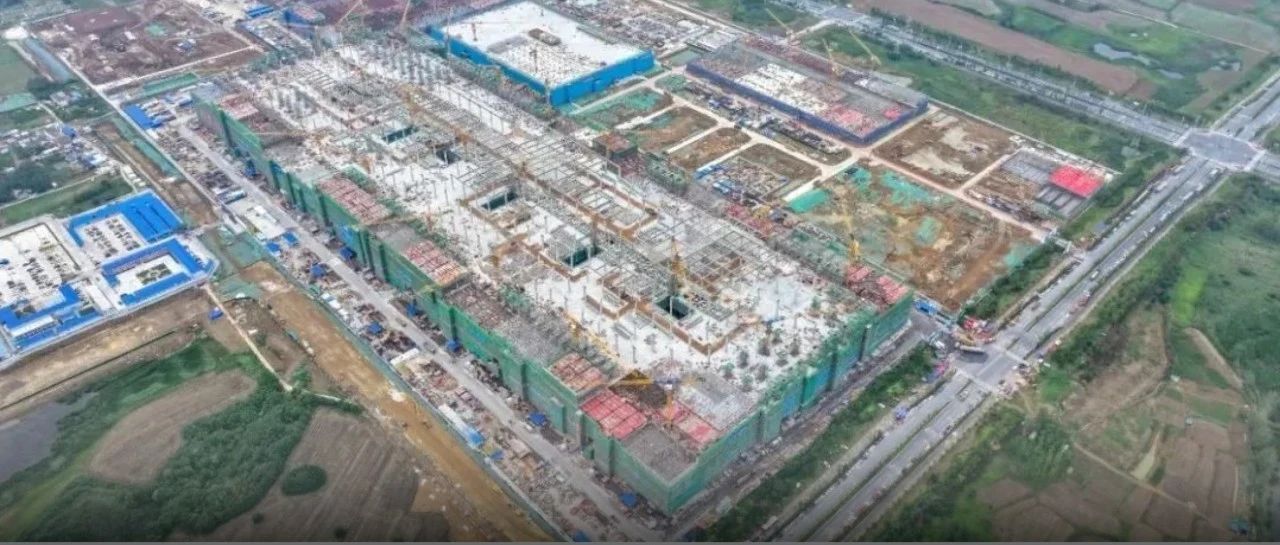
Core Viewpoint - The article highlights the advancements in the 8.6 generation AMOLED production lines in China, particularly focusing on the projects by Hefei Guoxian, Samsung Display, and BOE, which are set to meet the growing demand for OLED technology in various applications, including laptops and tablets. Group 1: Hefei Guoxian Project - The Hefei Guoxian 8.6 generation AMOLED project has a total investment of 55 billion yuan and a construction area of approximately 800,000 square meters, with a designed capacity of 32,000 glass substrates per month [2] - The project is notable for being the world's first 8.6 generation AMOLED production line to adopt the FMM-free technology (ViP technology), targeting medium-sized applications such as displays for tablets and vehicles [2] - The project is expected to commence construction in September 2024, with the main structure already entering the final construction phase [1] Group 2: Samsung Display Project - Samsung Display's A6 factory in Asan, South Korea, is set to begin trial operations of its 8.6 generation OLED production line by the end of this year, with full-scale production planned for the second quarter of 2026 [2][3] - The A6 line, which is a modification of the existing L8 line, has a total investment of 4.1 trillion Korean won (approximately 21.279 billion yuan) and aims to produce 10 million laptop panels annually [3] - The timing of the A6 line's mass production aligns with Apple's anticipated release of OLED MacBook Pro and iPad models in the second half of 2026 [3] Group 3: BOE Project - BOE's first domestic 8.6 generation AMOLED production line has commenced equipment installation four months ahead of schedule, with a total investment of 63 billion yuan and a designed capacity of 32,000 glass substrates per month [4] - The production line is focused on medium-sized AMOLED panels for mid-to-high-end laptops and tablets, with capabilities to produce flexible OLED smartphone panels [4] - The project broke ground on March 27, 2024, and achieved full structural completion by September 26, 2024, with mass production expected by the end of 2026 and full capacity by 2029 [4]

视源股份拟于港交所主板上市
WitsView睿智显示· 2025-06-19 09:50
Core Viewpoint - The article discusses the listing application of Guangzhou Shiyuan Electronic Technology Co., Ltd. (Shiyuan) on the Hong Kong Stock Exchange, highlighting its business focus and financial performance. Group 1: Company Overview - Shiyuan was established in 2005 and specializes in the design, research and development, and sales of LCD display control boards and interactive smart panels. The company was listed on the Shenzhen Stock Exchange on January 19, 2017 [2]. - The company aims to optimize and expand its product portfolio in smart terminals and applications, support the development of smart control components and applications, and promote core technology development in interactive display and AI fields [2]. Group 2: Product and Technology - Shiyuan leverages its technological accumulation in display, audio-video, connectivity, power supply, and artificial intelligence to innovate and develop products for various application scenarios. It has established well-known brands such as Seewo and MAXHUB [3]. - The product system includes smart control components, smart terminals, and applications, with offerings such as interactive smart panels, digital signage, and LED displays [3]. Group 3: Financial Performance - In 2024, Shiyuan achieved a revenue of 22.401 billion yuan, representing a year-on-year growth of 11.05%. However, the net profit attributable to shareholders decreased by 29.13% to 971 million yuan [4]. - In the first quarter of this year, Shiyuan reported a revenue of 5.005 billion yuan, with a year-on-year increase of 11.35%. The net profit attributable to shareholders was 162 million yuan, down 9.23% year-on-year [6]. Group 4: Recent Developments - In February of this year, Shiyuan's Chongqing Industrial Park officially opened in the Liangjiang New Area, housing the company's Western headquarters, R&D center, and settlement center [6]. - In January, Shiyuan acquired a plot in the East District of the Shanghai Kangqiao Industrial Zone for a total investment of 550 million yuan, which will serve as the headquarters and an Industry 4.0 production demonstration base for the Yangtze River Delta region [6].
液晶显示企业经纬辉开出售子公司
WitsView睿智显示· 2025-06-18 07:16
Core Viewpoint - The company, Jingwei Huikai, announced the sale of its wholly-owned subsidiary, Changsha Yushun Display Technology Co., Ltd., to Huanuo Xingkong Technology Co., Ltd. for a total consideration of approximately 112 million yuan, which aims to enhance asset operation efficiency and sustainable development capabilities [1][3]. Summary by Sections Transaction Details - Huanuo Xingkong will acquire 100% of Changsha Yushun through a cash payment, with a total payment of 112,036,753.68 yuan. Additionally, Changsha Yushun owes Jingwei Huikai's subsidiary, Xinhui Kai Technology (Shenzhen) Co., Ltd., 27,963,246.32 yuan, leading to a combined payment of approximately 140 million yuan to Jingwei Huikai and Xinhui Kai [2][3]. Company Profile - Changsha Yushun was established in 2007, focusing on the research, production, and sales of LCD displays and electronic products, among other activities. Huanuo Xingkong's business scope includes intelligent building systems design, civil aircraft parts design and production, software development, and various technology services [3]. Financial Performance - In 2024, Jingwei Huikai reported a revenue of 3.261 billion yuan, a year-on-year decrease of 5.03%. However, the net profit attributable to shareholders increased significantly by 107.42% to 21.457 million yuan. In Q1 2025, the revenue was 587 million yuan, down 23.37%, with a net profit of 12.818 million yuan, a decline of 59.30%, primarily due to a one-time gain from land transfer in the previous year [5].

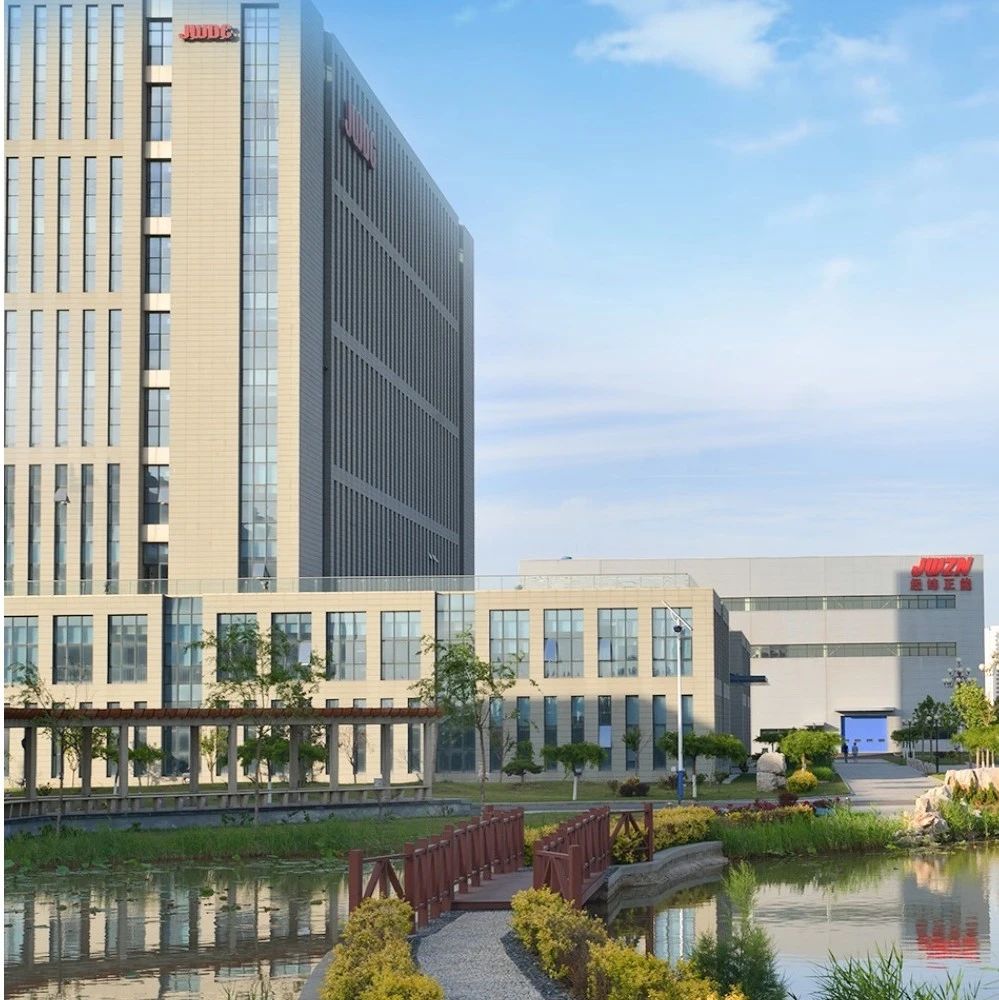
京东方、TCL华星等面板厂越南模组量产进度一览
WitsView睿智显示· 2025-06-18 07:16
Core Viewpoint - The article discusses the strategic shift of major IT brands, such as Dell and HP, requiring panel manufacturers to produce modules outside of mainland China to mitigate supply chain risks. This has led to increased module production planning in Vietnam by various panel manufacturers [1][2]. Group 1: Production Planning in Vietnam - Major panel manufacturers like AUO, LG Display, BOE, and TCL are planning module production capacity in Vietnam, with AUO and LGD already reaching mass production status [3][7]. - BOE and TCL are expected to achieve mass production status in the second half of this year [3]. - The proximity of Vietnam to mainland China reduces raw material transportation costs, making it an attractive location for production [2]. Group 2: Expansion Methods - AUO, BOE, and TCL are expanding their module capacity through self-built facilities, while LGD is collaborating with third parties for capacity acquisition [4][8]. - IVO is actively constructing production lines in Vietnam to secure orders from US IT brands and has obtained COO certification for its module lines [8]. Group 3: Cost Considerations - Despite the higher production costs in Vietnam compared to mainland China due to depreciation and travel expenses, panel manufacturers are still opting to establish production capacity in Vietnam to remain flexible in response to changing external conditions [10].