鑫椤锂电

Search documents
参考了100份资料的万字长文!最全的钠离子电池生产流程全面解析
鑫椤锂电· 2025-06-06 02:46
Core Viewpoint - Sodium-ion batteries are gaining attention as a potential alternative to lithium-ion batteries, with significant differences in production processes and material selection that impact cost, resource availability, and thermal stability [3][4][28]. Group 1: Overview of Sodium-Ion Battery Production Process - The production process of sodium-ion batteries includes five main stages: raw material preparation, positive and negative electrode material preparation, electrode preparation, battery assembly, and battery testing [3]. - Key advantages of sodium-ion batteries over lithium-ion batteries include lower material costs, higher resource availability, and better thermal stability, making them suitable for applications in energy storage and low-speed electric vehicles [3]. Group 2: Raw Material Preparation Stage - The raw material preparation stage is critical, involving the selection and pre-treatment of key materials such as positive and negative electrode materials, electrolytes, separators, and current collectors [4][5]. - Positive electrode materials include layered oxides and polyanionic compounds, with P2-Na0.67Ni0.1Fe0.1Mn0.8O₂ noted for its high capacity [4][5]. - Environmental control is crucial, with humidity levels needing to be kept below 1% to prevent sodium materials from absorbing moisture [7]. Group 3: Positive and Negative Electrode Material Preparation Stage - This stage is vital for determining the battery's energy density, cycle life, and safety, involving processes like raw material mixing, sintering, and post-treatment [8]. - Key parameters for positive electrode material preparation include sintering temperature (800-1100°C for layered oxides), sintering time (2-12 hours), and atmosphere control [8][11]. - Hard carbon is the mainstream choice for negative electrode materials due to its high sodium storage capacity and excellent cycling stability [8]. Group 4: Electrode Preparation Stage - The electrode preparation stage includes slurry preparation, coating, rolling, and cutting, with strict quality control impacting battery performance [12]. - Special mixing techniques are required to ensure slurry uniformity, and coating machines must maintain high humidity control [12][16]. - The rolling process enhances the density of electrode materials, significantly improving conductivity [13]. Group 5: Battery Assembly Stage - Battery assembly involves winding or stacking, welding, packaging, and electrolyte injection, with precision in these processes directly affecting battery consistency and safety [17]. - Winding machines must achieve alignment accuracy of ±0.5mm, while stacking machines require even higher precision [17][22]. - Laser welding techniques are adapted for the high reflectivity of aluminum current collectors used in sodium-ion batteries [17]. Group 6: Battery Testing and Screening Stage - This final stage includes formation, capacity grading, charge-discharge testing, cycle life testing, and safety performance testing to ensure batteries meet design standards [23]. - The formation process typically employs a three-stage charging method under vacuum conditions to stabilize the solid electrolyte interface (SEI) [23][27]. - Cycle life testing for sodium-ion batteries generally ranges from 1000 to 5000 cycles, necessitating process optimizations to enhance performance [25][40]. Group 7: Differences in Production Equipment - Sodium-ion battery production equipment differs from lithium-ion batteries primarily due to variations in current collector materials, electrode materials, and electrolyte compositions [28][30]. - The use of aluminum foil for both electrodes in sodium-ion batteries necessitates specialized welding equipment to address the challenges posed by its high reflectivity [28]. - Equipment for preparing electrolytes must be resistant to corrosion due to the specific sodium salts used [30]. Group 8: Key Technical Details in Production - Key technical details in sodium-ion battery production focus on material synthesis, electrode coating, and battery assembly, which directly influence performance and consistency [32]. - Innovations in coating technology, such as negative pressure techniques, help mitigate issues related to material aggregation and drying [32][38]. - The optimization of electrolyte formulations and additives is crucial for enhancing battery stability and cycle life [33]. Group 9: Environmental Control Requirements - Stringent environmental control is essential in sodium-ion battery production, particularly regarding humidity, dust, and temperature [34]. - Humidity levels must be maintained below 1% to prevent moisture absorption by sodium materials, while dust control is critical to avoid short circuits [34][35]. - Temperature control is vital during formation and capacity grading processes to ensure the stability of the SEI layer [35]. Group 10: Future Development Trends - The future of sodium-ion battery production is expected to focus on automation, process simplification, and the application of solid electrolytes [36][43]. - Innovations in winding and stacking processes aim to improve battery performance and consistency [38]. - The optimization of electrolyte formulations will enhance ionic conductivity and stability, extending battery life [38][43].

小米汽车:弗迪电池和宁德时代电池一样安全
鑫椤锂电· 2025-06-05 08:57
Core Viewpoint - The article discusses the battery specifications and performance of the Xiaomi YU7 electric vehicle models, highlighting the collaboration with leading battery manufacturers and the safety standards adhered to by Xiaomi [1][2]. Battery Specifications - The Xiaomi YU7 standard and Pro versions are equipped with a 96.3 kWh lithium iron phosphate battery, while the YU7 Max features a 101.7 kWh ternary lithium battery [1][2]. - The YU7 standard version offers a CLTC range of 835 km, making it the leader in range for mid-to-large pure electric SUVs [4]. - The YU7 Pro also has a CLTC range of 770 km and is recognized as the leader in range for all-wheel-drive pure electric SUVs [5]. - The YU7 Max has a CLTC range of 760 km [6]. Performance Metrics - The YU7 standard version accelerates from 0 to 100 km/h in 5.88 seconds, with a peak torque of 528 N·m and a maximum power of 320 PS [9]. - The YU7 Pro achieves 0 to 100 km/h in 4.27 seconds, with a peak torque of 690 N·m and a maximum power of 496 PS [10]. - The YU7 Max boasts a remarkable acceleration of 0 to 100 km/h in 3.23 seconds, with a peak torque of 866 N·m and a maximum power of 690 PS [10]. Safety and Standards - Xiaomi emphasizes that all battery packs meet stringent safety design and high standard requirements, ensuring compliance with the new national battery safety testing standards [2].


今早宣布,一家汽车新央企将成立
鑫椤锂电· 2025-06-05 08:12
关注公众号,点击公众号主页右上角" ··· ",设置星标 "⭐" ,关注 鑫椤锂电 资讯~ 本文来源:济南都市频道 传闻已久的东风、长安合并事宜已中止。6月5日早间,东风股份、长安汽车双双发布公告。 东风公司暂不涉及相关资产和业务重组 东风股份公告称,本公司接到间接控股股东东风公司通知,东风公司暂不涉及相关资产和业务重组。本公 司正常生产经营活动不会受到影响。 长安汽车:间接控股股东兵器装备集团分立汽车业务为独立央企 公告编号:2025-36 重庆长安汽车股份有限公司 关于中国兵器装备集团有限公司重组进展情况的公告 本公司及董事会全体成员保证信息披露的内容真实、准确、完整,没有虚假记载、误导性陈 述或重大遗漏。 2025年2月9日,重庆长安汽车股份有限公司(以下简称"本公司")接到间 接控股股东中国兵器装备集团有限公司(以下简称"兵器装备集团")通知,兵器 装备集团正在与其他国资央企集团筹划重组事项。详细内容见本公司于2025年2月 10 日披露的《关于控股股东拟发生变更的提示性公告》(公告编号:2025-05)。现 将有关进展情况公告如下: 2025年6月4日,本公司接到兵器装备集团通知,兵器装备集团收到国 ...

宁德时代同天成立两家新能源公司!
鑫椤锂电· 2025-06-05 08:12
近日, 长沙润时新能源有限公司 、 崇仁县润时新能源有限公司 成立,注册资本分别为58万元、381万 元,经营范围均包含:发电业务、输电业务、供(配)电业务;电气安装服务;合同能源管理;电池销 售;物联网技术服务;物联网技术研发等。 企查查股权穿透显示,两公司均由宁德时代(300750)间接全资持股。 | 细逻有远见的商业传奇 全国企业信用查询 | 长沙润时新能源有限公司 | | 0 值一下 | C 知彼阿尔法 | ■ 应用 ▼ | 企业中心 ロ | v SVIP 0 会居服务 | | --- | --- | --- | --- | --- | --- | --- | --- | | 基本信息 8 | 法律诉讼 | 经营风险 | 经营信息 1 | 企业发展 | 知识产权 | | 历史信息 1 | | 工商信息 ● | | | | | | | | | 工商信息 历史工商信息 | | | | 目 文字介绍 | G 工商官网快照▶ | ■ 导出 | 《 企音音 | | 统一社会信用代码 | 91430100MAEK8QPE93 | 企业名称 | 长沙润时新能源有限公司 | | | | | | 法定代表人 | 酸维 ...

又一国企跨界进军储能行业
鑫椤锂电· 2025-06-05 08:12
Core Viewpoint - The article discusses the acquisition plan of Zhongcheng Co., a subsidiary of Guotou Group, to purchase 100% equity of Zhongji Jiangsu from China National Technical Import and Export Corporation, along with raising supporting funds from specific investors. The focus is on the business model and financial performance of Zhongji Jiangsu in the energy management sector [1][2]. Group 1: Acquisition and Financial Overview - Zhongcheng Co. plans to acquire 100% equity of Zhongji Jiangsu, which was established in 2021 with a registered capital of 63.49 million yuan, focusing on investment, development, and operation of energy storage projects for commercial users [1]. - In 2023 and 2024, Zhongji Jiangsu is projected to achieve revenues of 14.4655 million yuan and 39.9 million yuan, with net profits of 1.4913 million yuan and 18.1592 million yuan respectively, indicating a net profit margin of 45.5% for 2024 [1]. Group 2: Business Model and Challenges - Zhongji Jiangsu's core profit model relies on the price difference between peak and valley electricity rates, purchasing electricity during low price periods and selling it during high price periods, sharing profits with commercial users [2]. - The business model faces three main challenges: 1. The reduction of peak-valley price differences in Jiangsu and other regions, expected to cut profit margins by 20% to 30% [2]. 2. Increased uncertainty in station revenues due to the full market entry of renewable energy [2]. 3. The low technical barrier of the business model makes it easily replicable, posing a risk to establishing a competitive moat [2].
碳酸锂工厂被叫停
鑫椤锂电· 2025-06-05 08:12
关注公众号,点击公众号主页右上角" ··· ",设置星标 "⭐" ,关注 鑫椤锂电 资讯~ 本文来源:锂电前沿 项目计划在玻利维亚西南部的乌尤尼盐湖(Salar de Uyuni)建设直接提锂设施。乌尤尼盐湖被认为是全 球已探明储量最大的锂盐湖之一,亦是"锂三角"(智利、阿根廷和玻利维亚)战略资源区的重要组成部 分。 根据玻利维亚国有锂业公司(YLB)负责人奥马尔·阿拉孔此前在新闻发布会上的表述,这两个项目预计 年产碳酸锂3.5万吨。YLB在两个合资项目中持股51%。 这项公益诉讼由乌尤尼地区诺尔利佩斯省原住民联合中心(代表50多个原住民社区)提起,原告指控,项 目推进未经宪法规定的环境磋商与社区同意程序,涉嫌侵犯原住民 环境权 。尽管协议尚未通过议会审 批,但据原住民代表称,CBC财团等已在项目现场展开部分前期施工与准备工作,缺乏合法授权与环评文 件。 根据美国地质调查局数据显示,当时全球探明的锂储量约8900万吨,其中玻利维亚探明锂储量有2100万 吨,是世界上锂资源储量最多的国家,世界上最大的盐滩乌尤尼盐沼也位于此。但该国缺乏直接提取锂的 技术,道路等基础设施发展也存在不足,自2019年政变后停止的锂矿 ...
配套动力电池PACK厂 浙江55亿项目开工
鑫椤锂电· 2025-06-05 08:12
Core Viewpoint - The Zhejiang Dongzhong Special Vehicles Project in Haining, Zhejiang Province, represents a significant investment in the production of new energy heavy trucks and mining vehicles, aiming to address industry challenges related to high energy consumption and emissions [1] Group 1: Project Overview - The total investment for the Zhejiang Dongzhong Special Vehicles Project is 5.5 billion yuan, covering an area of approximately 358 acres with a total construction area of about 153,000 square meters [1] - The project will have an annual production capacity of 3,500 new energy heavy trucks and 1,200 non-road wide-body dump trucks [1] - It will also include the establishment of a power battery PACK factory, an electric drive system R&D center, and an intelligent connected testing platform [1] Group 2: Economic Impact - Upon reaching full production capacity, the project is expected to directly drive over 30 upstream and downstream industry chain enterprises, forming a 10 billion yuan industrial cluster and creating 20,000 high-quality jobs [1] - The new generation of pure electric mining trucks will have a load capacity of 260 tons and can operate for 10 hours on a one-hour charge [1] Group 3: Environmental and Economic Benefits - Compared to similar diesel models, the lifecycle operating costs of the new electric mining trucks are reduced by 45%, and carbon emissions are decreased by 80% [1] - The products are set to be first applied in large open-pit mines in Inner Mongolia and Shanxi, with a market share expected to exceed 20% in the next three years [1]
招聘 固态电池研发 55-75K15薪
鑫椤锂电· 2025-06-05 02:43
Core Viewpoint - The article emphasizes the growing importance of solid-state battery technology in the global energy transition, highlighting China's advancements and the upcoming forum aimed at fostering collaboration and innovation in this field [9][10]. Industry Overview - The global lithium battery industry is experiencing significant developments, with a detailed distribution map illustrating the entire supply chain from raw materials to end applications, covering major regions such as China, North America, Europe, Japan, and Southeast Asia [5]. - In 2024, China's production of solid-state and semi-solid batteries is projected to reach 5.2 GWh, indicating a substantial growth in this sector [9]. Challenges and Opportunities - Despite advancements, the commercialization of solid-state battery technology faces challenges, including the need for improved ionic conductivity of solid electrolytes, stability of electrode/electrolyte interfaces, and the development of large-scale production processes [9]. - The article calls for enhanced market application scenarios, improved industry chain collaboration mechanisms, and the establishment of relevant policies and standards to support the growth of solid-state batteries [9]. Upcoming Event - A summit titled "2025 (Third) China Solid-State Battery Technology Development and Market Application Forum" will be held on July 8-9, 2025, in Shanghai, aimed at gathering experts, industry leaders, and investors to discuss the latest research, industrialization paths, market trends, and challenges in solid-state battery technology [10][11]. - The forum aims to promote deep integration of industry, academia, and research, accelerating innovation and sustainable development in the global solid-state battery industry [10].
马克龙见证!远景动力电池超级工厂投产
鑫椤锂电· 2025-06-04 08:41
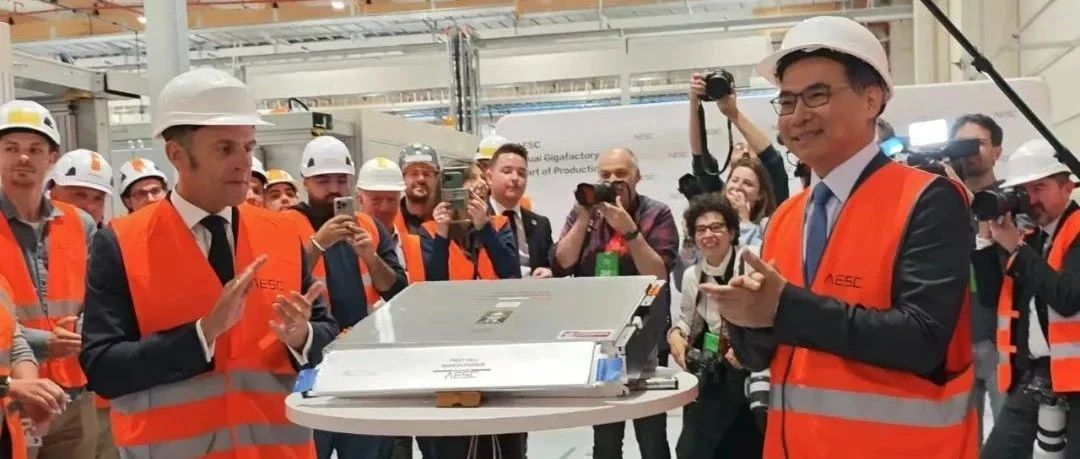
Core Viewpoint - The inauguration of Envision's battery super factory in Douai, France, marks a significant step in the country's green industrial transformation and is seen as a flagship project for France's re-industrialization efforts [1][2]. Group 1: Factory Inauguration and Impact - Envision's Douai super factory officially commenced operations on June 3, 2023, with attendance from French President Macron and Envision Technology Group Chairman Zhang Lei [1]. - The factory is expected to supply high-quality power batteries for 200,000 electric vehicles annually, contributing to Europe's low-carbon transition [2]. Group 2: Government and Corporate Collaboration - President Macron emphasized the collaboration with Envision as a means to transition the region from the "old energy era" to a "new power era," highlighting the importance of global partners in driving energy transition and industrial innovation [4]. - Macron's statements reflect a commitment to balancing economic growth with sustainability, asserting that manufacturing batteries in France is indeed possible, as demonstrated by the Douai factory [5]. Group 3: Technological Advancements - Envision's high-performance battery technology has already aided Renault's R5 model in becoming the top-selling electric vehicle in France, showcasing the company's role in advancing electric vehicle adoption [2]. - Zhang Lei noted that the successful launch of the factory accelerates the electrification of the European automotive sector, aligning with the vision of a "community of shared future for mankind" [5].
韩企将为宁德时代欧洲工厂供应电池铜箔
鑫椤锂电· 2025-06-04 08:01
Group 1 - The core viewpoint of the article highlights the partnership between Solus Advanced Materials and CATL, marking Solus as the first Korean copper foil supplier to establish a collaboration with CATL in Europe [1] - Solus will supply copper foil products produced at its Hungarian factory to CATL's European plant starting in 2026 [1] - Both companies aim to leverage Solus's product competitiveness in the local market and actively seek collaboration opportunities in new product development [1]