SENSETIME(00020)

Search documents
突发!美得州把 26 家中国科技公司拉黑
是说芯语· 2026-01-27 03:09
Core Viewpoint - Texas Governor Greg Abbott has expanded the list of prohibited technologies, adding 26 Chinese tech companies and AI platforms, to mitigate security risks associated with foreign adversaries [1][3][4]. Group 1: Prohibited Technologies - The updated list includes various AI institutions such as Zhipu AI, Baichuan Intelligence, and MiniMax, as well as hardware manufacturers like Hisense and tech companies including ByteDance, Baidu, Alibaba, CATL, and TP-Link [1][6][7]. - The Texas Cyber Command (TXCC) is responsible for assessing threats and identifying high-risk technologies to protect sensitive information [1][5][6]. Group 2: Security Concerns - Governor Abbott expressed concerns about hostile actors using AI and other technologies to harvest user data, manipulate users, and compromise their safety [4][5]. - The TXCC aims to prevent cyber attacks that could lead to the exfiltration of sensitive information to malicious entities globally [5][6]. Group 3: Implementation and Oversight - The prohibition is based on a threat assessment conducted by TXCC, which was established in June 2023 as the largest state-level cybersecurity department in the U.S. [6][1]. - The directive to expand the prohibited technologies list was communicated through a letter to key state officials, emphasizing the need for vigilance against foreign threats [4][5].





商汤官宣旗下AI Agent“咔皮记账”免费 未来将推“AI Pro”模式
Feng Huang Wang· 2026-01-26 08:16
Core Insights - SenseTime's AI Agent application "Kapi Accounting" has announced that its core accounting features will be permanently free, including 30 previously paid functionalities such as automatic bookkeeping, shared ledgers, budget planning, and multi-account management [1] Company Developments - The application leverages SenseTime's "Riri Xin" large model for multimodal understanding, enabling users to automatically recognize consumption information and categorize bookkeeping through methods like photographing receipts, voice input, or tapping on the phone [1] - Future plans include the launch of an "AI Pro" mode, which will provide users with personalized life planning and recommendations in addition to basic financial management [1] - Following this adjustment, users can access the application's bookkeeping features without any barriers [1]
2026年中国无障碍产业政策、产业链、市场规模、竞争企业及发展趋势研判:随着老龄化加速和残障群体需求升级,无障碍产业迎来前所未有的发展机遇[图]
Chan Ye Xin Xi Wang· 2026-01-26 01:40
Core Viewpoint - The accessibility industry is emerging as a significant economic growth point in China, transitioning from a welfare-focused sector to a market-driven one, driven by the aging population and the increasing needs of disabled groups [1][2]. Group 1: Industry Definition and Service Objects - The accessibility industry aims to improve, compensate, or replace human functions for groups such as the disabled, elderly, patients, and pregnant women, enhancing their quality of life and promoting social inclusion [1][2]. Group 2: Current Development Status - The market size of China's accessibility industry is projected to grow from 78 billion yuan in 2020 to 140 billion yuan by 2025, with an expected increase to 163 billion yuan by 2026 [2]. Group 3: Industry Chain - The upstream of the accessibility industry includes raw materials like metals, plastics, and electronic components, while the midstream consists of software systems and hardware products, and the downstream applications are found in homes, public buildings, and rehabilitation institutions [3]. Group 4: Development History - The accessibility industry in China has undergone four stages: the embryonic stage (2001-2007), the regulatory stage (2008-2014), the smart transformation stage (2015-2023), and the service ecosystem stage (2024-present) [3]. Group 5: Policy Environment - Recent national policies, such as the "Barrier-Free Environment Construction Law," have established a legal framework for the development of the accessibility industry, enhancing the construction of urban accessibility facilities [4]. Group 6: Competitive Landscape - Major companies in the accessibility software sector include iFlytek, SenseTime, and Tencent, while hardware companies include Yuyue Medical, Kefu Medical, and Shanghai Construction Group, among others [5][6]. - Kefu Medical reported a revenue of 1.496 billion yuan in the first half of 2025, with rehabilitation aids contributing 563 million yuan, accounting for 37.63% of total revenue [7][8]. - Yuyue Medical is a leading supplier of medical consumables, with a focus on rehabilitation care products, generating 234 million yuan in revenue from these products in the first half of 2025 [6]. Group 7: Future Development Trends - The accessibility industry is expected to expand significantly due to the aging population, with a shift from physical accessibility standards to digital, cultural, and social service areas, indicating a trend towards high-value software services and integrated solutions [9][10].




智通港股通持股解析|1月26日
智通财经网· 2026-01-26 00:32
Core Insights - The top three companies by Hong Kong Stock Connect holding ratios are China Telecom (00728) at 70.92%, Green Power Environmental (01330) at 69.34%, and Kaisa Group Holdings (01108) at 67.61% [1][2] - The largest increases in holding amounts over the last five trading days were seen in the following companies: Yingfu Fund (02800) with an increase of 4.041 billion, Hang Seng China Enterprises (02828) with 1.783 billion, and Alibaba - W (09988) with 1.455 billion [1][2] - The largest decreases in holding amounts over the last five trading days were recorded for China Mobile (00941) with a decrease of 2.395 billion, Innovent Biologics (01801) with 589 million, and UBTECH Robotics (09880) with 556 million [1][3] Group 1: Hong Kong Stock Connect Holding Ratios - China Telecom (00728) has a holding of 9.843 billion shares, representing 70.92% [2] - Green Power Environmental (01330) has a holding of 280 million shares, representing 69.34% [2] - Kaisa Group Holdings (01108) has a holding of 169 million shares, representing 67.61% [2] Group 2: Recent Increases in Holdings - Yingfu Fund (02800) saw an increase of 4.041 billion in holding amount, with a change of 14.9907 million shares [2] - Hang Seng China Enterprises (02828) increased by 1.783 billion, with a change of 1.8975 million shares [2] - Alibaba - W (09988) increased by 1.455 billion, with a change of 0.8637 million shares [2] Group 3: Recent Decreases in Holdings - China Mobile (00941) experienced a decrease of 2.395 billion, with a change of -3.01224 million shares [3] - Innovent Biologics (01801) saw a decrease of 589 million, with a change of -0.70319 million shares [3] - UBTECH Robotics (09880) had a decrease of 556 million, with a change of -0.38639 million shares [3]

GPU创企曦望一年融资30亿:出身商汤,押注推理
Guan Cha Zhe Wang· 2026-01-22 13:13
Group 1 - The company Sunrise has completed nearly 3 billion yuan in financing within a year, with investors including SANY Group's Huaxu Fund, Paradigm Intelligence, and IDG Capital [1] - The funds raised will be used for the development of the next generation of inference GPUs, large-scale production, and ecosystem building [1] - Sunrise was established in 2020 as a spin-off from SenseTime's chip division, focusing on high-performance GPUs and multimodal scene inference chips [1] Group 2 - The core team consists of over 200 employees, with more than 80% being technical and R&D personnel, many of whom come from leading companies like AMD and Huawei [1] - Co-CEO Wang Yong has over 20 years of experience in the chip industry, having previously worked at AMD and Baidu [2] - Co-CEO Wang Zhan, a founding member of Baidu, has significant experience in the field [2] Group 3 - Unlike traditional GPU manufacturers like NVIDIA that pursue "training and inference integration," Sunrise focuses solely on "pure inference" [4] - The company aims to reduce inference costs by 90% and provide stable services, positioning itself as a transformative player in the AI industry [4] - Sunrise has invested a total of 2 billion yuan in R&D over the past few years, developing a product matrix of three generations of chips [4] Group 4 - The S1 chip, launched in 2020, is China's first visual inference chip and has been licensed to major clients like Sony and Xiaomi [4] - The upcoming S2 chip, set for mass production in 2024, will compete with mainstream A/H series GPUs and be compatible with the CUDA ecosystem [4] - The S3 chip, expected in 2026, aims to achieve significant reductions in cost and energy consumption, targeting a new industry benchmark of "one cent per million tokens" [5]

港股开盘|恒指跌0.34% 商汤跌逾2%
Di Yi Cai Jing· 2026-01-22 11:11
Core Viewpoint - The Hang Seng Index opened lower by 0.34%, while the Hang Seng Tech Index fell by 0.7%, indicating a general decline in the technology sector stocks [1] Group 1: Market Performance - The technology stocks experienced a widespread pullback, with notable declines in companies such as Bilibili and SenseTime, both dropping over 2% [1] - Other companies that faced significant declines include Kuaishou, Xpeng Motors, NetEase, SMIC, and NIO, all showing notable losses [1]
获高盛3.53港元目标价,商汤布局“AI+”生态引发市场关注
Sou Hu Cai Jing· 2026-01-22 07:06
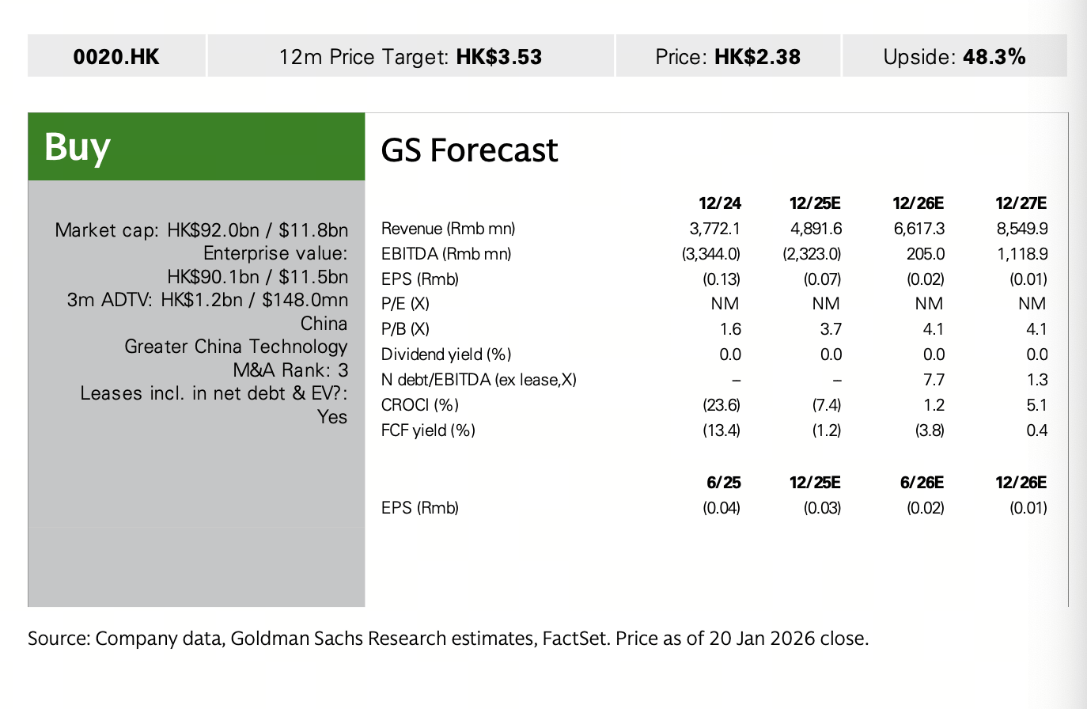
Core Viewpoint - SenseTime (00020.HK) is expected to see continued growth in its generative AI revenue due to its extensive product coverage and customized solutions for specific industries, leading to a "Buy" rating from Goldman Sachs with a target price of HK$3.53, representing an upside of 48.3% from the current price of HK$2.38 [1][2]. Group 1: Financial Projections - Goldman Sachs forecasts SenseTime's revenue to grow from RMB 3,772.1 million in 2024 to RMB 8,549.9 million by 2027 [2]. - The company's EBITDA is projected to improve from a loss of RMB 3,344.0 million in 2024 to a profit of RMB 1,118.9 million by 2027 [2]. - SenseTime's earnings per share (EPS) are expected to move from a loss of RMB 0.13 in 2024 to a loss of RMB 0.01 by 2027 [2]. Group 2: Strategic Initiatives - SenseTime is focusing on optimizing computing power and foundational models to enhance cost-effectiveness and shorten return cycles, as stated by CEO Xu Li [1][3]. - The company is integrating deeply with various application scenarios, including education, finance, tourism, and smart devices, to maximize its operational efficiency [1][3]. - SenseTime is advancing its "AI+" business ecosystem, with initiatives such as the launch of the ACE embodiment research paradigm by its robot product, Daxiao, on December 18, 2025 [3]. Group 3: Competitive Positioning - As a leading generative AI software company in China, SenseTime's self-developed AI foundational models and infrastructure provide a solid foundation for its growth [3]. - The AI industry is experiencing a structured "ecological niche differentiation," where companies are focusing on either B-end MaaS services or C-end killer applications, with SenseTime leveraging its "full-stack coverage + hardware-software synergy" to occupy a favorable ecological position [3].
智通港股通资金流向统计(T+2)|1月22日





智通财经网· 2026-01-21 23:35
Group 1 - The top three companies with net inflow of southbound funds are SMIC (00981) with 458 million, Sanhua Intelligent Control (02050) with 405 million, and Hua Hong Semiconductor (01347) with 390 million [1] - The top three companies with net outflow of southbound funds are China Mobile (00941) with -601 million, UBTECH (09880) with -516 million, and Sanofi (01530) with -357 million [1] - In terms of net inflow ratio, Haitian Flavoring (03288) leads with 76.61%, followed by Southern Hong Kong Stock Connect (03432) with 62.50%, and CIMC (02039) with 59.57% [1] Group 2 - The top ten companies by net inflow include Tencent Holdings (00700) with 272 million and Alibaba-W (09988) with 263 million [2] - The top ten companies by net outflow include Meituan-W (03690) with -287 million and Bilibili-W (09626) with -242 million [2] - The top three companies with the highest net outflow ratio are Dekang Agriculture (02419) at -50.69%, Sanofi (01530) at -47.05%, and Jianfa International Group (01908) at -45.45% [3]
港股收评:恒指涨0.37%,黄金、半导体芯片股大涨
Ge Long Hui· 2026-01-21 08:34
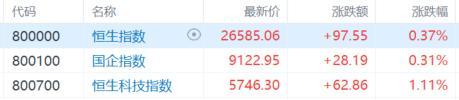
Market Performance - The Hong Kong stock market showed resilience, with the Hang Seng Index and the Hang Seng Tech Index recovering from previous declines, closing up by 0.37% and 1.11% respectively [1][2] - The overall market remained stable despite a significant drop in US stocks overnight [1] Sector Performance - Major technology stocks saw gains, with notable increases in shares of Hua Hong Semiconductor (up over 5%) and SenseTime (up over 4%) [4][5] - Semiconductor stocks were active, driven by positive sentiment in the AI-driven storage cycle, with companies like Zhaoyi Innovation reaching new highs [2][7] - Gold stocks surged, led by Chifeng Jilong Gold (up over 9%) and Lingbao Gold (up over 8%), as spot gold prices broke through $4,880 [6][8] Individual Stock Movements - The stock of Skyworth Group soared over 37% after announcing a distribution of shares in Skyworth Photovoltaic and plans for a mainboard listing [16] - Southbound funds recorded a net inflow of HKD 13.93 billion, indicating strong investor interest [19] Future Outlook - Analysts predict that the Hang Seng Index could challenge the 30,000 to 31,000 point range by 2026, as current valuations remain below historical averages [21]
AI明星“光环”褪色,900亿商汤,该如何破局?
3 6 Ke· 2026-01-21 06:46
Core Viewpoint - SenseTime, once a leading AI company, has seen its stock price decline significantly despite the ongoing AI boom, primarily due to its unsustainable business model and continuous losses [3][6][11] Group 1: Company Background - SenseTime was founded in 2014 by a team from top academic institutions and tech giants, focusing on computer vision technology [4] - The company initially built a business model centered around customized AI solutions for various sectors, including finance, security, and healthcare [5] - SenseTime achieved rapid revenue growth from 2018 to 2020, with a compound annual growth rate of 36.4% [5] Group 2: Financial Performance - From 2018 to mid-2025, SenseTime accumulated losses of 56.3 billion yuan, with a net profit of -1.478 billion yuan in the first half of 2025, despite a year-on-year growth of 39.84% [3][6] - The company's stock price has dropped over 70% from its peak of 9.7 HKD per share in 2022 to 2.38 HKD per share, resulting in a market capitalization of 96.2 billion HKD [3][6] Group 3: Business Model Challenges - SenseTime's reliance on a project-based business model has led to high marginal costs and limited scalability, resulting in a lack of recurring revenue [5][6] - The company has faced challenges in maintaining profitability due to the high costs associated with customized project delivery and long payment cycles [5][6] Group 4: Recent Developments - In response to industry changes, SenseTime launched the "Riri Xin" multimodal model in 2023, achieving notable performance in evaluations [7] - The company restructured its business into three main segments: generative AI, traditional AI, and smart vehicles, with generative AI showing significant revenue growth [8][9] - Despite the growth in generative AI, SenseTime's market share in the domestic large model market has declined from 16% to 13.8% [9][10] Group 5: Future Outlook - SenseTime is facing intense competition and financial challenges, leading to a series of stock placements to raise capital, totaling approximately 3.15 billion HKD [10] - The company acknowledges the need for substantial investment in computing power but lacks the financial strength to compete with larger players like Alibaba and Tencent [10][11]