HKEX(00388)

Search documents
下调!港交所最新宣布!
券商中国· 2025-07-29 05:51
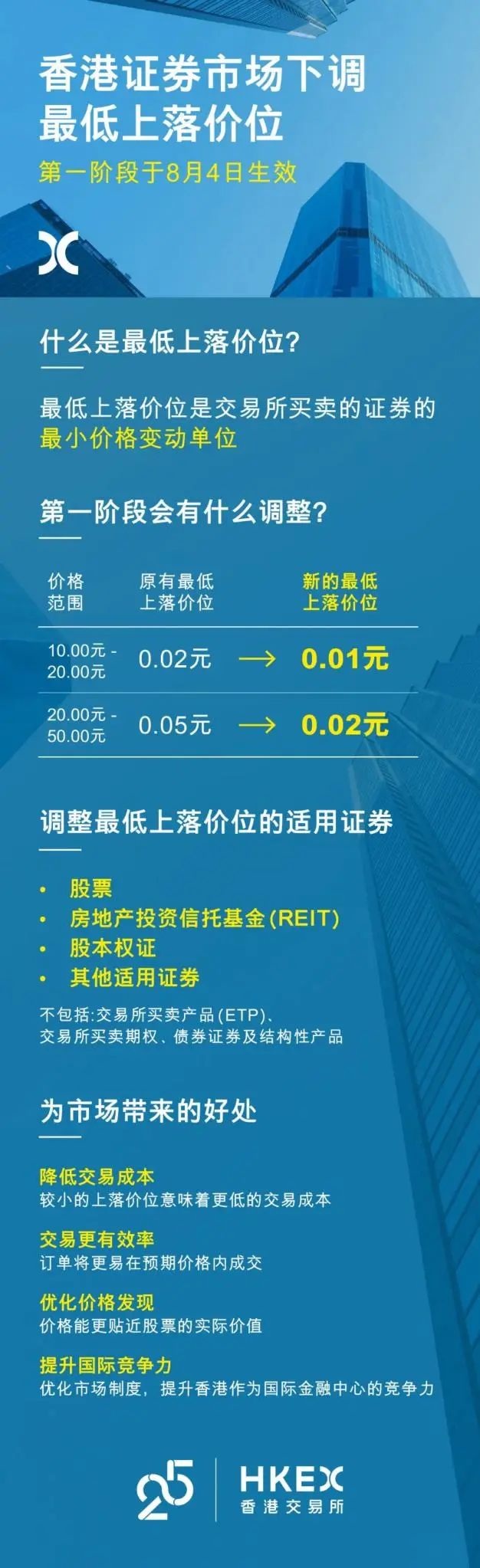
Core Viewpoint - The Hong Kong Stock Exchange (HKEX) has announced a reduction in the minimum price fluctuation unit for trading securities, effective August 4, aimed at lowering transaction costs and enhancing market efficiency [1][3][6]. Summary by Sections Minimum Price Fluctuation Adjustment - The minimum price fluctuation for securities priced between HKD 10 and HKD 20 will be reduced from HKD 0.02 to HKD 0.01, and for those priced between HKD 20 and HKD 50, it will be reduced from HKD 0.05 to HKD 0.02 [2][5]. - This adjustment applies to stocks, Real Estate Investment Trusts (REITs), and equity warrants [2][4]. Benefits of the Adjustment - The initiative is expected to lower trading costs, facilitate order execution at expected prices, improve market efficiency, and enhance the price discovery function [3][6]. - The HKEX plans a second phase of adjustments in mid-2026, which will further reduce the minimum price fluctuation for securities priced between HKD 0.5 and HKD 10 by 50% [3][8]. Settlement Cycle Changes - The HKEX is also considering shortening the stock settlement cycle from T+2 to T+1, aligning with international practices [10][11]. - This change aims to reduce market risk and improve capital efficiency for market participants [15]. Market Context - The HKEX has been actively working on reforms to lower transaction costs and enhance liquidity, with the goal of increasing its international competitiveness [3][10]. - As of mid-2025, the HKEX is expected to have over 2,600 listed companies, with an average daily trading volume of HKD 240.2 billion [13].


高盛:升香港交易所(00388)目标价至500港元 上调盈测 维持“买入”评级
智通财经网· 2025-07-29 03:46
Group 1 - Goldman Sachs raised the earnings per share forecast for Hong Kong Exchanges and Clearing (HKEX) for 2025, 2026, and 2027 by approximately 4% based on better-than-expected average daily trading volume [1] - The target price for HKEX was increased by 11%, from HKD 450 to HKD 500, corresponding to a price-to-earnings ratio of 40 times for 2026 [1] - Despite the upward revision of earnings estimates, HKEX's stock price remains about 20% lower than its peak in 2021, even as average daily trading volume in cash equities has reached a historical high of over HKD 200 billion [1] Group 2 - The number of IPO applications is nearing the peak levels of 2021, but the pace of new listings is still in the mid-cycle [2] - Key market activity indicators, such as turnover rate and the ratio of small to large-cap stock trading, are above the historical 90th percentile, yet the market's valuation relative to GDP is at historical average levels [1][2] - The average year-on-year growth in earnings per share for HKEX is projected to reach 42% from Q4 2024 to Q1 2025, with a 29% growth expected in Q2 2025, which is 3 to 4 times the normal growth rate [2]
港交所,重大变革!下周一生效
Zheng Quan Shi Bao· 2025-07-28 11:35
Core Viewpoint - The Hong Kong Stock Exchange (HKEX) is implementing a phased reduction in the minimum price fluctuation for stocks, aimed at lowering trading costs and enhancing market efficiency, with the first phase effective from August 4, 2023 [1][6]. Group 1: Phase One Implementation - The first phase will adjust the minimum price fluctuation for stocks priced between HKD 10 to 20 from HKD 0.02 to HKD 0.01, and for stocks priced between HKD 20 to 50 from HKD 0.05 to HKD 0.02, representing a reduction of 50% and 60% respectively [5][9]. - A preparatory period of at least six months is allocated before the implementation of both phases, with the first phase set to be reviewed after its implementation [5][10]. - A pre-launch test is scheduled for August 2, 2025, to ensure that market participants are ready for the changes [7][8]. Group 2: Phase Two Considerations - The second phase is expected to be implemented around mid-2026, contingent on the review of the first phase's effectiveness [4][6]. - Concerns have been raised regarding the potential impact of the second phase on lower-priced securities, particularly regarding the narrowing of bid-ask spreads and its effect on liquidity [9][10]. - HKEX believes that the reduction in minimum price fluctuation will lower transaction costs for active investors, thereby increasing trading volume and market liquidity [10].
港交所,重大变革!下周一生效
证券时报· 2025-07-28 11:29
Core Viewpoint - The Hong Kong Stock Exchange (HKEX) is implementing a significant change by reducing the minimum price fluctuation for certain stocks, which is expected to lower trading costs and enhance market efficiency [1][4]. Summary by Sections Phase One Implementation - The first phase of the adjustment will take effect on August 4, 2023, focusing on stocks priced between HKD 10 to 20 and HKD 20 to 50, with minimum price fluctuations reduced from HKD 0.02 to HKD 0.01 and from HKD 0.05 to HKD 0.02, respectively [1][6]. - The adjustments represent a 50% reduction for stocks priced between HKD 10 and 20, and a 60% reduction for those priced between HKD 20 and 50 [5]. Consultation and Support - The HKEX conducted a consultation process that began in June 2022, receiving 110 responses from various market participants, with a majority supporting the proposed changes [4][9]. - The feedback indicated a consensus on the positive impact of smaller minimum price fluctuations on market liquidity [9][10]. Future Phases - A second phase is planned for mid-2026, contingent on the evaluation of the first phase's effectiveness, with a six-month preparation period before implementation [5][10]. - The second phase will also target stocks priced between HKD 0.5 and 10, proposing a 50% reduction in minimum price fluctuation [5]. Market Impact and Concerns - Some market participants, particularly traders and retail investors, expressed concerns about the potential impact of the second phase on lower-priced securities, fearing it may narrow bid-ask spreads and hinder profitability [8][10]. - The HKEX acknowledged these concerns, stating that lower minimum price fluctuations could reduce trading costs and improve liquidity, thus benefiting public investors overall [10].

7月28日电,香港交易所信息显示,贝莱德对东风汽车集团H股持股比例从4.83%增至6.59%。
news flash· 2025-07-28 09:22
智通财经7月28日电,香港交易所信息显示,贝莱德对东风汽车集团H股持股比例从4.83%增至6.59%。 ...
7月28日电,香港交易所显示,腾讯在粉笔有限公司的持股比例降至4.9%。

news flash· 2025-07-28 09:14
智通财经7月28日电,香港交易所显示,腾讯在粉笔有限公司的持股比例降至4.9%。 ...
7月28日电,香港交易所信息显示,贝莱德在信达生物的持股比例于07月22日从4.63%升至5.19%。

news flash· 2025-07-28 09:07
智通财经7月28日电,香港交易所信息显示,贝莱德在信达生物的持股比例于07月22日从4.63%升至 5.19%。 ...
金十图示:2025年07月28日(周一)中国科技互联网公司市值排名TOP 50一览



news flash· 2025-07-28 02:55
Core Insights - The article presents the market capitalization rankings of the top 50 Chinese technology and internet companies as of July 28, 2025, highlighting significant shifts in valuations and market positions [1]. Group 1: Market Capitalization Rankings - The top three companies by market capitalization are Alibaba with 1,000.00 billion, Tencent at 800.00 billion, and Baidu at 600.00 billion [3]. - Notable companies in the top 10 include JD.com at 478.29 billion and Kuaishou at 398.09 billion [3]. - The rankings show a decline in market value for several companies, with Tencent Music and Li Auto both experiencing a decrease of 1% [3]. Group 2: Changes in Valuation - Companies like Kingsoft and China Software have shown slight increases in their market capitalization, with Kingsoft rising by 1% to 62.09 billion [4]. - Conversely, companies such as New Oriental and Kingdee International have seen declines, with New Oriental at 76.34 billion and Kingdee at 76.33 billion, both down by 2% [4]. - The overall trend indicates a mixed performance among the top 50 companies, with some gaining value while others are losing [5]. Group 3: Additional Insights - The data reflects daily calculations of market capitalization based on the current exchange rates between USD and HKD [5]. - The rankings serve as a tool for investors to gauge the performance and market position of leading technology firms in China [5].

中报业绩有望高增,建议关注绩优个股
Changjiang Securities· 2025-07-27 12:10
Investment Rating - The report maintains a "Positive" investment rating for the investment banking and brokerage industry [7] Core Insights - The report highlights that brokerage firms are expected to see significant growth in mid-year performance, driven by market conditions. The insurance sector is also anticipated to experience high growth in new business value due to an increase in value rates. The equity market is on an upward trend, leading to favorable investment returns and profit growth. Current valuations imply a pessimistic long-term investment outlook, but the report suggests that valuations remain safe considering medium to long-term interest rate spreads [4][5] - The report recommends several companies based on their stable profit growth and dividend rates, including Jiangsu Jinzhong, China Ping An, and China Pacific Insurance. Additionally, it suggests companies like New China Life, China Life, Hong Kong Exchanges, CITIC Securities, Dongfang Wealth, Tonghuashun, and Jiufang Zhitu Holdings based on their performance elasticity and valuation levels [4][5] Summary by Sections Brokerage Performance - This week, some brokerage firms disclosed performance forecasts, indicating a significant increase in mid-year results, which enhances their future allocation value. The report emphasizes the stability of profit growth and dividend rates as key factors for investment recommendations [4][5] Market Overview - The non-bank financial index increased by 3.5% this week, outperforming the CSI 300 by 1.8%. Year-to-date, the non-bank financial index has risen by 6.6%, with a relative underperformance of 1.7% against the CSI 300. The overall performance of the non-bank sector has been strong this week [5][18] Insurance Sector - In June 2025, the cumulative premium income for the insurance industry reached 373.5 billion yuan, reflecting a year-on-year increase of 5.31%. The report notes that both property and life insurance segments showed positive growth, with property insurance income at 96.45 billion yuan and life insurance income at 277.05 billion yuan [22][23] Investment Business - The report indicates that the equity market is recovering, with the CSI 300 index rising by 1.69% and the ChiNext index by 2.76%. The brokerage firms' investment assets are primarily composed of bonds, with equity investments accounting for approximately 10%-30% of their portfolios [42][44] Financing Activities - In June 2025, the equity financing scale reached 544.19 billion yuan, a significant increase of 3140.2% month-on-month, while bond financing totaled 8.83 trillion yuan, up by 21.3%. This indicates a recovery in both equity and bond financing activities [46][49] Asset Management - The report notes a rebound in the issuance of collective asset management products, with June 2025 seeing an issuance of 9.732 billion units, a 125.8% increase from the previous month. However, the new fund issuance decreased by 10.3% in June [51][53]



非银行业周报20250727:保险非对称调降预定利率,持续看好非银板块-20250727
Minsheng Securities· 2025-07-27 08:02
Investment Rating - The report maintains a positive outlook on the non-bank sector, particularly in insurance and securities, suggesting a "Recommended" rating for key companies in these sectors [3][41]. Core Insights - The report highlights a reduction in the preset interest rates for life insurance products, with ordinary life insurance at 2.0%, participating insurance at 1.75%, and universal insurance at 1.0%. This adjustment is expected to optimize the liability structure of insurance companies and promote a shift towards non-guaranteed income products [1][3]. - The China Securities Regulatory Commission (CSRC) is focused on stabilizing the capital market and enhancing market vitality through reforms, which is anticipated to boost investor confidence and market performance [2][3]. - The report emphasizes the positive impact of recent monetary policies, including interest rate cuts, which are expected to enhance market sentiment and support the valuation recovery of quality listed companies [3][41]. Summary by Sections Market Review - Major indices showed positive performance, with the Shanghai Composite Index up by 1.67% and the Shenzhen Component Index up by 2.33% during the week [7]. - The non-bank financial sector saw a mixed performance, with the securities index rising by 4.82% [7][8]. Securities Sector - The report notes that the total trading volume in the A-share market reached 10.66 trillion yuan, with a daily average trading volume of 1.78 trillion yuan, reflecting a 14.20% increase week-on-week [16]. - The IPO underwriting scale for the year reached 560.64 billion yuan, while refinancing underwriting amounted to 8050.88 billion yuan [16][18]. Insurance Sector - The report indicates that the life insurance premium growth rate for major companies like China Life and Ping An Life has shown positive trends, with significant increases in premium income [24][25]. - The adjustment of preset interest rates is expected to lower the liability costs for insurance companies, enhancing their financial stability [1][3]. Investment Recommendations - The report suggests focusing on key insurance companies such as China Pacific Insurance, Sunshine Insurance, and Ping An Insurance, as well as leading securities firms like CITIC Securities and Huatai Securities [41][42]. - It also highlights potential benefits for non-bank institutions from the implementation of stablecoin regulations and cross-border payment innovations [3][41].