
ZTE(00763)

Search documents
「数据看盘」四家实力游资豪掷近20亿抢筹中兴通讯 多只科创板ETF上周份额大减
Sou Hu Cai Jing· 2025-12-01 10:09
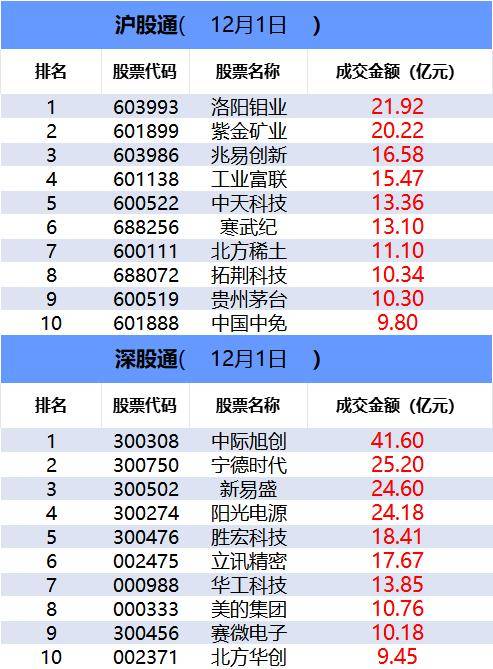
一、沪深股通前十大成交 今日沪股通总成交金额为1102.72亿,深股通总成交金额为1194.91亿。 | 排名 | 板块名称 | 主力资金净流出(亿元) | 主力资金净流出率(%) | | --- | --- | --- | --- | | 1 | 电新行业 | -48.83 | -2.65 | | 2 | 电力设备 | -30.77 | -6.49 | | 3 | 计算机 | -24.43 | -1.77 | | 4 | 医药 | -21.74 | -2.44 | | 5 | 文化传媒 | -20.76 | -3.33 | 从主力板块资金监控数据来看,电子板块主力资金净流入居首。 板块资金流出方面,电新行业主力资金净流出居首。 | | 沪股道( | 12月1日 | ) | | | --- | --- | --- | --- | --- | | 排名 | 股票代码 | 股票名称 | | 成交金额(亿元) | | 1 | 603993 | 洛瑞德国V | | 21.92 | | 2 | 601899 | 三十四年 | | 20.22 | | 3 | 603986 | 兆易创新 | | 16.58 | | 4 | ...


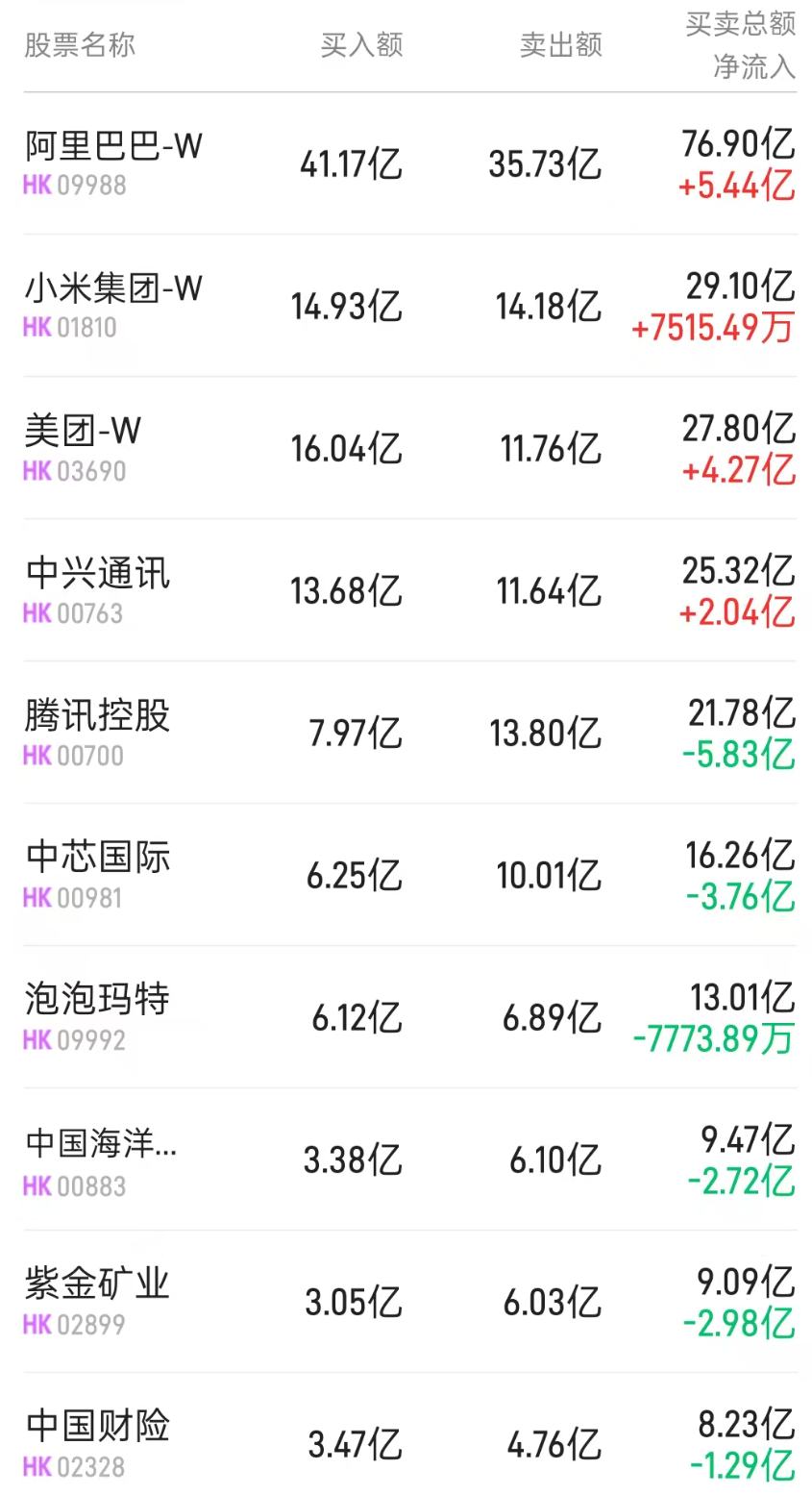
北水动向|北水成交净买入21.48亿 豆包携手中兴推出首款AI手机 北水抢筹中兴通讯(00763)超6亿港元
智通财经网· 2025-12-01 10:05
Summary of Key Points Core Viewpoint - The Hong Kong stock market experienced significant net inflows from northbound trading, with a total net buy of 21.48 billion HKD on December 1, 2023, indicating strong investor interest in certain stocks while others faced net sell-offs [1]. Group 1: Northbound Trading Activity - Northbound trading saw a net buy of 29.13 billion HKD through the Shenzhen Stock Connect and a net sell of 7.65 billion HKD through the Shanghai Stock Connect [1]. - The most bought stocks included Alibaba-W (09988), ZTE Corporation (00763), and Meituan-W (03690) [1]. - The most sold stocks were SMIC (00981), CNOOC (00883), and China Pacific Insurance (02328) [1]. Group 2: Individual Stock Performance - Alibaba-W (09988) had a net buy of 13.21 billion HKD, driven by the launch of Quark AI glasses and increased interest in Alibaba Cloud [4]. - ZTE Corporation (00763) saw a net buy of 6.06 billion HKD, with news of the Nubia M153 smartphone featuring the Doubao assistant technology [5]. - Meituan-W (03690) received a net buy of 5.94 billion HKD, reflecting positive market sentiment [6]. - Xiaomi Group-W (01810) had a net buy of 1 billion HKD, indicating stable investor confidence [6]. - CNOOC (00883) faced a net sell of 2.72 billion HKD, suggesting negative market sentiment [6]. - China Pacific Insurance (02328) experienced a net sell of 1.29 billion HKD amid rumors regarding its leadership [6]. - SMIC (00981) had a net sell of 3.02 billion HKD following the termination of an asset acquisition plan [6].




数据复盘丨98股获主力资金净流入超1亿元
Zheng Quan Shi Bao Wang· 2025-12-01 10:05
(原标题:数据复盘丨98股获主力资金净流入超1亿元) 12月1日,上证指数全天震荡走强,盘中收复3900点;深证成指、创业板指早盘冲高回落,随后再度上扬,午后震荡走强;科创50指数早盘探底回 升,午后冲高回落,尾盘有所回升。截至收盘,上证指数报3914.01点,涨0.65%,成交额7857亿元;深证成指报13146.72点,涨1.25%,成交额 10882.79亿元;创业板指报3092.50点,涨1.31%,成交额5228.84亿元;科创50指数报1336.76点,涨0.72%,成交额655亿元。沪深两市合计成交 18739.79亿元,成交额较上一交易日增加2881.39亿元。 通信、有色金属等行业走强 金富科技6连板 盘面上来看,行业板块、概念涨多跌少。其中,通信、有色金属、电子、商贸零售、国防军工、石油石化、交通运输、汽车等行业涨幅靠前;AI 手机、卫星互联网、6G、智能穿戴、盲盒经济、星闪、空间站、存储芯片、商业航天等概念走势活跃。农林牧渔、环保、房地产、保险、教育等 行业跌幅居前;钛白粉、国资云、AI语料、托育服务、生物质能发电等概念走势较弱。涨停个股主要集中在电子、通信、化工、国防军工、轻工 制造等 ...
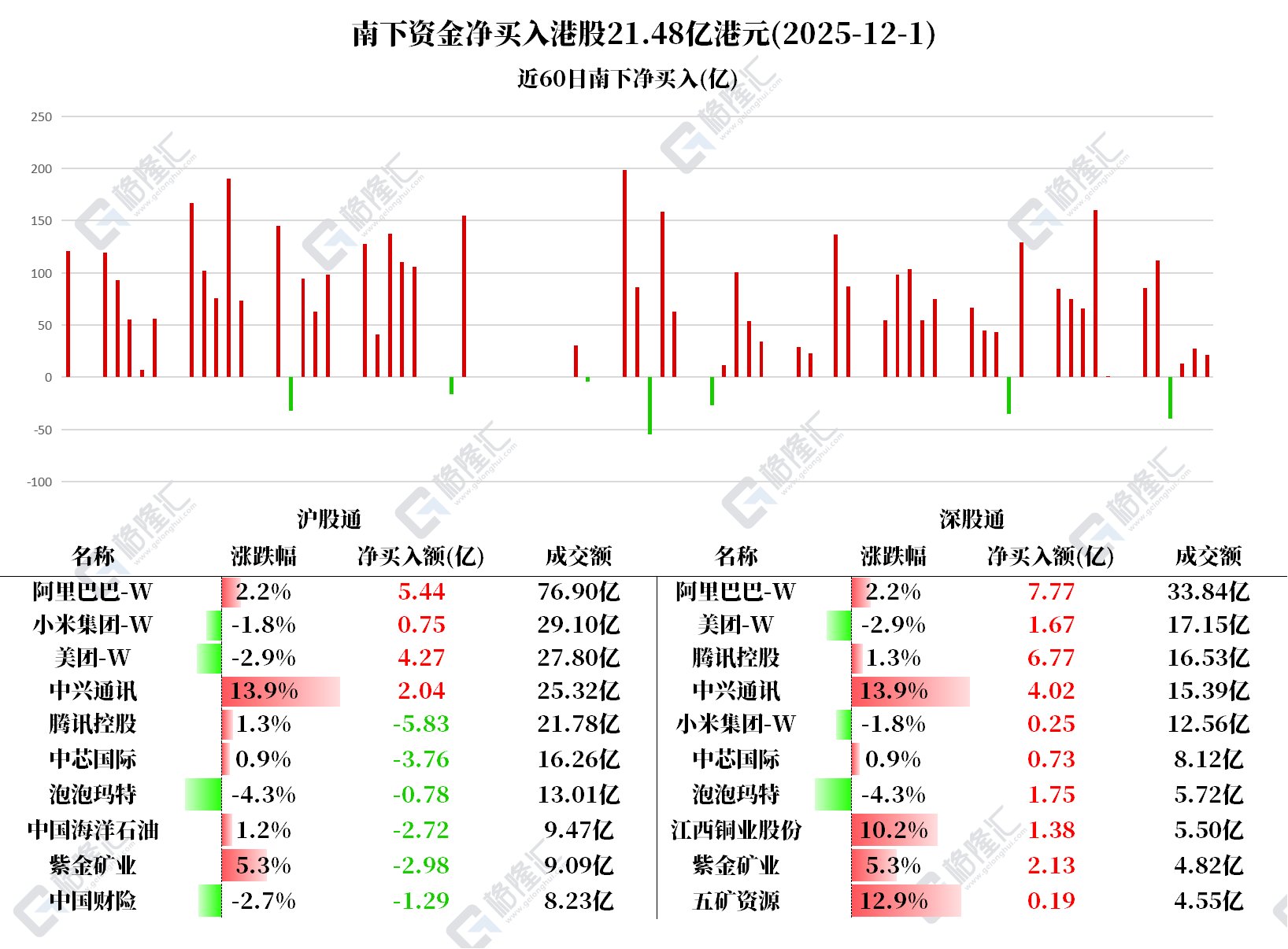
图解丨南下资金净买入港股21亿港元,入阿里、中兴通讯和美团
Ge Long Hui A P P· 2025-12-01 09:53
Group 1 - Southbound funds recorded a net purchase of HKD 2.148 billion today, with notable net buys in Alibaba-W (HKD 1.321 billion), ZTE Corporation (HKD 606 million), Meituan-W (HKD 594 million), Jiangxi Copper (HKD 137 million), and Xiaomi Group-W (HKD 100 million) [1] - Southbound funds have continuously net bought Alibaba for 13 days, totaling HKD 27.86542 billion, and have net bought Meituan for 3 days, totaling HKD 1.39023 billion [1] - There has been a continuous net sell of SMIC for 8 days, amounting to HKD 2.49582 billion [1] Group 2 - Alibaba-W saw a price increase of 2.2% with a net purchase of HKD 544 million and a transaction volume of HKD 7.690 billion [1] - Xiaomi Group-W experienced a price decrease of 1.8% with a net purchase of HKD 75 million and a transaction volume of HKD 2.910 billion [1] - Meituan-W had a price decrease of 2.9% with a net purchase of HKD 427 million and a transaction volume of HKD 2.780 billion [1] - ZTE Corporation had a price increase of 13.9% with a net purchase of HKD 204 million and a transaction volume of HKD 2.532 billion [1] - Tencent Holdings saw a price increase of 1.3% but had a net sell of HKD 583 million with a transaction volume of HKD 2.178 billion [1] - SMIC had a price increase of 0.9% but experienced a net sell of HKD 376 million with a transaction volume of HKD 1.626 billion [1] - CNOOC had a price increase of 1.2% but faced a net sell of HKD 272 million with a transaction volume of HKD 0.947 billion [1] - China Pacific Insurance had a price decrease of 2.7% with a net sell of HKD 129 million and a transaction volume of HKD 0.823 billion [1]

果然财经|十二月开门红!沪指重上3900点
Sou Hu Cai Jing· 2025-12-01 09:35
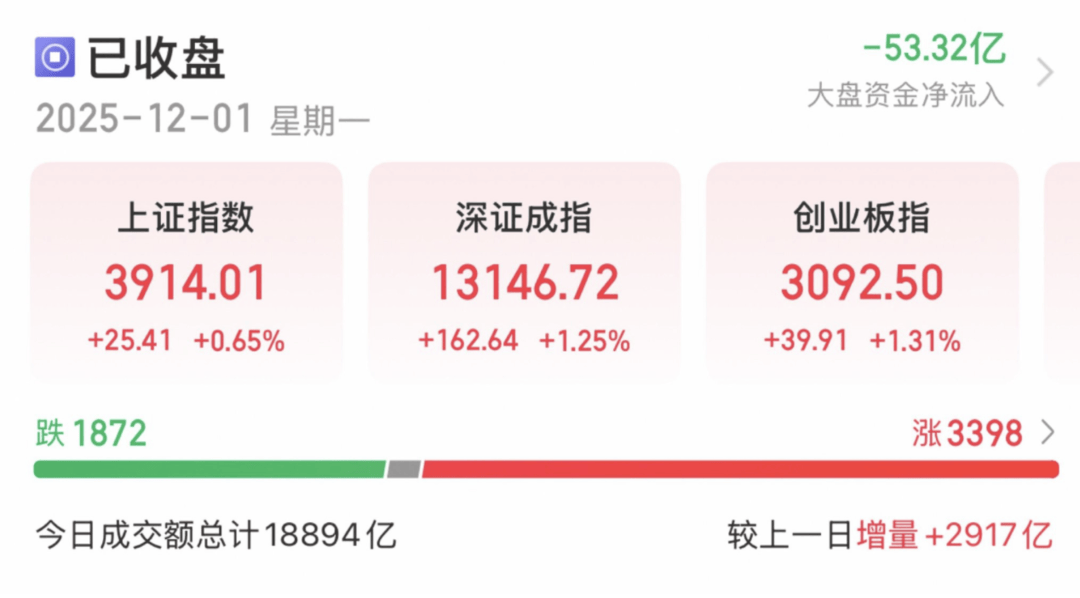
Market Overview - On the first trading day of December, the A-share market experienced a "good start," with all three major indices opening high and rising, with the Shanghai Composite Index surpassing the 3900-point mark again, closing at 3914.01 points, up 0.65% [1] - The Shenzhen Component Index closed at 13146.72 points, up 1.25%, and the ChiNext Index closed at 3092.5 points, up 1.31% [1] - Market activity was robust, with a trading volume of approximately 1.88 trillion yuan, an increase of about 291.7 billion yuan compared to the previous trading day [1] - Nearly 3400 stocks in the market rose, indicating a broad-based rally [1] Technology Sector - The technology sector, particularly the consumer electronics and AI applications, saw significant gains, with AI-related hardware such as AI phones and AI glasses becoming the strongest market focus [3] - Companies like ZTE and others in the AI hardware space experienced strong stock performance, with nearly 20 related stocks hitting the daily limit [3] - The commercial aerospace sector continued its strong performance, supported by the establishment of a commercial aerospace department by the National Space Administration, leading to increased interest in the industry [3] - Semiconductor sub-sectors, including photolithography and memory chips, also showed active performance, reflecting market expectations for domestic production and industry recovery [3] Resource and Media Sectors - The cyclical resource sector and the film and media sector performed well, driven by significant increases in international silver and copper prices [4] - Stocks in the non-ferrous metals sector, such as silver and copper companies, saw strong gains, with some stocks hitting the daily limit [4] - The film and media sector was boosted by record box office earnings from popular films, with "Zootopia 2" grossing over 1.9 billion yuan in less than a week [4] Adjustments and Risks - Despite the overall market rally, some sectors experienced adjustments, with the battery sector seeing a pullback and specific stocks like China Pacific Insurance dropping over 5% due to management concerns [5] - The insurance sector's performance contrasted with the broader market, highlighting the need for attention to individual company fundamentals and governance risks [5] Market Outlook - Institutions have mixed views on the market outlook, with overall positive sentiment [5] - CITIC Securities suggests a slow bull market with a focus on resource stocks and overseas investments, while CITIC Construction advises positioning for a year-end rally [5] - Huaan Securities predicts potential high-level fluctuations in the short term, emphasizing the importance of patience and maintaining focus on the core AI industry [5]
中兴通讯12月1日现1笔大宗交易 总成交金额601.9万元 溢价率为0.00%
Xin Lang Cai Jing· 2025-12-01 09:24
Core Viewpoint - ZTE Corporation's stock rose by 10.00% on December 1, closing at 46.30 yuan, with a significant block trade occurring [1] Group 1: Stock Performance - ZTE's stock experienced a closing price of 46.30 yuan after a 10.00% increase [1] - Over the last five trading days, the stock has accumulated a rise of 19.79% [1] Group 2: Trading Activity - A block trade was recorded with a total volume of 130,000 shares and a transaction amount of 6.019 million yuan [1] - The first transaction price was 46.30 yuan, with a total of 130,000 shares traded at a premium rate of 0.00% [1] - In the past three months, ZTE has seen a total of six block trades, amounting to 28.2075 million yuan [1] Group 3: Capital Flow - The net inflow of main funds into ZTE Corporation totaled 4.922 billion yuan [1]
资金流向日报:11个行业资金呈净流入
Zheng Quan Shi Bao Wang· 2025-12-01 09:16
Market Overview - On December 1, the Shanghai Composite Index rose by 0.65%, the Shenzhen Component Index increased by 1.25%, the ChiNext Index went up by 1.31%, and the CSI 300 Index gained 1.10% [1] - Among the tradable A-shares, 3,398 stocks rose, accounting for 62.56%, while 1,872 stocks declined [1] Capital Flow - The net inflow of main funds was 775 million yuan for the day [1] - The ChiNext saw a net outflow of 4.43 billion yuan, while the STAR Market had a net inflow of 545 million yuan [1] - The CSI 300 constituent stocks experienced a net inflow of 8.54 billion yuan [1] Industry Performance - Out of the 28 first-level industries classified by Shenwan, the top-performing sectors were non-ferrous metals and communications, with increases of 2.85% and 2.81%, respectively [1] - The sectors with the largest declines included agriculture, forestry, animal husbandry, and fishery (-0.43%), environmental protection (-0.23%), and real estate (-0.06%) [1] Industry Capital Flow - The electronic industry had the highest net inflow of main funds, totaling 7.22 billion yuan, with a daily increase of 1.58% [1] - The communication industry also saw significant inflow, with 5.56 billion yuan and a daily increase of 2.81% [1] - The power equipment industry had the largest net outflow, totaling 2.99 billion yuan, despite a daily increase of 0.57% [1] - The computer industry experienced a net outflow of 2.30 billion yuan, with a daily increase of 0.64% [1] Individual Stock Performance - A total of 2,117 stocks saw net inflows, with 737 stocks having inflows exceeding 10 million yuan, and 124 stocks exceeding 100 million yuan [2] - The stock with the highest net inflow was ZTE Corporation, which rose by 10.00% with a net inflow of 4.39 billion yuan [2] - Other notable inflows included Zhaoyi Innovation and Guanghetong, with net inflows of 1.05 billion yuan and 1.03 billion yuan, respectively [2] - Stocks with net outflows exceeding 100 million yuan included Sunshine Power, Industrial Fulian, and Shenghong Technology, with outflows of 1.31 billion yuan, 1.29 billion yuan, and 1.12 billion yuan, respectively [2]




沪指重回3900点,消费电子掀起涨停潮
2 1 Shi Ji Jing Ji Bao Dao· 2025-12-01 09:09
Market Overview - On December 1, the three major A-share indices collectively rose, with the Shanghai Composite Index returning to 3,900 points [1] - The consumer electronics sector experienced a significant surge, with companies like Haosheng Electronics hitting the daily limit, and over 20 stocks including ZTE, Meige Intelligent, Chaoyang Technology, and Hivi Technology also reaching the daily limit [1] Company Developments - Li Auto announced on its official WeChat account that it will hold a launch event for its AI glasses, Livis, on December 3 at 19:30 [1] - On November 27, Alibaba's Quark AI glasses were released, integrating with Alibaba's Qianwen [1] - ZTE's official WeChat account reported the limited release of the Nubia M153, which features the Doubao mobile assistant technology preview version for developers and interested users [1] Market Sentiment - Industrial analysts at Industrial Securities believe that the current cross-year market has a solid foundation due to the easing of previous overseas disturbances, an increase in global liquidity expectations, and improved risk appetite [1] - Following earlier market fluctuations and adjustments, the upcoming year-end meetings are expected to provide clearer guidance on economic and industrial development for the next year, potentially consolidating market consensus and directing main investment themes [1]
恒指收复26000点,这只股大涨566%
第一财经· 2025-12-01 09:01
Market Performance - The Hang Seng Index closed at 26,033.26, up by 0.67%, recovering above the 26,000 mark [1][2] - The Hang Seng Technology Index increased by 0.82% [1][2] - Sectors such as non-ferrous metals, transportation, electrical equipment, and semiconductors showed significant gains, while sectors like environmental protection and pharmaceuticals experienced declines [2] Gold Stocks - Gold stocks performed strongly, with China Gold International rising over 11%, Zijin Mining and China Silver Group increasing by over 5%, and Lingbao Gold and Shandong Gold up by over 4% [3][4] - Specific stock performances include: - China Gold International: 165.500c, up 11.37% - China Silver Group: 0.750c, up 5.63% - Zijin Mining: 32.320c, up 5.28% - Lingbao Gold: 17.070c, up 4.21% - Shandong Gold: 35.980c, up 4.05% [4] Company Developments - ZTE Corporation saw a nearly 14% increase in its stock price [5] - ByteDance announced the release of a technical preview version of the Doubao Phone Assistant, developed in collaboration with mobile manufacturers, with ZTE being the only disclosed partner [5] - TATA Health resumed trading after more than 1.5 years, with an intraday increase exceeding 720%, closing up over 566% [6]



中兴通讯今日大宗交易平价成交13万股,成交额601.9万元
Xin Lang Cai Jing· 2025-12-01 08:56
| 权益类证券大宗交易 (协议交易) | | | | | | | | 0 | | --- | --- | --- | --- | --- | --- | --- | --- | --- | | 交易日期 | 证券代码 | 证券简称 | 成交价格 | 成交量 | 成交金额 | 买方营业部 | | 卖方营业洁 | | | | | (元) | (万股/万份) | (万元) | | | | | 2025-12-01 | 000063 | 中兴通讯 | 46.30 | 13.00 | | 601.90 光大证券股份有限 | 华安证券股份有限 A. F. Boom B. B. B. B. B. B. B. B. | | 12月1日,中兴通讯大宗交易成交13万股,成交额601.9万元,占当日总成交额的0.04%,成交价46.3 元,较市场收盘价46.3元持平。 ...
