CNOOC(00883)

Search documents
智通港股通活跃成交|12月17日
智通财经网· 2025-12-17 11:04
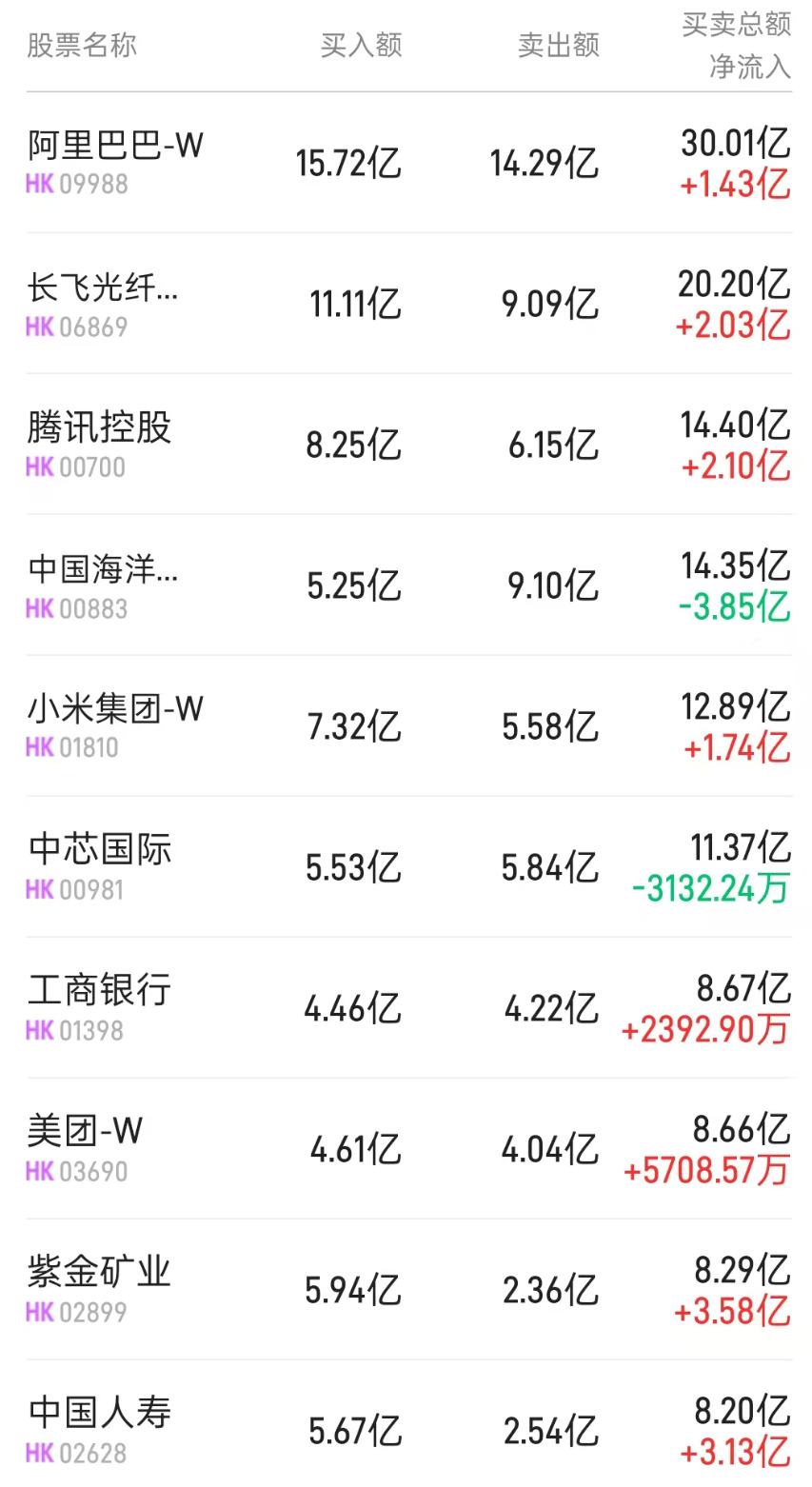
Core Insights - On December 17, 2025, Alibaba-W (09988), Changfei Optical Fiber Cable (06869), and Tencent Holdings (00700) were the top three stocks by trading volume in the Southbound Stock Connect, with trading amounts of 30.01 billion, 20.20 billion, and 14.40 billion respectively [1][2] - In the Shenzhen-Hong Kong Stock Connect, Alibaba-W (09988), Tencent Holdings (00700), and Xiaomi Group-W (01810) also led the trading volume, with amounts of 25.57 billion, 20.65 billion, and 14.33 billion respectively [1][2] Southbound Stock Connect (Shanghai-Hong Kong) - Top active companies by trading volume included: - Alibaba-W (09988): 30.01 billion with a net buy of +1.43 billion - Changfei Optical Fiber Cable (06869): 20.20 billion with a net buy of +2.03 billion - Tencent Holdings (00700): 14.40 billion with a net buy of +2.10 billion - Other notable companies included China National Offshore Oil (00883) with 14.35 billion and a net sell of -3.85 billion [2] Southbound Stock Connect (Shenzhen-Hong Kong) - Top active companies by trading volume included: - Alibaba-W (09988): 25.57 billion with a net buy of +4.01 billion - Tencent Holdings (00700): 20.65 billion with a net buy of +2.48 billion - Xiaomi Group-W (01810): 14.33 billion with a net buy of +8.89 billion - Other notable companies included Meituan-W (03690) with 11.13 billion and a net buy of +6.93 billion [2]



净买入约79亿港元创近三周新高 加仓长飞光纤及多只科技股
Xin Lang Cai Jing· 2025-12-17 10:39
智通财经12月17日讯(编辑 冯轶)据Wind数据显示,南向资金今日成交约796.24亿港元,短线三连降,较前一日缩量约97亿,约占恒指成交总额的 43.49%。 港股今日反弹拉升,南向资金全天大幅净买入约79.09亿港元,为近三周以来单日新高。其中,沪港股通净流入约22.18亿港元,深港股通净流入约56.91亿港 元。 个股方面,交易所数据显示,今日南向资金 美团-W今日涨1.81%,资金前5日加仓3490万股,短线持续流入。 长飞光纤光缆今日涨21.21%,资金前5日加仓580万股,短线加速流入。 紫金矿业今日涨1.82%,资金前5日减持1886万股,短线仍以流出为主。 中国移动今日涨0.18%,资金前5日减持240万股,短线继续流出。 中国海洋石油今日跌0.20%,资金前5日减持5307万股,短线延续流出趋势。 注:由于港交所T+2结算,实际为截至两日前的近5日数据 大幅净买入:小米集团-W(01810.HK)10.63亿港元;美团-W(03690.HK)7.51亿港元;长飞光纤光缆(06869.HK)4.14亿港元;紫金矿业 (02899.HK)3.58亿港元。 大幅净流出:中国移动(00941.HK ...




图解丨南下资金连续14日净买入小米,共计138亿港元
Ge Long Hui A P P· 2025-12-17 10:23
Group 1 - Southbound funds net bought Hong Kong stocks worth 7.909 billion HKD today [1] - Notable net purchases include Xiaomi Group-W at 1.063 billion HKD, Meituan-W at 750 million HKD, and Alibaba-W at 543 million HKD [1] - Southbound funds have continuously net bought Xiaomi for 14 days, totaling 13.84687 billion HKD, and Meituan for 6 days, totaling 5.55796 billion HKD [1] Group 2 - Net sales were recorded for China Mobile at 514 million HKD and China National Offshore Oil Corporation at 132 million HKD [1] - Alibaba-W experienced a 1.3% decline with a net purchase of 1.43 billion HKD [3] - Tencent Holdings saw a 1.4% increase with a net purchase of 2.10 billion HKD [3]

北水动向|北水成交净买入79.09亿 内资全天抢筹科网股 加仓南方恒生科技(03033)超7亿港元
智通财经网· 2025-12-17 10:04
Summary of Key Points Core Viewpoint - The Hong Kong stock market saw significant net buying from northbound capital, totaling HKD 79.09 billion, with notable interest in technology stocks and a cautious approach from investors as they await policy changes in the new year [1]. Group 1: Northbound Capital Inflows - Northbound capital recorded a net buying of HKD 79.09 billion, with HKD 22.18 billion from the Shanghai Stock Connect and HKD 56.91 billion from the Shenzhen Stock Connect [1]. - The most purchased stocks included Xiaomi Group-W (01810), Meituan-W (03690), and Southern Hang Seng Technology (03033) [1]. - The largest net sell-offs were seen in China Mobile (00941) and CNOOC (00883) [1]. Group 2: Individual Stock Performance - Alibaba-W (09988) had a net inflow of HKD 15.72 billion, with total transactions of HKD 30.01 billion [2]. - Meituan-W (03690) recorded a net inflow of HKD 4.61 billion, with total transactions of HKD 8.66 billion [3]. - Xiaomi Group-W (01810) saw a net inflow of HKD 10.62 billion, with a future focus on R&D investment of HKD 200 billion over five years [4]. Group 3: Sector Insights - The technology sector, particularly AI-related stocks, is expected to rebound significantly with potential policy catalysts in the new year [5]. - Longi Green Energy (06869) received a net inflow of HKD 4.13 billion, with plans to use proceeds from a new share placement to expand overseas [5]. - China Life (02628) had a net inflow of HKD 3.13 billion, with expectations of valuation recovery due to stabilizing long-term interest rates [6]. Group 4: Market Trends - Semiconductor company SMIC (00981) received a net inflow of HKD 2.17 billion, with its market share closely approaching that of Samsung [7]. - Overall, the top ten foundries saw a revenue increase of 8.1% quarter-over-quarter, indicating a positive trend in the semiconductor industry [7].

中国海油化学将全会精神融入发展实践
Zhong Guo Hua Gong Bao· 2025-12-17 07:37
Group 1 - China National Offshore Oil Corporation (CNOOC) is actively promoting the spirit of the 20th Central Committee's Fourth Plenary Session, focusing on integrating this spirit into the development of a world-class green chemical technology company [1] - The session emphasizes the importance of optimizing and upgrading traditional industries, which strengthens the confidence and clarity of goals for companies like Dayukou in their transformation journey [1] - Fudao Company is translating the session's spirit into development momentum by focusing on comprehensive utilization of natural gas in the South China Sea and advancing green ammonia and green alcohol technologies [1] Group 2 - The session calls for deepening state-owned enterprise reform to strengthen and optimize state-owned enterprises and capital [2] - Huhe Company emphasizes the importance of meticulous operations and striving for excellence to support overall quality improvement and structural upgrades [2] - The port is integrating the session's spirit with smart port construction and logistics network expansion, aiming to enhance operational efficiency through advanced technologies like 5G and artificial intelligence [2]
港股通红利低波ETF(159117)涨0.10%,成交额601.87万元
Xin Lang Cai Jing· 2025-12-17 07:09
Group 1 - The core viewpoint of the news is the performance and details of the Penghua Hong Kong Stock Connect Low Volatility Dividend ETF (159117), which closed with a slight increase of 0.10% on December 17, with a trading volume of 6.0187 million yuan [1] - The fund was established on September 30, 2025, with an annual management fee of 0.30% and a custody fee of 0.10%, and its performance benchmark is the S&P Hong Kong Stock Connect Low Volatility Dividend Index return (adjusted for exchange rates) [1] - As of December 16, the latest share count for the ETF is 155 million shares, with a total size of 158 million yuan [1] - The ETF has shown liquidity with a cumulative trading amount of 97.7976 million yuan over the last 20 trading days, averaging 4.8899 million yuan per day [1] Group 2 - The latest report indicates that the ETF's top holdings include companies such as Hang Lung Properties, Jiangxi Copper, China Shenhua, and others, with specific holding percentages and market values detailed [2] - The top holdings and their respective percentages are as follows: Hang Lung Properties at 1.08% with a market value of 4.0664 million yuan, Jiangxi Copper at 1.08% with a market value of 4.0565 million yuan, and China Shenhua at 1.05% with a market value of 3.9728 million yuan, among others [2]


中海油海南新能源公司增资至23.8亿,增幅约30%
Sou Hu Cai Jing· 2025-12-17 03:38
Core Viewpoint - CNOOC (Hainan) New Energy Co., Ltd. has increased its registered capital by approximately 30%, from about 1.83 billion RMB to about 2.38 billion RMB, alongside changes in key personnel [1] Company Summary - The company was established in December 2021 and is wholly owned by CNOOC (China) Limited [1] - The legal representative of the company is Jin Haibo [1] - The business scope includes power generation, transmission, distribution, installation, maintenance, and testing of electrical facilities, as well as biomass energy technology services, resource recycling technology research and development, emerging energy technology research and development, and sales of battery swap facilities for new energy vehicles [1]
全球首套!海上油气绿色转型再添“中国方案”
Bei Jing Ri Bao Ke Hu Duan· 2025-12-17 02:46
Core Insights - The world's first 5MW offshore high-temperature flue gas waste heat ORC (Organic Rankine Cycle) power generation device has successfully generated over 10 million kilowatt-hours of electricity at the Wenchang 9-7 oilfield, marking a new phase of stable and efficient operation [1] - This ORC power generation device converts waste flue gas heat into clean electricity, contributing to the green transformation of offshore oil and gas operations in China and achieving a significant breakthrough in waste heat utilization technology [1] Group 1 - The ORC power generation device serves as the "heart" of offshore platforms, traditionally generating electricity through the combustion of self-produced oil and gas, which emits a large amount of high-temperature flue gas [1] - The device utilizes high-temperature flue gas waste heat as a heat source, heating low-boiling-point organic substances to produce high-pressure steam that drives a turbine generator [1] - Since its operation, the device has improved power supply capacity by 20% and fuel utilization efficiency by 8%, significantly enhancing overall energy efficiency [1] Group 2 - The Wenchang 9-7 platform's ORC power generation device has saved approximately 6 million cubic meters of natural gas, enough to meet the annual gas needs of 20,000 households, and has reduced carbon dioxide emissions by about 9,000 tons, equivalent to planting 80,000 trees [1] - To promote energy efficiency and carbon optimization in offshore oil and gas fields, the CNOOC Research Institute is developing a green low-carbon technology system centered on three series: "Renewable Energy, Clean Energy, and New Energy" [2] - The next steps involve promoting multi-energy collaboration between traditional oil and gas, thermal, electrical, and renewable energy, aiming to build an integrated energy system and assist in achieving a "zero-carbon" future for marine energy development [2]
12月16日港股通净买入0.82亿港元





Zheng Quan Shi Bao Wang· 2025-12-17 01:36
Market Overview - On December 16, the Hang Seng Index fell by 1.54%, closing at 25,235.41 points, with a total net inflow of southbound funds through the Stock Connect amounting to HKD 0.82 billion [1][3] Trading Activity - The total trading volume for the Stock Connect on December 16 was HKD 89.399 billion, with a net inflow of HKD 0.82 billion. Specifically, the Shanghai Stock Connect had a trading volume of HKD 51.919 billion with a net outflow of HKD 1.106 billion, while the Shenzhen Stock Connect had a trading volume of HKD 37.480 billion with a net inflow of HKD 1.188 billion [1][2] Active Stocks - In the Shanghai Stock Connect, Alibaba-W had the highest trading volume at HKD 71.36 billion, followed by Tencent Holdings and Xiaomi Group-W with trading volumes of HKD 23.41 billion and HKD 19.99 billion, respectively. Tencent Holdings had the highest net inflow of HKD 0.63 billion, while Alibaba-W experienced the largest net outflow of HKD 1.012 billion [1][2] - In the Shenzhen Stock Connect, Alibaba-W also led with a trading volume of HKD 42.60 billion, followed by Tencent Holdings and Xiaomi Group-W with HKD 29.11 billion and HKD 14.09 billion, respectively. Xiaomi Group-W had the highest net inflow of HKD 0.459 billion, while Tencent Holdings faced the largest net outflow of HKD 0.432 billion [2] Stock Performance - The closing prices for key stocks on December 16 showed declines: Alibaba-W fell by 2.96%, Tencent Holdings decreased by 1.08%, and Xiaomi Group-W dropped by 2.25% [1][2]
中国石油股份近一个月首次上榜港股通成交活跃榜
Zheng Quan Shi Bao Wang· 2025-12-17 01:21
Core Viewpoint - On December 16, China Petroleum & Chemical Corporation (Sinopec) made its first appearance on the Hong Kong Stock Connect active trading list in a month, amidst a total trading volume of 319.39 billion HKD for active stocks, which accounted for 35.73% of the day's total trading amount [1] Group 1: Trading Activity - The total trading volume for Hong Kong Stock Connect on December 16 was 319.39 billion HKD, with a net selling amount of 13.29 billion HKD [1] - Alibaba Group (BABA) led the trading volume with 113.96 billion HKD, followed by Tencent Holdings (TCEHY) at 52.52 billion HKD and Xiaomi Corporation (XIACF) at 34.07 billion HKD [1] - The most frequently listed stocks in the past month were Alibaba and Tencent, each appearing 22 times, indicating strong interest from Hong Kong Stock Connect investors [1] Group 2: Individual Stock Performance - Sinopec's trading volume on December 16 was 6.50 billion HKD, with a net selling of 3.31 billion HKD, and the stock closed down by 1.35% [1] - Tencent Holdings had a trading volume of 52.52 billion HKD with a net buying of 1.98 billion HKD, closing down by 1.08% [1] - Xiaomi Corporation recorded a trading volume of 34.07 billion HKD with a net buying of 6.33 billion HKD, closing down by 2.25% [1] - Alibaba's trading volume was 113.96 billion HKD with a net selling of 6.32 billion HKD, closing down by 2.96% [1]