CNOOC(00883)

Search documents
石油股集体走低 中国海洋石油跌近3% 国际原油延续跌势
Xin Lang Cai Jing· 2025-11-24 02:43
Core Viewpoint - The Hong Kong oil stocks are experiencing a decline, influenced by falling international crude oil prices and potential impacts from a possible peace agreement between Russia and Ukraine [1] Group 1: Market Performance - Chinese offshore oil companies, including CNOOC, PetroChina, and Sinopec, have seen stock declines of nearly 3%, 2%, and over 1% respectively [1] - The overall trend in the oil market indicates a significant drop, with traders assessing the implications of a potential peace agreement that could increase oil supply [1] Group 2: Oil Price Dynamics - International crude oil prices continued to decline, following the largest weekly drop since early October [1] - The market is closely monitoring three key developments: the feasibility of the peace agreement, the potential easing of sanctions on Russia, and the impact of these developments on an already anticipated oversupply in the market next year [1] Group 3: Production Trends - OPEC+ and other oil-producing countries, particularly in the Americas, have been increasing production, contributing to a bearish outlook for oil prices [1] - The current market conditions suggest that oil prices are likely to end the year lower [1]

港股异动丨石油股集体走低 中国海洋石油跌近3% 国际原油延续跌势
Ge Long Hui· 2025-11-24 02:41
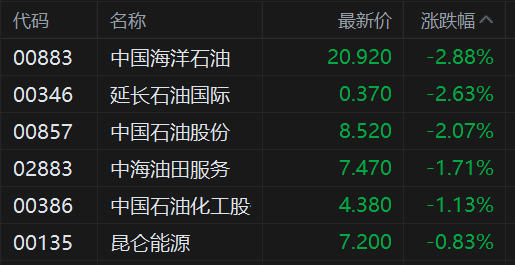
Core Viewpoint - The Hong Kong oil stocks are experiencing a decline, driven by falling international crude oil prices and concerns over potential oversupply in the market due to geopolitical developments [1][2] Group 1: Market Performance - Chinese offshore oil stock (00883) fell by 2.88% to 20.920 - Yanchang Petroleum International (00346) decreased by 2.63% to 0.370 - China Petroleum & Chemical Corporation (00857) dropped by 2.07% to 8.520 - CNOOC Services (02883) declined by 1.71% to 7.470 - China Petroleum (00386) fell by 1.13% to 4.380 - Kunlun Energy (00135) decreased by 0.83% to 7.200 [2] Group 2: Oil Price Trends - International crude oil prices continued to decline, following the largest weekly drop since early October [1] - Traders are assessing the potential impact of a peace agreement between Russia and Ukraine, which could lead to increased oil supply in an already well-supplied market [1] - Key developments being monitored include the feasibility of the peace agreement, the potential easing of sanctions on Russia, and the implications for an anticipated significant oversupply in the market next year [1]



【石油化工】坚守长期主义,持续看好“三桶油”——行业周报429期(20251117—20251123)(赵乃迪/蔡嘉豪/王礼沫)
光大证券研究· 2025-11-23 23:05
Group 1 - The core viewpoint of the article highlights the imbalance in global oil supply and demand, leading to a decline in international oil prices, with OPEC+ planning to pause production increases to alleviate the oversupply situation [4] - As of November 21, 2025, Brent and WTI crude oil prices were reported at $62.51 and $57.98 per barrel, reflecting a decrease of 2.8% and 3.3% respectively from the previous week [4] - OPEC's production increased to 28.46 million barrels per day in October 2025, marking a 6.68% rise since the beginning of the year, contributing to the shift from a tightening supply to an oversupply scenario [4] Group 2 - The "Big Three" oil companies in China, namely China National Petroleum, Sinopec, and CNOOC, demonstrated resilience in their earnings during the oil price downturn, with net profit declines of -4.9%, -32.2%, and -12.6% respectively for the first three quarters of 2025 [5] - In Q3 2025, the net profit declines for these companies were less severe compared to major international oil giants, showcasing their ability to withstand the pressures of falling oil prices [5] - The performance of the "Big Three" during this period reflects their cyclical resilience, as they maintained higher earnings levels than historical oil price periods [5] Group 3 - Expectations of a cold winter in 2025, potentially influenced by a "double La Niña" phenomenon, are likely to drive significant growth in natural gas demand during the heating season [6] - The "Big Three" are enhancing their market expansion efforts, leading to rapid growth in natural gas sales, benefiting from the ongoing market reforms in China's natural gas sector [6] - The proportion of regulated pricing in the natural gas sales of the "Big Three" is expected to continue decreasing, allowing for greater price flexibility in the unregulated segment [6] Group 4 - The natural gas business of the "Big Three" is anticipated to contribute significantly to operating profits during the heating season in Q4 2025, especially amid fluctuating oil prices [7]



石油化工行业周报第429期(20251117—20251123):坚守长期主义,持续看好三桶油-20251123
EBSCN· 2025-11-23 07:31
Investment Rating - The report maintains an "Overweight" rating for the oil and petrochemical industry [5] Core Views - The international oil market is experiencing a supply-demand imbalance, leading to downward pressure on oil prices. As of November 21, 2025, Brent and WTI crude oil prices were reported at $62.51 and $57.98 per barrel, reflecting declines of 2.8% and 3.3% respectively from the previous week. The OPEC+ group plans to pause production increases from January to March 2026, which is expected to alleviate the oversupply situation [1][4] - The "Big Three" oil companies in China (China National Petroleum Corporation, Sinopec, and CNOOC) have demonstrated resilience during the current downturn in oil prices, with their net profits declining less than many international oil giants. For the first three quarters of 2025, their net profits fell by 4.9%, 32.2%, and 12.6% respectively, showcasing their ability to navigate through cyclical challenges [2] - Anticipated cold winter conditions in 2025 are expected to significantly boost natural gas demand, benefiting the natural gas business of the "Big Three." The companies are enhancing market expansion efforts, leading to rapid growth in natural gas sales. The ongoing market reforms are expected to improve pricing flexibility and profitability in their natural gas operations [3] Summary by Sections Oil Supply and Demand - The global oil supply has shifted from a tightening to an oversupply situation, with the surplus increasing from 500,000 barrels per day in April to 2 million barrels per day in October 2025. OPEC+ has adjusted its production increase plans, reflecting a desire to stabilize oil prices [1] Company Performance - In Q3 2025, the "Big Three" oil companies' net profits showed a smaller decline compared to international peers, indicating their strong performance amid falling oil prices. Their production levels and cost control capabilities have allowed them to maintain profitability above historical levels [2] Natural Gas Outlook - The expectation of a cold winter is likely to drive up natural gas demand, with the "Big Three" positioned to capitalize on this through increased sales and improved pricing structures due to market reforms [3] Investment Recommendations - The report suggests a continued positive outlook for the "Big Three" and the oil service sector, alongside favorable conditions for chemical products in the long term. Specific companies to watch include China National Petroleum Corporation, Sinopec, CNOOC, and various subsidiaries involved in oil services and refining [4]
ADNOC三家公司亮相进口博览会
Shang Wu Bu Wang Zhan· 2025-11-22 14:29
Core Insights - ADNOC and its subsidiaries Masdar, Borouge, and TA'ZIZ participated in the 8th China International Import Expo to showcase energy projects and engage in cooperation discussions with Chinese clients [1] - ADNOC signed three agreements, including a memorandum of cooperation with CNOOC and an extension of crude oil supply agreement, further solidifying energy cooperation between China and the UAE [1] Group 1 - ADNOC's participation in the expo highlights its commitment to expanding its presence in the Chinese market [1] - The agreements signed indicate a strategic move to enhance bilateral energy relations and secure long-term partnerships [1] - The collaboration with CNOOC reflects ADNOC's strategy to leverage Chinese investments and technology in its energy projects [1]
信达生物(01801)、紫金矿业(02899)将被纳入恒指ESG增强指数成份股
智通财经网· 2025-11-21 11:53
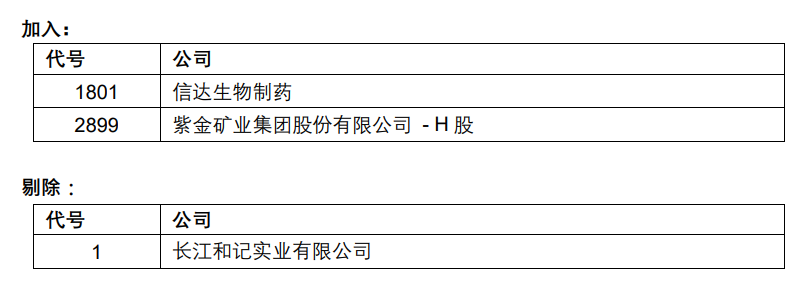
Group 1 - The Hang Seng Index Company announced the quarterly index review results for the Hang Seng ESG Enhanced Index, Hang Seng ESG Enhanced Select Index, and Hang Seng China Enterprises ESG Enhanced Index, effective from December 8, 2025 [1] - The number of constituents in the Hang Seng ESG Enhanced Index will increase from 76 to 77, with the inclusion of Innovent Biologics (01801) and Zijin Mining Group (02899), while Cheung Kong (00001) will be removed [1][3] - The Hang Seng ESG Enhanced Select Index will also see the addition of Innovent Biologics (01801) and Zijin Mining Group (02899), increasing its constituents from 74 to 75, with Cheung Kong (00001) being removed [1][3] Group 2 - The Hang Seng China Enterprises ESG Enhanced Index will include China National Offshore Oil Corporation (00883), Innovent Biologics (01801), and Yum China Holdings (09987), maintaining a total of 45 constituents [1][5] - The inclusion of these companies reflects a focus on enhancing the ESG profile of the indices [1]


石油ETF(561360)开盘跌1.17%,重仓股中国海油跌0.34%,中国石油跌0.10%
Xin Lang Cai Jing· 2025-11-21 11:43
Core Viewpoint - The oil ETF (561360) opened down by 1.17% at 1.185 yuan, reflecting a mixed performance among its major holdings [1] Group 1: ETF Performance - The oil ETF (561360) has a performance benchmark of the CSI Oil and Gas Industry Index return rate [1] - Since its establishment on October 23, 2023, the fund has achieved a return of 19.63% [1] - The fund's return over the past month is reported at 7.61% [1] Group 2: Major Holdings Performance - China National Offshore Oil Corporation (CNOOC) opened down by 0.34% [1] - China Petroleum opened down by 0.10% [1] - China Petrochemical remained unchanged at 0.00% [1] - Jereh Group opened down by 1.55% [1] - China Merchants Energy opened up by 0.33% [1] - Guanghui Energy opened down by 0.39% [1] - COSCO Shipping Energy opened up by 0.79% [1] - Hengli Petrochemical opened down by 1.15% [1] - China Merchants South Oil opened down by 0.31% [1] - CNOOC Engineering opened down by 0.53% [1]


智通港股通活跃成交|11月21日
智通财经网· 2025-11-21 11:19
Core Insights - On November 21, 2025, Alibaba-W (09988), Xiaomi Group-W (01810), and Yingfu Fund (02800) were the top three stocks by trading volume in the Southbound Stock Connect, with trading amounts of 75.13 billion, 50.10 billion, and 39.92 billion respectively [1] - In the Shenzhen-Hong Kong Stock Connect, Alibaba-W (09988), Xiaomi Group-W (01810), and Tencent Holdings (00700) also ranked as the top three, with trading amounts of 59.52 billion, 26.55 billion, and 24.41 billion respectively [1] Southbound Stock Connect - Top Active Companies - Alibaba-W (09988) had a trading amount of 75.13 billion with a net buying amount of +8.47 billion [1] - Xiaomi Group-W (01810) recorded a trading amount of 50.10 billion with a net buying amount of +9.48 billion [1] - Yingfu Fund (02800) had a trading amount of 39.92 billion but a net selling amount of -37.55 billion [1] - Tencent Holdings (00700) saw a trading amount of 36.12 billion with a net buying amount of +9.61 billion [1] - SMIC (00981) had a trading amount of 31.12 billion with a net buying amount of +1.49 billion [1] - Meituan-W (03690) recorded a trading amount of 12.35 billion with a net selling amount of -55.12 million [1] - Ganfeng Lithium (01772) had a trading amount of 11.02 billion with a net selling amount of -1.91 billion [1] - Pop Mart (09992) recorded a trading amount of 10.97 billion with a net selling amount of -6.97 million [1] - Hua Hong Semiconductor (01347) had a trading amount of 10.81 billion with a net selling amount of -6.86 million [1] - China National Offshore Oil Corporation (00883) recorded a trading amount of 9.73 billion with a net buying amount of +650.39 million [1] Shenzhen-Hong Kong Stock Connect - Top Active Companies - Alibaba-W (09988) had a trading amount of 59.52 billion with a net buying amount of +3.10 billion [1] - Xiaomi Group-W (01810) recorded a trading amount of 26.55 billion with a net buying amount of +3.20 billion [1] - Tencent Holdings (00700) saw a trading amount of 24.41 billion with a net buying amount of +7.75 billion [1] - SMIC (00981) had a trading amount of 24.07 billion with a net selling amount of -3.39 billion [1] - Southern Hang Seng Technology (03033) recorded a trading amount of 14.79 billion with a net buying amount of +723.43 million [1] - Yingfu Fund (02800) had a trading amount of 14.01 billion with a net selling amount of -13.88 billion [1] - Meituan-W (03690) recorded a trading amount of 10.17 billion with a net buying amount of +2.01 billion [1] - Hua Hong Semiconductor (01347) had a trading amount of 8.68 billion with a net selling amount of -2.69 billion [1] - XPeng Motors-W (09868) recorded a trading amount of 7.82 billion with a net buying amount of +1.34 billion [1] - Kuaishou-W (01024) had a trading amount of 6.63 billion with a net buying amount of +2.36 billion [1]




港股通红利低波ETF(159117)跌1.33%,成交额840.05万元
Xin Lang Cai Jing· 2025-11-21 07:16
Core Viewpoint - The Penghua Hong Kong Stock Connect Low Volatility Dividend ETF (159117) experienced a decline of 1.33% in its closing price on November 21, with a trading volume of 8.4005 million yuan [1]. Fund Overview - The fund was established on September 30, 2025, and is officially named Penghua S&P Hong Kong Stock Connect Low Volatility Dividend Index Securities Investment Fund [1]. - The management fee is set at 0.30% per annum, while the custody fee is 0.10% per annum [1]. - The performance benchmark for the fund is the S&P Hong Kong Stock Connect Low Volatility Dividend Index return (adjusted for exchange rates) [1]. Fund Size and Liquidity - As of November 20, the latest share count for the ETF is 161 million shares, with a total size of 170 million yuan [1]. - Over the past 20 trading days, the cumulative trading amount reached 218 million yuan, with an average daily trading amount of approximately 10.8994 million yuan [1]. Fund Management - The current fund managers are Yan Dong and Yu Zhanchang, both of whom have managed the fund since its inception on September 30, 2025, achieving a return of 6.76% during their tenure [1][2]. Top Holdings - The ETF's top holdings include: - Hang Lung Properties (1.08% holding, 496,000 shares, market value of 4.0664 million yuan) - Jiangxi Copper Co. (1.08% holding, 122,000 shares, market value of 4.0565 million yuan) - China Shenhua Energy (1.05% holding, 110,000 shares, market value of 3.9728 million yuan) - Far East Horizon (0.99% holding, 588,000 shares, market value of 3.7202 million yuan) - CNOOC (0.96% holding, 210,000 shares, market value of 3.6159 million yuan) - Sino Land (0.94% holding, 384,000 shares, market value of 3.5443 million yuan) - PetroChina (0.87% holding, 496,000 shares, market value of 3.2921 million yuan) - Hengan International (0.87% holding, 134,500 shares, market value of 3.2589 million yuan) - Henderson Land Development (0.81% holding, 122,000 shares, market value of 3.0452 million yuan) - Bank of China Hong Kong (0.81% holding, 91,000 shares, market value of 3.0623 million yuan) [2].


港股通红利ETF广发(520900)已经连续5周份额增长,近20日获1.5亿元资金净申购
Xin Lang Ji Jin· 2025-11-21 04:21
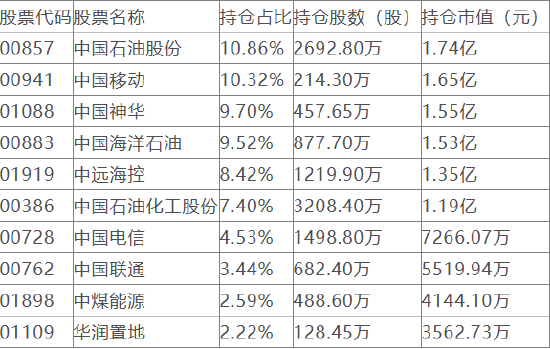
Core Viewpoint - The Hong Kong dividend assets are experiencing a correction, but the trend of capital inflow continues, driven by the demand for high-dividend assets from insurance companies under new accounting standards [1][2]. Group 1: Market Performance - As of November 21, the Hong Kong Stock Connect Dividend ETF (520900) fell by 1.74% with a trading volume of 33.55 million yuan [1]. - Over the past 10 days, the net inflow into the ETF was 104 million yuan, and over the past 20 days, it was 150 million yuan, with the latest fund size reaching 1.881 billion yuan [1]. Group 2: Fund Inflows and Trends - From October 13 to November 14, the ETF has seen continuous growth in shares for five consecutive weeks, with the latest share count at 1.728 billion [1]. - The demand for high-dividend stocks is expected to increase significantly as insurance companies switch to new accounting standards by 2026, with an estimated annual allocation of 250 to 500 billion yuan for high-dividend assets by five A-share listed insurance companies by 2027 [1]. Group 3: Investment Characteristics - The Hong Kong dividend assets exhibit a "defensive" characteristic in volatile markets, with a focus on high-dividend state-owned enterprises [2]. - The ETF tracks the CSI National New Hong Kong Stock Connect Central Enterprise Dividend Index, which emphasizes high-dividend state-owned enterprises, with the top three sectors being oil and petrochemicals (29.7%), telecommunications (21.2%), and transportation (13.5%) [2]. Group 4: Fund Details - The Hong Kong Stock Connect Dividend ETF (520900) was established on June 26, 2024, with a management fee of 0.50% and a custody fee of 0.10% [3]. - The current fund managers are Huo Huaming and Lv Xin, with returns of 12.68% and 26.76% respectively during their management periods [3]. Group 5: Top Holdings - The top holdings of the ETF include China Petroleum (10.86%), China Mobile (10.32%), and China Shenhua (9.70%), with significant market values for each [4]. - Investors focused on sustainable dividends and quality earnings can consider the ETF for a balanced exposure to high-dividend stocks in the Hong Kong market [4].