
ICBC(01398)

Search documents
1年近400家银行机构退出市场
21世纪经济报道· 2025-12-26 14:52
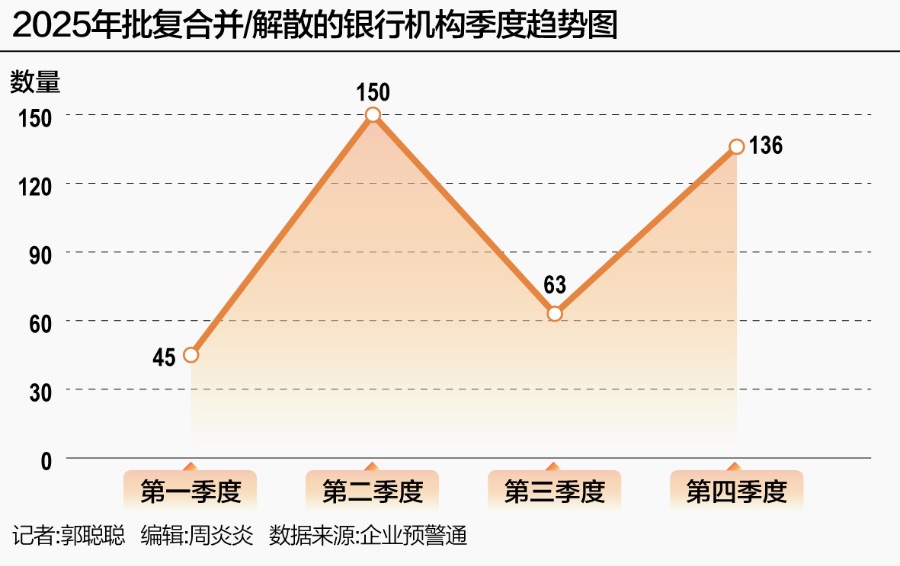
Core Viewpoint - The wave of mergers and restructuring among China's small and medium-sized banks has progressed with unexpected intensity and speed, focusing on financial risk prevention and high-quality industry development in 2025 [1][2]. Summary by Sections Mergers and Restructuring Overview - As of December 26, 2025, a total of 394 banking institutions have been approved for mergers or dissolutions, doubling the total from 2024 [1]. - Between 2024 and 2025, nearly 550 banking institutions were reduced through mergers and restructuring, surpassing the total from the previous seven years [1]. - The restructuring involved 28 provinces, with Inner Mongolia leading by integrating 139 institutions, followed by Shandong (33), Henan (26), and Sichuan (25) [1][9]. Characteristics of the Restructuring - The 2025 restructuring is characterized by two significant trends: the involvement of state-owned banks in "village-to-branch" transformations and the acceleration of provincial-level reforms in the rural credit system [2]. - This transformation is not merely a reduction in numbers but a comprehensive change across various types of institutions, moving towards a quality-driven development phase [2]. Regulatory and Policy Framework - The central financial work conference in 2024 emphasized the need to "properly handle risks in small financial institutions," placing them alongside local debts and real estate as key areas for financial risk prevention [4]. - The regulatory focus has been on risk prevention and resolution, with tailored reform plans developed for different regions [5]. Achievements and Progress - The reform efforts have led to a significant increase in the disposal of non-performing assets, with over a 40% increase compared to the previous five-year period [5]. - The number of high-risk small and medium-sized banks has significantly decreased, with some provinces achieving a "dynamic zero" for high-risk institutions [6]. Integration of Institutions - The integration process has seen state-owned banks actively participating in the restructuring of village banks, providing stronger support for their transformation [11]. - By the end of 2025, 231 village banks had merged or dissolved, with a notable acceleration in the second half of the year [12]. Future Outlook - The ongoing restructuring is expected to continue, with a focus on enhancing the quality and effectiveness of the integration process [17]. - The emphasis on "reducing quantity and improving quality" will remain a core theme in the upcoming years, as the industry transitions to a more stable and effective phase [17].



深度|银行业“瘦身”
2 1 Shi Ji Jing Ji Bao Dao· 2025-12-26 13:02
Core Insights - The wave of mergers and restructuring among China's small and medium-sized banks has progressed with unexpected intensity and speed, focusing on financial risk prevention and high-quality industry development as the core themes of the year [1][2]. Summary by Sections Mergers and Restructuring - As of December 26, 2025, a total of 394 banking institutions were approved to exit the market through mergers and dissolutions, doubling the total from 2024 [1][7]. - Between 2024 and 2025, nearly 550 banking institutions were reduced through mergers and restructuring, surpassing the total from the previous seven years [1]. - The restructuring involved 28 provinces, with Inner Mongolia leading by integrating 139 institutions, followed by Shandong (33), Henan (26), and others [1][9]. Characteristics of the Restructuring - The integration of small and medium-sized banks in 2025 is characterized by two significant trends: the involvement of state-owned banks in "village-to-branch" transformations and the acceleration of provincial-level reforms in the rural credit system [1][15]. - The core entities in the restructuring are village banks (231), followed by rural commercial banks (81) and rural credit cooperatives (71) [12]. Policy and Regulatory Framework - The central financial work conference in 2024 emphasized the need to "properly handle risks in small financial institutions," placing them alongside local debts and real estate as key areas for financial risk prevention [3]. - The regulatory focus during the "14th Five-Year Plan" period has been on risk prevention and resolution for small financial institutions, with a commitment to personalized reform strategies based on regional differences [4]. Achievements and Future Directions - Significant progress has been made in risk resolution, with over 40% more non-performing asset disposals compared to the previous five-year period, and the total capital and provisions in the industry exceeding 50 trillion yuan [5]. - The government work report for 2025 outlined a market-oriented and legal approach to risk resolution and transformation of local small financial institutions [5]. Service Upgrades and Market Dynamics - The restructuring is not merely a reduction in numbers but aims to enhance the quality and efficiency of financial services, particularly for rural and small enterprises [19][20]. - Merged institutions are expected to improve operational standards, risk resistance, and expand their service offerings through enhanced digital capabilities [19][20]. Long-term Outlook - The ongoing restructuring of small and medium-sized banks is anticipated to continue into 2026, with a focus on quality improvement and effective integration as the core theme [21].

2025年世界品牌500强发布
Xin Lang Cai Jing· 2025-12-26 12:24
Core Insights - Google ranks first, followed by Microsoft and Apple in the 2025 World Brand 500 list, with the United States leading with 184 brands, while China surpasses Japan with 50 brands, securing the third position globally [3][6]. Group 1: Brand Rankings - Google, Microsoft, and Apple are the top three brands in the 2025 World Brand 500 list [3][12]. - The United States has the highest representation with 184 brands, followed by France with 51, China with 50, Japan with 40, and the United Kingdom with 34 [6][12]. Group 2: Industry Representation - The automotive and parts industry leads with 33 brands, followed by the energy and food & beverage industries, each with 30 brands [4][5]. - The banking sector has 29 brands, while retail and computer & communications sectors each have 27 brands represented [4][5]. Group 3: Notable Chinese Brands - Key Chinese brands in the list include State Grid, Tencent, Haier, and ICBC, among others [7][8][9]. - The presence of Chinese brands has increased, with 50 brands listed, surpassing Japan's 40 brands [3][6]. Group 4: Impact of AI - The rise of generative AI is influencing brand creativity and expression, presenting both opportunities and challenges in the branding landscape [3][4].





关于2025深圳金融创新大赛拟获奖项目的公示
Xin Lang Cai Jing· 2025-12-26 12:21
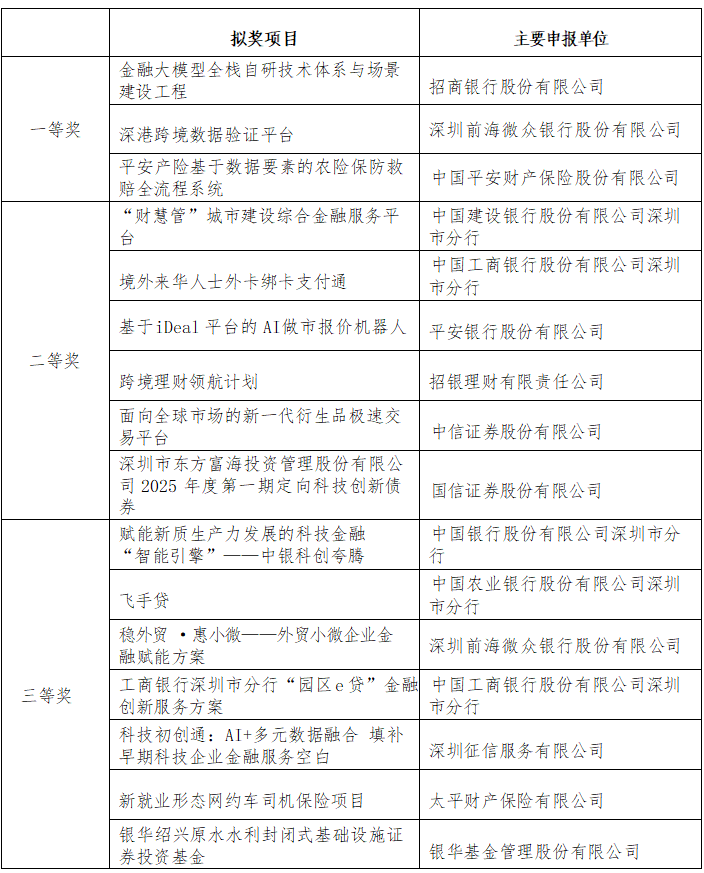
Core Viewpoint - The 2025 Shenzhen Financial Innovation Competition aims to enhance the financial services of local institutions and promote Shenzhen as a globally influential financial center, showcasing the innovation level of the financial industry in Shenzhen [1][4]. Summary by Category Competition Overview - The competition was announced in September 2025, receiving submissions from 113 units with a total of 173 projects [4]. - After various evaluation stages, 30 projects were selected for awards, including 3 first prizes, 6 second prizes, 12 third prizes, 3 most potential awards, 3 best growth awards, and 3 innovation breakthrough awards [4]. Awarded Projects - **First Prize Projects**: - Financial model full-stack self-research technology system and scenario construction project by China Merchants Bank and WeBank [6]. - Hong Kong-Shenzhen cross-border data verification platform [6]. - Agricultural insurance prevention and rescue system based on data elements by Ping An Property & Casualty Insurance [6]. - **Second Prize Projects**: - Cross-border wealth management navigation plan by China Merchants Bank Wealth Management [6]. - New generation derivative rapid trading platform for global markets by CITIC Securities [6]. - Technology financial empowerment plan for new quality productivity development by Bank of China Shenzhen Branch [6]. - **Third Prize Projects**: - AI and multi-data integration service for early-stage technology enterprises by Shenzhen Credit Service [6]. - New employment form ride-hailing driver insurance project by Taiping Property Insurance [6]. - **Most Potential Award Projects**: - "Housing Dream" project for large-scale urban village renovation by the National Development Bank Shenzhen Branch [7]. - New energy "technology + insurance" model construction by Ping An Property & Casualty Insurance Shenzhen Branch [7]. - **Best Growth Award Projects**: - New model for marine pastoral + insurance + N by Taiping Property Insurance [7]. - **Innovation Breakthrough Award Projects**: - "WeChat Quick Compensation" proactive claim model by Weimin Insurance Agency [7]. - Online self-service tax refund mini-program "Xing Shui Tong" by Guangdong Huaxing Bank Shenzhen Branch [7].


工商银行云南临沧分行原党委书记、行长赵国明被查
Bei Jing Shang Bao· 2025-12-26 11:24
北京商报讯(记者 宋亦桐)12月26日,来自云南省纪委省监委网站消息,据中国工商银行云南省分行 纪委、临沧市监委消息:中国工商银行云南临沧分行原党委书记、行长赵国明涉嫌严重违纪违法,目前 正接受中国工商银行云南省分行纪委纪律审查和临沧市监委监察调查。 ...
中国工商银行莱芜分行2025年连续三季度获评人行小微企业信贷政策导向效果评估“优秀”
Qi Lu Wan Bao· 2025-12-26 10:24
Core Viewpoint - The China Industrial and Commercial Bank (ICBC) Laiwu Branch has been recognized for its outstanding performance in the evaluation of small and micro enterprise credit policy guidance for the third quarter of 2025, receiving the highest rating of "Excellent" from regulatory authorities, reflecting its commitment to supporting the real economy and promoting inclusive finance [1][3]. Group 1: Mechanism and Policy Implementation - The Laiwu Branch has established a long-term mechanism to encourage lending, ensuring a robust support system for small and micro enterprises through policy and incentive improvements [1]. - The branch has focused on enhancing the scale of inclusive finance and directing resources effectively towards the small and micro enterprise sector [1]. Group 2: Product Supply and Service Quality - The Laiwu Branch has adopted a development strategy centered on "increasing volume, expanding coverage, improving quality, and enhancing efficiency," utilizing key online products such as "New Generation Business Quick Loan," "Online Loan," and "Digital Supply Chain" to meet the financing needs of small and micro enterprises [2]. - Continuous optimization of business processes has significantly improved the efficiency of loan approvals, making financing more accessible for small micro clients [2]. Group 3: Service Network and Marketing Collaboration - The branch has upgraded its inclusive finance service channels and strengthened the collaboration between branches, sub-branches, and outlets to create a cohesive marketing effort [2]. - A dedicated team of inclusive finance specialists has been established to foster a strong culture of inclusive finance throughout the organization [2]. Group 4: Cost Reduction and Financial Benefits - The Laiwu Branch adheres to regulatory guidelines on service fees, emphasizing compliance, quality pricing, transparency, and cost reduction to lower the financing costs for small and micro enterprises [2]. - The branch actively reduces costs and enhances efficiency, benefiting the real economy and allowing enterprises to operate with less financial burden [2]. Group 5: Future Directions - The Laiwu Branch aims to continue its customer-centric approach, implementing the latest inclusive finance policies and enhancing service quality to support the growth of small and micro enterprises and contribute to the high-quality development of the local economy [3].
谁是银行贵金属之王?
Xin Lang Cai Jing· 2025-12-26 10:11
Core Viewpoint - The global market is experiencing a rare super cycle in precious metals, driven by a reassessment of the dollar's credibility and real demand from new industrial revolutions such as AI and hydrogen energy [2][24]. Group 1: Market Dynamics - As of December 24, spot gold reached $4500 per ounce, with international silver and platinum increasing over 140% for the year [2][24]. - The demand for precious metals has shifted from traditional safe-haven assets to being driven by monetary credit, geopolitical factors, and green technology [10][34]. Group 2: Banking Sector Adjustments - Major banks like ICBC, CCB, and CITIC are cleaning up personal precious metal accounts that have been inactive, indicating a strategic shift towards focusing on quality clients rather than quantity [3][26]. - This move is not a retreat but a strategic adjustment to enhance service quality, risk control, and long-term trust [27][36]. Group 3: Asset Growth and Competition - By Q3 2025, ICBC led the market with precious metal assets of 385.43 billion yuan, followed by Bank of China, China Construction Bank, Agricultural Bank of China, and Shanghai Pudong Development Bank, all surpassing 100 billion yuan [29][31]. - The growth in precious metal assets is built on a solid foundation from 2024, with ICBC showing consistent expansion from 254.30 billion yuan in Q1 to 385.43 billion yuan in Q3 2025 [32][33]. Group 4: Future Outlook - Goldman Sachs predicts that gold prices may reach $4900 per ounce by 2026, with several financial institutions forecasting gold to potentially hit $5000 per ounce [21][41]. - The competition in the precious metals sector will focus on compliance, customer trust, and long-term strategies, with the true "king of precious metals" being the bank that retains the most engaged and trusting clients after account clean-ups [42].



工商银行取得产品推荐方法专利
Sou Hu Cai Jing· 2025-12-26 09:52
Group 1 - The core point of the article is that the Industrial and Commercial Bank of China (ICBC) has obtained a patent for a "product recommendation method, training method, device, electronic equipment, and medium," with the authorization announcement number CN116308641B and an application date of February 2023 [1] Group 2 - ICBC was established in 1985 and is located in Beijing, primarily engaged in monetary financial services [1] - The registered capital of ICBC is approximately 35.64 billion RMB [1] - According to data analysis, ICBC has invested in 28 companies, participated in 5,000 bidding projects, has 988 trademark information entries, and holds 5,000 patent information entries, along with 77 administrative licenses [1]
商业银行出海,谁在悄然发力
21世纪经济报道· 2025-12-26 09:17
Core Viewpoint - Chinese banks are expanding their global presence, establishing a comprehensive service network that supports domestic enterprises going abroad, particularly in emerging markets along the Belt and Road Initiative [1][2]. Group 1: Global Expansion Strategy - Chinese banks are transitioning from focusing primarily on traditional markets in Europe and the US to diversifying their operations in emerging markets such as Southeast Asia, the Middle East, and Latin America [1]. - The overseas expansion strategy of Chinese banks has evolved from rapid growth through new branches and acquisitions before 2019 to a more focused approach on strategic value and risk control since 2020 [11]. Group 2: Bank Performance and Revenue - As of June 2025, Bank of China leads with 783.13 billion yuan in overseas revenue, marking a 14.4% increase from the previous year, with overseas revenue accounting for 23.77% of its total [14]. - Agricultural Bank of China reported a 21.03% increase in overseas revenue, while Construction Bank's overseas revenue grew by 40.92% [14][15]. - In contrast, Everbright Bank experienced a 12.72% decline in overseas revenue, indicating varying performance among banks [16]. Group 3: Regional Distribution and Focus - The distribution of overseas institutions varies among banks, with Bank of China having the most extensive network, followed by Industrial and Commercial Bank of China, which has a significant presence in 49 countries [4][5]. - Joint-stock banks tend to focus their internationalization efforts on key financial hubs like Hong Kong and London, aiming for niche markets in cross-border finance and wealth management [9]. Group 4: Challenges and Opportunities - Chinese banks face challenges in compliance with differing regulatory environments, cultural integration, and brand recognition in international markets [18]. - The demand for diversified financial services is increasing among Chinese enterprises going abroad, with a shift towards high-value industries and a need for localized services [19][20]. Group 5: Future Directions - To enhance competitiveness, Chinese banks must focus on global collaboration, local market adaptation, compliance risk management, and financial technology innovation [22]. - The future of internationalization for Chinese banks will hinge on their ability to create value in a complex global environment, moving from broad network expansion to deep operational excellence [22].

工商银行取得音视频数据处理方法专利
Sou Hu Cai Jing· 2025-12-26 08:03
Group 1 - The core point of the article is that the Industrial and Commercial Bank of China (ICBC) has obtained a patent for a method and device for processing audio and video data, with the patent announcement number CN119835458B and an application date of December 2024 [1] Group 2 - ICBC was established in 1985 and is located in Beijing, primarily engaged in monetary financial services [1] - The registered capital of ICBC is approximately 35.64 billion RMB [1] - According to data analysis, ICBC has invested in 28 companies, participated in 5,000 bidding projects, has 988 trademark records, and holds 5,000 patent records, along with 77 administrative licenses [1]