ICBC(01398)

Search documents
国有大型银行板块1月8日跌0.68%,工商银行领跌,主力资金净流出7.17亿元
Zheng Xing Xing Ye Ri Bao· 2026-01-08 08:56
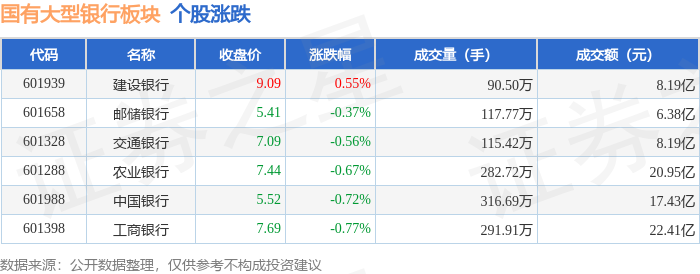
Group 1 - The core viewpoint of the news is that the state-owned large bank sector experienced a decline of 0.68% on January 8, with Industrial and Commercial Bank of China leading the drop [1] - The Shanghai Composite Index closed at 4082.98, down 0.07%, while the Shenzhen Component Index closed at 13959.48, down 0.51% [1] - The trading performance of individual stocks in the state-owned large bank sector showed mixed results, with China Construction Bank increasing by 0.55% while others like Agricultural Bank of China and Bank of China saw declines of 0.67% and 0.72% respectively [1] Group 2 - The net outflow of main funds from the state-owned large bank sector was 717 million yuan, while retail investors saw a net inflow of 541 million yuan [1] - The detailed fund flow data indicates that China Construction Bank had a net outflow of 2.14 million yuan from main funds, while retail investors contributed a net inflow of 29.14 million yuan [2] - In contrast, Bank of China experienced a significant net outflow of 244 million yuan from main funds, but had a net inflow of 119 million yuan from retail investors [2]





工商银行日照分行被罚3.5万元:违反信用信息采集、提供、查询及相关管理规定
Xin Lang Cai Jing· 2026-01-08 05:37
Core Viewpoint - The China Industrial and Commercial Bank's Rizhao branch was fined 35,000 yuan for violating credit information collection, provision, and inquiry regulations [1][2][4]. Summary by Categories Administrative Penalties - The China Industrial and Commercial Bank's Rizhao branch received a fine of 35,000 yuan for non-compliance with credit information regulations [1][2]. - Two individuals, Fei Moulin (former financial accounting department manager) and Lou Moubin (former branch manager), were each fined 7,000 yuan for their responsibility in the violations [1][3][5]. Violations - The violations pertained to the collection, provision, and inquiry of credit information as mandated for financial institutions and other entities [1][2][5].
金价强劲开局 国有银行率先上调个人黄金投资门槛
Nan Jing Ri Bao· 2026-01-07 23:35
Core Viewpoint - The Industrial and Commercial Bank of China (ICBC) has announced an increase in the risk assessment requirements for personal customers engaging in gold accumulation business, reflecting a proactive approach to risk management in response to market volatility and regulatory requirements [1][5]. Group 1: Announcement Details - Starting from January 12, 2026, personal customers must achieve a risk assessment result of C3 (balanced) or higher to engage in gold accumulation activities, which includes account opening and investment plans [2]. - Existing customers with valid risk assessment results and signed risk disclosure documents are exempt from re-evaluation [2]. - The announcement raises the entry threshold for personal customers in the gold accumulation business, which previously allowed those with a C1 (conservative) rating to participate [2]. Group 2: Industry Trends - ICBC is the first major commercial bank this year to raise the investment threshold for personal gold investments, following similar adjustments by other banks last year [3]. - Other banks, such as Ningbo Bank and Citic Bank, have also implemented higher risk assessment requirements for gold accumulation business, indicating a trend in the industry towards stricter investment criteria [3]. - The minimum investment amount for gold accumulation has been consistently increasing across various banks, with many now setting the threshold at one thousand yuan [3]. Group 3: Rationale Behind Adjustments - The adjustments are seen as a response to regulatory requirements aimed at ensuring that financial products are sold to appropriate investors, thereby preventing potential disputes arising from risk mismatches [5]. - The current high volatility in gold prices necessitates a shift in banks' risk management strategies from reactive to proactive measures [5]. - The move is expected to guide rational investment behavior among the public and maintain stability in the financial market [5][6].
智通ADR统计 | 1月8日





智通财经网· 2026-01-07 22:21
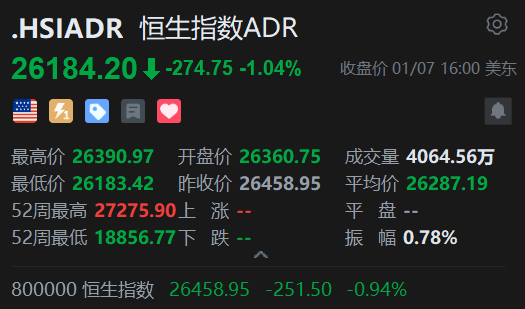
Market Overview - The Hang Seng Index (HSI) closed at 26,184.20, down by 274.75 points or 1.04% from the previous close of 26,458.95 [1] - The index reached a high of 26,390.97 and a low of 26,183.42 during the trading session, with an average price of 26,287.19 [1] Major Blue-Chip Stocks Performance - HSBC Holdings closed at 124.996 HKD, down 1.73% from the previous close [2] - Tencent Holdings closed at 619.762 HKD, down 0.76% from the previous close [2] - Alibaba Group (W) saw a decline of 3.25%, closing at 145.900 HKD [3] - Other notable declines include: - Xiaomi Group (W) down 1.55% to 38.160 HKD [3] - NetEase (S) down 2.88% to 222.600 HKD [3] - Meituan (W) down 1.51% to 104.500 HKD [3] ADR Performance - Tencent's ADR closed at 619.762, reflecting a decrease of 0.76% compared to its Hong Kong stock price [3] - HSBC's ADR was at 124.996, down 1.73% from its Hong Kong counterpart [3] - Alibaba's ADR closed at 142.841, down 2.10% compared to its Hong Kong price [3]
五大行董事长、行长2024薪酬大揭秘!哪位高管拿下最高年薪?
Xin Lang Cai Jing· 2026-01-07 17:31
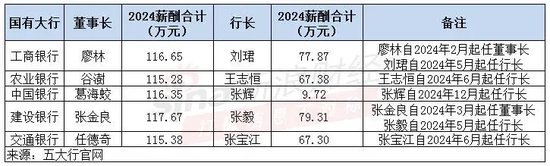
Summary of Key Points Core Viewpoint - The five major state-owned banks in China have disclosed the salaries of their chairpersons and presidents for the year 2024, with all chairpersons earning over 1.15 million yuan annually [2][5]. Group 1: Chairpersons' Salaries - The chairperson of China Construction Bank, Zhang Jinliang, has an annual salary of 1.1767 million yuan, starting from March 2024 [5][6]. - The chairperson of Industrial and Commercial Bank of China, Liao Lin, has an annual salary of 1.1665 million yuan, starting from February 2024 [5][6]. - The chairperson of Bank of China, Ge Haiqiao, has an annual salary of 1.1635 million yuan [5][6]. - The chairperson of Bank of Communications, Ren Deqi, has an annual salary of 1.1538 million yuan [5][6]. - The chairperson of Agricultural Bank of China, Gu Shu, has an annual salary of 1.1528 million yuan [5][6]. Group 2: Presidents' Salaries - The president of Industrial and Commercial Bank of China, Liu Jun, has an annual salary of 778,700 yuan, starting from May 2024 [3][7]. - The president of Agricultural Bank of China, Wang Zhiheng, has an annual salary of 673,800 yuan, starting from June 2024 [3][7]. - The president of Bank of China, Zhang Hui, has an annual salary of 97,200 yuan, starting from December 2024 [3][7]. - The president of China Construction Bank, Zhang Yi, has an annual salary of 793,100 yuan, starting from May 2024 [3][7]. - The president of Bank of Communications, Zhang Baojiang, has an annual salary of 673,000 yuan, starting from June 2024 [3][7]. Group 3: Highest Salaries Among Executives - The highest salary among executives is held by Song Jianhua, Senior Business Director of Industrial and Commercial Bank of China, with a total of 1.4746 million yuan [9][10]. - The highest salary in Agricultural Bank of China is held by former Chief Risk Officer Wu Gang, with a total of 1.4531 million yuan [9][10]. - The highest salary in Bank of China is held by former Risk Director Zhao Rong, with a total of 1.4062 million yuan [9][10]. - The highest salary in China Construction Bank is held by Chief Financial Officer Sheng Liuyong, with a total of 1.4831 million yuan [9][10]. - The highest salary in Bank of Communications is held by Chief Risk Officer Liu Jianjun, with a total of 1.376 million yuan [12]. Group 4: Overall Salary Distribution - The total salary expenditure for Agricultural Bank of China is the highest among the five banks, exceeding 107.895 billion yuan [14][15]. - The average salary for employees in Bank of Communications is the highest at 316,400 yuan, while the other banks have average salaries below 300,000 yuan [15]. - The total salary expenditure for Industrial and Commercial Bank of China is over 95.747 billion yuan, while China Construction Bank's total is 88.276 billion yuan [14][15].


频次高结构优 上市公司分红总额屡创新高
Zheng Quan Ri Bao· 2026-01-07 17:31
Core Insights - In 2025, A-share listed companies' total cash dividends reached 2.61 trillion yuan, marking an 8.75% year-on-year increase, continuing a trend of annual growth [1][2] - The increase in cash dividends reflects improvements in corporate governance, performance, and policy guidance, indicating a profound transformation in the A-share market ecosystem [2][3] Policy and Regulatory Environment - The new "National Nine Articles" emphasizes strengthening the regulation of cash dividends and encourages measures to increase dividend yields [2] - The China Securities Regulatory Commission released a draft regulation supporting companies in formulating reasonable and stable dividend policies [2] Financial Performance - In the first three quarters of 2025, A-share companies achieved a total operating revenue of 53.46 trillion yuan, a 1.36% increase, and a net profit of 4.70 trillion yuan, up 5.50% [3] - By the end of Q3 2025, listed companies had a total cash reserve of 18.36 trillion yuan, indicating strong dividend-paying capacity [3] Dividend Frequency and Structure - The frequency of dividends has increased, with multiple distributions per year becoming the norm; over 900 companies disclosed three-year dividend plans, enhancing transparency and predictability [4][3] - In 2025, 16 companies executed four cash dividends, 88 companies executed three, and 902 companies executed two [5] Sectoral Analysis - Traditional industries like finance and oil & gas continue to dominate high dividend payouts, while technology companies are also increasing their dividend distributions [6] - In 2025, 945 companies on the ChiNext board distributed 137.45 billion yuan in cash dividends, an 8.41% increase year-on-year [6] Market Dynamics - The rise in dividend amounts is seen as a shift in the capital market's focus from financing expansion to shareholder returns, establishing predictable cash returns as a new benchmark for asset pricing [3][7] - The number of ETFs linked to dividend indices has grown, with 42 new products launched in 2025, and the total scale of these ETFs reached 1520.18 billion yuan by the end of 2025, a 70.11% increase from the previous year [7]
拨康视云-B:法院裁定对拨康视云广州在中国工商银行开设的银行账户实施司法保全至11月30日止
Zhi Tong Cai Jing· 2026-01-07 15:05
Core Viewpoint - The company is facing legal proceedings initiated by Cedar Wealth Management SPC, which has resulted in a court order for asset preservation affecting its bank account in China, with a cash balance of approximately RMB 2.55 million, until November 30, 2026 [1][2]. Group 1: Legal Proceedings - The court issued a notification on December 24, 2025, regarding the asset preservation order based on Cedar Wealth's arbitration application submitted on August 11, 2025 [1]. - Cedar Wealth claims that the company owes them approximately USD 2.05 million in unpaid service fees and other expenses, along with interest and legal fees totaling around RMB 1.04 million [2]. - The company has not received any invoices or requests for payment prior to the arbitration application, and is actively seeking more information from Cedar Wealth to understand the claims [2]. Group 2: Company Response - The board of directors is consulting legal advisors regarding the legal proceedings and arbitration, and is monitoring the potential legal, operational, and financial impacts on the company [2]. - As of the announcement date, the board believes that the legal proceedings and asset preservation order have not significantly adversely affected the company's overall business, operations, or cash flow [2]. - The company intends to negotiate with Cedar Wealth to explore possible settlement options to resolve misunderstandings and potentially terminate the legal proceedings and asset preservation order [3].
拨康视云-B(02592):法院裁定对拨康视云广州在中国工商银行开设的银行账户实施司法保全至11月30日止
智通财经网· 2026-01-07 15:00
在仲裁申请中,Cedar Wealth提出以下申索: (a) 公司向Cedar Wealth支付的款项包括:(i)未偿还服务费 及其他支出达205万美元; (ii)按全国银行间同业拆借中心公布的一年期贷款最优惠利率计算据称未偿还 费用所产生的利息;及(iii)法律费用及资产保全保险费用合共约人民币104万元; (b) 拨康视云广州就支付 该等申索金额承担连带责任;及 (c) 仲裁程序费用将由被告承担。 由于被告于仲裁申请送达日期前未收到任何发票、费用通知或据称未偿还费用的要求,集团已积极与 Cedar Wealth保持联络,以收集有关引起该等申索的必要资料及详情。然而,截至本公告日期, Cedar Wealth尚未向集团提供更多详情,因此董事会认为于集团于2026年1月6日收到法院通知前,尚无有关仲 裁程序的足够资料以评估仲裁程序的性质及潜在影响与后果。 智通财经APP讯,拨康视云-B(02592)发布公告,于2026年1月6日,拨康视云生物医药科技(广州)有限公 司(根据中华人民共和国法律注册成立的公司间接全资附属公司)收到由广州市黄埔区人民法院签发日期 为2025年12月24日的通知。 法院应Cedar ...
“平衡型”成入门底线!银行积存金投资门槛大摸底
Bei Jing Shang Bao· 2026-01-07 13:44
Core Viewpoint - The recent announcement by Industrial and Commercial Bank of China (ICBC) to raise the risk acceptance level for personal gold accumulation business to C3 (balanced) and above has triggered significant changes in the precious metals investment market, reflecting a broader industry trend towards stricter risk management in response to increased market volatility and rising gold prices [1][6][7]. Group 1: Industry Trends - Major banks have collectively raised the entry-level risk tolerance for gold accumulation investments to at least a balanced level (C3), with some banks even requiring higher levels such as aggressive [3][4][7]. - The shift in risk assessment standards is a response to the fundamental change in market risk characteristics due to the recent volatility in gold prices, which have reached historical highs [6][7]. Group 2: Bank-Specific Requirements - ICBC now requires personal clients to achieve a C3 (balanced) risk assessment result to engage in gold accumulation activities, a change from the previous requirement of C1 (conservative) [3][4]. - Other banks, such as Postal Savings Bank and Shanghai Rural Commercial Bank, have also implemented similar or stricter requirements, with some categorizing their gold accumulation products as medium to high risk [4][6]. Group 3: Investor Behavior and Risks - There is a concern that some investors may attempt to misrepresent their risk tolerance in order to qualify for gold accumulation products, which undermines the integrity of the risk assessment process [8][9]. - The industry is urged to enhance investor education and awareness regarding the risks associated with gold investments, especially in a volatile market environment [8][9].

按揭、信用卡、消费贷与经营贷深度:深度银行四大零售资产的风险分析框架
ZHONGTAI SECURITIES· 2026-01-07 11:17
Investment Rating - The report maintains an "Overweight" rating for the banking sector [2] Core Insights - The four categories of retail loans (mortgages, credit cards, consumer loans, and business loans) collectively constitute household liabilities, each with distinct collateral types, duration structures, and policy influences. The report aims to establish a risk framework for these retail assets and assess their impact on banking operations in the future [2][4] - Under stress testing, the non-performing loan (NPL) ratios for mortgages, credit cards, and consumer loans are projected to increase by 11, 12, and 20 basis points respectively in 2026, while the growth in non-performing amounts remains manageable. The overall quality of corporate assets is expected to continue improving, indicating a stable banking sector [2][4] - Retail asset risks are deemed controllable, with policies expected to maintain stability in the near term [2] Summary by Sections Retail Asset Analysis Framework: Collateral Types + Duration Structure + Policy Impact - The overall NPL ratio for retail loans of listed banks is estimated at 1.27% in the first half of 2025, slightly above the corporate NPL ratio of 1.26%, but the increase in NPL ratios is stabilizing. The composition of existing NPLs is 63% corporate and 37% retail, with business loans and mortgages showing higher proportions of both existing and newly added NPLs [2][12] - The report establishes a risk analysis framework for retail assets, highlighting the differences in collateral types, duration structures, and policy impacts among the four categories of retail loans [2][4] Consumer Loans: "High-Risk" Assets - The relationship between consumer loans and consumption trends is closely aligned, with notable deviations occurring during strict property purchase restrictions and regulatory cycles for online loans. The market structure for consumer credit (excluding credit cards and mortgages) shows that listed banks hold over 51.5% of the market, while non-listed banks account for 17% and other players for 31% [2][4] - The risk logic for consumer credit indicates that risk pricing is primarily determined by interest rates, which can be categorized into four tiers based on risk levels. The report estimates that 4.4% of consumer loans fall into the "high-risk" category, with commercial banks' high-risk consumer loans representing only 0.6% of their total consumer loans [2][4] Mortgage Loans: Risk Sources and International Comparisons - The primary sources of mortgage risk include negative cash flow and high loan-to-value (LTV) ratios, with 1.2% of respondents reporting monthly incomes below their mortgage payments. The report anticipates that the current high LTV portion, which constitutes 2.9% of total mortgage balances, will not necessarily lead to increased NPLs [2][4] - International comparisons indicate that mortgage NPL ratios in most countries remain below 2%, suggesting that the risks in the domestic market are manageable [2][4] Business Loans: High-Risk Assets - The report estimates that approximately 2 trillion yuan of high-risk business loans were outstanding at the end of 2021, with nearly one-third of these high-risk assets already exposed. The peak of risk exposure is expected in 2024 and the first half of 2025, with NPL ratios projected to rise by 18 basis points to 1.96% under stress testing conditions [2][4] Credit Cards: Early NPL Exposure - Credit cards have historically shown early exposure to NPLs, with the NPL ratio at 2.44% in the first half of 2025. The report notes that the net increase in credit card NPLs has significantly decreased, indicating that credit cards are not currently a major pressure point for banks [2][4] Investment Recommendations - The report suggests two main investment lines for bank stocks: focusing on regional banks with strong certainty and advantages, particularly in areas like Jiangsu, Shanghai, Chengdu, Shandong, and Fujian, and recommending large banks with high dividend yields such as Agricultural Bank, Construction Bank, and Industrial and Commercial Bank [2][4]