
JXR(01951)

Search documents
港股异动 | 锦欣生殖(01951)盘中涨超8% 政策红利逐步释放 公司为民营辅助生殖龙头
智通财经网· 2025-07-31 02:21
Group 1 - The core viewpoint of the article highlights the positive impact of government policies on the reproductive health industry, particularly in assisted reproductive technology (ART) [1] - Jin Xin Reproductive (01951) saw a significant stock price increase, rising over 8% during trading, indicating strong market sentiment towards the company amid favorable policy announcements [1] - The National Medical Insurance Administration announced that all 31 provinces in China will include ART in insurance reimbursement, with over 1 million people expected to benefit by 2024, which is anticipated to boost demand for reproductive services [1] Group 2 - The report from Haitong International suggests that the domestic demand for assisted reproduction is expected to reach a turning point, with policy benefits gradually being realized [1] - The average age of childbirth in China is approaching 30, with an increasing proportion of older mothers, leading to a significant rise in demand for assisted reproductive technologies [1] - From 2023 to 2025, ART will be included in national health insurance, expanding from regional trials, which is expected to release pent-up demand in the market [1] - The supply-side landscape of the industry is stabilizing, with tighter issuance of licenses, positioning Jin Xin Reproductive as a leading private player to capture incremental demand through its technological advantages and accumulated case studies [1]
锦欣生殖盘中涨超8% 政策红利逐步释放 公司为民营辅助生殖龙头
Zhi Tong Cai Jing· 2025-07-31 02:19
Core Viewpoint - The stock of Jinxin Fertility (01951) has seen a significant increase, attributed to favorable government policies regarding reproductive health and financial support for families [1] Group 1: Government Policies - The State Council's press conference on July 30 announced that all 31 provinces and regions in China will include assisted reproductive technology in medical insurance reimbursement, benefiting over 1 million people by 2024 [1] - The Ministry of Finance plans to establish a "Childcare Subsidy Fund" with an initial budget of approximately 90 billion yuan for this year [1] Group 2: Industry Outlook - Haitong International's recent research indicates that the demand for assisted reproduction in China is expected to reach a turning point, with policy benefits gradually being realized [1] - The average age of childbirth in China is approaching 30, with an increasing proportion of older mothers, leading to a significant rise in demand for assisted reproductive technology [1] - From 2023 to 2025, the inclusion of assisted reproduction in medical insurance will expand from regional trials to nationwide implementation, suggesting a potential release of pent-up demand [1] - The supply-side landscape of the industry is stabilizing, with tighter regulations on license issuance, positioning the company as a leading private player to capture incremental demand through its technological advantages and accumulated case studies [1]
锦欣生殖(01951)上涨5.56%,报3.42元/股
Jin Rong Jie· 2025-07-31 01:46
Core Viewpoint - Jinxin Fertility (01951) experienced a 5.56% increase in stock price, reaching HKD 3.42 per share, with a trading volume of HKD 42.8843 million, indicating positive market sentiment towards the company [1]. Group 1: Company Overview - Jinxin Fertility Medical Group Limited is a leading assisted reproductive service provider in China and the United States, operating multiple hospitals and medical centers [1]. - The company ranked third in the Chinese assisted reproductive services market in 2018, performing 20,958 in vitro fertilization (IVF) cycles, capturing approximately 3.1% market share, and ranked first among non-state-owned assisted reproductive service institutions [1]. Group 2: Financial Performance - As of the 2024 annual report, Jinxin Fertility reported total revenue of CNY 2.812 billion and a net profit of CNY 283 million [2].
港股早评:三大指数低开 科技股、金融股多数低迷 锦欣生殖续涨3.4%
Ge Long Hui· 2025-07-31 01:35
Group 1 - The Federal Reserve has maintained interest rates for the fifth consecutive time, leading to mixed performance in the U.S. stock market, with major indices showing varied results [1] - The Chinese concept index fell by 1.82%, while Hong Kong's three major indices opened lower, with the Hang Seng Index down by 0.77% and the Hang Seng Tech Index down by 0.58% [1] - Major technology stocks in Hong Kong continued to decline, with Meituan dropping by 3%, and JD, Alibaba, and Xiaomi each falling by approximately 1% [1] Group 2 - Innovative drug concept stocks experienced a pullback, with WuXi AppTec planning to issue 73.8 million H-shares at a discount of 6.9% to raise HKD 7.7 billion, resulting in a 4% drop in its stock price [1] - Gold prices fell over 1.7% in New York, with the Philadelphia Gold and Silver Index declining by more than 3.3%, leading to a general downturn in gold stocks, including China Silver Group and Lingbao Gold, which both fell by over 3% [1] - Chinese brokerage and insurance stocks mostly declined, with Everbright Securities and China Pacific Insurance both dropping by over 2% [1] Group 3 - The announcement of a 3,600 yuan childbirth subsidy has led to a continued rise in three-child concept stocks, with Jinxin Fertility rising by 3.4% [1] - Some live-streaming and rare earth concept stocks saw partial increases amid the ongoing market developments [1]
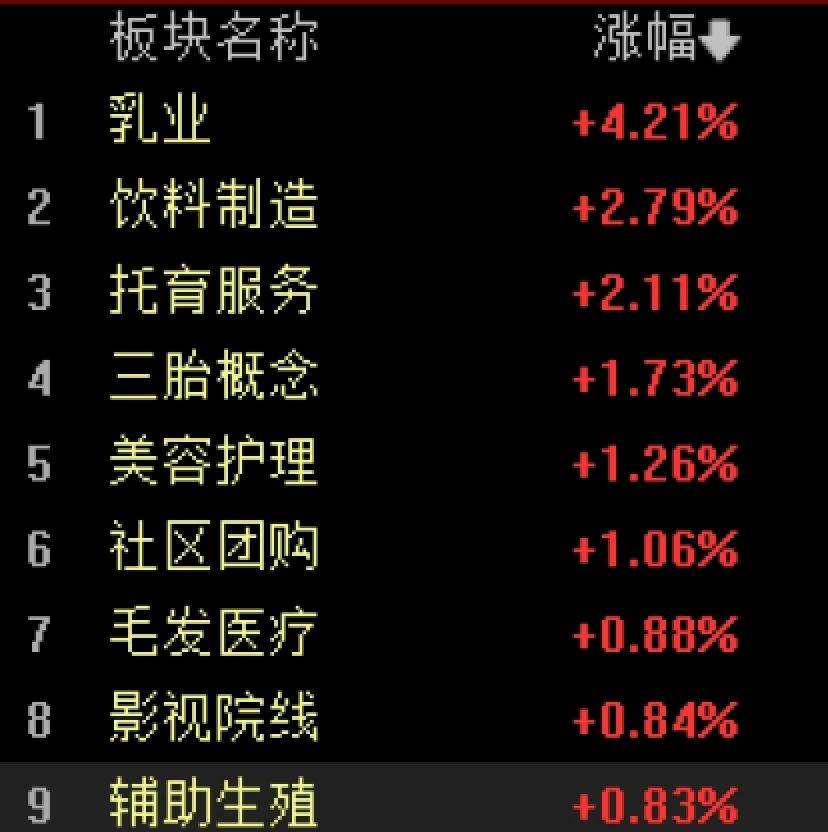
国家千亿红包砸向育儿市场!乳业、托育、辅助生殖板块集体狂欢
Sou Hu Cai Jing· 2025-07-30 06:27
文/王海 导语: 7月28日,中国正式开启"育儿补贴元年"!国务院重磅发布《育儿补贴制度实施方案》,明确从2025年起,所有3周岁 以下婴幼儿每年可领取3600元国家补贴,直接引爆资本市场。次日开盘,乳业、托育、辅助生殖等板块掀起涨停潮, 贝因美、阳光乳业等12只A股封死涨停,港股中国育儿网络单日暴涨54%,锦欣生殖、中国飞鹤等龙头股集体飙升。 这场"真金白银"的政策红利,正催生万亿级消费新蓝海。 | 板块名称 | | 涨幅 | | | --- | --- | --- | --- | | 1 | 레 | +4.21% | | | P | 饮料制造 | +2.79% | | | 3 | 托育服务 | +2.11% | | | ঘ | 三胎概念 | +1.73% | | | 5 | 美容护理 | +1.26% | | | b | 社区团购 | +1.06% | | | T | 毛发医疗 | +0.88% | | | | 影视院线 | +0.84% | | | 9 | 辅助生殖 | +0.85196 | | | 代码 | 名称 | 演唱歌 现价 | | | 832786 骑士乳业 | | +21.12% | 13. ...



锦欣生殖(01951)上涨3.11%,报3.32元/股
Jin Rong Jie· 2025-07-30 03:38
Core Insights - Jinxin Reproductive Medical Group Limited is a leading assisted reproductive service provider in China and the US, operating multiple hospitals and medical centers [1] - The company ranked third in the Chinese assisted reproductive services market in 2018, conducting 20,958 in vitro fertilization cycles, with a market share of approximately 3.1%, and ranked first among non-state-owned assisted reproductive service institutions [1] - As of the 2024 annual report, the company reported total revenue of 2.812 billion yuan and a net profit of 283 million yuan [2] Financial Performance - The stock price of Jinxin Reproductive increased by 3.11% to 3.32 yuan per share, with a trading volume of 301 million yuan as of July 30 [1] - The company's total revenue for the year 2024 was 2.812 billion yuan, with a net profit of 283 million yuan [2]
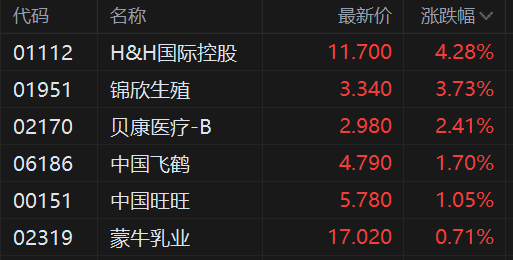
港股异动 婴童概念股表现活跃 H&H国际控股(01112)涨超4% 锦欣生殖(01951)涨超3%
Jin Rong Jie· 2025-07-30 03:25
Core Viewpoint - The announcement of a new childcare subsidy policy in China is expected to significantly benefit the infant and child-related stocks, leading to notable increases in their market performance [1]. Group 1: Stock Performance - H&H International Holdings (01112) rose by 4.28%, trading at 11.7 HKD [1] - Jinxin Fertility (01951) increased by 3.73%, trading at 3.34 HKD [1] - Beikang Medical-B (02170) saw a rise of 2.41%, trading at 2.98 HKD [1] - China Feihe (06186) grew by 1.7%, trading at 4.79 HKD [1] Group 2: Policy Announcement - The State Council Information Office will hold a press conference on July 30, 2023, to discuss the childcare subsidy system and related measures [1]. - Starting from January 1, 2025, families will receive an annual subsidy of 3600 CNY for each child until they reach three years old, regardless of whether they have one, two, or three children [1]. - For children born before January 1, 2025, and under three years old, the subsidy will be calculated based on the number of months eligible [1]. Group 3: Market Analysis - According to CITIC Securities, four sectors are expected to benefit the most: dairy products, maternal and infant retail, infant products, and postpartum care services [1]. - The market size for infant formula is projected to grow from 200 billion CNY to 300 billion CNY by 2025 [1]. - Maternal and infant retail is expected to maintain a growth rate of over 20% [1]. - The infant products market will continue to expand due to consumption upgrades [1]. - Postpartum care services are anticipated to be the fastest-growing segment, with an annual growth rate exceeding 30% [1].
港股异动丨三胎概念股普涨 H&H国际控股涨4.28% 锦欣生殖涨3.5%
Ge Long Hui· 2025-07-30 02:46
昨日呈现高开低走的三胎概念股再起升势,其中,H&H国际控股涨4.28%,锦欣生殖涨近4%,贝康医 疗涨2.4%,中国飞鹤涨1.7%,蒙牛乳业跟涨。 | 代码 | 名称 | 最新价 | 涨跌幅 ▽ | | --- | --- | --- | --- | | 01112 | H&H国际控股 | 11.700 | 4.28% | | 01951 | 锦欣生殖 | 3.340 | 3.73% | | 02170 | 贝康医疗-B | 2.980 | 2.41% | | 06186 | 中国飞鹤 | 4.790 | 1.70% | | 00151 | 中国旺旺 | 5.780 | 1.05% | | 02319 | 蒙牛乳业 | 17.020 | 0.71% | 消息面上,7月28日,中办、国办印发《育儿补贴制度实施方案》,明确对3周岁以下婴幼儿按每孩每年 3600元标准发放补贴。浙商证券发布研究报告称,国家育儿补贴制度实施方案于2025年7月28日公布, 面向育儿家庭全国范围全面直接发放现金补贴,有助于缓解家庭养育压力。随着生育补贴政策实施落 地,有望改善市场预期,母婴消费产业链或更多获益,汽车、餐饮等领域也可能迎来 ...


婴童概念股表现活跃 H&H国际控股涨超4% 锦欣生殖涨超3%
Zhi Tong Cai Jing· 2025-07-30 02:32
Core Viewpoint - The announcement of a new childcare subsidy policy in China is expected to significantly benefit the infant and child-related sectors, leading to increased stock prices for companies in this industry [1] Industry Impact - The infant and child concept stocks opened higher, with notable increases: H&H International Holdings rose by 4.28% to HKD 11.7, Jinxin Fertility rose by 3.73% to HKD 3.34, BeiKang Medical-B rose by 2.41% to HKD 2.98, and China Feihe rose by 1.7% to HKD 4.79 [1] - The new childcare subsidy policy will provide an annual subsidy of CNY 3,600 for each child until the age of three, starting from January 1, 2025, which is expected to stimulate demand in the sector [1] Company Analysis - According to CITIC Securities, four sectors are expected to benefit the most: dairy products, maternal and infant retail, infant products, and postpartum care services [1] - The market for infant formula is projected to grow from CNY 200 billion to CNY 300 billion by 2025, indicating a strong demand for essential products [1] - Maternal and infant retail is expected to maintain a growth rate of over 20%, while the infant products market will continue to expand due to consumption upgrades [1] - Postpartum care services are anticipated to be the fastest-growing segment, with an annual growth rate potentially exceeding 30% [1]
港股异动 | 婴童概念股表现活跃 H&H国际控股(01112)涨超4% 锦欣生殖(01951)涨超3%
智通财经网· 2025-07-30 02:28
Group 1 - The core viewpoint of the article highlights the positive market response of baby and child concept stocks following the announcement of a new childcare subsidy policy by the Chinese government [1] - H&H International Holdings (01112) rose by 4.28% to HKD 11.7, Jinxin Fertility (01951) increased by 3.73% to HKD 3.34, Beikang Medical-B (02170) gained 2.41% to HKD 2.98, and China Feihe (06186) saw a rise of 1.7% to HKD 4.79 [1] - The new childcare subsidy policy will provide an annual subsidy of CNY 3,600 for each child until the age of three, starting from January 1, 2025, benefiting all families regardless of the number of children [1] Group 2 - According to CITIC Securities, four sectors are expected to benefit significantly from the new policy: dairy products, maternal and infant chain retail, baby products, and postpartum care services [1] - The market size for infant formula milk is projected to grow from CNY 200 billion to CNY 300 billion by 2025, indicating a strong demand for essential products [1] - Maternal and infant chain retail is expected to maintain a growth rate of over 20%, while the baby products market will continue to expand due to consumption upgrades [1] - Postpartum care services are anticipated to be the fastest-growing segment, with an annual growth rate potentially exceeding 30% [1]