
JXR(01951)

Search documents
3600元育儿补贴引爆母婴消费链:奶粉、托育、辅助生殖等核心赛道谁主沉浮?
智通财经网· 2025-07-29 13:39
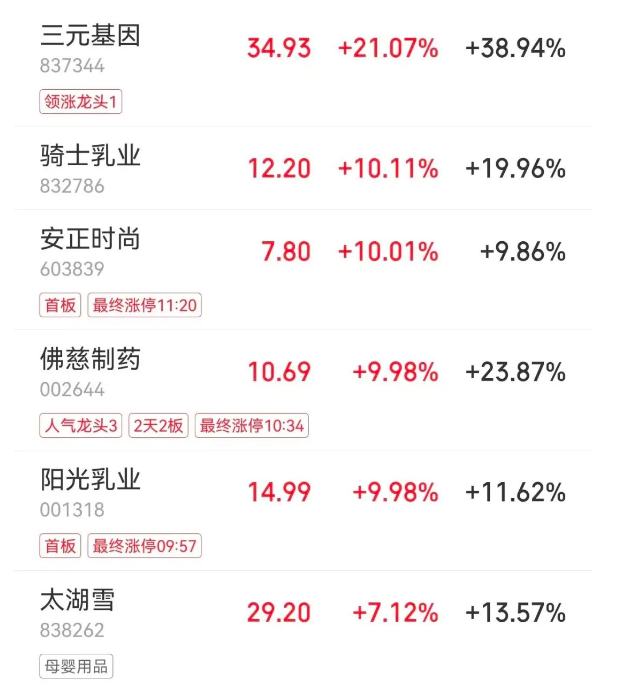
国家育儿补贴政策出台,母婴概念股迎来爆发式增长。 政策利好下,市场机构纷纷上调对母婴行业的发展预期。 7月28日,中共中央办公厅、国务院办公厅近日印发的《育儿补贴制度实施方案》明确,从2025年1月1 日起,对符合法律法规规定生育的3周岁以下婴幼儿发放补贴,至其年满3周岁。育儿补贴按年发放,现 阶段国家基础标准为每孩每年3600元。这一重大利好消息立即在资本市场引发强烈反响。 7月29日,港股、A股开盘后,母婴概念股集体爆发,形成了一道亮丽的"红色风景线"。其中,A股贝因 美(002570.SZ)、爱婴室(603214.SH)等个股强势涨停,孩子王(301078.SZ)、骑士乳业 (832786.BJ)等涨幅超过10%。港股婴童概念股亦多数高开,锦欣生殖 (01951) 涨 8.93%;H&H 国际控股 (01112) 涨 7.33%;中国飞鹤 (06186) 涨 5.12%;圣贝拉 (02508) 涨 3.13%,报 7.9 港元。简言之,母婴板 块成为当日市场最耀眼的明星板块。 | 一元县大 | 34.93 +21.07% +38.94% | | --- | --- | | 837344 | | | 领涨 ...


南向资金今日净买入127.20亿港元,小米集团-W净买入16.59亿港元
Zheng Quan Shi Bao Wang· 2025-07-29 12:00
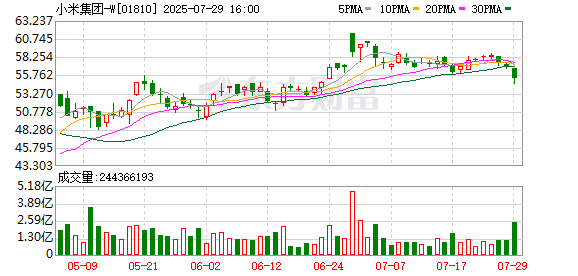
今日上榜个股中,小米集团-W、腾讯控股、阿里巴巴-W等8只股同时上榜港股通(深)、港股通(沪)成交活跃股, 小米集团-W合计成交额 83.68亿港元,成交净买入16.59亿港元,腾讯控股合计成交额45.43亿港元,成交净买入8.33亿港元。泡泡玛特合计成交额23.37亿港元,成交净卖 出3.51亿港元,美团-W合计成交额37.51亿港元,成交净卖出2.88亿港元。 从连续性进行统计, 有4只股获南向资金连续3天以上净买入,连续净买入天数较多的有腾讯控股、中芯国际、阿里巴巴-W,连续净买入天数分 别为4天、3天、3天。以其间净买入金额统计,净买入金额最多的是小米集团-W,合计净买入为24.46亿港元,其次是腾讯控股合计净买入为20.89 亿港元,中芯国际合计净买入为13.03亿港元。(数据宝) | 7月29日南向资金成交活跃股 | | --- | | 代码 简称 | 成交金额 成交净买入 | 今日涨跌幅(%) | | --- | --- | --- | | | (万港元) (万港元) | | | 01810 小米集团-W | 836751.42 165918.68 -2.64 | | | 00700 腾讯控股 ...


7月29日港股通净买入127.20亿港元
Zheng Quan Shi Bao Wang· 2025-07-29 11:57
Core Viewpoint - The Hang Seng Index fell by 0.15% to close at 25,524.45 points on July 29, with a net inflow of HKD 12.72 billion through the southbound trading channel [1] Group 1: Market Activity - The total trading volume for the southbound trading on July 29 was HKD 155.49 billion, with a net buy of HKD 12.72 billion [1] - The Shanghai Stock Exchange's southbound trading accounted for HKD 98.34 billion in trading volume, with a net buy of HKD 5.88 billion, while the Shenzhen Stock Exchange had a trading volume of HKD 57.15 billion and a net buy of HKD 6.84 billion [1] Group 2: Active Stocks - The most actively traded stock on the Shanghai Stock Exchange was Xiaomi Group-W, with a trading volume of HKD 5.36 billion, followed by Guotai Junan International and Tencent Holdings, with trading volumes of HKD 4.15 billion and HKD 3.00 billion, respectively [2] - In terms of net buying, Tencent Holdings led with a net buy of HKD 1.06 billion, despite its stock price closing down by 0.09% [1][2] - The stock with the highest net sell was Pop Mart, with a net sell of HKD 272 million, while its stock price increased by 5.91% [1][2] Group 3: Detailed Stock Data - The top ten actively traded stocks on the Shenzhen Stock Exchange included Xiaomi Group-W with a trading volume of HKD 3.00 billion and a net buy of HKD 670 million, despite a closing drop of 2.64% [2] - Meituan-W had the highest net sell amount of HKD 509 million, with a closing price decrease of 0.62% [2] - Other notable stocks included Alibaba-W and Southbound Hang Seng Technology, with trading volumes of HKD 2.24 billion and HKD 1.67 billion, respectively [2]
北水成交净买入127.2亿 北水再度加仓创新药概念 全天买入小米(01810)超16亿港元
Zhi Tong Cai Jing· 2025-07-29 11:07
| 中芯国际 | 6.421Z | 5.18 亿 | 11.60亿 | | --- | --- | --- | --- | | HK 00981 | | | +1.24 亿 | | 快手-W | 4.62亿 | 4.71亿 | 9.33亿 | | HK 01024 | | | -850.31万 | | 石药集团 | 5.88亿 | 3.24亿 | 9.11亿 | | HK 01093 | | | +2.64 乙 | | 信达生物 | 6.77 亿 | 1.62亿 | 8.39亿 | | HK 01801 | | | +5.141Z | | 泡泡玛特 | 3.63亿 | 4.43亿 | 8.06亿 | | HK 09992 | | | -7973.47万 | 港股通(深)活跃成交股 | 股票名称 | 买入额 | 卖出额 | 买卖总额 | | --- | --- | --- | --- | | | | | 净流入 | | 小米集团-W HK 01810 | 31.76亿 | 21.87 亿 | 53.64亿 | | | | | +9.89 亿 | | 国泰君安 ... | 21.58亿 | 19.90亿 | 41 ...

智通港股通活跃成交|7月29日





智通财经网· 2025-07-29 11:03
| 公司名称 | 成交金额 | 净买入额 | | --- | --- | --- | | 小米集团-W(01810) | 53.64 亿元 | +9.89 亿元 | | 国泰君安国际(01788) | 41.48 亿元 | +1.69 亿元 | | 腾讯控股(00700) | 30.04 亿元 | +10.60 亿元 | | 阿里巴巴-W(09988) | 22.43 亿元 | +2.02 亿元 | | 中芯国际(00981) | 21.86 亿元 | +2.43 亿元 | | 美团-W(03690) | 20.67 亿元 | +2.21 亿元 | | 南方恒生科技(03033) | 16.71 亿元 | -6787.71 万元 | | 锦欣生殖(01951) | 15.63 亿元 | +1.95 亿元 | | 泡泡玛特(09992) | 15.31 亿元 | -2.72 亿元 | | 石药集团(01093) | 14.85 亿元 | +3.88 亿元 | 智通财经APP获悉,2025年7月29日当天,小米集团-W(01810)、国泰君安国际(01788)、腾讯控股 (00700)位居沪港通(南向)成交额前3 ...
一图看懂 | 育儿补贴新政概念股
市值风云· 2025-07-29 10:08
Core Viewpoint - The national childcare subsidy policy will provide an annual subsidy of 3600 yuan per child until the age of three, benefiting over 20 million families each year starting from January 1, 2025 [4][5]. Subsidy Standard - Each child will receive a subsidy of 3600 yuan per year until they turn three years old. For children born before January 1, 2025, who are under three years old, the subsidy will be calculated based on the remaining months [8]. Coverage - The policy applies to all families with children under three years old, regardless of whether they have one, two, or three children, and is uniformly implemented across the country [9]. Application Process - Parents or guardians can apply for the subsidy online through the childcare subsidy information management system or offline, providing necessary documents such as birth certificates and household registration books [10]. Funding Source - The central government will establish a "childcare subsidy fund," providing financial support to eastern, central, and western regions proportionally, with any additional local funding being the responsibility of local governments [11]. Market Impact Analysis - The infant food market is expected to exceed 72 billion yuan, directly benefiting the maternal and infant consumption industry chain [12]. - The childcare industry is projected to reach a scale of 162.1 billion yuan by 2025, with an average annual growth rate of 7.5%, accelerated by the policy [13]. - Demand for children's medical and nutritional health products is anticipated to rise, with the pediatric medication market expected to grow at a rate exceeding 10% annually [14]. Beneficiary Companies - Leading maternal and infant retail companies are expected to benefit directly from increased customer spending and frequency of purchases [15]. - Companies such as Kidswant and Huaiying Room are positioned to gain from the subsidy implementation due to their extensive retail networks and service offerings [16]. - Major players in the infant formula market, like China Feihe and Yili, are likely to see increased demand driven by the subsidy [17][18].




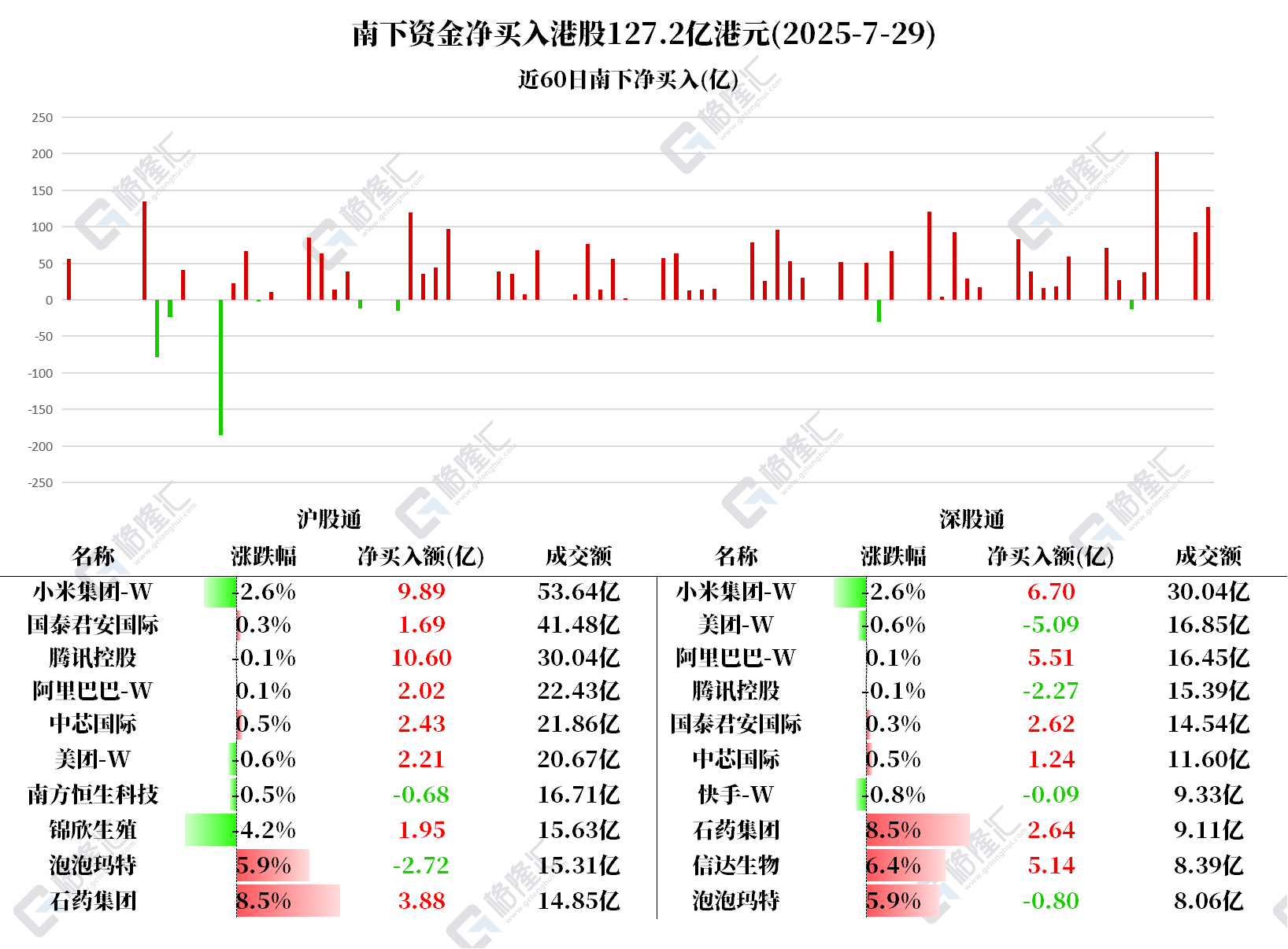
图解丨南下资金净买入港股127亿港元,加仓小米、腾讯和阿里
Ge Long Hui A P P· 2025-07-29 10:04
Group 1 - Southbound funds net bought Hong Kong stocks worth 12.72 billion HKD today, with notable purchases in Xiaomi Group-W (1.659 billion), Tencent Holdings (0.832 billion), and Alibaba-W (0.753 billion) [1] - Southbound funds have net bought Tencent for four consecutive days, totaling 2.08902 billion HKD, and Xiaomi for three consecutive days, totaling 2.44603 billion HKD [1] - Other significant net purchases include Sino Biopharmaceutical (0.651 billion), InnoCare Pharma (0.514 billion), and SMIC (0.366 billion) [1] Group 2 - In the Shanghai Stock Connect, Xiaomi Group-W saw a decrease of 2.6% with a net buy of 0.989 billion, while Tencent Holdings increased by 0.1% with a net buy of 1.060 billion [3] - Alibaba-W had a slight increase of 0.1% with a net buy of 0.202 billion, and SMIC rose by 0.5% with a net buy of 0.243 billion [3] - Meituan-W experienced a decline of 0.6% with a net sell of 0.221 billion, while Pop Mart saw a significant increase of 5.9% with a net sell of 0.272 billion [3]
港股概念追踪 | 国家育儿补贴方案公布!提振母婴消费及辅助生殖市场(附概念股)
智通财经网· 2025-07-28 10:03
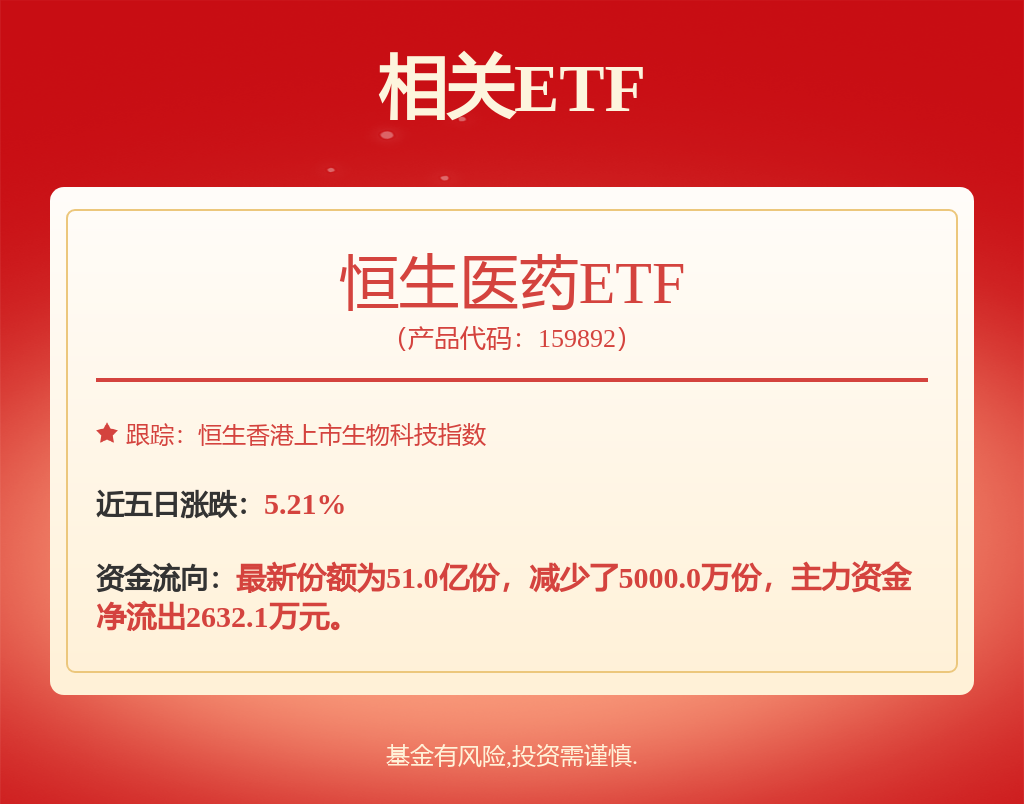
Group 1 - The implementation of the childcare subsidy policy is set to begin on January 1, 2025, providing annual subsidies of 3,600 yuan per child for families with children under three years old [1][2] - The subsidy aims to alleviate the financial burden of raising children and is expected to significantly boost the maternal and infant consumption market, indirectly benefiting the assisted reproductive industry [1][3] - Over 20 provinces in China are already exploring childcare subsidy policies, indicating a growing trend towards enhancing birth support measures at the local level [3] Group 2 - Companies in the maternal and infant product sector, such as Goodbaby International, are positioned to benefit from the expected increase in demand due to the subsidy policy [4] - China Feihe, a leading infant formula brand, is likely to see positive impacts from the subsidy as it targets the high-end market, aligning with the demographic benefiting from the policy [5] - The assisted reproductive services sector, represented by companies like Jinxin Fertility, may experience increased demand as the subsidy lowers the cost of raising children, potentially enhancing the willingness of couples facing infertility to seek IVF services [5]
锦欣生殖(01951.HK)更新报告:晚育、中美政策红利有望改善需求和支付端
Ge Long Hui· 2025-07-16 02:42
Group 1 - The demand for assisted reproductive technology in China is expected to reach a turning point due to increasing average maternal age and rising proportion of older mothers [1] - From 2023 to 2025, assisted reproduction will be included in national health insurance, which is anticipated to release significant demand following policy implementation [1] - The company, as a leading private player in assisted reproduction, is expected to benefit from tightened licensing and its technical advantages in third-generation IVF [1] Group 2 - The company's overseas business, particularly in the U.S., is experiencing strong growth, with an expected 18.2% year-on-year increase in egg retrieval cycles in 2024 [1] - The U.S. team is expanding, with plans to grow from 23 to 40 doctors by 2027, which will enhance operational capacity [1] - A new policy in California requiring group insurance to cover IVF treatments is expected to directly benefit the company's operations on the West Coast [1] Group 3 - The company has demonstrated resilience in profitability, with a projected domestic gross margin of approximately 27.6% in 2024 [2] - Adjusted net profit is expected to be 420 million yuan, with a profit margin of 14.8%, gradually recovering from the pandemic period [2] - Cost control measures have effectively alleviated pressure on overseas profit margins, with sales and management expense ratios optimized to 22.5% [2] Group 4 - Revenue projections for 2025 and 2026 are estimated at 2.99 billion yuan and 3.26 billion yuan, with growth rates of 6.4% and 9.0% respectively [2] - Adjusted net profit forecasts for 2025 and 2026 are 420 million yuan and 470 million yuan, with growth rates of 0.9% and 10.5% respectively [2] - The company maintains a target price of HKD 3.69 per share, corresponding to 22x and 20x PE for 2025 and 2026, reflecting confidence in long-term value and industry recovery [2]
锦欣生殖(01951):更新报告:晚育、中美政策红利有望改善需求和支付端
Haitong Securities International· 2025-07-14 01:02
Investment Rating - The report maintains an "OUTPERFORM" rating for Jinxin Fertility [1][2]. Core Views - The demand for assisted reproductive technology (ART) in China is expected to reach a turning point, driven by delayed childbearing and the gradual release of policy benefits. The average childbearing age in China is approaching 30, leading to an increase in the proportion of older mothers and a significant rise in demand for ART [3][29]. - The company's overseas business is experiencing strong growth, particularly in the U.S., where the number of egg retrieval cycles is projected to increase by 18.2% year-on-year in 2024. New policies in California are expected to further boost demand for ART services [3][4]. Summary by Sections 1. Future Trends in China's Assisted Reproductive Demand - The number of newborns in China is expected to stabilize in 2024, with a continuous increase in the proportion of births from older mothers. The average childbearing age has risen to 29.0 years, with a significant demand for ART from older women [14][16]. - The penetration rate of ART in China is anticipated to accelerate as the average childbearing age surpasses 30, similar to trends observed in other developed countries [19][20]. - Payment policies are identified as a core factor influencing ART penetration rates, with significant room for improvement in China's healthcare insurance and subsidy policies [25][26]. 2. Revenue and Profit Outlook for Domestic and Overseas Businesses - The company's revenue for 2024 is projected at RMB 28.1 billion, reflecting a modest growth of 0.8%, primarily due to patients delaying treatment in anticipation of policy changes [34]. - The domestic business is expected to stabilize, while the overseas business, particularly in the U.S., is set to grow significantly due to an increase in the number of doctors and favorable policy changes [38][40]. - The company has successfully controlled costs, with a sales and management expense ratio of approximately 22.5%, which has helped mitigate pressure on profit margins [44]. 3. Profit Forecast and Valuation - The company is expected to achieve revenues of RMB 29.9 billion and RMB 32.6 billion in 2025 and 2026, respectively, with growth rates of 6.4% and 9.0% [5][46]. - The adjusted net profit is forecasted to be RMB 4.2 billion and RMB 4.7 billion for the same years, with growth rates of 0.9% and 10.5% [5][46]. - The target price for the company's stock is set at HKD 3.69, corresponding to a price-to-earnings ratio of 22x for 2025 and 20x for 2026, reflecting confidence in the company's long-term value as a leader in the assisted reproductive sector [49].