CMBC(01988)

Search documents
2.7分钟定生死 手机银行存量厮杀谁在“断臂”,谁在“吃肉”?
Jing Ji Guan Cha Wang· 2026-02-18 04:57
Core Insights - The report by iResearch indicates that the monthly active users (MAU) of mobile banking apps in China have stabilized after fluctuating between 648 million and 739 million, signaling a ceiling in user growth and a shift from acquiring new users to enhancing existing user engagement [2] - User behavior is undergoing a structural reversal, with the effective daily usage time per device dropping from 4.9 minutes in 2023 to around 2.7 minutes by mid-2025, leading to a focus on high-frequency, short-duration, and functional usage [2] - Financial institutions are compelled to streamline operations and focus resources on core transaction scenarios to survive in this competitive landscape, where efficiency and precision are paramount [2] Mobile Banking Market Overview - The top three banks in terms of MAU are Agricultural Bank of China (2.49 billion), Industrial and Commercial Bank of China (1.94 billion), and China Construction Bank (1.09 billion), with all six major state-owned banks ranking in the top ten [3][5][6] - Private banks, represented by WeBank and MYbank, have faced significant setbacks, with many dropping out of the top 50 MAU rankings by 2025 [4] Competitive Landscape - State-owned banks are solidifying their dominance through extensive customer bases and integrated ecosystems, leveraging services embedded in high-frequency life scenarios such as government services and healthcare [7] - Joint-stock commercial banks are adopting a "specialized and precise" survival strategy, with China Merchants Bank leading among them with 71.85 million MAU, focusing on wealth management and intelligent interaction [8][10] - Regional banks are thriving by deeply engaging with local markets, while private banks struggle due to high customer acquisition costs and lack of local ecosystem support [13][14] Future Outlook - The mobile banking market is transitioning from a phase of scale expansion to one of value cultivation, with state-owned banks building moats through ecosystems, joint-stock banks seeking niches through specialization, and regional banks solidifying their local roots [14] - The ability to create irreplaceable value in a limited user engagement environment will be crucial, with technology applications such as AI reshaping service processes and enhancing risk management [15][16]






投资人探厂记:华工教授All in 康复硬科技 谁给的底气?
2 1 Shi Ji Jing Ji Bao Dao· 2026-02-15 06:20
Core Insights - The article highlights the advancements in rehabilitation technology, particularly through the use of AI and robotics, exemplified by the lower limb rehabilitation robot developed by Lizi Intelligent Technology (Guangzhou) Co., Ltd, which aids patients with Parkinson's disease and lower limb paralysis [1][3]. Company Overview - Lizi Intelligent, a spin-off from South China University of Technology, has accumulated over 100 invention patents and international patents, positioning itself as a strong player in the "AI + medical rehabilitation" sector [3]. - The company was founded in 2022 after nearly a decade of technological development, focusing on transforming research achievements into marketable products [5]. Market Context - There are approximately 15 million stroke patients in China, with 3.3 million new cases annually, and a lifetime risk of stroke for adults reaching 39% [4]. - The high disability rate from strokes in China, around 75%, compared to 20%-30% in developed countries, underscores the urgent need for rehabilitation technology [4]. Technological Development - Lizi Intelligent has developed nearly 20 intelligent rehabilitation robot products, with 6 receiving Class II medical device registration, and plans to complete certification for the remaining products within the year [5][9]. - The company has established a comprehensive technology chain, including brain-computer interfaces, physiological and motion sensing sensors, AI algorithms, and embodied intelligent robots [5]. Financial Support and Growth - Lizi Intelligent received significant financial backing, including a multi-million yuan credit line from Minsheng Bank, reflecting confidence in its technology and market potential [3][7]. - The company has successfully navigated early challenges, including product market acceptance and funding crises, ultimately securing multiple rounds of financing in 2023 and 2024 [7][10]. Future Plans - The company aims to develop more cost-effective home rehabilitation robots, focusing on lightweight, compact, and intelligent designs to make rehabilitation accessible to a broader audience [10]. - Minsheng Bank is committed to supporting Lizi Intelligent's growth through a comprehensive financial service system tailored for technology-driven enterprises [10].


最新21家系统重要性银行名单公布
Jing Ji Ri Bao· 2026-02-14 04:21
Group 1 - The People's Bank of China and the National Financial Regulatory Administration have conducted an assessment for the 2025 systemically important banks, identifying 21 domestic banks as systemically important, including 6 state-owned commercial banks, 10 joint-stock commercial banks, and 5 city commercial banks [1][3] - The list aims to establish a comprehensive macro-prudential management system and strengthen the regulation of systemically important financial institutions [2] Group 2 - Systemically important banks in China are categorized into five groups based on their importance scores, with the first group consisting of 11 banks, the second group having 4 banks, the third group with 2 banks, the fourth group containing 4 banks, and no banks in the fifth group [3] - The People's Bank of China plans to enhance the combined effect of macro-prudential management and micro-prudential regulation, continuing to solidify additional supervision for systemically important banks to promote their safe and sound operation and better serve the high-quality development of the real economy [3]



国内系统重要性银行名单发布 21家银行入选
Cai Jing Wang· 2026-02-14 02:03
Core Viewpoint - The People's Bank of China has conducted an assessment of systemically important banks for 2025, identifying 21 domestic banks categorized into five groups based on their systemic importance scores [1] Group 1: Assessment Overview - The assessment is part of a broader effort to establish a comprehensive macro-prudential management system and strengthen the regulation of systemically important financial institutions [1] - The evaluation was carried out in collaboration with the National Financial Regulatory Administration [1] Group 2: Classification of Banks - A total of 21 banks were recognized as systemically important, including 6 state-owned commercial banks, 10 joint-stock commercial banks, and 5 city commercial banks [1] - The banks are divided into five groups based on their systemic importance scores: - Group 1: 11 banks including China Minsheng Bank, China Everbright Bank, Ping An Bank, Huaxia Bank, Ningbo Bank, Jiangsu Bank, Beijing Bank, Nanjing Bank, Guangfa Bank, Zheshang Bank, and Shanghai Bank [1] - Group 2: 4 banks including Industrial Bank, China CITIC Bank, Shanghai Pudong Development Bank, and China Postal Savings Bank [1] - Group 3: 2 banks including Bank of Communications and China Merchants Bank [1] - Group 4: 4 banks including Industrial and Commercial Bank of China, Bank of China, China Construction Bank, and Agricultural Bank of China [1] - Group 5: No banks were classified in this group [1]

央行重要发布!名单公布
Sou Hu Cai Jing· 2026-02-14 01:14
Core Viewpoint - The People's Bank of China and the National Financial Regulatory Administration have conducted an assessment of systemically important banks for 2025, identifying 21 domestic banks categorized into five groups based on their systemic importance scores [1]. Group 1: Assessment of Systemically Important Banks - A total of 21 banks have been recognized as systemically important, including 6 state-owned commercial banks, 10 joint-stock commercial banks, and 5 city commercial banks [1]. - The banks are divided into five groups based on their systemic importance scores, with the first group containing 11 banks, the second group 4 banks, the third group 2 banks, the fourth group 4 banks, and the fifth group having no banks [1]. Group 2: Breakdown of Banks by Group - **First Group (11 banks)**: Includes China Minsheng Bank, China Everbright Bank, Ping An Bank, Huaxia Bank, Ningbo Bank, Jiangsu Bank, Beijing Bank, Nanjing Bank, Guangfa Bank, Zheshang Bank, and Shanghai Bank [1]. - **Second Group (4 banks)**: Includes Industrial Bank, China CITIC Bank, Shanghai Pudong Development Bank, and China Postal Savings Bank [1]. - **Third Group (2 banks)**: Includes Bank of Communications and China Merchants Bank [1]. - **Fourth Group (4 banks)**: Includes Industrial and Commercial Bank of China, Bank of China, China Construction Bank, and Agricultural Bank of China [1]. - **Fifth Group**: No banks are included in this group [1]. Group 3: Future Regulatory Actions - The People's Bank of China and the National Financial Regulatory Administration will implement additional regulatory measures for systemically important banks according to the "Regulations on Additional Supervision of Systemically Important Banks (Trial)" [1]. - The aim is to enhance the synergy between macro-prudential management and micro-prudential supervision, ensuring the safe and sound operation of systemically important banks and better supporting the high-quality development of the real economy [1].
我国系统重要性银行名单公布
新华网财经· 2026-02-14 01:10
Group 1 - The People's Bank of China and the National Financial Regulatory Administration have conducted an assessment for the 2025 systemically important banks, identifying 21 domestic banks, including 6 state-owned commercial banks, 10 joint-stock commercial banks, and 5 city commercial banks [3][4]. - The list aims to establish a comprehensive macro-prudential management system and strengthen the regulation of systemically important financial institutions [4]. - Systemically important banks are categorized into five groups based on their importance scores, with the first group including 11 banks such as China Minsheng Bank and China Everbright Bank, and the fourth group including major banks like Industrial and Commercial Bank of China and Bank of China [5]. Group 2 - The People's Bank of China and the National Financial Regulatory Administration will enhance the combined efforts of macro-prudential management and micro-prudential regulation to solidify additional supervision of systemically important banks, promoting their safe and sound operation to better serve the high-quality development of the real economy [5].

系统重要性银行名单出炉
Shang Hai Zheng Quan Bao· 2026-02-13 17:01
Core Viewpoint - The People's Bank of China has identified 21 domestic systemically important banks for the year 2025, aiming to enhance macro-prudential management and regulatory oversight of these institutions [1] Group 1: Identification of Systemically Important Banks - A total of 21 banks have been recognized as systemically important, including 6 state-owned commercial banks, 10 joint-stock commercial banks, and 5 city commercial banks [1] - The banks are categorized into five groups based on their systemic importance scores, with the first group containing 11 banks, the second group 4 banks, the third group 2 banks, the fourth group 4 banks, and the fifth group having no banks [1] Group 2: Breakdown of Bank Groups - Group 1 includes: China Minsheng Bank, China Everbright Bank, Ping An Bank, Huaxia Bank, Ningbo Bank, Jiangsu Bank, Beijing Bank, Nanjing Bank, Guangfa Bank, Zheshang Bank, and Shanghai Bank [1] - Group 2 consists of: Industrial Bank, China CITIC Bank, Shanghai Pudong Development Bank, and China Postal Savings Bank [1] - Group 3 includes: Bank of Communications and China Merchants Bank [1] - Group 4 comprises: Industrial and Commercial Bank of China, Bank of China, China Construction Bank, and Agricultural Bank of China [1] Group 3: Future Regulatory Actions - The People's Bank of China and the financial regulatory authority will implement additional regulatory measures as per the "Regulations on Additional Supervision of Systemically Important Banks (Trial)" to ensure the safe and sound operation of these banks [1] - The aim is to strengthen the macro-prudential management and micro-prudential regulatory synergy, promoting the healthy development of systemically important banks to better serve the high-quality development of the real economy [1]
21家系统重要性银行名单出炉!浙商银行新入选
Guang Zhou Ri Bao· 2026-02-13 15:09
Core Viewpoint - The People's Bank of China and the National Financial Regulatory Administration have published the list of systemically important banks for 2025, identifying 21 domestic banks, including 6 state-owned commercial banks, 10 joint-stock commercial banks, and 5 city commercial banks [1][2]. Group 1: Systemically Important Banks - The newly published list includes Zhejiang Commercial Bank as a new entrant among systemically important banks [1]. - The banks are categorized into five groups based on their systemic importance scores, with the first group containing 11 banks, the second group 4 banks, the third group 2 banks, the fourth group 4 banks, and the fifth group having no banks [1]. - The first group includes China Minsheng Bank, China Everbright Bank, Ping An Bank, Huaxia Bank, Ningbo Bank, Jiangsu Bank, Beijing Bank, Nanjing Bank, Guangfa Bank, Zhejiang Commercial Bank, and Shanghai Bank [1]. - The second group consists of Industrial Bank, China CITIC Bank, Shanghai Pudong Development Bank, and China Postal Savings Bank [1]. - The third group includes Bank of Communications and China Merchants Bank [1]. - The fourth group comprises Industrial and Commercial Bank of China, Bank of China, China Construction Bank, and Agricultural Bank of China [1]. - No banks are listed in the fifth group [1]. Group 2: Regulatory Measures - The People's Bank of China and the National Financial Regulatory Administration will implement additional regulatory measures for systemically important banks according to the "Regulations on Additional Supervision of Systemically Important Banks (Trial)" [2]. - The aim is to enhance macro-prudential management and micro-prudential supervision, ensuring the safe and sound operation of systemically important banks [2]. - This initiative is intended to better serve the high-quality development of the real economy [2].

我国系统重要性银行名单发布,共21家
Bei Ke Cai Jing· 2026-02-13 13:57
Core Viewpoint - The People's Bank of China and the National Financial Regulatory Administration have conducted an assessment of systemically important banks for 2025, identifying 21 domestic banks categorized into five groups based on their systemic importance scores [1] Group 1: Identification of Systemically Important Banks - A total of 21 domestic systemically important banks have been recognized, including 6 state-owned commercial banks, 10 joint-stock commercial banks, and 5 city commercial banks [1] - The banks are categorized into five groups based on their systemic importance scores, with the first group consisting of 11 banks, the second group containing 4 banks, the third group having 2 banks, the fourth group including 4 banks, and the fifth group having no banks [1] Group 2: Breakdown of Bank Groups - **First Group (11 banks)**: Includes China Minsheng Bank, China Everbright Bank, Ping An Bank, Huaxia Bank, Ningbo Bank, Jiangsu Bank, Beijing Bank, Nanjing Bank, Guangfa Bank, Zheshang Bank, and Shanghai Bank [1] - **Second Group (4 banks)**: Comprises Industrial Bank, China CITIC Bank, Shanghai Pudong Development Bank, and China Postal Savings Bank [1] - **Third Group (2 banks)**: Consists of Bank of Communications and China Merchants Bank [1] - **Fourth Group (4 banks)**: Includes Industrial and Commercial Bank of China, Bank of China, China Construction Bank, and Agricultural Bank of China [1] - **Fifth Group**: Currently has no banks included [1] Group 3: Future Regulatory Actions - The People's Bank of China and the National Financial Regulatory Administration will implement additional regulatory measures for systemically important banks according to the "Regulations on Additional Supervision of Systemically Important Banks (Trial)" [1] - The aim is to enhance macro-prudential management and micro-prudential supervision, ensuring the safe and sound operation of systemically important banks and better supporting the high-quality development of the real economy [1]
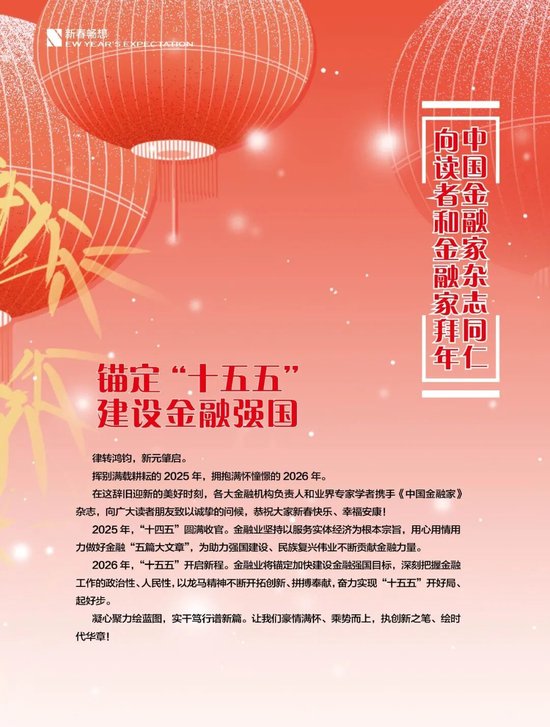
中国民生银行首席经济学家兼研究院院长温彬发表新春畅想
Xin Lang Cai Jing· 2026-02-13 13:17
Core Viewpoint - The article emphasizes the importance of building a modern financial system in China, focusing on serving the real economy and achieving high-quality development in the banking sector as part of the broader "14th Five-Year Plan" [5][10]. Group 1: Policy and Economic Context - In 2025, the Chinese banking industry adhered to a policy framework characterized by "seeking progress while maintaining stability" and "systematic integration" to enhance financial service quality in key areas [4][9]. - The year 2026 marks the beginning of the "14th Five-Year Plan," which is crucial for advancing the construction of a financial powerhouse in China [5][10]. Group 2: Goals and Strategies - The construction of a financial powerhouse requires a focus on a people-centered approach, serving the real economy, and contributing to international financial stability [5][10]. - The article highlights the necessity of providing high-quality international financial products and digital financial infrastructure to support global economic development and promote a community with a shared future for mankind [5][10]. Group 3: Leadership and Development - Strengthening the comprehensive leadership of the Party is deemed essential for ensuring that financial work remains focused on the people, risk prevention, and deepening structural reforms in financial supply [5][10]. - The commitment to a customer-centric approach and innovation as a driving force is emphasized, with a clear alignment to the goals of the "14th Five-Year Plan" [5][10].