
PING AN OF CHINA(02318)

Search documents
平安又把幸福告了,涉案64亿
Feng Huang Wang Cai Jing· 2026-01-08 12:03
Core Viewpoint - The arbitration application against Huaxia Happiness and its actual controller Wang Wenxue by Ping An Asset Management and Ping An Life Insurance involves approximately 6.4 billion yuan, stemming from performance compensation obligations outlined in agreements from 2018-2019 [1] Group 1 - Huaxia Happiness's major shareholder, Huaxia Happiness Holdings, and Wang Wenxue are facing arbitration initiated by Ping An Asset Management and Ping An Life Insurance, with the case concerning the validity of the arbitration agreement [1] - The case is set to be heard in the Shanghai Financial Court on December 17, 2025, following the filing of the arbitration application [1] - Ping An invested heavily in Huaxia Happiness through equity and debt from 2018 to 2020, but a debt crisis emerged in 2021, leading to Ping An becoming the largest shareholder after forced disposal of shares by the original controlling shareholder [1] Group 2 - In the first half of 2021, Ping An recorded a 35.9 billion yuan impairment provision due to Huaxia Happiness's issues [2] - Disagreements have grown between Ping An and Huaxia Happiness regarding the debt restructuring process, with Huaxia Happiness planning a pre-restructuring while Ping An questions its compliance [2] - Ping An has begun to reduce its stake in Huaxia Happiness, planning to sell up to 11.74 million shares, representing 3% of the total share capital, between September 1 and November 30, 2025 [2] Group 3 - As of November 30, the share reduction plan period has expired [3] - After the completion of the share reduction, Ping An Life and Ping An Asset Management collectively hold 24.99% of Huaxia Happiness's shares, maintaining their position as the largest shareholder [4]


汉中金融监管分局同意平安产险南郑支公司变更营业场所
Jin Tou Wang· 2026-01-08 11:49
2025年12月30日,汉中金融监管分局发布批复称,《中国平安财产保险股份有限公司陕西分公司关于南 郑支公司变更营业场所的请示》(平保产陕分发〔2025〕137号)收悉。经审核,现批复如下: 一、同意中国平安财产保险股份有限公司南郑支公司将营业场所变更为:陕西省汉中市南郑区天汉大道 以西天佑商务酒店1幢2层2-办公区01号。 二、中国平安财产保险股份有限公司应按照有关规定及时办理变更及许可证换领事宜。 ...
中国万亿市值公司之变:四家新贵晋级 两大增长逻辑
2 1 Shi Ji Jing Ji Bao Dao· 2026-01-08 11:41
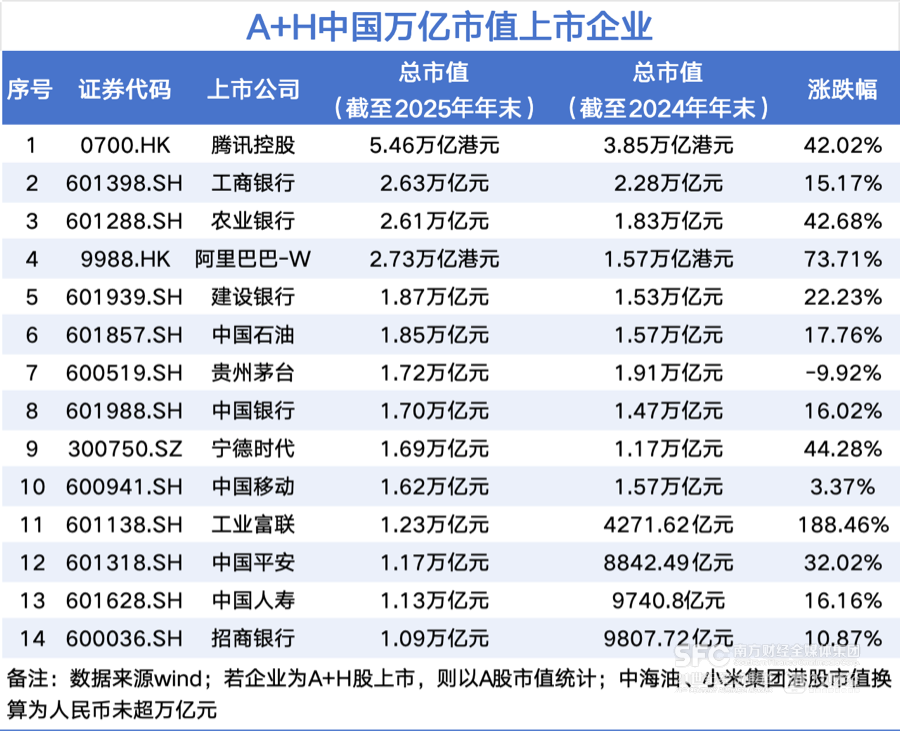
Core Insights - The number of companies with a market capitalization exceeding 1 trillion yuan in mainland China has increased to 14 by the end of 2025, with a total market value increase of over 9 trillion yuan, reflecting a growth rate of over 50% [1][2] Group 1: New Trillion-Yuan Companies - Four new companies have joined the trillion-yuan market cap club: Industrial Fulian, China Ping An, China Life, and China Merchants Bank, with four headquartered in Shenzhen [3][4] - Industrial Fulian has seen a remarkable market cap increase of approximately 188%, while the other three companies in the financial sector have experienced more modest growth rates: China Ping An at 32.02%, China Life at 16.16%, and China Merchants Bank at 10.87% [4][5] Group 2: Market Trends and Dynamics - The rise of these companies reflects two core market dynamics: explosive growth in the technology sector and valuation recovery in the financial sector [5] - Industrial Fulian's rapid growth is attributed to its comprehensive involvement in the AI industry chain, with a significant revenue increase of 38.4% year-on-year, reaching 603.93 billion yuan in the first three quarters of 2025 [6] - China Life has reported a total premium exceeding 700 billion yuan, with a 41% increase in total investment income, while China Ping An has established a strong competitive barrier through its extensive customer base and technology capabilities [7] Group 3: Performance of Major Players - Tencent and Alibaba have also seen significant market cap increases, with both companies adding over 1 trillion Hong Kong dollars to their valuations, driven by AI advancements and a recovery in their core businesses [8][10] - Tencent's market cap reached 5.46 trillion Hong Kong dollars by the end of 2025, with a stock price increase of over 40%, while Alibaba's market cap rose to 2.73 trillion Hong Kong dollars [10][11] Group 4: Banking Sector Insights - The banking sector has shown signs of valuation recovery, with Agricultural Bank of China achieving a notable stock price increase of over 50% and breaking the long-standing "price-to-book" ratio below 1 [12][13] - Agricultural Bank's revenue for the first three quarters of 2025 was 550.88 billion yuan, with a net profit of 220.86 billion yuan, reflecting a year-on-year increase of 3.03% [12][13]



保险板块1月8日跌2.61%,中国平安领跌,主力资金净流出21.09亿元
Zheng Xing Xing Ye Ri Bao· 2026-01-08 08:56
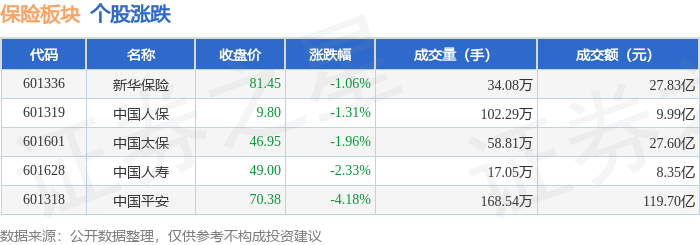
证券之星消息,1月8日保险板块较上一交易日下跌2.61%,中国平安领跌。当日上证指数报收于 4082.98,下跌0.07%。深证成指报收于13959.48,下跌0.51%。保险板块个股涨跌见下表: | 代码 | 名称 | 收盘价 | 涨跌幅 | 成交量(手) | 成交额(元) | | | --- | --- | --- | --- | --- | --- | --- | | 601336 | 新华保险 | 81.45 | -1.06% | 34.08万 | | 27.83亿 | | 601319 | 中国人保 | 9.80 | -1.31% | 102.29万 | | 26666 | | 601601 | 中国太保 | 46.95 | -1.96% | 58.81万 | | 27.60亿 | | 601628 | 中国人寿 | 49.00 | -2.33% | 17.05万 | | 8.35 7 | | 601318 | 中国平安 | 70.38 | -4.18% | 168.54万 | | 119.70亿 | 从资金流向上来看,当日保险板块主力资金净流出21.09亿元,游资资金净流入5.31亿元,散户资金净 ...
中国平安成交额超100亿元
Zheng Quan Shi Bao Wang· 2026-01-08 06:53
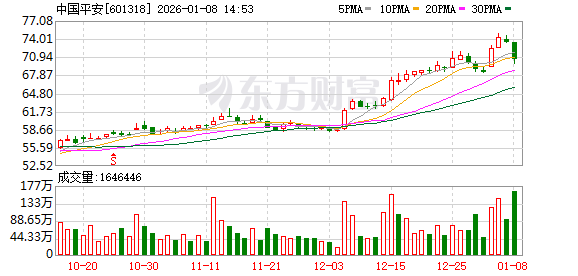
数据宝统计,截至14:34,中国平安成交额107.14亿元,超100亿元。最新股价下跌4.77%,换手率 1.41%。上一交易日该股全天成交额为67.97亿元。(数据宝) (文章来源:证券时报网) ...
中国平安(601318):重估平安系列之一:内外资金共振,核心资产回归
Guoxin Securities· 2026-01-08 06:42
Investment Rating - The investment rating for the company is "Outperform the Market" (maintained) [1] Core Views - The recent strength of the insurance sector, represented by China Ping An, is driven by a combination of policy support, macroeconomic changes, fundamentals, and market liquidity [3][24] - The valuation of China Ping An is expected to be re-evaluated in 2026, driven by both internal adjustments in public fund allocations and external capital inflows [4][11] - The company's strategic focus on "comprehensive finance + ecosystem" aligns well with the aging economy and domestic demand themes, particularly through its investments in health and wellness and AI technologies [5][15][22] Summary by Relevant Sections Investment Rating - The report maintains an "Outperform the Market" rating for China Ping An, with expected earnings per share (EPS) of 7.72, 8.57, and 9.26 CNY for 2025 to 2027, respectively [3][26] Market Dynamics - Since December 2025, the A-share insurance sector has seen a maximum monthly increase of 20%, with China Ping An reaching a nearly four-year high [2] - The appreciation of the RMB has attracted foreign capital to reallocate towards core Chinese assets, with China Ping An being a key choice due to its liquidity and low valuation [3][11] Internal and External Factors - Internally, the high-quality development of public funds is expected to shift from growth to value styles by 2026, favoring low-valuation, high-dividend stocks like China Ping An [3][4] - Externally, the strategic allocation of overseas capital is anticipated to increase, focusing on stable, high-dividend companies like China Ping An [4][11] Strategic Initiatives - China Ping An's investments in health and wellness, along with AI, are expected to create a second growth curve, enhancing service experience and operational efficiency [5][15][22] - The company is building a "finance + healthcare" service system that meets the growing demand for high-quality health and elderly care services, aligning with national policies to boost domestic consumption [15][22] Financial Projections - The report projects an average annual growth rate of 11% for the company's enterprise value (EV) over the next three years, with a reasonable P/EV valuation range of 1.02 to 1.13 [3][26] - The current P/EV ratios for 2025, 2026, and 2027 are expected to be 0.71, 0.65, and 0.59, respectively, indicating significant potential for valuation recovery [3][26]
大金融板块跌势扩大 中国平安等多股跌超5%
Xin Lang Cai Jing· 2026-01-08 06:28
Core Viewpoint - The financial sector is experiencing a significant decline, particularly in the non-bank financial segment, with major companies facing substantial losses [1] Group 1: Company Performance - China Ping An, Huatai Securities, and Huaxin Securities have all seen their stock prices drop by over 5% [1] - Hualin Securities has hit its daily trading limit down, indicating severe market pressure [1] - Other firms such as Industrial Securities, GF Securities, Guotai Junan, and CITIC Securities are also experiencing declines in their stock prices [1]


重磅!非车险“报行合一”最权威解释出炉:松绑“见费出单”,政策性业务满足一定条件可出单,退运险等应实时结算或2日内结算
Sou Hu Cai Jing· 2026-01-08 03:54
Core Viewpoint - The implementation of the "reporting and issuing together" policy for non-auto insurance continues to advance, with the National Financial Regulatory Administration providing detailed answers to various issues arising during the process, aiming to clarify policy implications and unify industry standards [1][2]. Group 1: Regulatory Framework - The core content of the recent notification includes that short-term health insurance is not applicable under the "reporting and issuing together" policy, with some exceptions [2]. - Insurance intermediaries collecting premiums are not considered as "reporting and issuing together" [4]. - Agricultural insurance should follow relevant regulations and execute "reporting and issuing together" [8]. Group 2: Business Scenarios and Requirements - Certain businesses, such as those involving public interest funded by government finances, may not strictly adhere to "reporting and issuing together" [8][10]. - From July 1, 2026, high-frequency, fragmented, and scenario-based internet insurance products like return freight insurance should achieve real-time settlement or periodic settlement within two natural days after issuance [9]. - Policies issued after March 1, 2026, should generally be issued after premium collection and invoicing, with allowances for companies facing difficulties in changing payment methods [12][17]. Group 3: Specific Business Types - For foreign currency or offshore RMB businesses, insurance companies can use bank transfer or other verifiable payment proofs to issue policies [5]. - In the case of RMB business, a bank acceptance bill can be considered as "reporting and issuing together" [6]. - For co-insurance, the main underwriting company can issue policies and invoices after collecting premiums, which will be regarded as "reporting and issuing together" [7]. Group 4: Payment Management - The notification specifies that for public interest businesses using government funds, insurance companies can issue policies based on signed government documents without immediate premium collection [10]. - For businesses where the government subsidizes premiums, the full premium must be collected before issuing policies [10]. - The notification emphasizes that installment payment structures should not be manipulated as competitive leverage, and the last payment should not exceed the average installment amount [12].


当人工智能遇上健康管理 健康险风险减量能否破局
Jin Rong Shi Bao· 2026-01-08 03:42
Core Insights - The insurance industry is transitioning from traditional financial compensation models to a customer-centric service model, focusing on risk reduction through proactive health management [1][4] - The establishment of the Ping An Health Management Company marks a significant step in integrating health management services with health insurance, aiming to enhance customer engagement and reduce claims [1][2] Group 1: Health Management Integration - Ping An Health has reported a service revenue of 159 million yuan in the first half of 2025, providing health management services to over 4.8 million customers, reflecting a year-on-year growth of 21.4% [2] - Other companies, such as China Pacific Insurance and China Ping An, have also established health management subsidiaries to enhance their competitive edge in the health insurance market [3][4] - Health management services are becoming a standard feature in health insurance products, even in basic insurance offerings, which now include services like health consultations and chronic disease follow-ups [2][3] Group 2: Shift from Passive to Active Management - The health insurance sector is undergoing a transformation from passive risk compensation to active health management, aiming to lower claim rates and improve customer retention [4][5] - The importance of health management is recognized as a core component for product competitiveness and sustainable industry development, especially in the context of rising health demands and clearer basic insurance roles [4][5] Group 3: Challenges and Opportunities - Despite the recognized importance of health management, low user awareness and service utilization rates remain significant challenges for the industry [5] - The Chinese government has issued guidelines to promote the integration of health insurance and health management, emphasizing the need for preventive measures and improved public understanding of health insurance [6][7] - Artificial intelligence (AI) is seen as a potential solution to enhance service delivery and efficiency in health management, with applications in personalized health interventions and dynamic assessments [6][7]
摩根大通:保险股首选中国平安(02318) 目标价上调至100港元
Zhi Tong Cai Jing· 2026-01-08 03:17
智通财经APP获悉,摩根大通发表研究报告指出,2025年香港上市的保险股表现优于亚太区同业,其中 国人寿(02628)升87%,跑赢恒指28%的升幅。该行预期,2026年将是主要寿险公司强劲资产负债表、稳 健分销渠道及优化产品组合获得市场认可的一年。中国平安(02318)为该行首选,给予"增持"评级,目 标价上调至100港元。其次为中国人寿(02628),目标价40港元。 对于非寿险板块,该行维持谨慎立场,对人保(01339)及财险(02328)维持"中性"评级。该行继续偏好H股 多于A股,认为H股具有更有利的风险回报状况,预计H-A股估值差距将会收窄。中国平安(02318)以 2026财年预测市盈率7倍及5%股息率交易,估值吸引。 该行同时将太保(02601)评级由"中性"上调至"增持",反映其基本面复苏。不过,将新华保险(01336)评 级由"增持"下调至"中性",主要由于2025年股价强劲上涨后,相对主要寿险公司的准备金质量差距扩 大。 ...