
B&K(02396)

Search documents
华芢生物(02396) - 稳定价格期间结束、无稳定价格行动及超额配股权失效
2026-01-18 10:12
(於中華人民共和國註冊成立的股份有限公司) (股份代號:2396) 香港交易及結算所有限公司、香港聯合交易所有限公司(「聯交所」)及香港中央結算有限公司 (「香港結算」)對本公告的內容概不負責,對其準確性或完整性亦不發表任何聲明,並明確表 示概不就因本公告全部或任何部分內容而產生或因依賴該等內容而引致的任何損失承擔任 何責任。 除本公告另有界定者外,本公告所用詞彙與華芢生物科技(青島)股份有限公司(「本公司」)於 2025年12月12日刊發的招股章程(「招股章程」)所界定者具有相同涵義。 本公告乃根據香港法例第571W章《證券及期貨(穩定價格)規則》第9(2)條作出。本公告僅供參 考,並不構成任何人士收購、購買或認購本公司任何證券的要約或誘使作出要約的邀請。本 公告並非招股章程。有意投資者於決定是否投資於發售股份前,務請細閱招股章程中有關本 公司及下文所述全球發售的詳細資料。 本公告並不構成出售要約或招攬購買的要約,亦不會在有關要約、招攬或出售將屬違法的任 何司法管轄區出售任何發售股份。本公告不得直接或間接於或向美國境內(包括其領土及屬地、 美國任何州及哥倫比亞特區)或法律禁止有關發佈、刊發、分發的任何其他司 ...
华芢生物(02396) - 截至二零二五年十二月三十一日止股份发行人的证券变动月报表
2026-01-06 11:08
股份發行人及根據《上市規則》第十九B章上市的香港預託證券發行人的證券變動月報表 截至月份: 2025年12月31日 狀態: 新提交 致:香港交易及結算所有限公司 公司名稱: 華芢生物科技(青島)股份有限公司 呈交日期: 2026年1月6日 I. 法定/註冊股本變動 | 1. 股份分類 | 普通股 | 股份類別 | H | | 於香港聯交所上市 (註1) | | 是 | | | --- | --- | --- | --- | --- | --- | --- | --- | --- | | 證券代號 (如上市) | 02396 | 說明 | H股 | | | | | | | | | 法定/註冊股份數目 | | | 面值 | | 法定/註冊股本 | | | 上月底結存 | | | 83,022,145 | RMB | | 1 RMB | | 83,022,145 | | 增加 / 減少 (-) | | | 0 | | | RMB | | | | 本月底結存 | | | 83,022,145 | RMB | | 1 RMB | | 83,022,145 | | 2. 股份分類 | 普通股 | 股份類別 | 其他類別 ...
智通港股52周新高、新低统计|1月5日


智通财经网· 2026-01-05 08:44
Key Points - A total of 113 stocks reached a 52-week high as of January 5, with notable performers including Woan Robotics (06600), China New Holdings (08125), and Dimi Life Holdings (01667) [1] - Woan Robotics achieved a high rate of 26.54%, closing at 110.000 and peaking at 118.000 [1] - China New Holdings and Dimi Life Holdings followed with high rates of 24.62% and 18.60%, respectively [1] Stock Performance Summary - **Top Performers**: - Woan Robotics (06600): Closed at 110.000, highest price 118.000, high rate 26.54% [1] - China New Holdings (08125): Closed at 0.800, highest price 0.810, high rate 24.62% [1] - Dimi Life Holdings (01667): Closed at 0.480, highest price 0.510, high rate 18.60% [1] - **Other Notable Stocks**: - XL Nanshan Samsung (07747): High rate 15.99%, closed at 44.240 [1] - XL Nanshan Samsung-U (09747): High rate 15.64%, closed at 5.625 [1] - Gaoke Bridge (09963): High rate 15.44%, closed at 1.560 [1] 52-Week Low Summary - **Top Decliners**: - Different Group (06090): Closed at 66.300, lowest price 64.750, low rate -26.50% [4] - XI Nanshan Samsung (07347): Low rate -15.96%, closed at 0.835 [4] - XI Nanshan Samsung-U (09347): Low rate -14.96%, closed at 0.108 [4] - **Other Notable Decliners**: - Huazhi Bio-B (02396): Low rate -13.80%, closed at 13.700 [4] - Easy Life Holdings (00223): Low rate -10.00%, closed at 0.124 [4] - Hongyang Real Estate (01996): Low rate -10.00%, closed at 0.028 [4]
智通港股52周新高、新低统计|12月30日



智通财经网· 2025-12-30 08:40
Summary of Key Points Core Viewpoint - As of December 30, a total of 59 stocks reached their 52-week highs, with notable performers including Manman (08186), Base Champion Group (08460), and Gaoao International (08042) leading the gains in high rates of 32.63%, 23.92%, and 21.43% respectively [1]. Group 1: 52-Week Highs - Manman (08186) closed at 1.260, achieving a high rate of 32.63% [1] - Base Champion Group (08460) reached a closing price of 2.160, with a high rate of 23.92% [1] - Gaoao International (08042) closed at 0.068, marking a high rate of 21.43% [1] - Other notable stocks include Junyu Foundation (01757) with a high rate of 12.01% and TEAMWAY INTL at 11.11% [1] Group 2: 52-Week Lows - Huasheng Bio-B (02396) recorded a low rate of -15.81% with a closing price of 17.910 [3] - Ruike Bio-B (02179) reached a low rate of -14.89% with a closing price of 4.180 [3] - XI Ernan Samsung (07347) had a low rate of -12.89% with a closing price of 1.146 [3] - Other significant declines include Ziranmei (00157) at -11.36% and Yingji Tea Group (08241) at -11.11% [3] Group 3: Additional Stock Movements - Valiant International-B (09887) saw a decrease of -7.22% with a closing price of 51.000 [4] - Honglong China Real Estate (06968) dropped by -7.14% to 0.069 [4] - Other stocks with notable declines include Haowen Holdings (08019) at -6.67% and Xiaoyu Yingtong (00139) at -6.25% [4] Group 4: Minor Stock Movements - Star Health Travel (03662) decreased by -1.18% with a closing price of 0.420 [5] - Helen's (09869) saw a decline of -1.11% to 0.900 [5] - Other minor declines include Tiehuo (01029) at -1.09% and Lixin International (00191) at -1.03% [5]
港股异动 | 华芢生物-B(02396)早盘跌超12%创新低 较招股价已腰斩
智通财经网· 2025-12-30 03:32
Group 1 - The core viewpoint of the article highlights that Hua Yan Biotech-B (02396) has seen a significant decline in its stock price, dropping over 12% to a new low of 18.6 HKD, which is a substantial decrease from its IPO price of 38.2 HKD [1] - As of the latest report, the company's stock is trading at 18.67 HKD with a trading volume of 746.2 million HKD [1] - Hua Yan Biotech is a biopharmaceutical company focused on the discovery, development, and commercialization of wound healing therapies [1] Group 2 - The company has a pipeline of ten candidate products scheduled for development by December 5, 2025, with seven of these being PDGF candidate drugs, including two core products, Pro-101-1 and Pro-101-2 [1] - Financially, the company has not generated any revenue from product sales, reporting net losses of 110 million, 210 million, and 130 million for the years 2023, 2024, and up to September 30, 2025, respectively [1] - The majority of the company's net losses are attributed to research and development expenses as well as administrative costs [1]
华芢\生物-B早盘跌超12%创新低 较招股价已腰斩
Zhi Tong Cai Jing· 2025-12-30 03:30
Core Viewpoint - 华芢生物-B (02396) has experienced a significant decline in stock price, dropping over 12% to a new low of 18.6 HKD, which is a 51% decrease from its IPO price of 38.2 HKD [1] Company Overview - 华芢生物 is a biopharmaceutical company focused on the discovery, development, and commercialization of wound healing therapies [1] - As of December 5, 2025, the company has a pipeline of ten candidate products, with seven being PDGF candidate drugs, including two core products, Pro-101-1 and Pro-101-2 [1] Financial Performance - The company has not generated any revenue from product sales to date [1] - Projected net losses for the years 2023, 2024, and up to September 30, 2025, are 110 million, 210 million, and 130 million HKD respectively [1] - The majority of the net losses are attributed to research and development expenses as well as administrative costs [1]
华芢生物两日下跌超四成,PDGF产品有多大想象空间?
Zheng Quan Shi Bao· 2025-12-26 09:40
Core Viewpoint - The stock price of Huazhang Biotech (02396.HK) dropped over 40% in the first two trading days after its IPO, with a significant decline of 29.32% on the first day. The company, which is not yet profitable, focuses on PDGF drugs for conditions like diabetic foot and burns, but has not received any product approvals since its establishment in 2012 [1][2]. Financial Performance - Huazhang Biotech reported revenues of 472,000 yuan in 2023 and 261,000 yuan in 2024, with zero revenue for the first nine months of 2025. The net losses for the same periods were 105 million yuan, 212 million yuan, and 134 million yuan respectively. Although the loss for the first nine months of 2025 decreased compared to the previous year, this was primarily due to cost management rather than operational improvements [3][4]. - The company has a cash and cash equivalents balance of approximately 73.79 million yuan as of September 30, which, given a monthly cash burn rate of about 17 million yuan, provides only about 4.34 months of operational runway [1][3]. Funding and Valuation - The IPO proceeds are seen as "emergency" funding, with 61.8% allocated to ongoing clinical and commercialization projects Pro-101-1 and Pro-101-2, 18.8% for R&D and quality control equipment, and 10.0% for working capital [1][2]. - The company has undergone multiple funding rounds, with valuations increasing from approximately 805 million yuan in May 2021 to 3.3 billion yuan in May 2023. However, the A and B rounds included redemption clauses that could lead to significant financial obligations if the IPO did not occur by the end of 2026 [2][3]. Product Pipeline - The core focus of Huazhang Biotech is on two PDGF candidate drugs: Pro-101-1 for deep second-degree burns, which is in the final stages of a Phase IIb trial and aims to start Phase III in Q3 2025, and Pro-101-2 for diabetic foot ulcers, currently in Phase II, with a target for market submission around 2030 [4][5]. - Pro-101-1 has not met statistical significance in its primary endpoint during the Phase IIb trial, raising concerns about its clinical acceptance and market competition, as there are already established alternatives in the market [4][5]. Market Potential - The diabetic foot treatment market in China is projected to reach approximately 38.3 billion yuan in 2024, with a lack of approved specialized drugs. Currently, only one product, Su Bi Yi ointment, is approved for diabetic foot treatment [5][6]. - The potential market size for PDGF in burn treatment is estimated at around 6.66 million yuan by 2033, while the diabetic foot market for PDGF could reach about 580 million yuan. If Huazhang Biotech captures 30% of the diabetic foot PDGF market, it would correspond to annual sales of approximately 174 million yuan, which may not justify its current valuation of 3.3 billion yuan [6].
冰与火之歌:宝济药业(02589)180%暴涨vs华芢生物(02396)、翰思艾泰(03378)腰斩 港股生物科技新股极端分化启示录
智通财经网· 2025-12-24 04:56
Core Viewpoint - The Hong Kong IPO market for biotech companies has experienced extreme differentiation, with Baoyi Pharmaceutical achieving a significant surge in stock price while Huasheng Biotechnology and Hansai Aitai faced substantial declines, reflecting a shift in investor sentiment and valuation criteria in the sector [1][2][3]. Market Overview - The Hong Kong biotech IPO market in 2025 showed a "hot then cold" trend, with the first half benefiting from global market recovery and supportive policies, leading to significant first-day gains for new listings [2][3]. - December marked a turning point, with Baoyi Pharmaceutical's listing on December 10 serving as a watershed moment, followed by a sharp decline in the stock prices of Huasheng Biotechnology and Hansai Aitai shortly thereafter [3][4]. Market Shift Factors - The extreme differentiation in stock performance is attributed to multiple pressures in the Hong Kong IPO market, including stricter regulatory requirements and a significant increase in the number of new listings, leading to a higher rate of stock price declines [5][6]. - The biotech sector is facing valuation pressure as previous high valuations are reassessed against fundamental performance, with investors focusing on pipeline certainty and commercial viability [6]. Pipeline Comparison - Baoyi Pharmaceutical's "pyramid" pipeline strategy balances certainty and growth, focusing on clinically validated products and innovative therapies, while Huasheng Biotechnology and Hansai Aitai struggle with slow clinical progress and high uncertainty [7][10][12]. - Baoyi's pipeline includes products like SJ02 and KJ017, which have clear market potential and established clinical pathways, contrasting with Huasheng's limited and delayed pipeline [7][12]. Financial Health - Baoyi Pharmaceutical has demonstrated initial self-sustaining revenue capabilities, with significant revenue growth driven by commercialized products, while Hansai Aitai and Huasheng Biotechnology lack main business income and face escalating losses [15][18][20]. - Baoyi's financial position is bolstered by a strong cash reserve and successful fundraising, while Hansai Aitai and Huasheng Biotechnology are at risk of operational disruption due to cash flow constraints [17][19][21]. Commercialization Potential - Baoyi Pharmaceutical's products target large and growing markets, supported by strong partnerships, enhancing its commercial viability [22][23]. - In contrast, Hansai Aitai and Huasheng Biotechnology face significant challenges in commercializing their products due to intense competition and limited market acceptance [24][25]. Valuation Logic Shift - The valuation logic in the biotech sector has shifted from speculative "story-driven" assessments to a more rational "value-driven" approach, emphasizing pipeline certainty and financial sustainability [26][27][28]. - Baoyi Pharmaceutical's success is attributed to its clear commercial pathways and financial health, while Huasheng and Hansai Aitai's struggles highlight the risks of lacking fundamental support [28][30]. Investor Sentiment - The differentiation in stock performance reflects a broader trend of investors moving towards value-based assessments, focusing on core competencies and sustainable business models [31][32]. - The market is expected to continue favoring companies with strong fundamentals, while those lacking such support may face increasing scrutiny and potential exclusion from investor interest [32].
财富观 | 港股打新亏钱!4只新股上市首日集体破发
Sou Hu Cai Jing· 2025-12-23 11:08
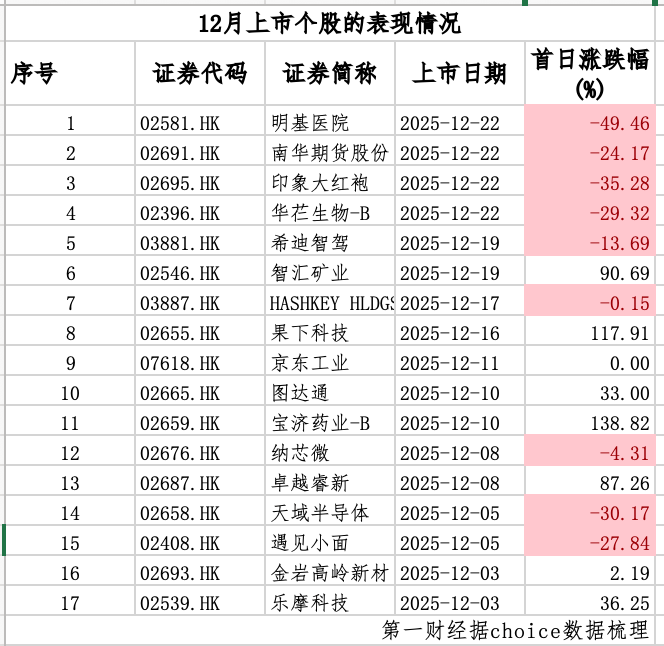
Core Viewpoint - The Hong Kong IPO market experienced a rare event where four new stocks collectively fell below their issue prices on their first trading day, indicating a significant shift in market sentiment and performance [2][3]. Group 1: IPO Performance - Four new stocks listed on December 22, 2025, including Mingji Hospital, Impression Dahongpao, Huazai Biotechnology, and Nanhua Futures, saw declines of 49.46%, 35.28%, 29.32%, and 24.17% respectively, with Mingji Hospital's drop marking the largest first-day decline for a new stock since 2025 [2][4]. - In December 2025, out of 17 newly listed stocks, 9 experienced first-day declines, representing over 50% of the total, contrasting sharply with the strong performance of new stocks earlier in the year [3]. Group 2: Market Conditions - The overall liquidity environment in the Hong Kong market has tightened, with daily trading volumes on the Hong Kong Stock Exchange falling below 2 billion HKD, and net inflows from southbound funds significantly decreasing to 219.12 billion RMB in December [5][6]. - The Hang Seng Index, Hang Seng Tech Index, and Hang Seng China Enterprises Index all experienced declines of 1.10%, 2.82%, and 1.96% respectively during the week of December 15-19, 2025 [5]. Group 3: Factors Influencing Performance - The recent decline in new stock performance is attributed to multiple factors, including tightening liquidity, high valuations relative to fundamental performance, and regulatory changes affecting public fund holdings in Hong Kong stocks [7][8]. - Mingji Hospital's high price-to-earnings (P/E) ratio of approximately 29.8 times compared to the average P/E of 17 times for the private hospital sector in Hong Kong indicates a mismatch between valuation and fundamental performance [8][9]. Group 4: Regulatory Changes - The introduction of "Mechanism B" for IPOs allows issuers to set a lower limit on the proportion of shares available for public subscription, which can reduce the risk of mispricing but may also limit the ability of companies with high valuations to attract sufficient demand [9][10]. - Mingji Hospital utilized Mechanism B for its IPO, issuing 67 million shares with only 10% allocated for public sale, resulting in a limited float of approximately 394 million HKD [10].

华芢\生物-B上市次日再挫逾18% 较招股价已跌逾四成
Zhi Tong Cai Jing· 2025-12-23 03:15
Core Viewpoint - 华芢生物-B (02396) experienced a significant decline in its stock price, dropping nearly 30% on its debut and over 18% the following day, indicating market concerns regarding its financial performance and product pipeline [1] Company Overview - 华芢生物 is a biopharmaceutical company established in 2012, focusing on the discovery, development, and commercialization of wound healing therapies [1] - The company has a pipeline of ten candidate products as of December 5, 2025, with seven being PDGF candidate drugs, including two core products, Pro-101-1 and Pro-101-2 [1] Financial Performance - The company has not generated any revenue from product sales to date [1] - Projected net losses for the years 2023, 2024, and up to September 30, 2025, are estimated at 110 million, 210 million, and 130 million respectively, with the majority of losses attributed to research and development expenses and administrative costs [1]