
B&K(02396)

Search documents
港股异动 | 华芢生物-B(02396)上市次日再挫逾18% 较招股价已跌逾四成
智通财经网· 2025-12-23 03:13
Core Viewpoint - Hua Yan Biopharma-B (02396) experienced a significant decline in stock price, dropping nearly 30% on its first trading day and over 18% the following morning, with a low of 21.82 HKD, representing a decline of more than 40% from its IPO price of 38.2 HKD [1] Company Overview - Hua Yan Biopharma, established in 2012, is a biopharmaceutical company focused on the discovery, development, and commercialization of wound healing therapies [1] - As of December 5, 2025, the company has a pipeline of ten candidate products, with seven being PDGF candidate drugs, including two core products, Pro-101-1 and Pro-101-2 [1] Financial Performance - The company has not generated any revenue from product sales to date [1] - Projected net losses for the years 2023, 2024, and up to September 30, 2025, are 110 million HKD, 210 million HKD, and 130 million HKD, respectively [1] - The majority of the net losses are attributed to research and development expenses as well as administrative costs [1]
上市首日破发近30%,华芢生物-B(02396)“机制B+无基石”难获市场认可?
智通财经网· 2025-12-23 02:52
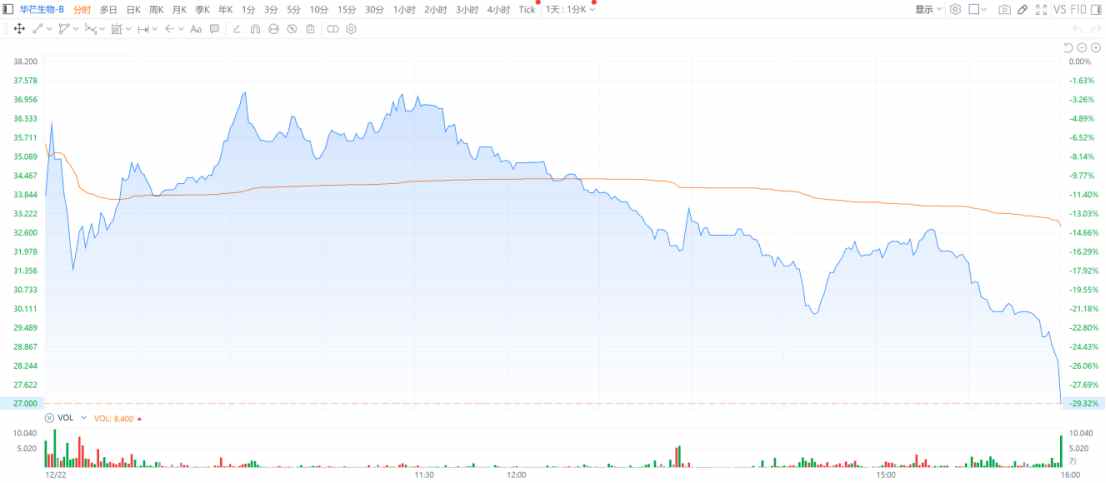
Core Viewpoint - The initial public offering (IPO) of Huazhang Biotech-B (02396) on December 22 saw a significant drop in share price, closing at 27.00 HKD, a decline of 29.32% from the issue price of 38.20 HKD, which was below investor expectations [1][14]. Group 1: IPO Performance - On the first trading day, Huazhang Biotech's stock price fell as much as 21.68%, reaching a low of 31 HKD before closing at 27.00 HKD [1]. - The company was initially viewed as a promising investment due to its status as the "first PDGF stock in Hong Kong," but the performance on the first day was disappointing for many investors [1][14]. - The stock experienced a significant oversubscription of 791.95 times during the global offering, indicating strong initial interest [3]. Group 2: Financial Details - The global offering consisted of 17.6488 million H-shares, with 90% allocated for international sale and 10% for public sale, raising approximately 674 million HKD [3]. - The company set the issue price at the lower end of the range, with a total fundraising target of approximately 787 million HKD [4]. - The entry fee for investors was notably high at 10,302.88 HKD, which is above the average for Hong Kong IPOs this year [6]. Group 3: Market Context - The company operates in the biotechnology sector, focusing on developing and commercializing protein-based therapies, particularly in wound healing [11]. - Huazhang Biotech's core products, Pro-101-1 and Pro-101-2, are currently in clinical trials for treating burn injuries and diabetic foot ulcers, respectively [13]. - The Chinese diabetes market is projected to grow from 4.7 billion USD in 2023 to 9.3 billion USD by 2032, with a compound annual growth rate (CAGR) of 7.9% [12]. Group 4: Challenges and Risks - Despite the promising market potential, the company is classified as an "unprofitable 18A" entity, indicating high research and development costs without current product sales [14]. - The company reported minimal revenues of 472,000 HKD and 261,000 HKD for 2023 and 2024, respectively, with significant net losses attributed to R&D and administrative expenses [14]. - The absence of cornerstone investors and reliance on institutional investors for price stabilization may have contributed to the stock's poor performance on its debut [8][9].

上市首日破发近30%,华芢\生物-B“机制B+无基石”难获市场认可?
Zhi Tong Cai Jing· 2025-12-23 02:51
Core Viewpoint - The initial public offering (IPO) of Huazhang Biotech-B (02396) on December 22, 2025, experienced significant volatility, with the stock price dropping as much as 29.32% by the end of the trading day, which was below investor expectations given its status as the "first PDGF stock in Hong Kong" [1][2][15] Group 1: IPO Performance - On the first trading day, Huazhang Biotech's stock opened significantly lower, with a maximum drop of 17.80% within the first 10 minutes, reaching a low of 31.4 HKD [1] - The stock price rebounded briefly but ultimately closed at 27.00 HKD, marking a total decline of 29.32% [1] - The company had a substantial oversubscription rate of 791.95 times during the IPO, indicating strong initial interest despite the poor first-day performance [4][7] Group 2: Financial Details - The IPO involved the global issuance of 17.6488 million H-shares, with 90% allocated for international sale and 10% for public offering, raising approximately 674 million HKD [4] - The offering price was set at the lower end of the range at 38.20 HKD per share, with a total fundraising target of about 6.74 billion HKD [5] - The company reported minimal revenue of 47,200 HKD and 26,100 HKD for 2023 and 2024, respectively, primarily from research services, while incurring significant net losses of 1.05 billion HKD, 2.12 billion HKD, and 1.35 billion HKD over the same period [15] Group 3: Market Context and Product Pipeline - Huazhang Biotech focuses on developing and commercializing protein-based therapies, particularly in the wound healing sector, with core products Pro-101-1 and Pro-101-2 targeting burn injuries and diabetic foot ulcers [12][14] - The Chinese diabetes market is projected to grow from 4.7 billion USD in 2023 to 9.3 billion USD by 2032, with a compound annual growth rate (CAGR) of 7.9% [13][14] - The company is in the clinical trial stages for its products, with Pro-101-1 expected to submit an IND application to the FDA in Q1 2026 [14]
港股生物医药IPO热潮背后:从华芢生物与明基医院破发看资本的理性回归
Xin Lang Zheng Quan· 2025-12-23 02:31
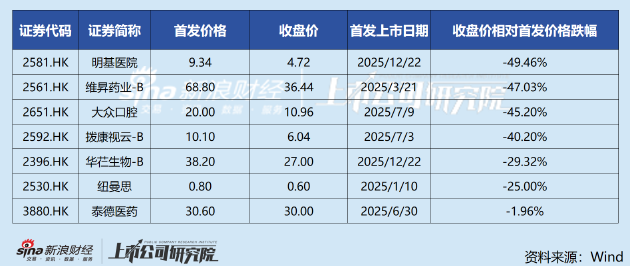
Group 1 - Four new stocks were listed on December 22, 2025, including two from the healthcare sector: Huashan Bio and Mingji Hospital [1] - Huashan Bio experienced a significant increase of over 30% in dark market trading prior to its public offering, with a subscription ratio reaching nearly 792 times and over 500 billion HKD in frozen funds [1] - Despite initial excitement, both Huashan Bio and Mingji Hospital saw their stock prices drop significantly upon listing, with Huashan Bio falling over 11% and Mingji Hospital dropping more than 30% [1] Group 2 - Huashan Bio is positioned as the first PDGF stock in Hong Kong, targeting a blue ocean market for wound healing with seven PDGF candidate drugs, including Pro-101-1, which is noted for its rapid clinical development [1][2] - The potential market size for PDGF drugs in burn treatment is only about 6.66 million RMB by 2033, and the diabetic foot ulcer market is highly competitive with existing treatment options [2] - Huashan Bio lacks commercialized products, revenue, and profit, categorizing it as a "three-no company" [1][2] Group 3 - Mingji Hospital is the largest private profit-making hospital group in East China, with over 2 million outpatient visits in 2024 and the highest revenue per bed among similar hospitals in the country [3] - However, Mingji Hospital's revenue has stagnated, with a 1.1% decline in 2024 and a further 1.34% drop in the first half of 2025, alongside a significant decrease in net profit from 167 million RMB in 2023 to 109 million RMB in 2024 [3] - The static P/E ratio for Mingji Hospital in 2024 is estimated to be between 25x and 31x, which is significantly higher than the average for the Hong Kong healthcare sector [3] Group 4 - Early investors, such as CDH Medical Services Limited, exited before the IPO, indicating cautious expectations regarding the company's value [4] - CDH invested 100 million USD in 2014 and sold its shares for 195 million USD in 2023, realizing a profit of 95 million USD [4] - The cases of Huashan Bio and Mingji Hospital reflect a broader trend of market sentiment diverging from asset fundamentals, with recent IPOs in the Hong Kong biotech sector being driven by external liquidity and market corrections [4][5] Group 5 - As of early 2025, 24 biotech companies have successfully listed on the Hong Kong stock market, with 7 currently trading below their IPO prices [5] - Notable declines include Mingji Hospital, which has seen a drop of 49.46% from its IPO price of 9.34 HKD to a closing price of 4.72 HKD [6]
惨烈!今天,港交所上市4只新股,全崩了!
Xin Lang Cai Jing· 2025-12-22 23:43
Group 1 - Four newly listed stocks in the Hong Kong market experienced significant declines on their debut, with drops of 49.46%, 29.32%, 24.17%, and 35.28% respectively, marking a record low for first-day performance in 2025 [1][8] - Among these, Ming Kee Hospital saw the largest drop, nearly halving its value, which is attributed to its high issuance price-to-earnings (PE) ratio of approximately 29.8 times, significantly above the industry average of about 17 times [5][10] - Impression Da Hong Pao, despite being oversubscribed by 3,397 times, still faced a drop of over 35% on its first day, indicating a decline in its shareholder profits [5][14] Group 2 - The collective failure of these new stocks is linked to tightening market liquidity, with southbound capital inflows significantly reduced in December and average daily trading volume on the Hong Kong Stock Exchange falling below HKD 200 billion [4][12] - Concerns regarding the valuation and fundamental performance of the new stocks have emerged, particularly for Ming Kee Hospital, which has seen a profit decrease of 34.95% year-on-year for 2024 [5][11] - The new IPO pricing mechanism introduced by the Hong Kong Stock Exchange in August, which allows a minimum public subscription ratio of 10%, has been criticized for potentially exacerbating the situation for companies with high valuations and low institutional interest [6][12] Group 3 - The Hong Kong IPO market has cooled significantly since November, with a 50% first-day drop rate among newly listed stocks, compared to 30.23% in the first half of the year and 35.71% for the entire year of 2024 [7][12] - Analysts suggest that the misalignment between primary market pricing and secondary market risk appetite, along with a heavy reliance on southbound capital, has made new stocks particularly vulnerable to sell-offs [13] - The recent performance of these four new stocks serves as a warning to investors that the era of easy profits from IPOs may be over, emphasizing the importance of fundamental quality and reasonable pricing in determining future performance [13]

今日财经要闻TOP10|2025年12月22日
Xin Lang Cai Jing· 2025-12-22 12:33
Group 1 - The People's Bank of China has announced a one-time credit repair policy, allowing individuals to have overdue information removed from the financial credit information database if they repay overdue debts of up to 10,000 RMB by March 31, 2026 [1] Group 2 - In the next two weeks, 46 routes between China and Japan will cancel all flights, with a total of 2,195 flights canceled from mainland China to Japan by December 22, 2025, resulting in a cancellation rate of 40.4% [2] Group 3 - Four new stocks in Hong Kong experienced a collective drop on their first trading day, with Mindray Hospital falling nearly 50%, marking the worst performance for new stocks this year [4] Group 4 - The U.S. Secretary of State emphasized the importance of maintaining relations with China while continuing strong partnerships with Japan, indicating a balanced approach to U.S. policy in the Asia-Pacific region [3][10] Group 5 - Zhiyuan Robotics expects to achieve sales revenue exceeding 1 billion RMB this year, with plans for significant growth in robot shipments and revenue in the coming years [4] Group 6 - The State-owned Assets Supervision and Administration Commission of China is committed to deepening cooperation with Hong Kong to enhance its status as a financial center and support the internationalization of the RMB [6] Group 7 - The Ministry of Commerce announced temporary countervailing measures on imported dairy products from the EU, effective December 23, 2025 [10]
今日港股4新股全部破发!明基医院跌近50%创年内港股新股首日最差表现
Jin Rong Jie· 2025-12-22 11:42
Group 1 - The Hong Kong IPO market experienced a collective downturn on December 22, 2025, with four newly listed stocks, including Impression Da Hong Pao (HK02695), Huaren Biotech-B (HK02396), Ming Kee Hospital (HK02581), and Nanhua Futures (HK02691), all facing significant declines, with Ming Kee Hospital dropping 49.46%, marking the worst debut performance of the year [1] - All four new stocks opened lower and continued to decline throughout the trading day, closing near their lowest prices. Ming Kee Hospital, which had an offering price of 9.34 HKD, closed at 4.73 HKD, resulting in a loss of 1,420 HKD per lot of 500 shares, surpassing the previous record decline of 47.67% set by Conch Cement Technology [1] - Impression Da Hong Pao, despite receiving a 3,400 times oversubscription and a pre-listing increase of 11% on the Futu platform, ultimately closed down 35.28% at 2.33 HKD, leading to a loss of 1,270 HKD per lot of 1,000 shares [1] Group 2 - Following the reform of the Hong Kong IPO pricing mechanism in August 2025, the new stock failure rate was only 7.14% from August to October, but it surged to 42.10% from November onwards, significantly exceeding the 30.23% rate observed in the first half of the year [2] - The core reason for this discrepancy is the misalignment between primary market pricing and secondary market risk appetite, with issuers often referencing A-share valuations while Hong Kong investors prioritize cash flow and dividend returns, compounded by increased pressure from southbound capital and smaller float sizes, leading to concentrated sell-offs post-listing [2] - The Hong Kong IPO market has reached a scale of 267.1 billion HKD this year, with potential to reclaim the top position globally for IPOs. However, ongoing fluctuations in Federal Reserve policy expectations and changes in cross-border capital flows indicate that the valuation restructuring in the Hong Kong new stock market is still ongoing, resulting in a more cautious sentiment among investors regarding new listings [2]
华芢\生物港股上市首日破发跌29% 2年9个月共亏4.5亿
Zhong Guo Jing Ji Wang· 2025-12-22 09:01
Core Viewpoint - Huazhen Biotechnology (Qingdao) Co., Ltd. (stock code: 02396.HK) was listed on the Hong Kong Stock Exchange, opening below the issue price at HKD 33.80 and closing at HKD 27.00, reflecting a decline of 29.32% from the final offer price of HKD 38.20 [1][4]. Group 1: Offering Details - The total number of shares offered globally was 17,648,800 H-shares, with 1,765,000 shares available for public offering in Hong Kong and 15,883,800 shares for international offering [2]. - The final offer price was set at HKD 38.20, with total proceeds amounting to HKD 674.18 million, and net proceeds after estimated listing expenses of HKD 74.36 million were HKD 599.82 million [4][5]. Group 2: Use of Proceeds - The net proceeds from the global offering are intended to fund the ongoing clinical development and commercialization of core products Pro-101-1 and Pro-101-2, purchase professional equipment related to R&D and quality control, and cover third-party service fees and costs for clinical research of other PDGF products [6]. Group 3: Financial Performance - The company reported revenues of RMB 472,000 in 2023 and RMB 261,000 in 2024, with no revenue generated from product sales during the reporting period [7][8]. - The net losses for 2023 and 2024 were RMB 105.2 million and RMB 212.3 million, respectively, with total accumulated losses of RMB 451.9 million over the two years and nine months [7][8]. - Operating cash flow for the years 2023 and 2024 was negative, with net cash used in operating activities amounting to RMB 57.9 million and RMB 90.1 million, respectively [9].

港股收盘(12.22) | 恒指收涨0.43% 光通信、半导体股表现亮眼 有色金属全天强势
智通财经网· 2025-12-22 08:47
Market Overview - The Hong Kong stock market experienced fluctuations, with the Hang Seng Index closing up 0.43% at 25,801.77 points and a total trading volume of HKD 169.77 billion [1] - The market is currently in a left-side layout phase, with strong expectations for a spring rally, although there are supply and demand pressures towards the end of the year [1] Blue Chip Performance - Semiconductor company SMIC (00981) led blue-chip gains, rising 5.92% to HKD 68.9, contributing 27.67 points to the Hang Seng Index [2] - Other notable blue-chip performers included Zijin Mining (02899) up 5.3% and Pop Mart (09992) up 4.61%, while WuXi AppTec (02359) and Hang Lung Properties (00101) saw declines [2] Sector Highlights - Large technology stocks generally rose, with Alibaba up 0.76% and Tencent up 0.08% [3] - The metals sector saw significant gains, with gold prices surpassing USD 4,400 per ounce and LME copper prices nearing USD 12,000 per ton [4] - The new consumption sector was active, with companies like Mixue Group (02097) rising 10.13% following the opening of a new store in Los Angeles [6] Investment Opportunities - The storage and advanced process sectors are expected to see accelerated growth, benefiting domestic equipment manufacturers [5] - The AI and robotics sectors are gaining traction, with companies like Ubiquiti (09880) and others seeing increased orders and market interest [6][7] New Stock Listings - Four new stocks listed on the Hong Kong market faced significant declines on their debut, with Mindray Hospital (02581) dropping 49.46% [8] - China Duty Free Group (01880) saw a strong performance, rising 15.77% amid positive sales data from Hainan's duty-free shopping [9] Company-Specific Developments - Yujian (02432) faced downward pressure due to an upcoming lock-up expiration and a recent share placement [10]


华芢生物上市首日收跌29.32%
Bei Jing Shang Bao· 2025-12-22 08:47
Core Viewpoint - Huazhang Biopharmaceutical (02396.HK) experienced a significant decline of 29.32% on its first day of trading on the Hong Kong Stock Exchange, closing at HKD 27 per share [1] Company Overview - Established in 2012, Huazhang Biopharmaceutical is a biopharmaceutical company headquartered in China [1] - The company focuses on developing various therapies, particularly protein drugs targeting medical needs and market opportunities [1] - Huazhang's primary focus is on discovering, developing, and commercializing therapies for wound healing, with a current emphasis on platelet-derived growth factor (PDGF) drugs [1]