CPIC(02601)

Search documents
保险业:理赔捐赠同步 服务保障并行
Jin Rong Shi Bao· 2025-12-01 01:32
Core Viewpoint - The insurance industry in Hong Kong has rapidly mobilized to support rescue and recovery efforts following a severe fire incident in Tai Po, demonstrating its role as an economic stabilizer and social safety net through emergency response measures and significant financial contributions [1][4]. Group 1: Emergency Response Actions - Multiple insurance companies, including China Life, China Pacific, and Taikang Insurance, activated emergency response plans immediately after the fire, establishing management teams and simplifying claims processes to ensure rapid support for affected clients [2][3]. - China Life's overseas branch initiated emergency claims services, proactively contacting policyholders to ensure timely assistance [2]. - China Taiping Insurance quickly identified affected clients and established a claims hotline, demonstrating a commitment to rapid response and support [3]. Group 2: Financial Contributions - Insurance institutions have collectively donated over 60 million HKD to aid in rescue efforts, with AIA Hong Kong contributing 20 million HKD for emergency assistance and community recovery [4][6]. - China Ping An announced a donation of 10 million HKD for emergency relief and recovery efforts, emphasizing its commitment to supporting affected communities [4][5]. - Taikang Insurance pledged 10 million RMB for urgent relief and community rebuilding, showcasing the industry's solidarity with the affected population [6]. Group 3: Reinsurance Support - Reinsurance companies, such as China Re, played a crucial role in stabilizing market confidence by providing essential support for local insurers in managing disaster-related claims [7][8]. - China Re activated its emergency response mechanism to assist direct insurers in assessing losses and expediting claims processes, reinforcing the insurance system's resilience [7]. - Qianhai Reinsurance established a dedicated task force to support claims services and ensure timely compensation for affected areas, enhancing the overall response capability of the insurance sector [8].





陕西省“险资入陕”交流观摩活动举办
Shan Xi Ri Bao· 2025-11-30 22:36
11月27日至28日,由省委金融办、省发展改革委、省民政厅、省金融监管局联合主办,陕西丝路金 融研究院协办的2025年陕西省"险资入陕"交流观摩活动在西安举办。 11月28日,险资机构投资团队分赴西安市丝路科学城、集成电路创新中心、陕西空天动力创新中 心、曲江文旅产业园区、龙腾半导体项目基地、西安财金投资管理公司等重点园区与企业实地考察,深 入了解项目融资需求,推动产投合作加快落地。 保险资金作为天然的"耐心资本",具有规模大、期限长、来源稳等显著优势,在服务国家战略、支 持实体经济和保障国计民生中发挥着重要作用。省委金融办相关负责人表示,将联合省发展改革委、省 民政厅、陕西金融监管局等部门,持续加大工作力度,进一步畅通资本与项目合作渠道,推动保险资金 与陕西优质项目深度对接,为谱写陕西新篇、争做西部示范注入强劲金融动能。(记者:孙丹) 在2025年陕西省"险资入陕"交流大会上,政府有关部门负责人、险资机构代表以及省内高端制造、 能源化工、文化旅游等重点领域的产业园区、重点企业和上市后备企业负责人共计300余人参会。人保 资本保险资产管理公司、中保投资公司、太平洋资产管理公司等头部险资机构专家围绕保险资金支持 ...

金融行业周报(2025、11、30):保险开门红展望积极,坚持银行板块配置策略-20251130
Western Securities· 2025-11-30 12:49
Core Conclusions - The financial industry experienced a weekly increase of +0.68% in the non-bank financial index, underperforming the CSI 300 index by 0.96 percentage points [1] - The banking sector saw a decline of -0.59%, lagging behind the CSI 300 index by 2.23 percentage points, with state-owned banks, joint-stock banks, city commercial banks, and rural commercial banks showing varied performance [1][9] Insurance Sector Insights - The insurance sector's index rose by +0.20%, underperforming the CSI 300 index by 1.44 percentage points, driven by strong demand for dividend insurance products that align with residents' needs for stable returns and value appreciation [2][12] - Major insurance companies are focusing on dividend insurance as a strategic core, with product offerings expanding significantly ahead of the 2026 "opening red" period [2][12] - The growth of new single premiums is expected to be strong in 2026, supported by improved net present value margins (NBVM) and a favorable regulatory environment for dividend insurance [2][17] Brokerage Sector Insights - The brokerage sector index increased by +0.74%, underperforming the CSI 300 index by 0.90 percentage points, with recent developments in refinancing for two brokerages indicating a cautious approach to capital raising [2][18] - The current environment presents a mismatch between profitability and valuation in the brokerage sector, suggesting potential for valuation recovery [2][19] - Recommendations include strong mid-to-large brokerages with low valuations and those involved in mergers or restructuring [2][19] Banking Sector Insights - The banking sector's index decreased by -0.59%, underperforming the CSI 300 index by 2.23 percentage points, with a focus on high dividend strategies remaining viable [3][20] - The average dividend yield for banks is approximately 4.1%, which is attractive compared to other sectors, particularly in the context of a stable earnings outlook [3][21] - Recommendations include state-owned banks and resilient city commercial banks, with specific attention to banks with strong fundamentals and low volatility [3][22]


非银金融行业周报:多只券商股被调入重要指数,关注被动资金流入、调整公告日-20251130
Shenwan Hongyuan Securities· 2025-11-30 10:45
Investment Rating - The report maintains a positive outlook on the non-bank financial sector, particularly highlighting the potential benefits for brokerage firms and insurance companies in the upcoming year [3][4]. Core Insights - The report emphasizes the expected inflow of passive funds into newly included stocks in major indices, which could enhance liquidity and market performance for these stocks [4]. - It identifies key trends for 2026, including a shift in insurance companies' focus towards asset-liability matching and the stabilization of core business indicators due to new regulatory standards [4]. - The report recommends specific brokerage firms such as Dongfang Securities, GF Securities, Huatai Securities, and China Galaxy, as well as insurance companies like China Life and Ping An, based on their competitive positioning and growth potential [4]. Summary by Sections Market Performance - The Shanghai Composite Index closed at 4,526.66 with a weekly increase of 1.64%, while the non-bank index rose to 1,932.15, reflecting a 0.68% increase [7]. - The brokerage sector index reported a 0.74% increase, and the insurance sector index saw a 0.20% rise [7]. Brokerage Sector Insights - Notable stocks in the brokerage sector included Guosheng Securities and Xinyi Securities, which saw increases of 3.68% and 3.36%, respectively [9]. - The average daily trading volume for the Shanghai and Shenzhen markets was 17,370.85 billion, a decrease of 6.87% week-on-week, but a year-to-date increase of 61.11% [20]. Insurance Sector Insights - The insurance sector is expected to experience a systematic revaluation in 2026, driven by long-term interest rate increases and continued investment from insurance funds into the stock market [4]. - The report highlights the performance of major insurance companies, with A-shares like China Life and Ping An showing modest increases [9]. Key Data Points - As of November 28, 2025, the average daily trading volume was 19,147.38 billion, and the margin trading balance was 24,720.45 billion, reflecting a year-on-year increase of 32.6% [51][20]. - The report notes that the total market value of private equity funds reached 22.05 trillion, marking a historical high [21].


行业周报:公募REITs试点纳入商业不动产,险企开门红向好-20251130
KAIYUAN SECURITIES· 2025-11-30 07:11
Investment Rating - The industry investment rating is optimistic (maintained) [1] Core Views - The insurance sector is preparing actively for the 2026 "opening red" period, with a focus on dividend insurance products, which are expected to outperform traditional insurance due to higher yield rates [6] - The brokerage sector continues to show high profitability, with wealth management, investment banking, and overseas business expected to drive earnings improvement [5][7] - The long-term interest rates are stabilizing at the bottom, which is expected to support the asset side logic and improve the liability cost for insurance companies [6] Summary by Sections Insurance Sector - The insurance companies are gearing up for the 2026 "opening red" with dividend insurance becoming the main product, offering a yield rate significantly higher than traditional insurance [6] - The market share of listed insurance companies is expected to increase due to the expansion of bank insurance channels and the release of "storage demand" [6] - The overall outlook for the liability side is optimistic, with potential improvements in the value rate of dividend insurance supported by rate adjustments and structural optimization [6] Brokerage Sector - The average daily trading volume of stock funds from January to November increased by 77.1% year-on-year, indicating strong market activity [7] - The China Securities Regulatory Commission has proposed to include commercial real estate in the public REITs pilot program, which is expected to enhance the market for REITs [7] - Major brokerage firms are expected to see significant ROE expansion under the current growth-oriented strategy, with low valuations presenting strategic allocation opportunities [7] Recommended Stocks - Recommended stocks include China Pacific Insurance, Ping An Insurance, China Life Insurance H, Huatai Securities, Guotai Junan, and others [8]

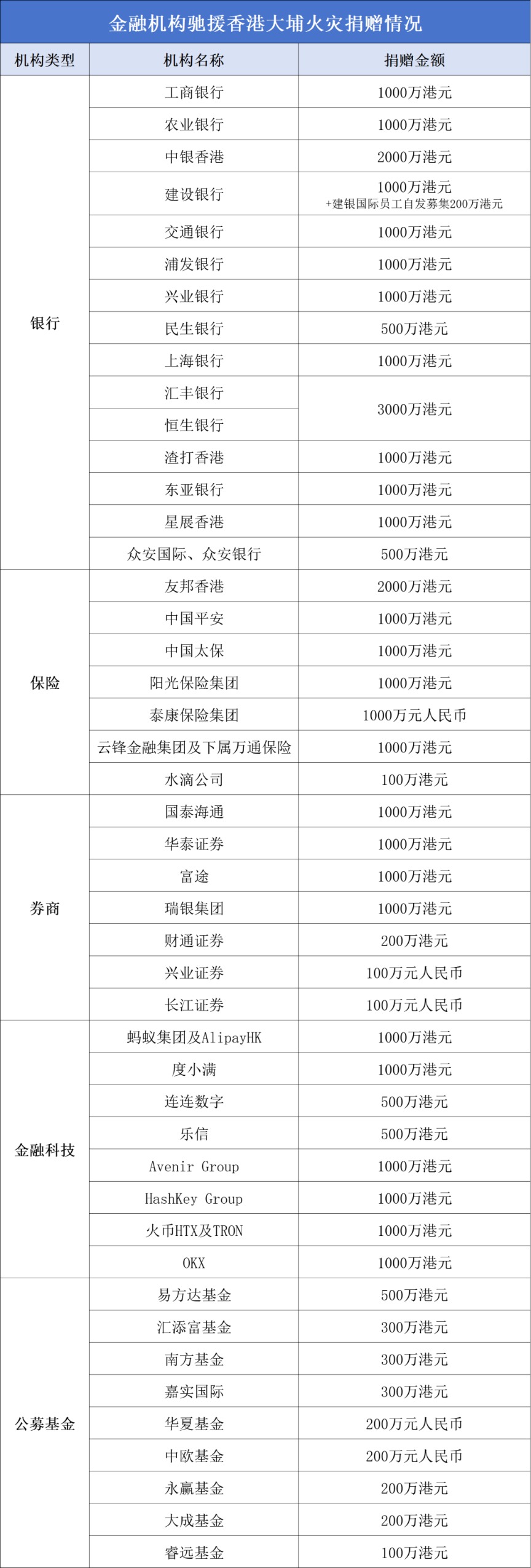
逾3.7亿港元!近50家金融机构捐款捐物驰援香港大埔火灾
Guo Ji Jin Rong Bao· 2025-11-29 10:06
Core Viewpoint - The fire at Hong Kong's Tai Po Wang Fuk Court resulted in significant casualties, with 128 confirmed dead and around 200 individuals unaccounted for, prompting a swift response from the financial sector to support relief efforts [1][2]. Financial Institutions' Donations - Nearly 50 financial institutions have contributed over 370 million HKD to aid in disaster relief, including major banks, insurance companies, and fintech firms [1][2]. - Notable contributions include: - Bank of China Hong Kong: 20 million HKD - HSBC: 30 million HKD - Agricultural Bank of China: 10 million HKD [2][3][6]. Emergency Support Measures - The Hong Kong Monetary Authority and the Hong Kong Association of Banks urged banks to provide flexible support to affected individuals, including expedited cash withdrawals and waiving fees [6][7]. - Major state-owned banks, including ICBC and Agricultural Bank of China, quickly mobilized to assist in relief and reconstruction efforts [6][7]. Insurance Companies' Response - Insurance firms activated emergency plans, offering streamlined claims processes and immediate financial support to affected clients [9][10]. - AIA Hong Kong pledged 20 million HKD for community support and initiated contact with potentially affected clients [9][10]. Securities Firms' Contributions - Several securities firms, including Guotai Junan and Huatai Securities, donated funds to support emergency relief and reconstruction efforts [12][13]. - UBS announced a donation of 10 million HKD through its charitable foundation for community support [13][14]. Fintech Sector Involvement - Fintech companies, such as Ant Group and Du Xiaoman, contributed 10 million HKD each to assist with emergency relief and recovery efforts [17][18]. - Various digital asset platforms also pledged significant donations to support affected communities [19]. Public Fund Contributions - Public fund companies collectively donated over 20 million HKD to support disaster relief and recovery initiatives [20][21]. - Notable contributions include: - E Fund: 5 million HKD - Huatai Fund: 3 million HKD [21][22][23]. Overall Impact - The financial sector's rapid response and substantial contributions highlight its role as a stabilizing force in times of crisis, providing essential support to affected communities [27][28].




血脉相连!友邦、阳光、平安等险企各捐赠千万援助香港;太平积极处理超20亿保额理赔;保险资管业协会更名添“银行”|13精周报
13个精算师· 2025-11-29 03:03
Regulatory Dynamics - The China Insurance Asset Management Association has been renamed to include "Bank," marking a new phase in self-regulation for the banking and insurance asset management industry [8] - Beijing has upgraded vehicle insurance real-name authentication to a dual-factor verification system using "facial recognition + mobile verification" [9] - The Beijing Financial Regulatory Bureau reported that the insurance depth and density in the region remain the highest in the country [10] - Shenzhen's insurance industry reported a premium income growth rate of 12.2% in the first ten months, leading among first-tier cities [12] - Guangdong supports insurance funds to legally increase equity investment ratios and actively participate in merger and acquisition projects [13] - Shaanxi has established mechanisms to support insurance funds in setting up private equity venture capital funds [14] Company Dynamics - Taikang Life has increased its stake in Hong Kong-listed Fuhong Hanlin by purchasing 51,850 shares, raising its holding to 5.26% [16] - China Life has increased its stake in China National Railway Signal & Communication by 115,800 shares [17] - Dajia Life has invested over 20 billion in the Huage Nengrong (Shenzhen) Expressway [18] - China Life and Cainiao have jointly established a logistics investment fund with a scale exceeding 1.7 billion [19] - Caixin Jixiang and Guoshou Capital have laid out the first water and electricity private REIT in the country [20] - China Post has been approved to operate insurance agency business [25] - 法巴天星 has been approved to commence operations, with significant stakes held by both the French insurance group and Xiaomi [26] Industry Dynamics - The recent fire in Hong Kong's Tai Po district highlighted the low penetration rate of home insurance in mainland China, with many older residential areas lacking coverage [62] - Insurance capital has accelerated its equity investments, with 37 instances of stake acquisitions this year, the highest in nearly a decade [63] - The China Insurance Investment Fund became the largest winner in the IPO of "domestic Nvidia" Moer Thread, acquiring 437,520 shares [64][65] - The insurance industry is optimistic about the upcoming market trends, with expectations of a "spring surge" in stock market activity [66] - The China Actuarial Association suggests that insurance products should shift towards being less sensitive to interest rates [67] Personnel Changes - Zhao Yulong has been elected as the president of the China Insurance Industry Association [38] - He Xin has been approved to serve as the chairman of Dongfang Jiafu Life Insurance [40] - The board of directors of Zhong An Online has elected Yin Hai as chairman [41] - Key management adjustments have been made at China Reinsurance [42]


长三角地区多家金融机构相继捐款 支援香港大埔火灾救援
Jing Ji Guan Cha Wang· 2025-11-28 14:43
Group 1 - Several financial institutions in the Yangtze River Delta region have made donations to support the emergency relief efforts following the fire in Hong Kong's Tai Po district [2] - Bank of Communications plans to donate HKD 10 million for disaster relief and post-disaster reconstruction, while also providing emergency support measures for affected clients and residents [2] - Shanghai Pudong Development Bank has activated its emergency donation mechanism, contributing HKD 10 million to the Hong Kong White Magnolia Charity Foundation for emergency relief and reconstruction efforts [2] - Shanghai Bank has also initiated an emergency donation mechanism, donating HKD 10 million to the Hong Kong White Magnolia Charity Foundation, with funds transferred quickly to support rescue and recovery efforts [2] - Lianlian Digital Company and its employees have collectively donated HKD 5 million to assist with medical aid, emergency housing, and living support for affected residents [2] Group 2 - China Pacific Insurance has quickly activated its emergency response mechanism, ensuring customer service measures are in place to protect the rights of affected individuals [3] - China Pacific Life Insurance in Hong Kong has recruited over 20 employees to form a volunteer service team for on-site rescue efforts and has encouraged staff to participate in voluntary blood donation [3] - China Pacific Insurance has announced an emergency donation of HKD 10 million to support local disaster relief and resettlement efforts [3]




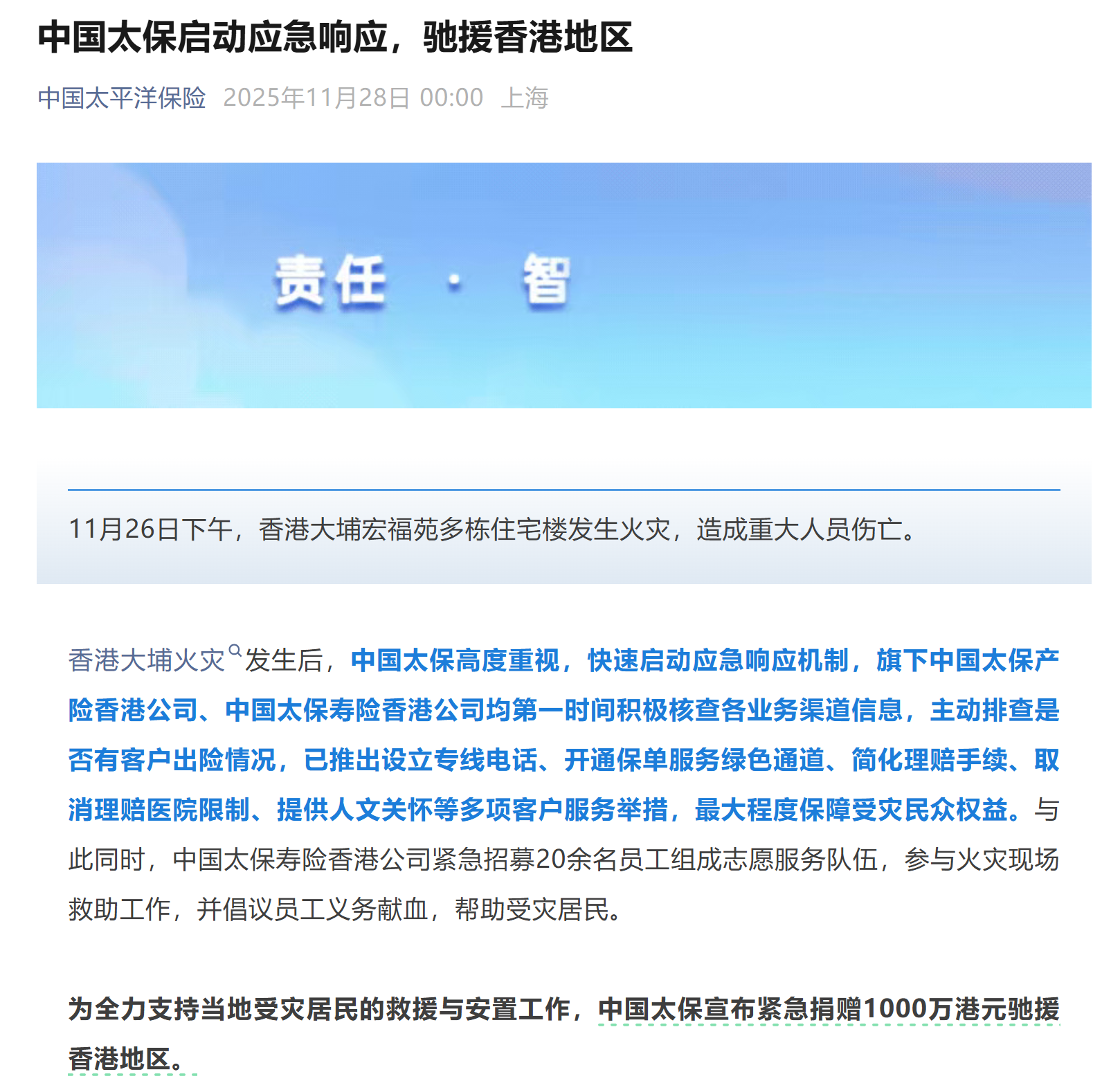
中国太保启动应急响应,捐赠1000万港元驰援香港
Guo Ji Jin Rong Bao· 2025-11-28 14:17
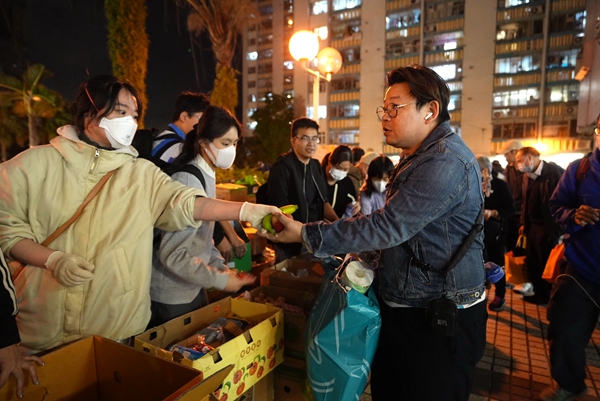
有需要的客户或亲属可通过以下方式联系咨询: 中国太保产险香港公司服务热线:(852)35719977(24小时紧急服务电话) (852)21377639 中国太保寿险香港公司服务热线:(852)22139019(专线服务电话) (852)31695500 11月26日下午,香港大埔宏福苑多栋住宅楼发生火灾,造成重大人员伤亡。 香港大埔火灾发生后,中国太保高度重视,快速启动应急响应机制,旗下中国太保产险香港公司、中国太保寿险香港公司均第一时间积极核查各业务渠 道信息,主动排查是否有客户出险情况,已推出设立专线电话、开通保单服务绿色通道、简化理赔手续、取消理赔医院限制、提供人文关怀等多项客户服务 举措,最大程度保障受灾民众权益。 与此同时,中国太保寿险香港公司紧急招募20余名员工组成志愿服务队伍,参与火灾现场救助工作,并倡议员工义务献血,帮助受灾居民。 为全力支持当地受灾居民的救援与安置工作,中国太保宣布紧急捐赠1000万港元驰援香港地区。 11月26日下午,香港大埔宏福苑多栋住宅楼发生火灾,造成彭 香港大埔火灾 发生后,中国太保高度重视,快速启动应急呱 险香港公司、中国太保寿险香港公司均第一时间积极核查各业 否 ...
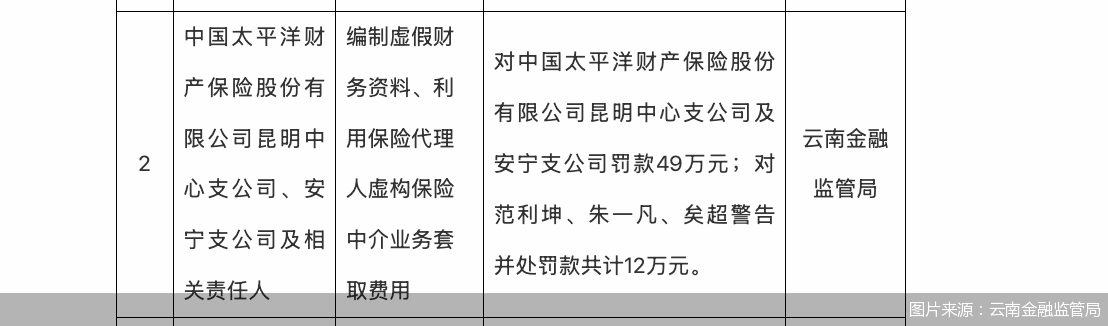
编制虚假财务资料等,太保产险两家支公司合计被罚61万元
Bei Jing Shang Bao· 2025-11-28 13:05
北京商报讯(记者 胡永新)11月28日,云南金融监管局发布的行政处罚信息显示,中国太平洋财产保险股份有限公司昆明中心支公司、安宁支公司及相关 责任人存在编制虚假财务资料、利用保险代理人虚构保险中介业务套取费用的违法违规行为,云南金融监管局对中国太平洋财产保险股份有限公司昆明中心 支公司及安宁支公司罚款49万元;对范利坤、朱一凡、矣超警告并处罚款共计12万元。 | | 中国太平洋财 | 编制虚假财 | 对中国太平洋财产保险股份 | | | | --- | --- | --- | --- | --- | --- | | | 产保险股份有 限公司昆明中 | 务资料、利 用保险代理 | | | | | | | | 有限公司昆明中心支公司及 | | | | | | | | 区南金融 | | | 2 | 心支公司、安 人虚构保险 | | 安宁支公司罚款49万元;对 | 监管局 | | | | | | 范利坤、朱一凡、矣超警告 | | | | | 宁支公司及相 | 中介业务套 | | | | | | | | 并处罚款共计12万元。 | | | | | 关责任人 | 取费用 | | | | | | | | | | 图片来源: ...