BANK COMM(03328)

Search documents
银行业:支持促消费政策落地 更好释放消费潜力
Jin Rong Shi Bao· 2025-08-21 02:23
Group 1 - Consumption is emphasized as a key driver for economic growth, with the People's Bank of China (PBOC) calling for stronger support to boost consumption in the second half of 2025 [1] - A series of policies aimed at promoting consumption and expanding domestic demand have been introduced, including a 500 billion yuan service consumption and pension relending program [1][4] - Experts believe that expanding domestic demand is crucial for maintaining stable economic growth in the coming months, with a clear policy direction favoring consumer spending [1] Group 2 - The government has allocated 300 billion yuan in special long-term bonds to support the "trade-in" program for consumer goods, which has positively impacted sales in key sectors like home appliances and communication devices [2] - The "trade-in" policy has led to improved profitability for related industries, while also stabilizing employment [2] - Banks are responding to the "trade-in" initiative by offering dedicated services to facilitate consumer participation and streamline the process [2][3] Group 3 - The PBOC's relending policy aims to enhance service consumption and improve the quality of services, which is expected to directly benefit the public and create more job opportunities [4][5] - Financial institutions are actively working to implement the service consumption and pension relending policies to support economic growth [4] Group 4 - The introduction of personal consumption loan interest subsidy policies is seen as an innovative approach to stimulate consumption by reducing financing costs for consumers and service industry operators [6] - Financial institutions are encouraged to tailor their offerings based on specific consumption scenarios to effectively meet the needs of consumers and businesses [7]
交通银行股份有限公司关于召开2025半年度业绩说明会的公告
Zhong Guo Zheng Quan Bao - Zhong Zheng Wang· 2025-08-21 02:01
Group 1 - The company will hold a half-year performance briefing on August 29, 2025, from 17:00 to 18:30 [7][8] - The briefing will be conducted via live streaming [3][8] - Investors can submit questions to the company's investor relations email by August 26, 2025, or ask questions during the live event [2][4] Group 2 - The company will disclose its 2025 half-year report on the same day as the briefing [2] - Attendees will include the company's president, independent director representatives, and other senior executives [8] - The live streaming interaction address will be provided for investors to participate [7]
智通ADR统计 | 8月21日
智通财经网· 2025-08-20 22:43
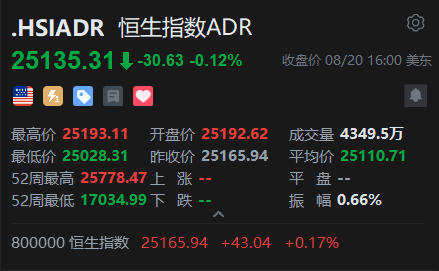
Market Overview - The Hang Seng Index (HSI) closed at 25,135.31, down by 30.63 points or 0.12% on August 20 [1] - The index reached a high of 25,193.11 and a low of 25,028.31 during the trading session, with a trading volume of 43.495 million shares [1] Major Blue-Chip Stocks - HSBC Holdings closed at HKD 102.118, up by 2.63% compared to the previous close [2] - Tencent Holdings closed at HKD 591.523, with a slight increase of 0.17% from the previous close [2] Stock Performance Summary - Tencent Holdings (00700) latest price is HKD 590.500, down by 0.34% [3] - Alibaba Group (09988) latest price is HKD 117.500, down by 0.68% [3] - HSBC Holdings (00005) latest price is HKD 99.500, up by 0.45% [3] - Meituan (03690) latest price remains unchanged at HKD 120.800 [3] - Pinduoduo (09992) saw a significant increase, closing at HKD 316.000, up by 12.54% [3]




恒指半年检结果揭晓在即!泡泡玛特等有望“染蓝” 机构看好这些个股入港股通
Zhi Tong Cai Jing· 2025-08-20 13:40
Group 1 - The Hang Seng Index will announce its semi-annual review results on August 22, 2025, affecting major indices such as the Hang Seng Index, the Hang Seng China Enterprises Index, and the Hang Seng Tech Index, with changes effective from September 8, 2025 [1] - Several brokerages, including UBS, Huatai Securities, and CICC, have released reports predicting adjustments to the Hang Seng Index and potential candidates for inclusion in the Hong Kong Stock Connect [1][2] - CICC highlights the significant size of passive funds tracking flagship indices, with ETF sizes for the Hang Seng Index, the Hang Seng China Enterprises Index, and the Hang Seng Tech Index being approximately $30.35 billion, $6.63 billion, and $26.12 billion respectively, indicating substantial potential fund flows due to component changes [1] Group 2 - CICC estimates that potential candidates for inclusion in the Hang Seng Index include Bank of Communications (03328), Pop Mart (09992), Yum China (09987), XPeng Motors (09868), Huazhu Group (01179), JD Logistics (02618), and Innovent Biologics (01801) [1][2] - UBS predicts that stocks likely to be included in the Hang Seng Index are WuXi AppTec (02268), Pop Mart, JD Logistics, Kingsoft (03888), and Bank of Communications, while Pop Mart is also expected to be included in the Hang Seng China Enterprises Index [2] Group 3 - Companies such as Cao Cao Travel (02643), InnoCare Pharma (09606), and Zhou Liu Fu (06168) are expected to be included in the Hong Kong Stock Connect, which connects Hong Kong-listed companies with mainland investors [3] - CICC estimates that 19 stocks meet the criteria for inclusion in the Hong Kong Stock Connect, including Cao Cao Travel, InnoCare Pharma, Zhou Liu Fu, and others [3][4] - UBS forecasts potential candidates for the Hong Kong Stock Connect based on the Hang Seng Composite Index predictions, including East Asia Bank, InnoCare Pharma-B, Blue Moon Group, and others [3] Group 4 - Huatai Securities also anticipates that 19 stocks may be included in the Hong Kong Stock Connect, with a list that includes Yunzhisheng, InnoCare Pharma-B, and others [4] - Historical data indicates that newly included stocks in the Hong Kong Stock Connect tend to outperform the market, while stocks removed from the index face significant capital outflows [4]
恒指半年检结果揭晓在即!泡泡玛特(09992)等有望“染蓝” 机构看好这些个股入港股通
智通财经网· 2025-08-20 13:36
Group 1 - The Hang Seng Index Company will announce the semi-annual review results of the Hang Seng series indices on August 22, 2025, with changes effective from September 8, 2025 [1] - Major brokerages, including UBS, Huatai Securities, and CICC, have released reports predicting adjustments to the Hang Seng Index, Hang Seng China Enterprises Index, and Hang Seng Composite Index [1][2] - CICC highlights the significant scale of passive funds tracking flagship indices, with ETF sizes for the Hang Seng Index, Hang Seng China Enterprises Index, and Hang Seng Technology Index being approximately $30.35 billion, $6.63 billion, and $26.12 billion respectively [1] Group 2 - Potential candidates for inclusion in the Hang Seng Index include Bank of Communications, Pop Mart, Yum China, XPeng Motors, Huazhu Group, JD Logistics, and Innovent Biologics [1][2] - UBS predicts that stocks likely to be included as blue-chip stocks are WuXi AppTec, Pop Mart, JD Logistics, Kingsoft, and Bank of Communications [2] - Historical data indicates that actual results of the Hang Seng Index's quarterly reviews may differ significantly from predictions based on market capitalization rankings [2] Group 3 - Companies such as Cao Cao Travel, InnoCare Pharma, and Chow Tai Fook are expected to be included in the Stock Connect list, which connects Hong Kong-listed companies with mainland investors [3] - CICC estimates that 19 stocks meet the criteria for inclusion in the Stock Connect, including Cao Cao Travel, InnoCare Pharma, and Nanshan Aluminum [3][4] - UBS forecasts potential additions to the Stock Connect list, including East Asia Bank, InnoCare Pharma-B, and Blue Moon Group [3] Group 4 - Huatai Securities also anticipates that 19 stocks may be added to the Stock Connect, including Yunzhisheng, Huiju Technology, and InnoCare Pharma-B [4] - Historical performance shows that newly included stocks in the Stock Connect tend to outperform the Hang Seng Index during the adjustment period, while stocks removed from the index face significant outflows [4]
消费贷贴息落地倒计时 有大行App即将上线“贴息专区”
Mei Ri Jing Ji Xin Wen· 2025-08-20 12:50
Core Viewpoint - The implementation plan for the personal consumption loan interest subsidy policy has been released, with major banks preparing to comply and establish specific operational guidelines [1][2]. Group 1: Policy Implementation - Major banks, including six large state-owned banks, are actively preparing to implement the personal consumption loan interest subsidy policy, with details to be announced through official channels [1][2]. - Some banks plan to set up a dedicated section in their mobile banking apps for loan interest subsidies, allowing customers to authorize transaction information for automatic identification of eligible loans [2][3]. Group 2: Loan Interest Rates - Current consumer loan interest rates in Shanghai remain at a minimum of 3%, with some banks offering rates as low as 3% after discounts [4][5]. - Analysts have noted that the subsidized consumer loan rates could drop below 3%, raising concerns about borrowers replacing higher-rate mortgage loans with lower-rate consumer loans [5][6]. Group 3: Loan Usage and Compliance - The subsidy applies to personal consumption loans used for specific categories, including consumer goods, home purchases, education, and healthcare [5][6]. - Banks have emphasized the importance of ensuring that loan funds are used for legitimate consumption purposes, warning against fraudulent practices to obtain subsidies [5][6].



三家大行接连发行TLAC债券,年内总规模达2500亿元
Cai Jing Wang· 2025-08-20 11:21
Core Viewpoint - The issuance of TLAC bonds by major state-owned banks in China has reached a total scale of 250 billion yuan this year, reflecting compliance with regulatory requirements for total loss-absorbing capacity [1][2][3]. Group 1: TLAC Bond Issuance - Major state-owned banks, including Bank of China, Agricultural Bank of China, and others, have issued TLAC bonds totaling 250 billion yuan this year, surpassing last year's issuance [2]. - The total issuance of TLAC bonds in the market has reached 480 billion yuan this year, with the five major banks receiving approval for a total of 440 billion yuan in TLAC debt instruments [2][3]. - Bank of China issued a 500 billion yuan TLAC bond with a fixed interest rate of 1.93% for a four-year term, aimed at enhancing its total loss-absorbing capacity [1]. Group 2: Compliance with Regulatory Requirements - The four major state-owned banks have successfully met the first phase of TLAC requirements, with their TLAC/RWA ratios exceeding the minimum requirement of 20% as of Q1 2025 [3]. - According to Fitch Ratings, the TLAC/RWA ratios for these banks need to reach 20% and 22% by 2025 and 2028, respectively, with specific targets for each bank [2][3]. - Agricultural Bank of China and Bank of China have TLAC/RWA ratios of 20.5% and 20.7%, respectively, indicating compliance with regulatory standards [3]. Group 3: Innovation in TLAC Bonds - The issuance of floating-rate TLAC bonds by Bank of Communications represents an innovative approach, with a total issuance of 300 billion yuan, including both fixed and floating-rate options [3][4]. - The floating-rate TLAC bond has a subscription rate of 1.42 times, indicating strong market interest and recognition of its investment value [4]. - The floating-rate bond's structure allows for effective hedging against interest rate risks, providing investors with a stable income stream [4].
交通银行(601328) - 交通银行关于召开2025半年度业绩说明会的公告
2025-08-20 09:30
股票代码:601328 股票简称:交通银行 编号:临 2025-053 交通银行股份有限公司 关于召开 2025 半年度业绩说明会的公告 交通银行股份有限公司(以下简称"交通银行"或"本公司")董事会及全体董事保证 本公告内容不存在任何虚假记载、误导性陈述或者重大遗漏,并对其内容的真实性、准确性 和完整性承担法律责任。 重要内容提示 全景网 https://rs.p5w.net/html/175489811078812.shtml 投资者如需提问,可于 2025 年 8 月 26 日(星期二)17:00 前将相关问 题发送至本公司投资者关系邮箱 investor@bankcomm.com,或于业绩说明会当日 登录上述直播地址问答区留言。 本 公 司 拟 于 2025 年 8 月 29 日 ( 星 期 五 ) 在 上 海 证 券 交 易 所 网 站 (www.sse.com.cn)披露 2025 半年度报告,并于同日 17:00-18:30 召开业绩说 明会,就 2025 半年度业绩予以说明,与分析师、媒体记者、投资者进行交流。 一、业绩说明会类型 本次业绩说明会通过网络直播方式召开。 二、业绩说明会有关安排 ...
交通银行(03328) - 关於召开2025年中期业绩说明会的公告
2025-08-20 09:19
香港交易及結算所有限公司及香港聯合交易所有限公司對本公告之內容概不負責,對其準確性 或完整性亦不發表任何聲明,並明確表示,概不就因本公告全部或任何部分內容而產生或因倚 賴該等內容而引致之任何損失承擔任何責任。 交通銀行股份有限公司 Bank of Communications Co., Ltd. 關於召開2025年中期業績說明會的公告 交通銀行股份有限公司(「本行」)謹此宣佈,本行擬於2025年8月29日(星期五)在 香港聯合交易所有限公司網站( www.hkexnews.hk )披露本行2025年中期業績,並 於同日17:00-18:30通過網絡直播方式召開業績說明會(「業績說明會」),就2025年 中期業績予以說明,與分析師、媒體記者、投資者進行交流。本行行長張寶江先 生、獨立非執行董事代表、其他高級管理人員將出席業績說明會。 投資者屆時可通過登錄網絡直播地址( https://rs.p5w.net/html/175489811078812.shtml ) 或掃描以下二維碼觀看業績說明會: 投資者如需提問,可於2025年8月26日(星期二)17:00前,將相關問題發送至本行 投資者關係郵箱investor ...
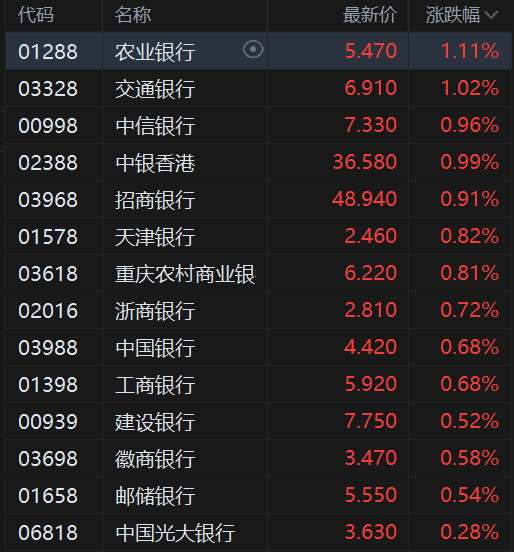
内银股普涨 小摩指中国银行股有望进一步上涨
Ge Long Hui· 2025-08-20 03:07
Group 1 - The core viewpoint of the articles indicates that Chinese bank stocks are experiencing a collective rise, with specific banks like Agricultural Bank and Bank of Communications seeing increases of over 1% [1][2] - Morgan Stanley's report suggests that Chinese bank stocks are expected to rise further due to the stabilization of net interest margins and growth in fee income, with a potential upside of 15% for A-share banks and 8% for Hong Kong bank stocks [1] - UBS analysts express an optimistic outlook for foreign investment in the Chinese stock market, predicting that the liquidity-driven bull market rebound will last at least until September [1] Group 2 - Specific stock performance data shows Agricultural Bank at 5.470 with a rise of 1.11%, Bank of Communications at 6.910 with a rise of 1.02%, and other banks like CITIC Bank and China Merchants Bank also showing positive changes [2] - The report highlights that several banks, including China Bank, Industrial and Commercial Bank, and China Construction Bank, have recorded varying degrees of increases, contributing to the overall positive sentiment in the banking sector [2]