
Huishang Bank(03698)

Search documents
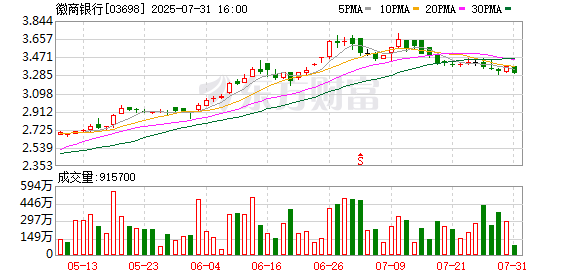
徽商银行(03698):严琛辞任董事长
Zhi Tong Cai Jing· 2025-07-31 11:13
智通财经APP讯,徽商银行(03698)发布公告,因工作调动,该行董事长严琛先生于2025年7月30日辞任 该行董事长、执行董事、发展战略与消费者权益保护委员会主任委员及委员、风险管理委员会主任委员 及委员、人事提名和薪酬委员会委员职务,其辞任自即日起生效。 (原标题:徽商银行(03698):严琛辞任董事长) ...
徽商银行(03698.HK):严琛辞任董事长及执行董事职务
Ge Long Hui· 2025-07-31 11:02
格隆汇7月31日丨徽商银行(03698.HK)公告,因工作调动,董事长严琛于2025年7月30日辞任董事长、执 行董事、发展战略与消费者权益保护委员会主任委员及委员、风险管理委员会主任委员及委员、人事提 名和薪酬委员会委员职务,其辞任自即日起生效。 ...
徽商银行(03698) - 董事名单及其角色与职能
2025-07-31 10:59
執行董事 孔慶龍 (行長) 非執行董事 馬淩霄 盧浩 王朝暉 左敦禮 Gao Yang(高央) 王文金 獨立非執行董事 Huishang Bank Corporation Limited* 徽商銀行股份有限公司 * (於中華人民共和國註冊成立的股份有限公司) (股份代號:3698) 董事名單及其角色與職能 徽商銀行股份有限公司董事會(「董事會」)成員載列如下。 * 徽商銀行股份有限公司根據銀行業條例(香港法例第155章)並非一家認可機構,並非受限 於香港金融管理局的監督,及不獲授權在香港經營銀行╱接受存款業務。 2 董事會設有五個董事會專門委員會。下表載列各董事會成員所任職之該等委員會 之成員資料。 董事會專門 委員會 董事 發展戰略與 消費者權益 保護委員會 審計委員會 人事提名和 薪酬委員會 關聯交易 控制委員會 風險管理 委員會 孔慶龍 M M M 馬淩霄 M 盧浩 M M 王朝暉 M 左敦禮 M M M Gao Yang(高央) M M 王文金 M M 戴培昆 M C 周亞娜 C M 劉志強 M M 殷劍峰 M M M 黃愛明 M M C 徐佳賓 M M C 有關董事會專門委員會之主任委員 M 有關董 ...
徽商银行(03698) - 董事长、执行董事、发展战略与消费者权益保护委员会主任委员及委员、风险管理...
2025-07-31 10:56
香港交易及結算所有限公司及香港聯合交易所有限公司對本公告之內容概不負責,對其準確性 或完整性亦不發表任何聲明,並明確表示,概不就因本公告全部或任何部分內容而產生或因倚 賴該等內容而引致之任何損失承擔任何責任。 徽商銀行股份有限公司 * Huishang Bank Corporation Limited* 董事會對嚴先生在任期間恪盡職守,勤勉盡責深表謝意。 本行將就本行董事長、執行董事的繼任人選適時另行刊發公告。 徽商銀行股份有限公司* (於中華人民共和國註冊成立的股份有限公司) (股份代號:3698) 董事長、執行董事、發展戰略與消費者權益保護委員會主任委員 及委員、風險管理委員會主任委員及委員、人事提名和 薪酬委員會委員辭任 徽商銀行股份有限公司(「本行」)董事會(「董事會」)宣佈,因工作調動,本行董 事長嚴琛先生(「嚴先生」)於2025年7月30日辭任本行董事長、執行董事、發展戰 略與消費者權益保護委員會主任委員及委員、風險管理委員會主任委員及委員、 人事提名和薪酬委員會委員職務,其辭任自即日起生效。 嚴先生確認,其與董事會並無意見分歧,亦並無與其辭任有關的其他事項須敦請 本行股東或債權人或香港聯合交易所 ...
徽商银行“一把手”严琛跨省履新 调任河南工信厅厅长
2 1 Shi Ji Jing Ji Bao Dao· 2025-07-31 10:21
Group 1 - The core point of the article is the appointment of Yan Chen as the new head of the Henan Provincial Department of Industry and Information Technology, following his tenure as the chairman of Huishang Bank [2] - Yan Chen has a diverse background in both large financial institutions and local government, having previously worked at the National Development Bank and held various positions in the Anhui provincial government [2] - Huishang Bank, established in 1997, is the first bank formed by the merger of urban commercial banks and urban credit cooperatives in China, headquartered in Hefei, Anhui Province [3] Group 2 - As of the end of 2024, Huishang Bank reported total assets of 2,013.753 billion yuan, an increase of 207.609 billion yuan, representing a growth rate of 11.49% [3] - The bank achieved an operating income of 37.128 billion yuan, up by 0.763 billion yuan, with a growth rate of 2.10% [3] - Net profit for Huishang Bank reached 15.917 billion yuan, an increase of 0.926 billion yuan, reflecting a growth rate of 6.18% [3] - The non-performing loan balance was 9.876 billion yuan, a decrease of 1.146 billion yuan, with a non-performing loan ratio of 0.99%, down by 0.27 percentage points [3] - The non-performing loan provision coverage ratio stood at 286.47%, an increase of 14.53 percentage points [3] Group 3 - The current president of Huishang Bank is Kong Qinglong, who joined the bank in January 2023 and became the president in April of the same year [4] - Kong Qinglong has a rich background in various financial institutions, including positions at Huaxia Securities and China Minmetals Securities [4][5]

中小银行IPO辅导报告密集披露,汉口银行“长跑”15年仍在等
Bei Jing Shang Bao· 2025-07-23 14:16
Core Viewpoint - The A-share IPO market for banks has been stagnant for three and a half years, with 15 banks currently in the listing guidance phase, facing various challenges in their path to IPO [1][3][10]. Group 1: Current Status of Banks in IPO Guidance - There are 15 banks in the IPO guidance phase, with guidance durations ranging from over 2 years to 15 years, highlighting the prolonged nature of the process [1][3]. - HanKou Bank has been in the guidance phase since December 2010, focusing on capital supplementation to alleviate capital adequacy pressure [3][4]. - New entrants like Guilin Bank began their guidance process in August 2023, indicating a mix of experienced and new players in the IPO preparation [3][4]. Group 2: Challenges Faced by Banks - Many banks are struggling with issues related to equity management, asset ownership, and corporate governance, which hinder their IPO progress [6][9]. - Specific challenges include unresolved equity disputes, excessive shareholding by employees, and incomplete asset rights documentation [7][8]. - Capital pressure remains a significant constraint, with banks like HanKou Bank needing to explore multiple channels for capital supplementation to meet IPO requirements [9]. Group 3: Market Environment and Regulatory Landscape - The IPO market has become increasingly cautious, with no new bank listings since January 2022, reflecting a tightening regulatory environment [10]. - The shift to a registration-based system has led to stricter scrutiny of corporate governance and a focus on regional banks' roles in local economies [10][11]. - Banks are advised to assess their readiness and market conditions carefully before submitting IPO applications, considering factors like risk management and economic recovery [11]. Group 4: Recommendations for Banks - Analysts suggest that banks in the guidance phase should adopt a dual approach: continue rectifying issues for IPO readiness while exploring alternative capital-raising methods [11]. - Engaging strategic investors and optimizing equity structures through mergers and acquisitions are recommended strategies for banks facing prolonged guidance periods [11].

从“智能秒批”到“暖心纾困”,徽商银行金融“活水”润消费
Nan Fang Du Shi Bao· 2025-07-14 08:18
Core Viewpoint - The central economic work conference has prioritized "boosting consumption, improving investment efficiency, and expanding domestic demand" as the key task for economic work in 2025, with Huishang Bank actively responding to this strategy through a unique consumption finance empowerment system [2] Group 1: Digital Transformation and Consumer Experience - Huishang Bank is leveraging digital and intelligent technologies to enhance customer experience, exemplified by a case where a customer received an 180,000 yuan renovation loan alongside a mortgage, showcasing the bank's efficient service model [3] - The bank has established a fully integrated intelligent financial service system, optimizing processes and improving approval efficiency through deep integration of business, technology, and data [3][4] - As of June 2025, Huishang Bank's personal consumption loan scale exceeded 238.3 billion yuan, with a year-to-date increase of 19.658 billion yuan, serving 3 million customers [4] Group 2: Innovation in Consumer Finance - Huishang Bank is adapting to changing consumer preferences towards quality and experiential consumption by building a multi-layered, comprehensive consumption finance service system [5] - The bank has launched a series of innovative products tailored to consumer behavior, including Huibank e-loan, consumption e-loan, and renovation e-loan, among others, to support consumption upgrades [5] - The bank is creating a comprehensive ecosystem by integrating consumption, scenarios, payment, and credit services, collaborating with major brands and platforms to enhance service offerings [5] Group 3: Green and Elderly Finance Initiatives - Huishang Bank is promoting green finance by lowering thresholds and optimizing services for green consumption, including support for electric vehicle financing with zero down payment options [6] - The bank is focusing on elderly finance by providing tailored services and products for the aging population, including dedicated debit cards and wealth management products [6] Group 4: Commitment to Supporting Businesses and Consumers - Huishang Bank is implementing a "zero additional fee" policy for individual businesses, ensuring no extra charges beyond loan interest, and offering discounts on transaction fees [7] - The bank has initiated a "Winter Sunshine" program to provide personalized solutions for clients facing short-term income declines, helping over 2,000 customers alleviate financial difficulties [7] - The bank aims to deepen its "finance for the people" philosophy by developing green and elderly consumption financial products and enhancing its service network [7]

全市场发行超6200亿元 中小银行加速入局科创债
经济观察报· 2025-07-05 08:34
Core Viewpoint - The issuance of technology innovation bonds (科创债) has gained momentum, with various banks participating actively, indicating a strong market response to the supportive policies introduced for these bonds [2][6][12]. Group 1: Issuance Overview - As of July 3, 2025, a total of 419 technology innovation bonds have been issued, with an aggregate issuance scale exceeding 620 billion yuan, highlighting the growing interest in this financial instrument [2]. - Among the issuers, banks have emerged as the main players, having issued 27 bonds with a total scale of over 220 billion yuan [2][3]. Group 2: Bank Participation - Large banks lead in issuance scale, while small and medium-sized banks are also entering the market, with 11 banks participating in the issuance process [3][4]. - The issuance scale of city commercial banks and rural commercial banks collectively reached 391 billion yuan, with notable contributions from banks like Beijing Bank (80 billion yuan) and Shanghai Bank (50 billion yuan) [6][7]. Group 3: Interest Rates and Credit Ratings - The credit ratings of the issuers are predominantly high, with most banks rated AAA, except for one rated AA+ [3][7]. - The interest rates for technology innovation bonds vary, with large banks offering rates between 1.17% and 1.65%, while small and medium-sized banks have higher rates, with some reaching up to 1.95% [3][10]. Group 4: Fund Utilization - The funds raised through technology innovation bonds are primarily directed towards supporting technology loans and investing in bonds issued by technology innovation enterprises, creating a synergistic effect [11]. - Major banks have consistently used the proceeds for "issuing technology loans," while some also invest in technology innovation enterprises' bonds [11]. Group 5: Future Trends - The market is expected to see innovations in bond products and an expansion of issuing entities, with banks likely to introduce more flexible bond terms to cater to the specific needs of technology enterprises [12]. - There is a growing emphasis on technology finance as a strategic focus for banks, particularly among small and medium-sized banks, which may accelerate their participation in the technology innovation bond market [12].





科创债全市场发行超6200亿元 中小银行加速入场
Jing Ji Guan Cha Wang· 2025-07-04 09:54
Core Insights - The launch of the Science and Technology Innovation Bonds (科创债) has attracted various participants, with a total issuance of 419 bonds amounting to over 620 billion yuan as of July 3, 2025 [2] - Large banks are leading the issuance, while small and medium-sized banks are also entering the market, increasing the number of issuers to 11 [2] - The credit ratings of the issuers are predominantly high, with most rated AAA, and the interest rates for small and medium-sized banks are higher compared to large banks [2][4] Issuance Overview - As of June 30, 2025, policy banks and state-owned banks are the main issuers, with the China Development Bank issuing 3 bonds totaling 20 billion yuan, and major state-owned banks collectively issuing 1.1 billion yuan [4] - The issuance scale of various banks includes 550 billion yuan from joint-stock banks and 391 billion yuan from city and rural commercial banks [4][5] - The issuance of floating-rate bonds has also been noted, with Sichuan Bank issuing the first floating-rate 科创债 [5] Interest Rates - The overall interest rates for 科创债 are relatively low, with the weighted average interest rate for commercial banks decreasing by 5 basis points [6] - The lowest rates are observed in the China Development Bank's bonds, with rates as low as 1.17% for short-term bonds [6] - Small and medium-sized banks face higher issuance rates, with some reaching up to 1.95% [6] Fund Utilization - The funds raised through 科创债 are primarily directed towards supporting technology loans and investing in bonds issued by technology innovation enterprises [7] - Major banks have a consistent focus on issuing 科创债 for technology loan disbursement, while some joint-stock and city commercial banks also invest in technology innovation bonds [7] Future Trends - There is potential for innovation in bond products and expansion of issuers in the 科创债 market, with banks likely to introduce more flexible bond terms [8] - Small and medium-sized banks are expected to design issuance plans that align with local industry characteristics and technology enterprise funding needs [8]



资金流信息平台赋新能 徽商银行 “资金流e贷”提效中小微企业融资
Di Yi Cai Jing· 2025-06-24 07:52
Core Viewpoint - The introduction of "Zijin Flow e-loan" by Huishang Bank represents a significant innovation in online financing for small and micro enterprises, aimed at improving their financing efficiency through the use of the national fund flow credit information sharing platform [1][2] Group 1: Product Overview - "Zijin Flow e-loan" is the first online loan product in Anhui Province utilizing the fund flow information platform, with an initial loan of 5 million yuan successfully issued to a local company [1] - The product offers a maximum credit limit of 5 million yuan, operates entirely online, and features a fast approval process, significantly simplifying the financing process for small and micro enterprises [2] Group 2: Platform and Data Utilization - The fund flow information platform, established by the People's Bank of China, provides credit information sharing services to financial institutions nationwide, addressing the financing challenges faced by small and micro enterprises [1] - Huishang Bank has conducted approximately 13,500 inquiries into enterprise fund flow credit information, leading the province in query volume and achieving full coverage across its branches [1] Group 3: Future Plans and Impact - Huishang Bank plans to further promote the application of the fund flow information platform, optimizing financial services to provide more precise, efficient, and convenient financing support for small and micro enterprises [2] - The use of fund flow credit information is expected to enhance the creditworthiness of small and micro enterprises lacking credit history, thereby improving banks' ability to support their financing needs [2]