CM BANK(03968)

Search documents
招行行长王良最新发声:“办银行是马拉松比赛,不是百米冲刺”
中国基金报· 2025-09-02 04:01
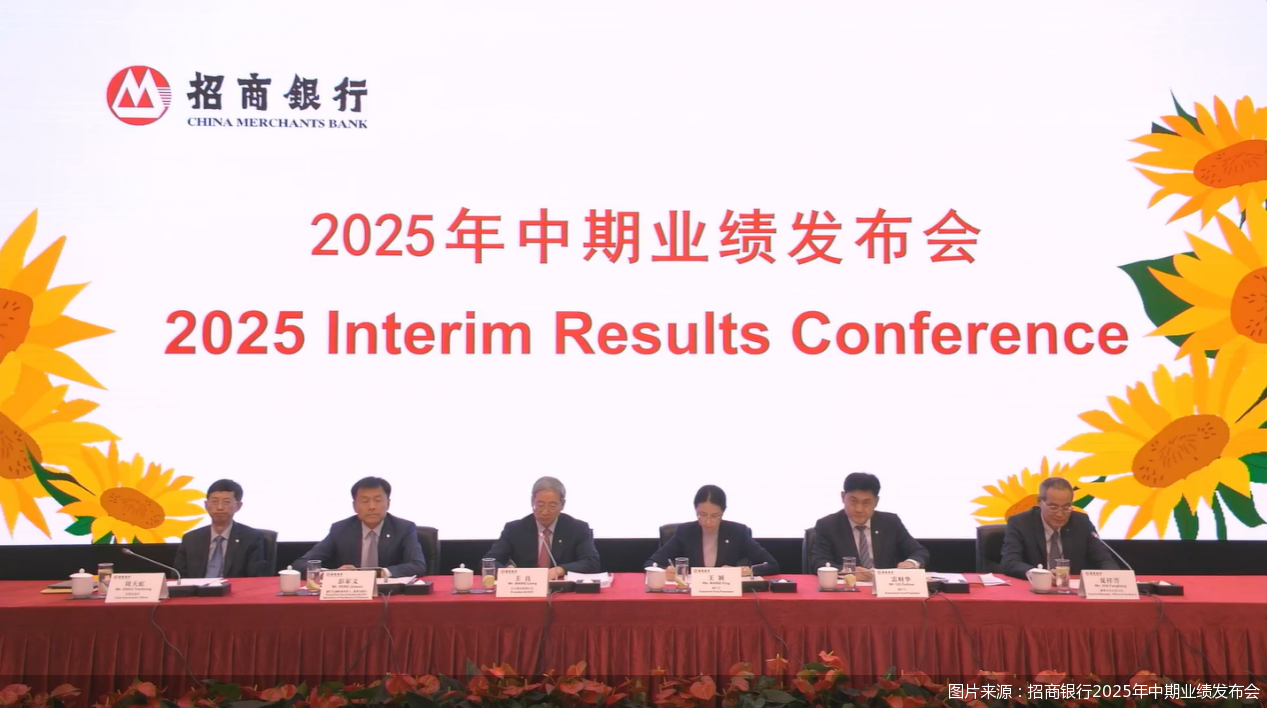
Core Viewpoint - The management of China Merchants Bank (CMB) expressed confidence in achieving steady progress and completing the annual budget goals despite recent challenges in the banking sector [2][4]. Group 1: Annual Performance Outlook - CMB's net profit growth turned positive in the first half of the year, with the second quarter performing better than the first, which faced significant pressure due to loan repricing [3][4]. - The bank aims to implement strategic development, enhance cost management, promote non-interest income, and strengthen asset quality to maintain a positive growth trajectory [4]. Group 2: Retail Business Strengths - CMB's retail business is supported by three key factors: technological capabilities, a dedicated workforce, and a customer-centric value system [5][6][7]. - Retail assets under management (AUM) reached 16.03 trillion yuan, with the highest growth in recent years, and retail wealth management income increased by 6% year-on-year [5]. Group 3: Balancing Short-term and Long-term Goals - The bank emphasizes the importance of balancing short-term performance with long-term sustainability, likening banking operations to a marathon rather than a sprint [8]. - CMB aims to solidify its foundational aspects, including customer base and management, while focusing on long-term strategic goals [8]. Group 4: Changes in Customer Risk Preferences - There has been a shift in retail customers' risk preferences, with a gradual improvement in their inclination towards equity assets, although a conservative approach remains predominant [9]. - CMB is committed to providing a stable and comprehensive wealth management experience to meet evolving customer needs [9]. Group 5: Return on Equity (ROE) Management - CMB has established a financial management system focused on ROE, which currently stands at 13.85%, significantly higher than the industry average of around 9% [10][11]. - The bank aims to balance profit growth, net asset accumulation, and dividends to maintain a competitive ROE and meet investor expectations [11][12]. Group 6: Internationalization Strategy - CMB is accelerating its internationalization efforts, recognizing it as a new growth point amid increasing global integration and domestic market saturation [13]. - The bank has already established a network of overseas branches and is enhancing the capabilities of its international operations [13].


招行行长王良最新发声:“办银行是马拉松比赛,不是百米冲刺”
Zhong Guo Ji Jin Bao· 2025-09-02 03:56
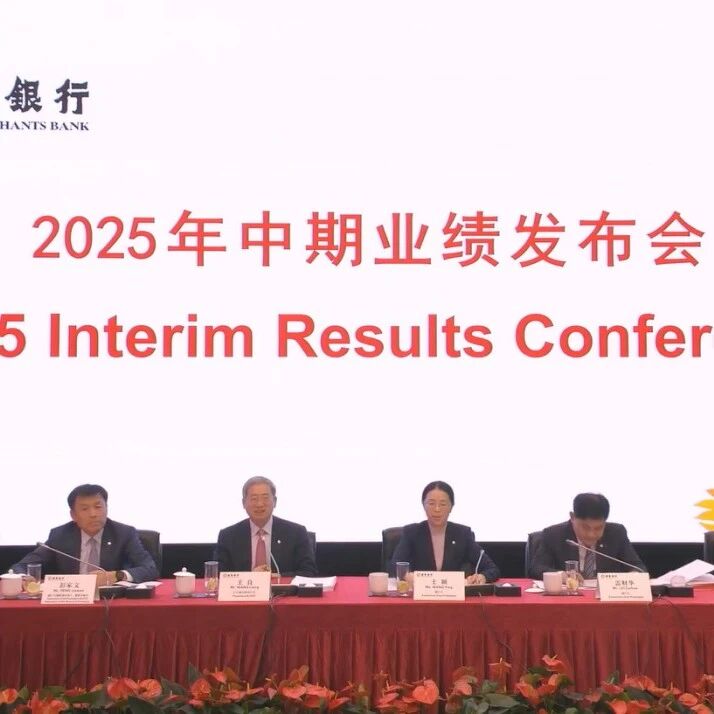
Group 1: Annual Performance Outlook - The company believes it can achieve steady progress and meet the budget goals set at the beginning of the year, with a positive outlook for the second half of the year [6][4] - The first quarter faced significant pressure due to loan repricing starting January 1, leading to a decline in net interest margin, but the second quarter showed improvement [6][4] - The company plans to focus on strategic development, cost management, non-interest income growth, and asset quality control to maintain a positive trajectory [6][4] Group 2: Retail Business Strengths - The retail business is supported by three key factors: technological capabilities, a dedicated workforce, and a customer-centric value system [5][7] - Retail assets under management (AUM) reached 16.03 trillion yuan, with the highest growth in recent years, and retail wealth management income increased by 6% year-on-year [7][5] Group 3: Balancing Short-term and Long-term Goals - The company emphasizes that banking is a marathon, not a sprint, and must focus on long-term sustainability rather than short-term gains [11][12] - It aims to strengthen foundational aspects such as customer base, workforce, management, and business to ensure long-term success [11][12] Group 4: Changes in Customer Risk Preferences - There has been a shift in retail customers' risk preferences, with a gradual improvement in their willingness to engage in riskier investments [12][5] - The company aims to adapt to market trends and customer needs to provide a comprehensive wealth management experience [12][5] Group 5: Return on Equity (ROE) Management - The company's ROE is currently at 13.85%, significantly higher than the industry average of around 9%, and it aims to maintain this leading position [13][14] - Future ROE levels will depend on the recovery of profitability, net asset growth, and dividend policies [14][13] Group 6: Internationalization Strategy - The company is accelerating its internationalization efforts, recognizing it as a new growth point amid increasing global integration [15][16] - It has established a network of overseas branches and is enhancing the capabilities of its international operations [16][15]
招商银行将全力推动个人消费贷款贴息工作落地
Jin Tou Wang· 2025-09-02 03:30
Core Viewpoint - China Merchants Bank (招商银行) is implementing a personal consumption loan interest subsidy policy to reduce consumer credit costs and stimulate consumption potential from September 1, 2025, to August 31, 2026 [1] Group 1: Subsidy Scope - The subsidy applies to personal consumption loans issued by China Merchants Bank, excluding credit card transactions, that are used for consumption and can be identified through the borrower's bank account [2] - The subsidy covers consumption amounts below 50,000 yuan and specific categories of consumption above this threshold, including household vehicles, education, and healthcare [2] Group 2: Subsidy Calculation Rules - The annual subsidy rate is set at 1% of the eligible loan principal, capped at 50% of the loan contract interest rate [3] - Each borrower can receive a maximum subsidy of 3,000 yuan, corresponding to a total eligible consumption amount of 300,000 yuan [3] - For loans below 50,000 yuan, the maximum subsidy is 1,000 yuan, linked to a total eligible consumption of 100,000 yuan [3] Group 3: Subsidy Application Process - Borrowers must sign a supplementary agreement to apply for the subsidy, either at the time of loan application or after loan disbursement [4] - The bank will automatically identify eligible transactions for subsidy; if not identifiable, borrowers can apply through offline channels by providing proof of consumption [5] Group 4: Subsidy Disbursement - The subsidy amount will be deducted directly from the loan interest during the loan settlement process, based on the agreed subsidy rate and limits [7] Group 5: Additional Information - Customers can check their subsidy amounts through the bank's app and will be notified via SMS or app notifications [8] - The bank does not charge any service fees for the subsidy process and warns against fraudulent activities related to loan applications [8][9]
港股异动丨内银股逆势上涨 农行涨近3% 浙商银行涨超2% 四大行上半年净利超千亿
Ge Long Hui· 2025-09-02 03:22
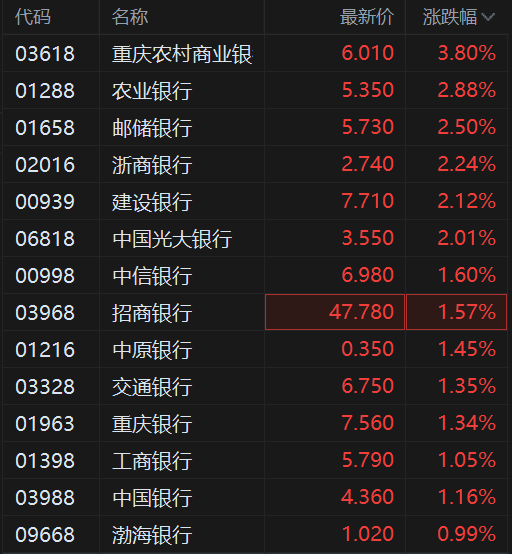
Core Viewpoint - Hong Kong banking stocks have risen against the trend, with several banks showing significant gains, indicating a positive market sentiment towards the banking sector amid stable financial performance [1] Group 1: Stock Performance - Agricultural Bank and Postal Savings Bank rose nearly 3%, while China Everbright Bank, China Construction Bank, and Zhejiang Commercial Bank increased over 2% [1] - Other banks such as CITIC Bank and China Merchants Bank saw a rise of 1.6%, with several others including Bank of Communications, Bank of China, and Industrial and Commercial Bank of China increasing by over 1% [1] Group 2: Financial Performance - As of the end of August, 42 listed banks have reported their semi-annual results, showing a steady increase in support for the real economy [1] - The 42 A-share listed banks achieved a total operating income exceeding 2.9 trillion yuan, representing a year-on-year growth of over 1% [1] - The net profit attributable to shareholders reached 1.1 trillion yuan, with a year-on-year increase of 0.8% [1] - Major banks such as ICBC, CCB, ABC, and BOC reported net profits exceeding 100 billion yuan, while the non-performing loan ratio for the six major commercial banks remained low [1]


招商银行(600036):盈利增速稳健,财富管理回暖持续
Ping An Securities· 2025-09-02 02:56
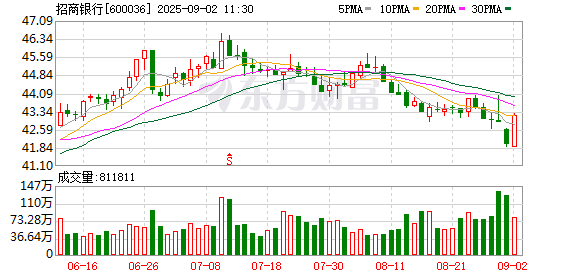
银行 2025 年 9 月 2 日 主要数据 | 行业 | 银行 | | --- | --- | | 公司网址 | www.cmbchina.com | | 大股东/持股 | 香港中央结算(代理人)有限公司 | | | /18.06% | | 实际控制人 | | | 总股本(百万股) | 25,220 | | 流通 A 股(百万股) | 20,629 | | 流通 B/H 股(百万股) | 4,591 | | 总市值(亿元) | 10,629 | | 流通 A 股市值(亿元) | 8,660 | | 每股净资产(元) | 42.10 | | 资产负债率(%) | 89.8 | 行情走势图 相关研究报告 【平安证券】招商银行(600036.SH)*季报点评*存款 扩张积极,非息拖累营收负增*强烈推荐20250430 证券分析师 招商银行(600036.SH) 盈利增速稳健,财富管理回暖持续 强烈推荐(维持) 股价:41.98 元 | 袁喆奇 | 投资咨询资格编号 | | --- | --- | | | S1060520080003 | | | YUANZHEQI052@pingan.com.cn | | 许淼 ...
直击消费贷款贴息落地首日
财联社· 2025-09-01 23:54
Core Viewpoint - The implementation of the personal consumption loan interest subsidy policy aims to stimulate consumer spending and support the retail credit market, with banks actively participating in the program and developing systems to facilitate the process [1][2][6]. Group 1: Policy Implementation - The personal consumption loan interest subsidy policy officially started on September 1, with participating banks accepting applications for the subsidy [1]. - The subsidy covers consumption loans under 50,000 yuan and key areas such as home purchases, elderly care, and education [1]. - Different banks have varying operational details regarding application channels and eligibility criteria, including whether existing loans prior to September 1 qualify for the subsidy [1][5]. Group 2: Technical Integration - Banks are utilizing technology to streamline the subsidy process, with some institutions directly deducting the subsidy from loan interest payments [2][5]. - The maximum cumulative subsidy for each borrower is set at 3,000 yuan, corresponding to a total consumption amount of 300,000 yuan during the policy period [2]. Group 3: Market Impact - Bank executives express optimism about the positive impact of the subsidy policy on retail credit growth, with expectations of stable growth in personal consumption and business loans [6]. - The subsidy is anticipated to enhance the leverage effect of funds, potentially increasing the lending capacity of state-owned and joint-stock banks [6]. Group 4: Risk Considerations - Credit card installment plans are explicitly excluded from the subsidy program [7]. - Concerns regarding rising risks in retail credit are noted, with banks monitoring credit card risk as a leading indicator for overall retail credit risk [8]. - Banks have issued warnings against misuse of personal consumption loans, stating that violations may result in the denial or recovery of subsidies [8].



招商银行1H25业绩点评:非息降幅收窄,营收业绩环比改善
Xin Lang Cai Jing· 2025-09-01 21:02
Core Viewpoint - China Merchants Bank reported a slight decline in revenue for the first half of 2025, but net profit showed a modest increase, indicating resilience in its financial performance amidst challenging market conditions [1]. Financial Performance - The bank achieved a revenue of 169.97 billion yuan in 1H25, a year-on-year decrease of 1.7%, with the decline narrowing by 1.4 percentage points compared to 1Q25 [1]. - The net profit attributable to shareholders reached 74.93 billion yuan, reflecting a year-on-year growth of 0.3%, with an increase of 2.3 percentage points from 1Q25 [1]. Interest and Non-Interest Income - Net interest income remained stable, amounting to 106.09 billion yuan in 1H25, representing a year-on-year increase of 1.6% [1]. - The decline in non-interest income has slowed, indicating improved performance in this segment [1]. Loan Growth and Quality - The loan balance at the end of 1H25 was 7,116.6 billion yuan, showing a year-on-year growth of 5.5%, slightly down from 5.8% at the end of 2024 [1]. - Corporate loans experienced a significant increase, rising by 11.5% year-on-year to 3,089.7 billion yuan [1]. - The non-performing loan (NPL) ratio at the end of 1H25 was 0.93%, stable compared to 1Q25, with corporate NPLs improving by 13 basis points from the end of the previous year [1]. Interest Margin and Cost Management - The net interest margin stood at 1.88%, down 12 basis points year-on-year, but the decline was less severe than the 17 basis points drop in 2024 [1]. - The bank is optimizing its funding costs, which is contributing to the stabilization of its interest margin [1]. Investment Strategy - The bank is deepening its wealth management strategy, with rapid growth in retail assets under management (AUM) and a solid competitive position in retail banking [1]. - With the expected recovery in economic growth, the bank's performance is anticipated to improve, maintaining a "recommended" rating for investment [1].
2375亿!17家上市银行中期分红大手笔
Shen Zhen Shang Bao· 2025-09-01 16:41
Core Viewpoint - The listed banks in China have shown strong performance in the first half of the year and are preparing to reward investors with significant mid-term dividends, reflecting their profitability and commitment to shareholder returns [2][4]. Group 1: Dividend Distribution - Among the 42 listed banks in A-shares, nearly half will implement mid-term dividends for 2025, with 17 banks already disclosing their plans, totaling 237.54 billion yuan [2]. - The six major state-owned banks lead in dividend distribution, with Industrial and Commercial Bank of China (ICBC) at the forefront, distributing 50.396 billion yuan, followed by China Construction Bank and Agricultural Bank of China with 48.605 billion yuan and 41.823 billion yuan respectively [2]. - The total dividends from the six major state-owned banks account for 86% of the total dividends announced by the 17 banks [2]. Group 2: Specific Bank Plans - Among joint-stock banks, CITIC Bank, Minsheng Bank, Ping An Bank, and Huaxia Bank have announced their mid-term dividend plans, with CITIC Bank proposing a total of 10.461 billion yuan [3]. - In the city and rural commercial banks, seven banks have announced mid-term dividends, including Ningbo Bank and Shanghai Bank, with Shanghai Bank proposing a cash dividend of 3 yuan per 10 shares [3]. - Four banks have a dividend payout ratio exceeding 30%, including Shanghai Bank and Postal Savings Bank, indicating a strong commitment to returning value to shareholders [3]. Group 3: Market Implications - The expansion of banks implementing mid-term dividends and their willingness to distribute reflects the resilience of the banking sector's profitability and a positive response to shareholder return demands [4]. - This trend indicates improved cash flow and capital management capabilities among certain banks, which may help boost market confidence and attract long-term value investors [4].



果然财经|个人消费贷贴息今起实施,单家机构最高贴息3000元
Sou Hu Cai Jing· 2025-09-01 16:31
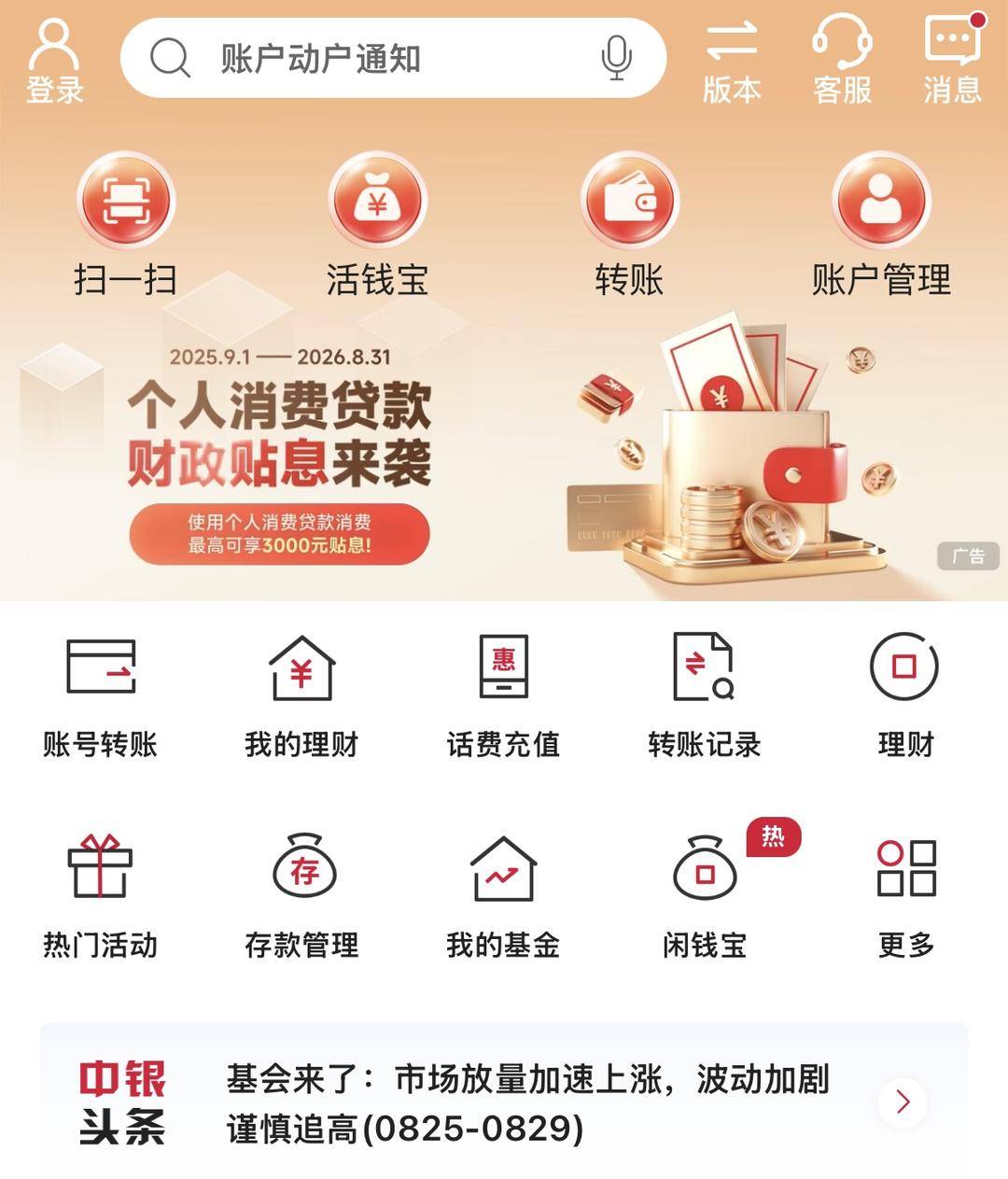
Core Viewpoint - The implementation of a personal consumption loan interest subsidy policy marks the first time the central government has provided subsidies for personal consumption loans, allowing residents to enjoy a 1% annual subsidy on loans used for various consumption purposes [1]. Group 1: Policy Details - The subsidy applies to personal consumption loans obtained from financial institutions for purposes such as home renovation, travel, education, and purchasing consumer goods like electronics and vehicles [1]. - The maximum subsidy per individual at a single bank is capped at 3,000 yuan, corresponding to a total consumption amount of 300,000 yuan [3]. - For loans under 50,000 yuan, the maximum subsidy is 1,000 yuan, linked to a consumption amount of 100,000 yuan [3]. Group 2: Application Process - Consumers can apply for the consumption loan products directly through bank apps, which will automatically calculate and deduct the subsidy from the loan interest [3]. - Existing customers with outstanding loans prior to September 1 may also qualify for the subsidy if the funds are utilized for eligible consumption after this date [4]. Group 3: Bank Initiatives - Many banks have established dedicated sections in their apps for the subsidy, making the application process user-friendly and straightforward [4][6]. - Major banks like China Bank and Construction Bank have prominently featured the subsidy in their apps, allowing consumers to easily access related products and agreements [6][8]. Group 4: Fund Usage Management - Strict management of fund usage is emphasized, requiring that loan funds be used for actual consumption to qualify for the subsidy [9]. - Consumers must utilize the loan funds within one month of disbursement for designated consumption, or they risk losing the subsidy [9]. - Banks have mechanisms in place to verify that funds are used for legitimate consumption, including automatic recognition through payment systems and the option to submit receipts for verification [9]. Group 5: Fraud Prevention Measures - Banks are implementing strict measures to prevent fraudulent activities related to the subsidy, including the prohibition of false documentation and illegal loan practices [10]. - Violations may lead to legal consequences and impact the borrower's credit record, emphasizing the importance of responsible borrowing [10].

信贷风险未现拐点、息差相对变化承压,“零售之王”招商银行如何保持定力?
Bei Jing Shang Bao· 2025-09-01 15:14
Core Viewpoint - The core viewpoint of the article emphasizes the long-term strategy of China Merchants Bank, highlighting its ability to achieve a positive net profit in a challenging banking environment characterized by low interest rates and low spreads [1][2]. Financial Performance - In the first half of 2025, China Merchants Bank reported a net profit attributable to shareholders of 74.93 billion yuan, a year-on-year increase of 0.25%, maintaining the leading position among joint-stock banks [2][3]. - The bank's operating income was 169.97 billion yuan, a decrease of 1.72% year-on-year, with net interest income at 106.09 billion yuan, up 1.57%, and non-interest income at 63.88 billion yuan, down 6.73% [2][3]. Retail Banking Insights - The bank's retail customer base reached 216 million, growing by 2.86% from the end of the previous year, with high-net-worth clients increasing to 5.63 million, a growth rate of 7.57% [3]. - Retail financial business pre-tax profit was 52.04 billion yuan, up 1.64%, accounting for 58.53% of total pre-tax profit, an increase of 1.42 percentage points year-on-year [3]. Credit Risk and Strategy - The bank faces challenges in the retail credit sector, with rising risks and a significant decline in new credit growth across the industry [3][4]. - The bank's strategy includes focusing on quality, scale, efficiency, and structure in its credit offerings, with 90% of retail loans coming from high-quality clients and over 80% being secured loans [4]. Interest Margin Situation - As of June 30, 2025, the bank's net interest yield was 1.88%, down 12 basis points year-on-year, and the net interest margin was 1.79%, down 9 basis points [5]. - The average annual yield on interest-earning assets was 3.14%, down 46 basis points, while the average cost of interest-bearing liabilities was 1.35%, down 37 basis points [5]. Internationalization Strategy - The bank is accelerating its internationalization strategy, driven by the increasing overseas investment needs of Chinese enterprises and the integration of the Chinese economy into the global market [7][8]. - As of the reporting period, the bank had established six branches and three wholly-owned subsidiaries overseas, with total assets of overseas institutions growing by 6.56% year-on-year [8]. Future Development Focus - The bank aims to enhance its digital transformation by investing in financial technology for risk control and efficiency improvement [9]. - It plans to offer more comprehensive financial services, particularly in emerging sectors like technology and green finance, while also diversifying its international retail product offerings [9].