
INTEL(04335)

Search documents
英特尔(INTC.US)浴火重生! Q3营收超预期增长且扭亏为盈 “世纪联手”英伟达点燃增长引擎
Zhi Tong Cai Jing· 2025-10-24 00:05
Core Viewpoint - Intel has successfully returned to profitability and provided an optimistic performance outlook, leading to a significant stock price increase of over 9% in after-hours trading, indicating positive progress in its recovery efforts [1][6]. Financial Performance - Intel's Q3 revenue increased by 3% year-over-year to $13.7 billion, marking the first positive year-over-year growth in a year and a half [7]. - The adjusted earnings per share for Q3 were reported at $0.23, significantly exceeding Wall Street's expectations [7]. - The company anticipates Q4 revenue in the range of $12.8 billion to $13.8 billion, with a midpoint of approximately $13.3 billion, slightly below analyst expectations when including the recently divested Altera business [2][7]. Market Demand and Product Development - Intel's management indicated that demand for its chips is expected to exceed supply until 2026, driven by a surge in high-performance server CPU demand due to the unprecedented AI boom [6][11]. - The company is benefiting from a recovery in PC demand and the AI-driven upgrade cycle, which is significantly boosting its performance [5][13]. - Intel's new Core Ultra processors, which integrate AI-specific neural processing units (NPU) with GPUs, are designed to capitalize on the AI PC market [13]. Strategic Partnerships and Investments - Intel has secured approximately $15 billion in new funding through partnerships with the U.S. government and major tech companies, including a $5 billion investment from Nvidia [7][9]. - The collaboration with Nvidia is expected to enhance Intel's market position in the AI sector, allowing it to leverage Nvidia's GPU technology alongside its x86 CPU architecture [16][17]. Competitive Landscape - Despite being the largest manufacturer of PC processors, Intel faces challenges in regaining its competitive edge against rivals like Nvidia and AMD, particularly in the AI infrastructure space [5][11]. - The partnership with Nvidia is seen as a pivotal move to reshape the AI PC market and regain market share lost to competitors [16][18].


英特尔第三季度营收136.5亿美元,同比增加2.8%
Xin Lang Cai Jing· 2025-10-23 23:06
Core Insights - Intel reported third-quarter revenue of $13.65 billion, a year-over-year increase of 2.8% [1] - The adjusted gross margin for the third quarter was 40% [1] - Adjusted earnings per share for the third quarter were $0.23, compared to a loss of $0.46 per share in the same period last year [1] - For the fourth quarter, Intel expects revenue between $12.8 billion and $13.8 billion [1] - The company anticipates an adjusted gross margin of 36.5% for the fourth quarter [1] - Adjusted earnings per share for the fourth quarter are projected to be $0.08 [1]
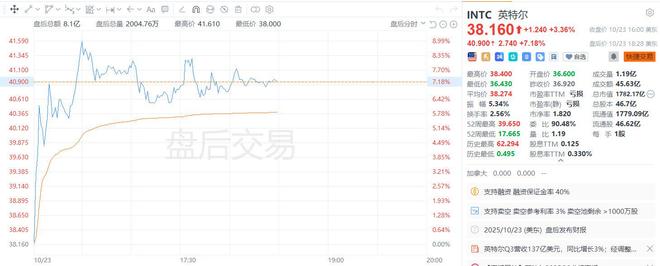
美股异动|英特尔盘后涨超7%,三季度营收136.5亿美元同比增长2.8%
Ge Long Hui A P P· 2025-10-23 22:45
Core Insights - Intel's stock rose over 7% after reporting Q3 revenue of $13.65 billion, a year-over-year increase of 2.8% [1] Revenue Breakdown - Data Center and AI revenue for Q3 was $4.12 billion, exceeding analyst expectations of $3.97 billion [1] - Client Computing revenue for Q3 reached $8.54 billion, surpassing analyst forecasts of $8.15 billion [1] - Intel Foundry revenue for Q3 was $4.24 billion, slightly below analyst expectations of $4.51 billion [1] Profitability Metrics - Adjusted gross margin for Q3 was 40%, higher than the expected 36.1% [1] - Adjusted profit margin for Q3 was 11.2%, significantly above the anticipated 3.07% [1] Future Guidance - The performance guidance excludes the Altera business, which is expected to remove $400-500 million from revenue forecasts [1] - For Q4, Intel expects revenue to be between $12.8 billion and $13.8 billion [1]
需求旺盛助力英特尔重回正轨 控制资本支出让投资者喜忧参半
Ge Long Hui A P P· 2025-10-23 22:45
Core Viewpoint - Intel has released an optimistic revenue forecast, projecting fourth-quarter sales between $12.8 billion and $13.8 billion, indicating a positive trajectory after a turbulent year [1] Group 1: Financial Performance - The company reported that current demand is exceeding supply, a trend expected to continue until 2026 [1] - Intel's third-quarter performance surpassed expectations, attributed to the potential strength in its core markets [1] Group 2: Management Strategy - New CEO Tan emphasized stricter financial discipline, suggesting a pause in manufacturing plans when investment returns are unclear [1] - This approach raises concerns that Intel may no longer pursue maintaining a leading position in the semiconductor industry [1]
黄金反弹 国际油价大涨超5%;扭亏为盈!英特尔公布最新财报;重磅发布会 今天上午10时举行丨每经早参
Mei Ri Jing Ji Xin Wen· 2025-10-23 22:45
Group 1 - The 14th National People's Congress Standing Committee of China is holding its 18th meeting from October 24 to 28 in Beijing [3] - The 2025 World Top Scientists Forum will take place in Shanghai from October 24 to 26 [3] - The U.S. stock market saw all three major indices rise, with the Nasdaq up 0.89%, S&P 500 up 0.58%, and Dow Jones up 0.31% [5] Group 2 - The Chinese government reported that the number of applications for the 2025 automobile trade-in subsidy has exceeded 10 million, with over 57.2% of the vehicles being new energy vehicles [7] - E-commerce in China has shown healthy growth, with online retail sales increasing by 9.8% in the first three quarters of the year [10] Group 3 - Intel reported a third-quarter adjusted earnings per share of $0.23, compared to a loss of $0.46 in the same period last year, with revenue of $13.65 billion, a 2.8% year-over-year increase [27] - NIO has achieved a significant increase in delivery volume, surpassing 10,000 units in a single week for the first time [22] Group 4 - Boeing appointed Landon Loomis as the new president of Boeing China, indicating a strategic focus on the Chinese market [20] - JD.com reported a successful auction for its "National Good Car" with a final bid of 78.19 million yuan, reflecting strong market interest [18]



英特尔:第三季度调整后每股收益0.23美元 较去年同期扭亏为盈
Mei Ri Jing Ji Xin Wen· 2025-10-23 22:15
每经AI快讯,10月23日美股盘后,英特尔公布2025年第三季度财务数据和第四季度业绩指引。英特尔 第三季度营收136.5亿美元,同比增加2.8%;第三季度经调整毛利率40%,市场预估36.1%;第三季度调 整后每股收益0.23美元,上年同期每股亏损0.46美元。英特尔预计第四季度营收128亿美元至138亿美 元;预计第四季度经调整毛利率36.5%;预计第四季度调整后每股收益0.080美元,市场预估0.10美元。 ...
普京:布达佩斯会晤更像是改期而非取消;黄金反弹,国际油价大涨超5%;扭亏为盈!英特尔公布最新财报;重磅发布会,今天上午10时举行丨每经早参
Mei Ri Jing Ji Xin Wen· 2025-10-23 22:05
每经编辑|陈鹏程 王晓波 1 中国十四届全国人大常委会第十八次会议10月 24日至28日在北京举行 2 欧元区10月综合PMI初值公布 ③美国9月核心CPI、10月密歇根大学消费者信心 指数等数据公布 4 2025世界顶尖科学家论坛将于10月24日至26 日在上海举办 ⑤日本9月CPI公布 1 党的二十届四中全会审议通过"十五五"规划建议 中国共产党第二十届中央委员会第四次全体会议,于2025年10月20日至23日在北京举行。全会由中央政治局主持。中央委员会总书记习近平作了重要讲话。 全会听取和讨论了习近平受中央政治局委托所作的工作报告,审议通过了《中共中央关于制定国民经济和社会发展第十五个五年规划的建议》。习近平就 《建议(讨论稿)》向全会作了说明。(央视新闻) 2 中共中央将于24日上午举行新闻发布会 介绍和解读党的二十届四中全会精神 中共中央将于10月24日上午10时举行新闻发布会,介绍和解读党的二十届四中全会精神。中央广播电视总台及新华网、中国网等将对新闻发布会进行直播。 (央视新闻) 3 隔夜市场 美股三大指数集体收涨,纳指涨0.89%,标普500指数涨0.58%,道指涨0.31%;大型科技股多数上 ...


英特尔美股盘后涨超8%
Mei Ri Jing Ji Xin Wen· 2025-10-23 21:19
Core Viewpoint - Intel's stock rose over 8% after reporting third-quarter earnings that exceeded market expectations, indicating positive momentum in the company's financial performance [1] Financial Performance - The company reported third-quarter revenue of $13.65 billion, representing a year-over-year increase of 2.8% [1] - Adjusted gross margin for the third quarter was 40%, surpassing market expectations of 36.1% [1]
英特尔预计四季度将营收128亿-138亿美元
Hua Er Jie Jian Wen· 2025-10-23 20:03
Core Insights - The article discusses the current trends and developments in the investment banking sector, highlighting the impact of recent economic changes on market dynamics [1] Group 1: Market Trends - Investment banking is experiencing a shift due to rising interest rates, which are affecting deal-making activities and valuations [1] - There is a notable increase in mergers and acquisitions (M&A) as companies seek to consolidate and enhance their market positions amid economic uncertainty [1] Group 2: Financial Performance - Recent financial reports indicate a decline in revenue for several major investment banks, attributed to lower trading volumes and reduced advisory fees [1] - Some firms are adapting by diversifying their service offerings and focusing on technology-driven solutions to improve efficiency and client engagement [1] Group 3: Future Outlook - Analysts predict a gradual recovery in the investment banking sector as market conditions stabilize and companies regain confidence in pursuing growth strategies [1] - The emphasis on sustainable finance and ESG (Environmental, Social, and Governance) factors is expected to shape future investment decisions and opportunities [1]
美股前瞻 | 三大股指期货齐跌 油价跳涨 特斯拉、IBM绩后走低 英特尔盘后公布财报
智通财经网· 2025-10-23 11:59
盘前市场动向 1. 10月23日(周四)美股盘前,美股三大股指期货齐跌。截至发稿,道指期货跌0.20%,标普500指数期货跌0.11%,纳指期货跌 0.21%。 | = US 30 | 46,498.50 | 46,615.60 | 46,418.50 | -91.90 | -0.20% | | --- | --- | --- | --- | --- | --- | | = US 500 | 6.692.10 | 6,716.60 | 6,682.80 | -7.30 | -0.11% | | 트 US Tech 100 | 24,827.40 | 24,973.10 | 24,799.30 | -51.60 | -0.21% | 2. 截至发稿,德国DAX指数跌0.15%,英国富时100指数涨0.62%,法国CAC40指数涨0.40%,欧洲斯托克50指数涨0.30%。 | 德国DAX30 | 24,121.53 | 24,221.46 | 24,037.79 | -36.24 | -0.15% | | --- | --- | --- | --- | --- | --- | | 英国富时100 | 9,574 ...
