INTEL(04335)

Search documents
英特尔寻求让苹果提供投资,作为提振业务的后备计划。双方讨论了如何更加紧密地合作。(彭博)


Hua Er Jie Jian Wen· 2025-09-24 19:51
市场有风险,投资需谨慎。本文不构成个人投资建议,也未考虑到个别用户特殊的投资目标、财务状况或需要。用户应考虑本文中的任何 意见、观点或结论是否符合其特定状况。据此投资,责任自负。 风险提示及免责条款 英特尔寻求让苹果提供投资,作为提振业务的后备计划。双方讨论了如何更加紧密地合作。(彭博) ...
明星科技股走势分化,英特尔涨超3%,特斯拉、高通涨近2%


Mei Ri Jing Ji Xin Wen· 2025-09-24 16:31
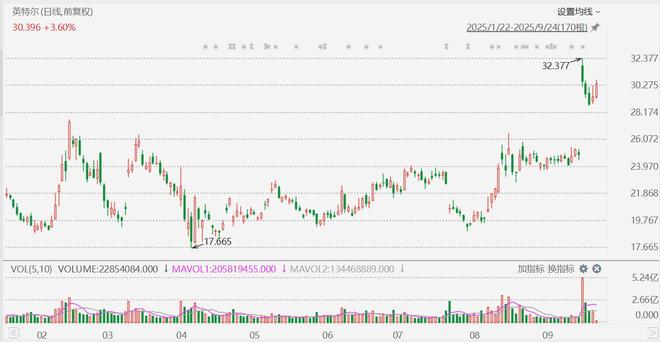
每经AI快讯,明星科技股走势分化,英特尔涨超3%,特斯拉、高通涨近2%;美光科技、甲骨文跌近 4%,苹果、英伟达、谷歌跌超1%。 ...
英特尔(INTC.US)拉升涨4.5%
Xin Lang Cai Jing· 2025-09-24 13:57
格隆汇9月24日|英特尔(INTC.US)拉升涨4.5%报30.67美元。消息面上,英特尔发布一份聚焦人工智能 的简报,内容涉及与Trust Stamp的合作事宜。 来源:格隆汇APP ...

第二个英特尔?特朗普政府被曝寻求入股美洲锂业(LAC.US) 股价盘初狂飙70%
智通财经网· 2025-09-24 13:42
Group 1 - The U.S. government is negotiating with Lithium Americas Corp (LAC.US) to restructure a $2.3 billion Department of Energy loan, which could benefit miners and project developers [1] - Lithium Americas saw a significant stock increase of 71.50%, reaching $5.27, following reports of the negotiations [1] - The lithium industry has faced turmoil due to extensive supply disruptions in China, but recent news of early restarts at major Chinese mines has brought some optimism [1] Group 2 - The Thacker Pass lithium project, valued at approximately $3 billion, was approved at the end of Trump's first term, with the loan being allocated by the Biden administration last year [1] - General Motors invested $625 million in the Thacker Pass project last year, acquiring a 38% stake and rights to purchase lithium output, but is now being asked by Trump administration officials for purchase guarantees [2] - The potential equity stake by the Trump administration is part of a broader initiative to strengthen domestic manufacturing and attract more capital into the U.S. [2]

左手英特尔锁定供给,右手OpenAI刺激需求:英伟达大手笔投资背后的生意经
Hua Xia Shi Bao· 2025-09-24 11:11
至于这次的合作是否会涉及参股,《华夏时报》记者采访了英伟达方面,截至发稿,对方未做出回复。 华夏时报记者 石飞月 北京报道 财大气粗的英伟达又准备掏腰包了。9月23日,英伟达宣布计划向OpenAI投资高达1000亿美元,为 OpenAI的下一代AI基础设施部署至少10吉瓦的NVIDIA系统。受此消息影响,英伟达当日盘中股价几乎 直线拉升,最终涨3.93%,不过在当地时间9月23日,该公司股价下跌2.82%,总市值为4.34万亿美元。 值得一提的是,上周英伟达才刚刚宣布以50亿美元入股英特尔并达成战略合作,短短几天,该公司又准 备向OpenAI投入上千亿美元。这两笔看似方向迥异的投资背后,究竟蕴含着英伟达怎样的战略逻辑? 目前看来,该公司正同时锁定AI时代的"供给"与"需求",希望构建一个无人能撼动的闭环。 巨额投资 在全球半导体史上,1000亿美元也算一笔巨额投资了。 据英伟达官方消息,这笔巨额投资主要为助力OpenAI构建和部署至少10吉瓦(gigawatt)的AI数据中 心,这些数据中心将采用NVIDIA系统,包含数百万块英伟达GPU,为OpenAI的下一代AI基础设施提供 支持,用于训练和运行其下一代模 ...

「AI新世代」左手英特尔锁定供给,右手OpenAI刺激需求:英伟达大手笔投资背后的生意经
Hua Xia Shi Bao· 2025-09-24 09:15
本报(chinatimes.net.cn)记者石飞月 北京报道 财大气粗的英伟达又准备掏腰包了。9月23日,英伟达宣布计划向OpenAI投资高达1000亿美元,为 OpenAI的下一代AI基础设施部署至少10吉瓦的NVIDIA系统。受此消息影响,英伟达当日盘中股价几乎 直线拉升,最终涨3.93%,不过在当地时间9月23日,该公司股价下跌2.82%,总市值为4.34万亿美元。 值得一提的是,上周英伟达才刚刚宣布以50亿美元入股英特尔并达成战略合作,短短几天,该公司又准 备向OpenAI投入上千亿美元。这两笔看似方向迥异的投资背后,究竟蕴含着英伟达怎样的战略逻辑? 目前看来,该公司正同时锁定AI时代的"供给"与"需求",希望构建一个无人能撼动的闭环。 巨额投资 在全球半导体史上,1000亿美元也算一笔巨额投资了。 据英伟达官方消息,这笔巨额投资主要为助力OpenAI构建和部署至少10吉瓦(gigawatt)的AI数据中 心,这些数据中心将采用NVIDIA系统,包含数百万块英伟达GPU,为OpenAI的下一代AI基础设施提供 支持,用于训练和运行其下一代模型,从而部署超级智能,双方会在未来几周内确定这一新阶段合作的 ...

美股半导体股多数上涨 台积电、 英特尔涨超4%
Ge Long Hui A P P· 2025-09-23 14:17
Group 1 - TSMC and Intel saw stock increases of over 4% [1] - Micron Technology and ASML experienced nearly 2% gains [1] - Nvidia faced a decline of over 2% [1]


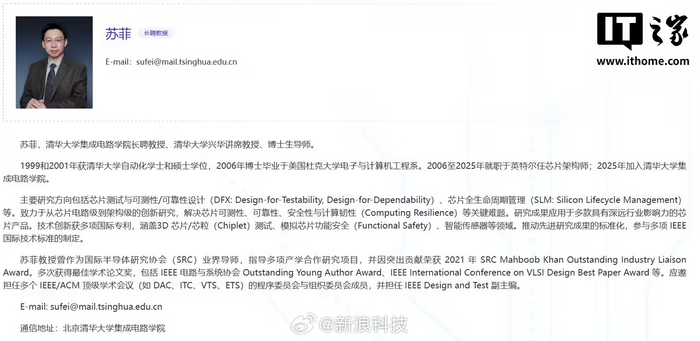
原英特尔芯片架构师苏菲回国,加盟清华大学
Feng Huang Wang· 2025-09-23 07:17
Core Viewpoint - Tsinghua University has appointed former Intel chip architect Sophie as a tenured professor and doctoral advisor at its Integrated Circuit Institute, highlighting the institution's commitment to advancing semiconductor research and innovation [1] Group 1: Appointment Details - Sophie holds a Bachelor's and Master's degree in Automation from Tsinghua University, obtained in 1999 and 2001 respectively, and earned her Ph.D. from Duke University in 2006 [1] - She worked at Intel from 2006 to 2025, serving as a chip architect [1] Group 2: Research Focus - Sophie's primary research areas include chip testing, reliability design, and lifecycle management, aiming to address critical challenges in chip testability, reliability, security, and computational resilience [1] - Her research has led to innovations that have been applied in several influential chip products, contributing to the advancement of the semiconductor industry [1] Group 3: Achievements and Contributions - Sophie holds multiple international patents related to 3D chip testing, functional safety of analog chips, and smart sensors [1] - She has participated in the development of several IEEE international technical standards and is a senior member of the IEEE, also serving as the associate editor for IEEE's "Design and Test" [1]
英伟达、英特尔联手重塑PC市场 联想(00992.HK)AI PC将成最大受益者
Ge Long Hui· 2025-09-23 07:17
Core Insights - The partnership between Nvidia and Intel, involving a $5 billion investment, is expected to redefine the AI PC market and accelerate its development [1] - Omdia predicts that by 2028, over 70% of PCs will have AI capabilities, presenting a significant market opportunity for both companies [1] Group 1: Strategic Implications for Lenovo - Lenovo stands to gain significantly from this collaboration, as it is a key OEM partner of Nvidia, positioning itself to capitalize on the AI PC trend [1][2] - The integration of Nvidia's RTX GPU into Intel's x86 architecture will create a powerful AI platform, enhancing local AI processing capabilities and reducing reliance on cloud services [2] - This partnership provides Lenovo with a unique branding and marketing opportunity, leveraging Intel's dominance in the PC market and Nvidia's leadership in graphics and AI [2][4] Group 2: Operational Benefits - The new integrated SoC will simplify Lenovo's material procurement and supply chain management, allowing for a more streamlined design process [3] - The single-chip architecture will improve thermal management and power efficiency, enabling Lenovo to develop lighter and more energy-efficient AI PCs [3] - Lenovo's leadership in the global PC market is underscored by its 25.1% market share and 15.2% year-on-year growth in Q2 2025, with AI PCs accounting for over 30% of its total shipments [3] Group 3: Market Positioning - Lenovo's strong position in both traditional PC and emerging AI PC markets provides a competitive advantage in the collaboration with Nvidia and Intel [3][4] - The strategic partnership is seen as a pivotal moment for Lenovo to enhance its product offerings and brand presence in the AI era [4]

原英特尔芯片架构师苏菲加盟清华大学任长聘教授
Xin Lang Ke Ji· 2025-09-23 07:02
Core Viewpoint - The appointment of former Intel chip architect Sophie as a tenured professor at Tsinghua University's School of Integrated Circuits signifies a strategic move to enhance research capabilities in chip design and reliability [1] Group 1: Appointment Details - Sophie has been appointed as a tenured professor and Xinhua Chair Professor at Tsinghua University, as well as a doctoral advisor [1] - She holds a Bachelor's and Master's degree in Automation from Tsinghua University and a Ph.D. from Duke University in Electrical and Computer Engineering [1] Group 2: Research Focus - Sophie's research areas include chip testing, reliability design, and lifecycle management, aiming to address critical issues in chip testability, reliability, security, and computational resilience [1] - Her research contributions have been applied to several influential chip products, showcasing her impact on the industry [1] Group 3: Achievements and Contributions - Sophie has been awarded multiple international patents related to 3D chip testing, chiplet technology, functional safety of analog chips, and smart sensors [1] - She has played a role in the standardization of advanced research outcomes and has participated in the formulation of several IEEE international technical standards [1] Group 4: Professional Affiliations - In addition to her tenure at Intel, Sophie is a senior member of the IEEE and serves as the associate editor for IEEE's "Design and Test" [1] - She has held positions on the technical program committees of various conferences, further establishing her influence in the field [1]