
INTEL(04335)

Search documents
【上证电子】台积电领衔晶圆代工2.0市场,英伟达50亿美元注资英特尔
Xin Lang Cai Jing· 2025-09-23 06:58
Market Overview - The SW Electronics Index increased by 2.96% from September 15 to September 19, outperforming the CSI 300 Index by 3.40 percentage points [1] - Among the six sub-sectors, the performance was as follows: Consumer Electronics (4.85%), Electronic Chemicals II (3.61%), Optical Electronics (2.89%), Semiconductors (2.79%), Components (1.37%), and Other Electronics II (0.74%) [1] TSMC's Market Position - TSMC's revenue for Q2 2025 surpassed $30.2 billion, with a foundry market share of 38% [2] - The global semiconductor foundry market is projected to reach $41.7 billion in Q2 2025, with TSMC holding a dominant 70.2% market share, reflecting an 18.5% increase from the previous quarter [2] - Year-on-year, the global foundry market revenue grew by 19%, with TSMC's market share rising from 31% to 38%, a 7 percentage point increase driven by strong demand for AI and advanced packaging technologies [2] - Approximately 75% of TSMC's Q2 revenue came from advanced process technologies below 7nm, with 3nm contributing about 25% [2] - Major clients include NVIDIA's Blackwell GPU, AMD's Zen 5 CPU, and Apple's M series chips, reinforcing TSMC's leadership in the global semiconductor market [2] - In contrast, Samsung's efforts to advance to 2nm GAA technology lack significant mass production orders, limiting its ability to challenge TSMC's market position [2] NVIDIA and Intel Collaboration - NVIDIA announced a $5 billion investment in Intel to enhance their ecosystem [3] - Intel will customize x86 CPUs for NVIDIA in the data center sector, while NVIDIA will integrate its RTX GPU chips into Intel's x86 system-on-chip (SoC) for personal computing [3] - This partnership aims to merge NVIDIA's AI and accelerated computing stack with Intel's CPU and extensive x86 ecosystem, laying the groundwork for the next computing era [3] - Post-transaction, NVIDIA may hold 4% or more of Intel's shares, becoming one of its major shareholders [3] - The collaboration agreement does not include NVIDIA's chip foundry business [3]


英特尔中国“铁娘子”谢幕:王锐本月退休,30年职业生涯画上句号
Xi Niu Cai Jing· 2025-09-23 06:33
Core Insights - Intel's China Chairman Wang Rui will officially retire this month after 30 years with the company, having led the Intel China 2.0 strategy since 2021, maintaining the revenue contribution from China at 26%-30% for four consecutive years [2][2][2] Management Transition - The leadership transition is described as a "planned replacement," with Wang Zichong appointed as Vice Chairman of China to work alongside Wang Rui for six months to ensure a smooth handover [2][2] Strategic Context - Over the past six months, Intel's global management has seen half of its executives adjusted, coinciding with the U.S. government's conversion of $8.9 billion in subsidies from the CHIPS Act into equity, making it approximately a 10% shareholder [2][2][2] - Intel is currently at a critical juncture, navigating strategic contraction amid geopolitical tensions [2]


砸50亿美元投资英特尔,英伟达被称花“小钱办大事”?
Sou Hu Cai Jing· 2025-09-23 06:25
Core Viewpoint - Nvidia (NVDA) has announced a $5 billion investment in Intel (INTC), making it one of Intel's largest shareholders with approximately 4% ownership, which enhances Intel's capital reserves amid previous investments from SoftBank and the U.S. government [1][5]. Group 1: Investment Details - Nvidia will invest in Intel's common stock at a price of $23.28 per share, contributing to Intel's growing capital reserves [1]. - This investment follows a $2 billion investment from SoftBank and a $5.7 billion investment from the U.S. government [1]. Group 2: Strategic Collaboration - Both companies have agreed to provide chips to create "multi-generational" joint products, connecting Intel's CPUs with Nvidia's AI and graphics chips using Nvidia's proprietary NVLink technology [3]. - The collaboration includes plans to jointly develop PC and data center chips, but does not involve Intel manufacturing chips for Nvidia [3]. Group 3: Market Implications - Nvidia's investment is seen as a strategic move to combine Intel's chips with Nvidia's flagship products, which is currently unmatched by other third-party chips [5]. - The partnership may help Intel achieve the necessary production capacity for its upcoming 14A manufacturing process, potentially enhancing its manufacturing viability [5]. - Nvidia's core GPU business heavily relies on TSMC's advanced processes, and investing in Intel serves as a strategic hedge against geopolitical risks and capacity constraints [5]. Group 4: Financial Impact - Nvidia's CEO stated that the opportunity could be worth up to $50 billion annually, with UBS estimating that this investment could separate Intel's product and foundry businesses, raising its valuation to $35-40 per share [7]. - Intel's stock surged 23% following the announcement, marking its largest single-day increase since October 1987, while Nvidia's stock rose 3.5% [9]. Group 5: Competitive Landscape - The collaboration is expected to provide Intel with a new opportunity to compete in the AI race, as it has struggled with profitability and market share losses [9]. - If Nvidia's investment accelerates the separation of Intel's product and foundry businesses, it could pose a challenge to competitors like AMD within a 3-4 year timeframe [9]. Group 6: Additional Developments - Nvidia has also signed a letter of intent with OpenAI to establish a strategic partnership, enabling OpenAI to utilize Nvidia's systems to build and deploy at least 10 gigawatts of AI data centers [11]. - This partnership further fuels the AI infrastructure boom and contributes to the upward momentum of the Nasdaq index [11].
台积电领衔晶圆代工2.0市场,英伟达50亿美元注资英特尔
Zhong Guo Neng Yuan Wang· 2025-09-23 06:07
Core Insights - The SW Electronics Index increased by 2.96% from September 15 to September 19, outperforming the CSI 300 Index by 3.40 percentage points [2] - In the six sub-sectors, the performance was as follows: Consumer Electronics (4.85%), Electronic Chemicals II (3.61%), Optical Electronics (2.89%), Semiconductors (2.79%), Components (1.37%), and Other Electronics II (0.74%) [2] Semiconductor Market Overview - TSMC's revenue surpassed $30.2 billion in Q2 2025, with a market share of 38% in the Foundry 2.0 segment [3] - The global semiconductor foundry market is projected to reach $41.7 billion by Q2 2025, with TSMC holding a dominant market share of 70.2% [3] - TSMC's revenue grew by 18.5% compared to the previous quarter, with nearly 75% of its revenue coming from advanced process technologies below 7nm [3] - Major clients include NVIDIA, AMD, and Apple, indicating strong demand for advanced chips driven by AI and high-performance computing [3] - Samsung's efforts in 2nm GAA technology are hindered by a lack of large-scale production orders, limiting its ability to challenge TSMC's market position [3] Strategic Partnerships - NVIDIA announced a $5 billion investment in Intel to enhance collaboration in the data center and personal computing sectors [4] - Intel will customize x86 CPUs for NVIDIA, which will integrate these into its AI infrastructure platform [4] - This partnership aims to merge NVIDIA's AI capabilities with Intel's extensive x86 ecosystem, potentially positioning NVIDIA as a significant shareholder in Intel [5] Investment Recommendations - The electronic semiconductor sector is expected to experience a comprehensive recovery by 2025, with an improved competitive landscape and profitability [6] - Recommended stocks include those in semiconductor design with low PE/PEG ratios, such as Zhongke Lanyun and Juchip Technology, as well as key materials and carbon-silicon industry leaders [6]
英伟达50亿美元投资英特尔并建立芯片合作伙伴关系
Sou Hu Cai Jing· 2025-09-22 17:48
Core Viewpoint - Nvidia plans to invest $5 billion to acquire Intel shares as part of a partnership to develop new chips, indicating a significant shift in computing driven by artificial intelligence [2][6]. Group 1: Investment and Partnership - Nvidia will purchase Intel shares at $23.05 each, representing a discount of over 5% from Intel's closing price, potentially making Nvidia the largest shareholder with approximately 4% of Intel [5]. - The partnership will focus on both data center and consumer markets, with Intel developing optimized CPUs to work alongside Nvidia GPUs [2][7]. Group 2: Market Reaction - Following the announcement, Intel's stock surged over 20%, while Nvidia's stock increased by 3.8%, reflecting a positive market response to the partnership [2][8]. - Analysts suggest that Nvidia stands to gain more from the deal, as it provides a direct pathway into Intel's PC ecosystem and enhances enterprise AI applications [2][8]. Group 3: Technological Developments - The collaboration will allow for the use of NVLink technology, which offers over 10 times the throughput compared to PCIe, enhancing the performance of data center operations [2][7]. - Nvidia aims to integrate custom chips developed with Intel into its AI infrastructure platform, including the advanced DGX systems [3][4]. Group 4: Strategic Implications - This partnership is seen as a confidence boost for Intel, providing capital and stability during its transformation phase amid competition from Nvidia [2][5]. - Nvidia's control over CPU development is expected to strengthen its position in local data centers and broaden its customer base in edge markets [5][7].
英特尔(INTC.US)股价飙升难掩代工业务亏损 分析师直言盈利可能性极低
智通财经网· 2025-09-22 15:21
Core Viewpoint - Intel's stock price has surged due to significant partnerships and financing news, but concerns remain regarding its substantial losses in the foundry business, which have not been fundamentally resolved [1] Group 1: Financial Performance - Intel's stock price has increased by 48% this year, adding over $50 billion to its market capitalization [1] - The foundry division generated nearly $18 billion in revenue over the past four quarters, accounting for about one-third of total company revenue, but incurred losses of $13 billion, becoming the largest drag on profitability [1] Group 2: Partnerships and Investments - Intel announced a new partnership with Nvidia and plans to raise $5 billion through equity sales, bolstered by $8.9 billion in government funding from the Trump administration and a $2 billion investment from SoftBank [1] - Nvidia's CEO emphasized that the collaboration is primarily product-focused and that Nvidia will continue to rely on TSMC as its main foundry partner, reflecting skepticism about Intel's foundry business prospects [2] Group 3: Analyst Perspectives - Citigroup downgraded Intel's rating from "neutral" to "sell," citing a low probability of success for its foundry business [2] - Analysts project Intel's adjusted net profit to be only $640 million in 2025, with revenue of $52 billion, and an increase to $3.2 billion in net profit and $54 billion in revenue by 2026, leading to a high price-to-earnings ratio of 43 times [2] - Concerns about Intel's high valuation persist, with a potential price increase to $50 per share resulting in a price-to-earnings ratio exceeding 70 times [2] Group 4: Capital Expenditure and Cash Flow - Intel faces significant capital expenditure pressures, with projected spending of $18 billion in 2025 and around $15 billion in 2026, leading to continued negative free cash flow [2] - The substantial funding and time required to build a competitive foundry raise uncertainties about Intel's future competitiveness in the market [2]
英伟达怒花350亿,把英特尔打回了40年前
3 6 Ke· 2025-09-22 04:04
Core Viewpoint - NVIDIA has announced a $5 billion investment to acquire a stake in Intel, marking a significant shift in their historical rivalry and indicating a potential collaboration between the two companies [1][2][4]. Group 1: Investment Details - NVIDIA will invest $5 billion to acquire approximately 4% of Intel's shares, making it one of Intel's major shareholders [4]. - Following the announcement, Intel's stock price surged over 30%, closing with a gain of more than 23%, the largest increase since 1987 [2][4]. Group 2: Strategic Collaboration - The agreement between NVIDIA and Intel includes plans for further collaboration, with NVIDIA aiming to penetrate the home computing market and Intel focusing on developing data center chips [2][4]. - NVIDIA's CEO Jensen Huang expressed confidence in the investment, calling it an "incredible investment," while Intel's new CEO Pat Gelsinger thanked Huang for his trust [4][6]. Group 3: Market Context and Challenges - Despite the investment, Intel faces significant challenges, including a lack of customers for its foundry services since entering the chip manufacturing business in 2021 [10][12]. - Analysts suggest that NVIDIA's investment may only provide short-term relief for Intel, and recommend that Intel consider separating its chip design and manufacturing operations to attract more clients [14][16]. Group 4: Historical Context - The investment is reminiscent of Microsoft's $150 million investment in Apple in 1997, highlighting a potential historical parallel in the tech industry [20]. - The collaboration between NVIDIA and Intel could pose a threat to competitors like TSMC and AMD, as Intel may leverage NVIDIA's support to enhance its manufacturing capabilities [18][16].
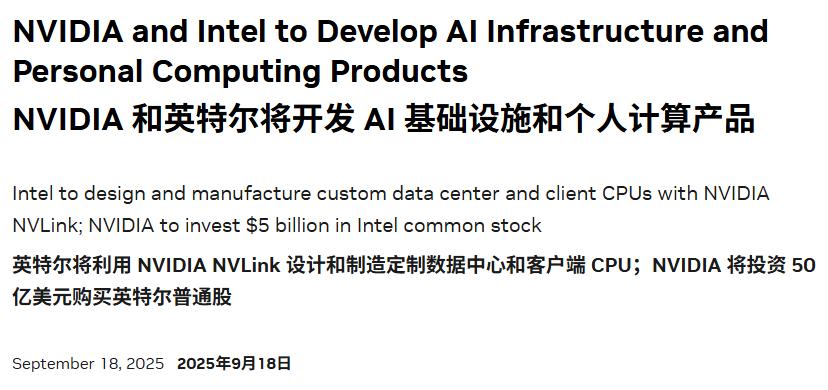
历史性合作!英伟达宣布豪掷50亿美元入股英特尔,黄仁勋:将全球最强CPU整合起来,加速计算和AI计算时代已经到来【附全球GPU芯片行业市场分析】
Qian Zhan Wang· 2025-09-22 01:56
Core Viewpoint - Nvidia announced a $5 billion acquisition of Intel common stock at $23.28 per share, making it one of Intel's largest shareholders with an expected ownership of over 4% [2] - Following the announcement, Intel's stock price surged over 30% in pre-market trading, marking its largest single-day increase in recent years [2] - Nvidia and Intel will collaborate to develop customized CPUs for data center platforms and integrate Nvidia's GPUs with Intel's CPUs, signaling a significant partnership in the AI and accelerated computing sectors [2] Group 1: Nvidia and Intel Collaboration - The partnership is described as a fusion of two world-class platforms, emphasizing that it is not merely a financial investment but a strategic alliance [2] - Nvidia's CEO highlighted the importance of this collaboration in driving advancements in AI and accelerated computing [2] - The integration of Nvidia's AI technology with Intel's x86 ecosystem is expected to open new application scenarios for Nvidia's CUDA platform [5] Group 2: Market Context - Intel has historically dominated the GPU market with over 60% market share, primarily due to its integrated GPU chips in desktop and laptop computers [3] - However, in the independent GPU market, Nvidia and AMD have captured most of the market share, leaving Intel with a minimal presence [5] - The collaboration is viewed as a pivotal moment for Intel's "second startup," potentially allowing it to catch up in the AI chip market [5] Group 3: Industry Trends - The global GPU chip industry is recognized as a vital and strategic sector, with applications in gaming, AI, data centers, and autonomous driving [2] - The semiconductor industry is shifting from a "arms race" to "ecosystem building," as evidenced by alliances like the Nvidia-Intel partnership and TSMC's wafer foundry collaborations [5]
半导体 - 对英特尔与英伟达合作的看法-Semiconductors North America-Thoughts on IntelNVDA partnership
2025-09-22 01:00
Summary of Key Points from the Conference Call Industry and Company Involved - **Industry**: Semiconductors, specifically focusing on North America - **Companies**: Intel Corporation (INTC) and Nvidia Corporation (NVDA) Core Insights and Arguments 1. **Collaboration Announcement**: Intel and Nvidia announced a partnership to develop custom data center and PC products, including Nvidia-custom x86 CPUs and x86 SOCs integrating Nvidia graphics chiplets with Intel CPUs [3][4] 2. **Investment Details**: Nvidia will invest $5 billion in Intel's common stock at a price of $23.28 per share [3] 3. **Market Impact**: The server CPU market is currently around 30 million units, with Intel holding approximately 65% market share. Nvidia's expected shipment of 30,000 racks this year represents a small contribution to Intel's overall market share [5][10] 4. **Strategic Importance**: The collaboration is seen as a positive development for Intel, particularly in enhancing its position in AI systems and regaining lost content from Nvidia's shift to its own Grace CPU [4][9] 5. **Long-term Product Release**: New products from this collaboration are not expected to hit the market until 2027 [13] 6. **Foundry Relationship Speculation**: There is potential for a future Nvidia-Intel foundry relationship, although no immediate plans were disclosed [14] 7. **Stock Market Reaction**: Initial enthusiasm for Intel's stock may fade if the partnership does not evolve into a foundry aspect, which is a concern for some investors [19] Additional Important Insights 1. **AMD's Position**: The collaboration is viewed as neutral for AMD, as it does not significantly impact their market share in either server or PC segments [22] 2. **ALAB's Outlook**: The partnership may affect ALAB due to potential changes in connectivity standards, but the specifics remain unclear [23] 3. **Capex Expectations**: Intel's capital expenditure is expected to increase, with estimates for 2026 capex around $13.2 billion, influenced by the partnership [24][25] 4. **Risks and Opportunities**: The semiconductor industry faces various risks, including competition from AMD and potential delays in new product launches, which could impact revenue growth [28][30] This summary encapsulates the key points discussed in the conference call regarding the Intel and Nvidia partnership, its implications for the semiconductor industry, and the potential market dynamics moving forward.