
UBTECH ROBOTICS(09880)

Search documents
12月30日南向资金净卖出38.45亿港元





Zheng Quan Shi Bao Wang· 2025-12-30 14:51
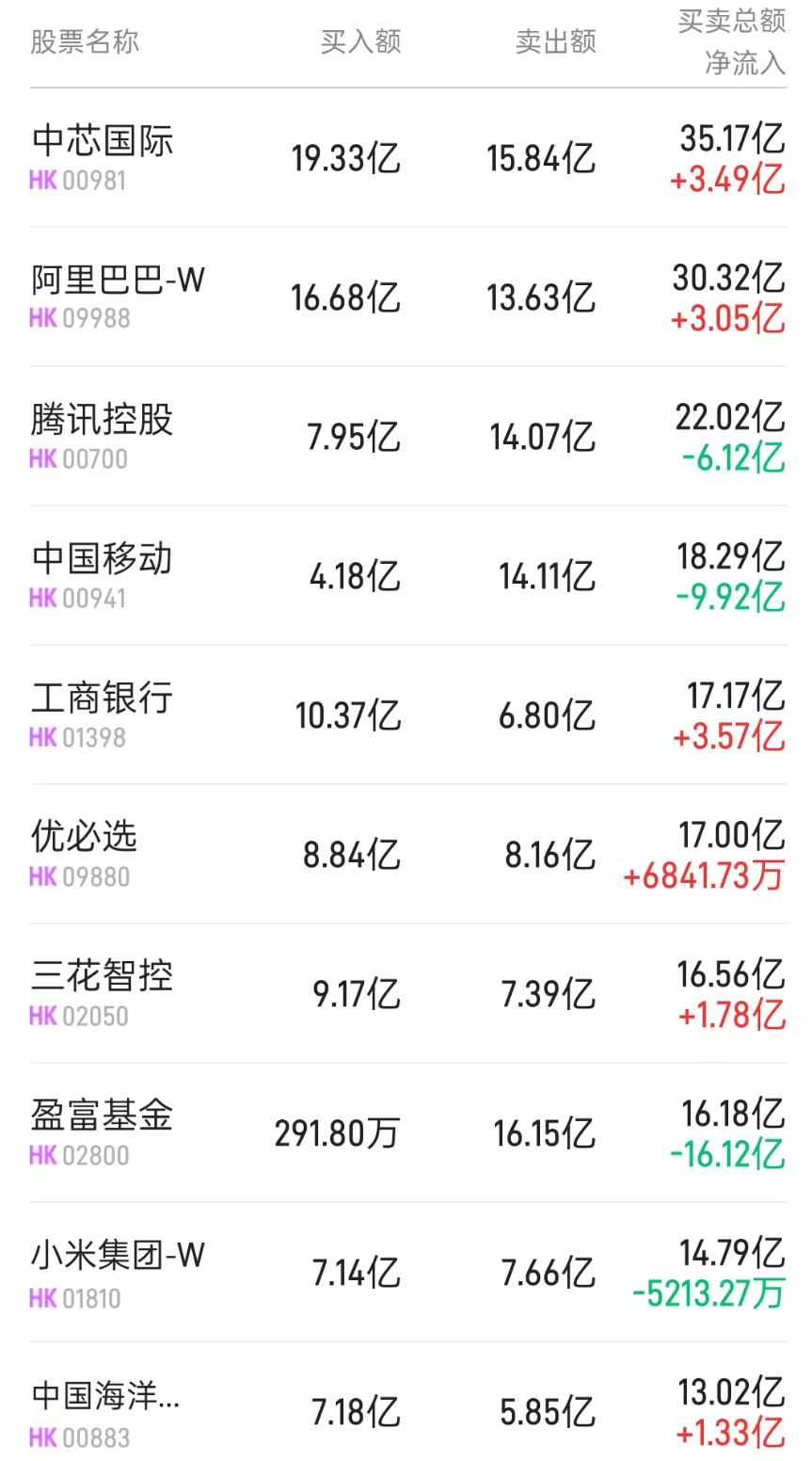
Market Overview - On December 30, the Hang Seng Index rose by 0.86%, closing at 25,854.60 points, while southbound funds through the Stock Connect recorded a net sell of HKD 3.845 billion [1][3] - The total trading volume for the Stock Connect on the same day was HKD 92.3 billion, with a net sell of HKD 3.845 billion [1][3] Trading Activity - In the Shanghai Stock Connect, the trading volume was HKD 59.138 billion with a net sell of HKD 1.327 billion, while in the Shenzhen Stock Connect, the trading volume was HKD 33.161 billion with a net sell of HKD 2.518 billion [1][3] Active Stocks - The most actively traded stock in the Shanghai Stock Connect was SMIC, with a trading volume of HKD 35.17 billion, followed by Alibaba-W and Tencent Holdings with trading volumes of HKD 30.32 billion and HKD 22.02 billion, respectively [1][2] - In terms of net buying, Industrial and Commercial Bank of China had the highest net buy amount of HKD 357 million, with its stock price increasing by 0.64% [1][2] - The stock with the highest net sell was the Tracker Fund of Hong Kong, with a net sell of HKD 1.612 billion, while its stock price rose by 0.93% [1][2] Shenzhen Stock Connect Highlights - In the Shenzhen Stock Connect, SMIC led with a trading volume of HKD 25.32 billion, followed by Alibaba-W and Tencent Holdings with HKD 23.47 billion and HKD 16.79 billion, respectively [2] - The highest net buy was also for SMIC, with a net buy of HKD 410 million, and its stock price increased by 4.24% [2] - Alibaba-W recorded the highest net sell in this segment, amounting to HKD 798 million, while its stock price rose by 0.84% [2]
南向资金今日净卖出38.45亿港元 盈富基金净卖出16.12亿港元
Zheng Quan Shi Bao Wang· 2025-12-30 14:51
Group 1 - The Hang Seng Index rose by 0.86% on December 30, with a total turnover of southbound funds amounting to HKD 923.00 billion, including buy transactions of HKD 442.28 billion and sell transactions of HKD 480.72 billion, resulting in a net sell of HKD 38.45 billion [1] - The southbound trading through Stock Connect (Shenzhen) had a total turnover of HKD 331.61 billion, with buy transactions of HKD 153.22 billion and sell transactions of HKD 178.40 billion, leading to a net sell of HKD 25.18 billion [1] - The southbound trading through Stock Connect (Shanghai) recorded a total turnover of HKD 591.38 billion, with buy transactions of HKD 289.06 billion and sell transactions of HKD 302.33 billion, resulting in a net sell of HKD 13.27 billion [1] Group 2 - Among the actively traded stocks, SMIC had the highest turnover with a total of HKD 60.49 billion and a net buy of HKD 7.59 billion, closing with a price increase of 4.24% [1][2] - CNOOC had a total turnover of HKD 21.87 billion with a net buy of HKD 4.61 billion, while ICBC recorded a net buy of HKD 3.57 billion [2] - Tencent Holdings had a total turnover of HKD 38.81 billion with a net sell of HKD 12.79 billion, and Alibaba-W had a turnover of HKD 53.79 billion with a net sell of HKD 4.93 billion [2] Group 3 - The stock with the longest consecutive net buy from southbound funds was Huahong Semiconductor, with a total net buy of HKD 5.45 billion over three days [2] - The stocks with the highest consecutive net sell included China Mobile, Tencent Holdings, and Alibaba-W, with total net sells of HKD 96.46 billion, HKD 32.97 billion, and HKD 18.05 billion respectively [2]

机器人概念普遍拉升 三花智控(02050)升近1成 工信部人形机器人与具身智能标委会成立
Xin Lang Cai Jing· 2025-12-30 11:04
Group 1 - The establishment of the humanoid robot and embodied intelligence standardization technical committee is a significant measure to implement the decisions of the central government and enhance high-quality standard supply [1][2] - The committee will focus on the formulation and revision of industry standards in areas such as common foundational technologies, key technologies, components, complete systems, applications, and safety for humanoid robots and embodied intelligence [2] - Huolong Securities maintains a "recommended" rating for the humanoid robot industry, noting that domestic companies are actively engaging in financing and expanding production capacity and market opportunities [2] Group 2 - The stock prices of several companies in the robot sector have risen significantly, with Sanhua Intelligent Control up 9.66%, Yujian up 8.79%, UBTECH up 7.95%, Fourth Paradigm up 4.9%, and Horizon Robotics up 3.9% [1][2]

北水动向|北水成交净卖出38.45亿 芯片及机器人概念获加仓 盈富基金(02800)遭内资抛售
智通财经网· 2025-12-30 09:58
Core Viewpoint - The Hong Kong stock market experienced significant net selling from northbound capital, totaling HKD 38.45 billion, with notable net selling in major stocks like Tencent and China Mobile, while stocks like SMIC and CNOOC saw net buying [1][5]. Group 1: Northbound Capital Flow - Northbound capital had a net selling of HKD 38.45 billion on December 30, with HKD 13.27 billion from the Shanghai Stock Connect and HKD 25.18 billion from the Shenzhen Stock Connect [1]. - The stocks with the highest net buying included SMIC (00981), CNOOC (00883), and ICBC (01398) [1]. - The stocks with the highest net selling included the Tracker Fund of Hong Kong (02800), Tencent (00700), and China Mobile (00941) [1]. Group 2: Individual Stock Performance - SMIC saw a net inflow of HKD 3.49 billion, with a total transaction volume of HKD 35.17 billion [2]. - CNOOC received a net buying of HKD 4.6 billion, with analysts noting a potential stabilization in oil prices due to seasonal demand and OPEC+ production adjustments [5]. - ICBC had a net inflow of HKD 3.56 billion, supported by expectations of stable credit growth in 2026 [5]. Group 3: Sector Trends - The semiconductor sector is gaining attention, with SMIC and Hua Hong Semiconductor receiving significant net buying, driven by positive market sentiment and government support [4]. - The robotics sector is also attracting investment, with stocks like Sihai Intelligent Control and UBTECH Robotics seeing net inflows, amid expectations of upcoming projects in North America [5]. - The technology sector showed mixed results, with Meituan (03690) experiencing net buying, while Alibaba (09988) and Tencent faced substantial net selling [6]. Group 4: Market Sentiment - The market sentiment remains cautious, with analysts suggesting that while there may be short-term opportunities, the overall environment is still under pressure, particularly for the Hong Kong market [7]. - The Tracker Fund of Hong Kong faced significant net selling, indicating a potential lack of confidence in the broader market [7].



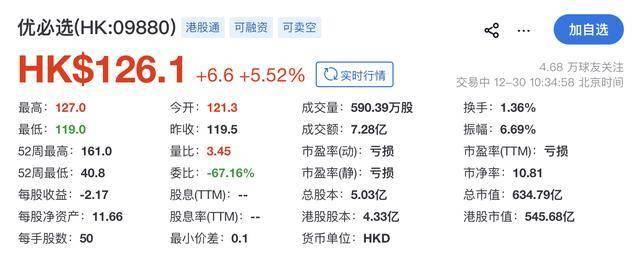
优必选创始人周剑再发禁售承诺,2026年人形机器人产能剑指万台
Sou Hu Cai Jing· 2025-12-30 06:15
值得一提的是,近日,优必选新中标惠州市惠阳区人形机器人大湾区数据采集中心项目和呼和浩特市具 身智能科技中心设备采购项目,中标金额分别为5962万元、7780万元,总金额超1.3亿元。2025年,优 必选人形机器人订单总金额已近14亿元。 另外,12月26日,优必选第1000台Walker S2在柳州机器人超级智慧工厂下线,全年已实现了千台产 能。预计2026年,优必选人形机器人年产能将达万台规模。 瑞财经 吴文婷 12月30日,"人形机器人第一股"优必选股价上涨。截至发稿时,其报126.1港元,涨 5.52%,总市值约634.79亿港元。 | 优心选(HK:09880) 港股通 可融资 可卖空 | | | 加自选 | | --- | --- | --- | --- | | HK$126.1 +6.6 +5.52% | | C 实时行情 | 4.68 万球友关注 交易中 12-30 10:34:58 北京时间 | | 最高: 127.0 | 今开:121.3 | 成交量:590.39万股 | 换手:1.36% | | 最低:119.0 | 昨收:119.5 | 成交额:7.28亿 | 振幅:6.69% | | ...
机器人概念午后涨幅扩大 三花智控(02050.HK)涨12%
Mei Ri Jing Ji Xin Wen· 2025-12-30 06:08
每经AI快讯,机器人概念股午后拉升。截至发稿,三花智控(02050.HK)涨12%,报38.26港元;越疆 (02432.HK)涨10.32%,报37.4港元;优必选(09880.HK)涨8.62%,报129.8港元;蓝思科技(06613.HK)涨 5.22%,报25.38港元。 ...
机器人概念午后涨幅扩大 三花智控涨12% 海内外厂商催化频频
Zhi Tong Cai Jing· 2025-12-30 05:48
Core Viewpoint - The robotics sector is experiencing a significant surge, driven by expectations surrounding Tesla's Optimus project and increasing domestic developments in humanoid robotics [1] Group 1: Stock Performance - Shares of Sanhua Intelligent Control (002050) rose by 12% to HKD 38.26 - Yujian (02432) increased by 10.32% to HKD 37.4 - UBTECH (09880) saw an 8.62% rise to HKD 129.8 - Lens Technology (300433) gained 5.22% to HKD 25.38 [1] Group 2: Market Developments - Supply chain companies are reportedly visiting clients in North America, with market expectations that Tesla's Optimus project will soon be contracted - The Trump administration is considering an executive order on robotics to be released in 2026 - JD.com and Yuzhu Technology are set to open their first offline experience store on December 31, promoting the commercialization of humanoid robots [1] Group 3: Industry Insights - Guojin Securities believes that embodied intelligence is the strongest application of AI, with humanoid robots being a key direction - The second half of the year should focus on new technology iterations and component ticket pricing in the robotics field - Caixin Securities notes that the humanoid robotics industry is on the brink of scaling, with a combination of technological iteration, cost reduction, and policy support [1]

港股异动 | 机器人概念午后涨幅扩大 三花智控(02050)涨12% 海内外厂商催化频频
智通财经网· 2025-12-30 05:48
消息面上, 据券商中国报道,有传闻指出,供应链公司近期陆续赴北美拜访客户,市场预期特斯拉 Optimus项目发包在即;另有消息称特朗普政府正考虑2026年发布一项关于机器人的行政命令。值得关 注的是,近期国内人形机器人领域也催化频频。京东与宇树科技两家公司合作的线下体验店首店将于12 月31日开业,推动人形机器人商业落地与消费者触达。此前12月26日,工信部成立人形机器人标准化技 术委员会。 智通财经APP获悉,机器人概念股午后拉升,截至发稿,三花智控(02050)涨12%,报38.26港元;越疆 (02432)涨10.32%,报37.4港元;优必选(09880)涨8.62%,报129.8港元;蓝思科技(06613)涨5.22%,报 25.38港元。 国金证券认为,具身智能是AI最强应用,而人形机器人则是具身智能最重要的方向之一。在机器人领 域,下半年可关注新技术迭代及零部件门票行情。财信证券指出,人形机器人行业处于规模化前夜,技 术迭代、成本下降与政策支持形成合力。建议重点关注人形机器人优质零部件供应商,特别是与海外头 部企业合作较多的厂商。 ...
花旗:优必选或将采取措施以缓解股价压力 维持对优必选的买入评级
Xin Lang Cai Jing· 2025-12-30 04:49
Group 1 - The core viewpoint of the article is that UBTECH may take measures to alleviate stock price pressure in the short term [1] - The CEO of UBTECH, Zhou Jian, has voluntarily announced that he will not sell his shares in the next 12 months [1] - Citigroup expects other key executives and major shareholders to make similar announcements soon in response to market concerns about potential share reductions [1] Group 2 - Citigroup maintains a positive outlook on the humanoid robot supply chain in China but prefers key component manufacturers like Hengli Hydraulic over original equipment manufacturers like UBTECH [1] - Despite the concerns, Citigroup maintains a buy rating on UBTECH with a target price of HKD 155.00 [1]
优必选创始人周剑再发禁售承诺:12个月内不减持个人所持公司H股
Xin Lang Cai Jing· 2025-12-30 04:26
Core Viewpoint - The company, UBTECH Robotics, has announced a voluntary lock-up commitment from its founder and CEO, Zhou Jian, to not sell his shares for 12 months starting December 29, 2025, which reflects confidence in the company's future and stability in its share price [1][2]. Group 1: Shareholding and Commitments - Zhou Jian holds 70.57435 million H-shares, representing 19.02% of the total H-shares and 15.98% of the total share capital of UBTECH [1]. - The market value of the shares Zhou Jian has committed not to sell is over HKD 8.4 billion, based on the closing price of HKD 119.5 per share on December 29 [1]. - This is the second time Zhou has made such a commitment, having previously pledged not to sell 70.4 million H-shares for a year starting December 29, 2024 [1]. Group 2: Strategic Developments - UBTECH announced a strategic acquisition of a 43% stake in the A-share listed company, Fenglong Co., for HKD 1.665 billion, which will change the controlling shareholder to UBTECH [2]. - The acquisition is seen as a strategic move to optimize the company's structure rather than a quick route to listing, aimed at enhancing its industrial chain and core competitiveness [2]. - UBTECH has secured nearly HKD 1.4 billion in orders for industrial humanoid robots this year, indicating strong market demand and operational capability [2]. Group 3: Financial Performance - For the first half of 2025, UBTECH reported a revenue of HKD 621 million, reflecting a year-on-year growth of 27.5% [3].