
BIDU(09888)

Search documents
中金:维持百度集团-SW(09888)跑赢行业评级 目标价196港元
智通财经网· 2026-01-21 02:04
Group 1 - The core viewpoint of the report maintains Baidu Group's revenue and non-GAAP profit forecasts for 2025, 2026, and 2027, with a target price of HKD 196, indicating a 33% upside potential compared to the current market valuation [1] - The expected non-GAAP net profit for Baidu in Q4 2025 is projected to be CNY 3 billion, with the core non-GAAP net profit also at CNY 3 billion [1] Group 2 - Baidu AI Cloud is expected to maintain a year-on-year growth rate exceeding 30% in Q4, driven by strong AI demand from enterprise clients and the company's differentiated self-developed infrastructure [2] Group 3 - The "萝卜快跑" (Roborace) has achieved significant milestones in its global expansion, launching fully autonomous commercial operations in Abu Dhabi and planning to deploy hundreds of vehicles by 2026 [3] - The company has received full autonomous testing permits in Dubai and is preparing to initiate autonomous driving tests in London in collaboration with Uber and Lyft [3] Group 4 - Multiple models from Baidu's Wenxin have ranked highly, with ERNIE-5.0-0110 and ERNIE-5.0-Preview-1203 achieving notable results in text and visual understanding categories [4] - The AI application landscape is rapidly evolving, with the "秒哒" no-code platform generating over 500,000 commercial applications and experiencing a daily growth rate of over 150% [4] - The overseas version of the GenFlow intelligent agent has gained millions of users, while the digital human "慧播星" is expanding into markets like Brazil, Thailand, and Vietnam [4]

一天两起车辆起火事件!小米回应:动力电池均处于正常状态;俞敏洪宣布聘请陈行甲,年薪150万;日本电视荣光不再!TCL拟控股索尼电视业务
雷峰网· 2026-01-21 00:26
Key Points - Sony officially announced the spin-off of its television business, forming a joint venture with TCL, where TCL will hold 51% and Sony 49% [4][5] - The new company will manage the entire global operations of television and home audio equipment, with plans to start operations by April 2027, pending regulatory approvals [4][5] - Sony's market share in China has significantly declined, with foreign brands collectively holding less than 5% of the market share in 2024, averaging around 1.25% each [4][5] - The overall shipment of televisions in China is projected to drop by 8.5% in 2025, reaching a new low since 2010, with the top eight brands dominating 94.1% of the market [5] - Xiaomi responded to two vehicle fire incidents, stating that the power batteries were functioning normally at the time of the incidents [10][11] - MiHoYo announced the closure of the Genshin Impact server operated in partnership with Xiaomi, effective January 20, 2025, due to strategic adjustments [12] - New Oriental's founder, Yu Minhong, announced the hiring of Chen Xingjia as a consultant with an annual salary of 1.5 million RMB, amidst controversy over high salaries in the nonprofit sector [7][8] - The mobile phone market in China for 2025 shows Vivo, Xiaomi, and Apple as the top three brands by activation volume, with Xiaomi's growth attributed to the success of its 17 series [21][22] - Hikvision reported a slight increase in revenue for 2025, achieving 92.517 billion RMB, with a net profit of 14.188 billion RMB, reflecting a growth of 18.46% year-on-year [30]






智通港股沽空统计|1月21日
智通财经网· 2026-01-21 00:23
| 股票名称 | 沽空金额↓ | 沽空比率 | 偏离值 | | --- | --- | --- | --- | | 泡泡玛特(09992) | 10.08 亿元 | 17.14% | -7.69% | | 小米集团-W(01810) | 8.25 亿元 | 10.26% | -11.52% | | 美团-W(03690) | 7.77 亿元 | 17.49% | 1.85% | | 中国人寿(02628) | 7.18 亿元 | 23.90% | 3.47% | | 洛阳钼业(03993) | 6.87 亿元 | 35.31% | 21.99% | | 百度集团-SW(09888) | 6.24 亿元 | 21.01% | -5.12% | | 阿里巴巴-W(09988) | 6.13 亿元 | 6.91% | -7.34% | | 比亚迪股份(01211) | 4.97 亿元 | 20.25% | 0.39% | | 腾讯控股(00700) | 4.79 亿元 | 3.27% | -7.53% | | 中国平安(02318) | 3.47 亿元 | 16.40% | -12.96% | 前十大沽空偏离值排行 ...




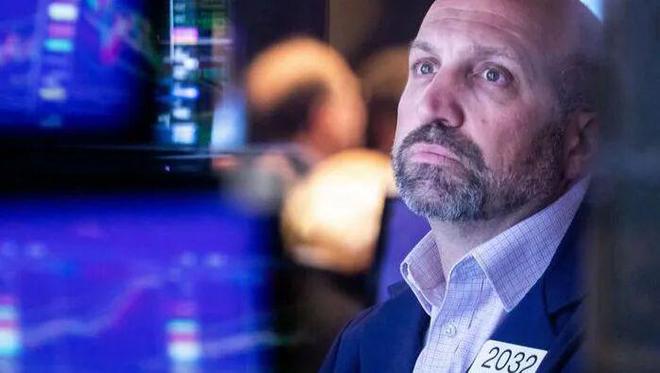
美股大跌,科技股全线下挫,热门中概股普跌
Di Yi Cai Jing Zi Xun· 2026-01-20 23:31
Group 1 - The global market risk appetite has significantly decreased following President Trump's renewed tariff threats towards Europe, leading to a sell-off in major stock indices [2][3] - The Dow Jones Industrial Average fell by 870.74 points, a decline of 1.76%, closing at 48,488.59 points; the S&P 500 dropped by 143.15 points, down 2.06%, at 6,796.86 points; and the Nasdaq Composite decreased by 561.07 points, a 2.39% drop, ending at 22,954.32 points, marking the worst single-day performance since October 10 of the previous year [2] - Major tech stocks experienced declines, with Nvidia down 4.32%, Apple down 3.45%, and Microsoft down 1.16%, among others [2] Group 2 - The CBOE Volatility Index (VIX), often referred to as the "fear index," rose to a two-month high, reflecting increased market anxiety [3] - Trading volume on U.S. stock markets reached approximately 20.6 billion shares, significantly above the 20-day average of 17.01 billion shares, indicating concentrated selling pressure [3] - Analysts suggest that the current geopolitical tensions regarding tariffs are more of an emotional shock rather than a fundamental change that would trigger a deep market correction [3] Group 3 - The global bond market is also experiencing spillover effects, with upward pressure on some European government bonds due to potential increases in defense spending [4] - The yield on the U.S. 10-year Treasury note reached a high of 4.313%, the highest since late August, closing at 4.287% after a rise of 5.6 basis points [5] - Market expectations for interest rate cuts by the Federal Reserve have been adjusted downward, with projections for a reduction of approximately 47 basis points in 2026, down from 53 basis points at the end of the previous year [5] Group 4 - Netflix reported fourth-quarter revenue of $12.1 billion, exceeding market expectations of $11.97 billion, with adjusted earnings per share of $0.56, also slightly above forecasts [6] - The company anticipates full-year revenue for 2026 to reach between $50.7 billion and $51.7 billion, with expectations for advertising revenue to potentially double in the future [6] - Following the announcement, Netflix's stock price fell by 4.9% in after-hours trading, influenced by merger financing and market sentiment [7] Group 5 - Gold prices surged significantly, with spot gold rising approximately 2% to $4,757.33 per ounce, reaching a historical high of $4,756.93 during the session [7] - Silver prices experienced a slight decline of 0.3%, settling at $94.38 per ounce, after hitting a record high of $95.87 [7] - Oil prices showed volatility, with light crude oil futures for February delivery rising by $0.90 to $60.34 per barrel, a 1.51% increase [8]


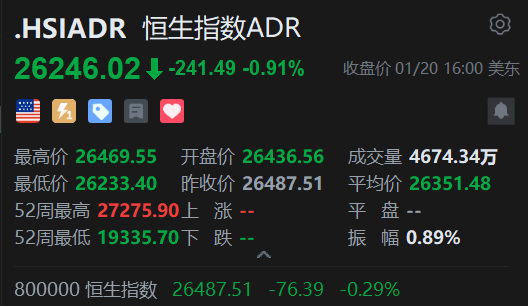
智通ADR统计 | 1月21日
智通财经网· 2026-01-20 22:29
Market Overview - The Hang Seng Index closed at 26,246.02, down by 241.49 points or 0.91% [1] - The index reached a high of 26,469.55 and a low of 26,233.40 during the trading session [1] - The average price for the day was 26,351.48, with a trading volume of 46.7434 million [1] Major Blue-Chip Stocks Performance - HSBC Holdings closed at HKD 128.682, up by 0.22% compared to the Hong Kong close [2] - Tencent Holdings closed at HKD 593.183, down by 1.30% compared to the Hong Kong close [2] - Alibaba Group (W) closed at HKD 159.700, down by 0.44% [3] - Xiaomi Group (W) closed at HKD 35.480, down by 2.74% [3] - Meituan (W) closed at HKD 97.350, down by 1.17% [3] Stock Price Changes - Tencent Holdings saw a decrease of HKD 9.000, or 1.48% [3] - HSBC Holdings increased by HKD 1.400, or 1.10% [3] - China Ping An rose by HKD 0.600, or 0.88% [3] - BYD Company experienced a decline of HKD 3.700, or 3.67% [3] - Kuaishou Technology (W) fell by HKD 0.700, or 0.91% [3]



百度文心助手月活超2亿
Bei Jing Shang Bao· 2026-01-20 14:51
Core Insights - Baidu's Wenxin Assistant has surpassed 200 million monthly active users, indicating significant user engagement and growth in the AI assistant market [1] Group 1: Product Development - Wenxin Assistant is an AI smart assistant launched within the Baidu App, showcasing the company's commitment to integrating AI technology into its services [1] - As of early January 2026, Wenxin Assistant has integrated with various Baidu ecosystem services, including Baidu Maps and Baidu Health, enhancing its functionality [1] Group 2: Partnerships and Ecosystem - The assistant connects with major partners such as JD.com, Meituan, and Yingmi Fund through the MCP (Model Context Protocol) service, expanding its reach across e-commerce, health, and local services [1] - The integration allows users to address various needs, including ticket booking, travel, shopping, financial management, and legal consultation [1]
OpenAI的不归路:关于ChatGPT加入广告的五个冷思考
Sou Hu Cai Jing· 2026-01-20 13:33
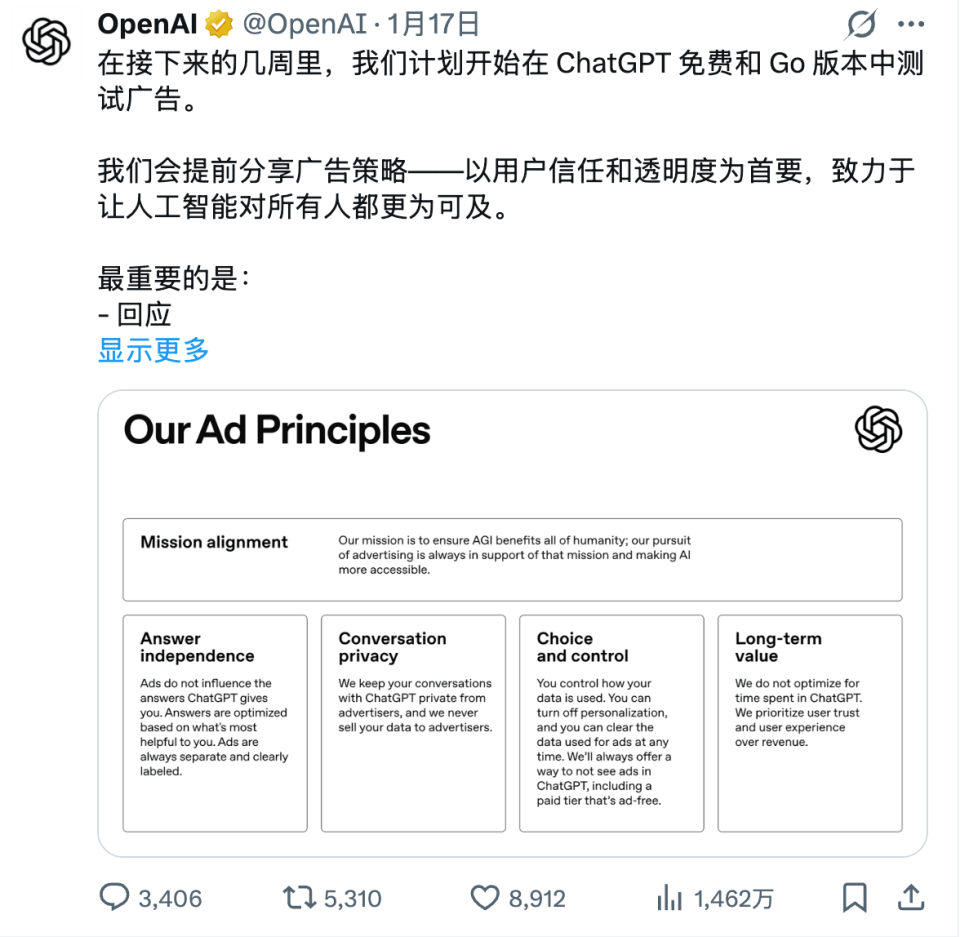
Core Insights - The article discusses the evolving advertising strategy of OpenAI, highlighting the pressure for monetization and the shift in leadership attitudes towards advertising as a viable business model [1][3][4]. Group 1: OpenAI's Advertising Strategy - OpenAI's decision to launch advertising just over a month after a "Code Red" alert indicates significant pressure to monetize its products [2][5]. - The recruitment of executives with strong advertising backgrounds, such as Fidji Simo and Kevin Weil, suggests a strategic pivot towards generating revenue through advertising [2][3]. - Sam Altman's changing perspective on advertising—from viewing it as a last resort to considering it a potential revenue stream—reflects a pragmatic approach to business [5][6]. Group 2: Cautious Implementation of Advertising - OpenAI is taking a cautious approach to advertising, ensuring that ads are clearly marked as "Sponsored" and do not interfere with the content of ChatGPT responses [7][10]. - Users have the option to disable personalized ads and provide feedback, indicating an effort to maintain user trust [9][10]. - Despite this cautious start, there are concerns about how long OpenAI can maintain this approach without succumbing to commercial pressures [11][14]. Group 3: Implications for Google - The introduction of advertising in ChatGPT could potentially divert ad revenue from Google, which relies heavily on its advertising business [19][21]. - Some analysts believe that Google's core advertising revenue is at risk if OpenAI successfully demonstrates higher ROI for conversational ads compared to traditional search ads [19][21]. - Conversely, others argue that Google's established advertising infrastructure and experience may give it an advantage in the competitive landscape [20][22]. Group 4: Revenue Projections for OpenAI - Initial revenue estimates for OpenAI's advertising model suggest it could generate between $2 billion and $7.2 billion in its first year, which would significantly contribute to its overall revenue [30][35]. - This revenue could help alleviate OpenAI's substantial operational costs, although it remains a small fraction of its projected infrastructure investments [36]. - Analysts predict that advertising could become OpenAI's largest revenue source within three years, potentially capturing a significant share of the global search advertising market [36]. Group 5: Broader Industry Context - Other AI companies, including Google and Baidu, have already begun integrating advertising into their AI products, indicating a trend towards monetization in the industry [38][40]. - The article suggests that many domestic AI companies have yet to adopt advertising due to competitive market conditions, but this is expected to change in the near future [45][50]. - The overall willingness to pay for AI services in domestic markets is lower than in international markets, making advertising a more viable monetization strategy [51].



昆仑万维周亚辉投资笔记:AI时代的Super App之战打响|甲子光年
Sou Hu Cai Jing· 2026-01-20 13:15
Core Viewpoint - The analysis suggests that Zhang Yiming will be the richest person in China and Asia in the next ten to twenty years due to his strong motivation, learning ability, execution power, and the resources of ByteDance [1]. Group 1: ByteDance's Strategic Position - ByteDance is expected to accelerate its international expansion, particularly with the launch of the Doubao phone and its entry into the automotive sector, aiming for a position in autonomous driving [2]. - The future of AI will see a significant reduction in the number of Super Apps, with only 3-4 likely to exceed 500 million monthly active users (MAU), compared to 10+ in the mobile internet era [2][3]. - The value of Super Apps in the AI era is projected to be several times greater than in the mobile internet era, with higher daily active users (DAU) to MAU ratios [2]. Group 2: Competitive Landscape - The competition for Super App dominance is intensifying, with Alibaba's Qwen positioned as a strong competitor to Doubao, marking a significant face-off between Zhang Yiming and Jack Ma [7]. - Other contenders for the Super App battle include Tencent, Meituan, Pinduoduo, JD.com, and Baidu, while smaller players like Xiaohongshu may struggle to compete effectively [7]. - The market for AI Super Apps is anticipated to be worth 1 trillion RMB, necessitating significant investment from companies with substantial cash reserves [7]. Group 3: Industry Insights - Huawei is unlikely to enter the Super App market due to its strategic focus on becoming a leading automotive group in China, while Tencent is seen as a stable player with a strong product matrix [8]. - The potential shift in user engagement from WeChat to Doubao could significantly alter the competitive dynamics in the app ecosystem, with Doubao's influence expected to grow rapidly [8].




2026,物理AI的六大趋势:新物种大爆发,淘汰赛开启
Tai Mei Ti A P P· 2026-01-20 07:36
Core Viewpoint - The next wave of artificial intelligence (AI) will transition from virtual content generation to Physical AI, enabling autonomous completion of complex tasks in the real world by 2026 [1] Group 1: Trends in Physical AI - Trend 1: Robotaxi will move from regional trials to large-scale operations, driven by reduced costs of core hardware and supportive regulations in major markets [3][4] - Trend 2: The shipment volume of humanoid robots is expected to double, leading to a competitive landscape where companies lacking closed-loop evolution capabilities may face challenges [5][7] - Trend 3: AI Agents will evolve from simple Q&A bots to personal intelligent partners, increasing interaction with the real world and intensifying competition between terminal and application manufacturers [8][10] Group 2: Developments in Wearable and Cleaning Devices - Trend 4: A surge of innovative wearable devices will emerge, focusing on specific functions and seamless AI integration for health and interaction [11][13] - Trend 5: AI toys will enhance emotional companionship capabilities, moving away from mere conversation to empathetic interactions [14][15] - Trend 6: The cleaning appliance sector will see accelerated embodiment, with products gaining advanced capabilities to perceive and adapt to their environments [16][17]

消息称百度文心一言月活跃用户突破2亿
Feng Huang Wang· 2026-01-20 07:24
Core Insights - Baidu's AI product, Wenxin Yiyan, has surpassed 200 million monthly active users amid increasing competition in the AI sector [1] Company Summary - Baidu has integrated its flagship search engine and PC applications with the AI-driven Wenxin Yiyan, enhancing user experience [1] - Wenxin Yiyan is linked with popular applications such as JD.com, Meituan, and Ctrip, enabling users to book flights, order takeout, and seek health and legal advice [1] - The AI assistant allows users to generate videos and images, write summaries, and perform various tasks, with options to choose different AI models [1] - Wenxin Yiyan is also connected to Baidu Maps and Baidu Health platforms, expanding its utility [1] Industry Summary - Major Chinese tech companies, including ByteDance, Alibaba, and Tencent, are heavily investing in AI models and applications [1] - Alibaba's Qianwen chatbot has also seen significant growth, reaching over 100 million monthly active users within two months of its launch in November [1]
