BIDU(09888)

Search documents
两个马年:中国互联网的十二年轮回
Hua Xia Shi Bao· 2026-02-21 10:58
文/陈岩鹏 这个世界有时候就是这么巧。 2014年,农历甲午马年,微信红包横空出世。那一年,张小龙团队做的一个小功能,改写了中国移动支 付的格局。 2026年,农历丙午马年,AI红包全面爆发。这一年,字节、阿里、腾讯、百度砸下超过45亿元,争夺 下一代智能入口。 十二年一个轮回。 两匹"马",恰好踩准了中国互联网两次最大的浪潮。 第一个马年:那匹"黑马"是怎么跑出来的? 2014年春节,微信团队做了一个小功能——红包。 2015年春晚,微信乘胜追击,正式开启"春晚红包"时代。那一夜,"摇一摇"摇出了10亿次红包收发,摇 出了微信支付的逆袭,也摇出了此后十二年的互联网春晚大战。 十二年间:那些年我们追过的红包 从2014到2026,这十二年是怎样的十二年? 是移动互联网从崛起到饱和的十二年。是BAT从鼎盛到分化,TMD从崛起到登台的十二年。是流量从 廉价到昂贵的十二年,是用户从新鲜到疲惫的十二年。 我们看着春晚红包从"摇一摇"变成"集五福",从"拼手速"变成"拼社交",从"抢几块钱"变成"抢几亿"。 我们看着互联网大厂轮番登场,微信、支付宝、淘宝、百度、快手、抖音、京东、拼多多——没有一个 缺席过春晚。 我们也 ...




智通ADR统计 | 2月21日
智通财经网· 2026-02-20 23:59
Group 1 - Major blue-chip stocks mostly rose, with HSBC Holdings closing at HKD 137.775, up 2.59% from the previous close in Hong Kong [2] - Tencent Holdings closed at HKD 531.758, an increase of 1.87% from the previous close in Hong Kong [2] Group 2 - Tencent Holdings reported a latest price of HKD 522.000, down HKD 11.000 or 2.06%, with an ADR price of HKD 531.758, showing an increase of HKD 9.758 compared to the Hong Kong stock price [3] - Alibaba Group (W) had a latest price of HKD 147.100, down HKD 7.600 or 4.91%, with an ADR price of HKD 150.874, reflecting an increase of HKD 3.774 compared to the Hong Kong stock price [3] - HSBC Holdings had a latest price of HKD 134.300, up HKD 0.100 or 0.07%, with an ADR price of HKD 137.775, indicating an increase of HKD 3.475 compared to the Hong Kong stock price [3]



今日财经要闻TOP10|2026年2月20日
Sou Hu Cai Jing· 2026-02-20 11:50
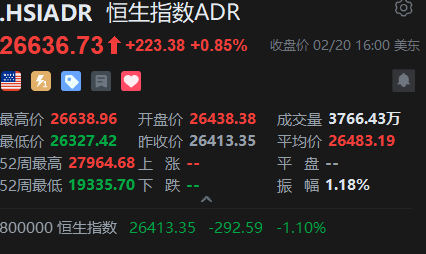
Market Performance - The Hang Seng Index closed down 1.10%, while the Hang Seng Tech Index fell by 2.91% on the first trading day after the Spring Festival, with a total market turnover of 165.37 billion HKD [6][9] - Notable stock movements included a significant rise in Zhihui (02513.HK) by 42.72%, reaching a market capitalization of over 320 billion HKD, and MINIMAX-WP (00100.HK) increasing by 14.52% [6][9] - Conversely, major tech stocks like Baidu (09888.HK) and Alibaba (09988.HK) saw declines of over 5% [6][9] Sector Trends - Oil, artificial intelligence, and robotics sectors showed strong performance despite the overall market decline, while sectors such as film and entertainment, internet healthcare, and online retail struggled [6][9] - The AI application and robotics concept stocks were highlighted as outperformers in a generally bearish market environment [1][6] Trade Agreements - The U.S. and Indonesia have finalized a reciprocal trade agreement aimed at expanding market access for U.S. goods, with Indonesia agreeing to eliminate tariffs on over 99% of U.S. exports [6] - The agreement includes approximately 33 billion USD in commercial cooperation, covering energy, aviation, and agricultural products [6] Economic Indicators - Federal Reserve Governor Stephen Milan revised down his expectations for significant interest rate cuts this year, citing stronger-than-expected employment data and persistent inflation [7] - Milan's updated stance suggests a potential reduction of 1 percentage point from the current rate of 3.5% to 3.75% [7]


TikToker Khaby Lame's $975 million deal is riding on a crashing stock
Business Insider· 2026-02-20 10:05
Core Insights - Khaby Lame's $975 million deal with Rich Sparkle Holdings is under pressure due to a significant drop in Rich Sparkle's share price, which fell from $180 to $11 [1][4] - Lame, a prominent TikTok influencer, has over 160 million followers and is known for his unique style of dialogue-free videos [2] - The deal involves creating an AI avatar of Lame to drive brand deals and product sales, with projections suggesting potential annual sales of $4 billion [3][12] Company Overview - Rich Sparkle Holdings, previously a financial printing company, aims to leverage Lame's popularity through an AI avatar for e-commerce [3][16] - The merger is structured as a reverse merger, allowing Lame to enter public markets with less scrutiny compared to a traditional IPO [17] Market Context - The influencer economy has seen limited success in public markets, with few enduring IPOs aside from major social media platforms [15] - Rich Sparkle's revenue for the 2025 fiscal year was reported at $6.2 million, indicating a need for substantial growth to meet projections [16] Digital Avatar Strategy - The use of digital avatars for sales is gaining traction, particularly in China, where they have generated significant revenue during livestreams [7][11] - Lame's digital avatar could potentially operate continuously, providing a competitive edge in e-commerce [8][9] Sales Projections and Challenges - Rich Sparkle's estimate of $4 billion in annual sales for Lame's avatar is ambitious, especially compared to existing platforms like Whatnot, which reported $8 billion in total sales for 2025 [13][14] - Current sales figures for TikTok Shop in the US are significantly lower, with around $500 million reported during peak shopping periods [14] Risks and Considerations - The reliance on a single personality for revenue generation poses risks, as seen in other influencer-led companies that have struggled post-IPO [18][19] - The valuation of Lame's business and its potential for success in public markets remains uncertain due to the lack of detailed financial information [5][6]
港股科网股开年大跌,恒生科技也变“老登”?
Di Yi Cai Jing Zi Xun· 2026-02-20 05:58
Core Viewpoint - The Hong Kong technology sector is experiencing significant downward pressure, with major stocks like Alibaba, Baidu, and Tencent facing declines, while some AI and chip-related new stocks are performing well [2][3][4]. Group 1: Market Performance - On February 20, the Hang Seng Technology Index fell over 2.5% to a new low of 5222 points, marking a five-month adjustment [2]. - Alibaba's stock dropped more than 4%, Baidu's fell over 6%, and Tencent's decreased by over 2% [2]. - In contrast, some new stocks related to AI and chips, such as Zhiyu (智谱), MINIMAX, and Lanke Technology (澜起科技), continued to rise and hit new highs [2]. - The Hang Seng Technology Index closed at 5245 points, down 2.28%, with a trading volume of 22.5 billion HKD, while the Hang Seng Index fell 0.61% to 26,544 points, with a trading volume of 91.7 billion HKD [2]. Group 2: Investor Sentiment and Concerns - Analysts note that competition in delivery and red envelope services is intense around the Spring Festival, leading to investor concerns about the return on AI investments [3]. - There is a prevailing sentiment that the technology sector will remain weak until March when companies like Tencent report earnings, potentially leading to stock buybacks and stabilization [3][4]. - Concerns are growing regarding the effectiveness of AI infrastructure investments, as costs have risen significantly compared to the previous year, while profits and revenues have not increased proportionately [3][4]. Group 3: Future Outlook - Short-term pressures on technology stocks are expected to persist, but as stock prices reflect negative factors, a bottom may form [4]. - Potential catalysts for a rebound include favorable policies and interest rate cuts from the Federal Reserve [4]. - Analysts anticipate that after earnings announcements, companies in the tech sector may restart buybacks, providing some support for stock prices [4].
港股午评:恒指收跌0.61% AI应用、机器人概念股逆势走强
Xin Lang Cai Jing· 2026-02-20 04:25
春节假期过后,港股今日迎来马年首个交易日,恒指、恒科指数低开。截至收盘,恒指早盘收跌 0.61%,科指早盘收跌2.28%,恒指大市成交额917.55亿港元。盘面上,石油、人工智能、机器人概念股 逆势走强,影视娱乐、互联网医疗、线上零售及明星科网股走势疲弱。个股方面,智谱(02513.HK)大涨 19.09%,MINIMAX-WP(00100.HK)涨10.04%,中国石油股份(00857.HK)涨4.58%,百度(09888.HK)跌 5.67%,阿里巴巴(09988.HK)跌3.75%,哔哩哔哩(09626.HK)跌5.12%。 来源:滚动播报 ...

智通ADR统计 | 2月20日
智通财经网· 2026-02-19 23:23
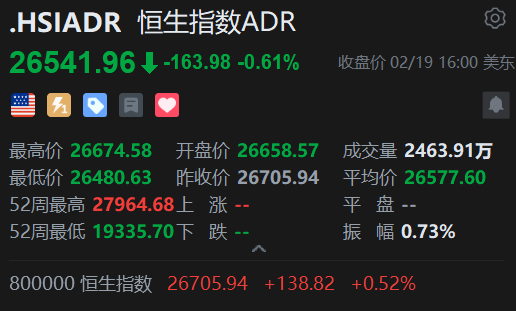
Market Overview - The Hang Seng Index (HSI) closed at 26,541.96, down by 163.98 points or 0.61% on February 19 [1] - The index opened at 26,658.57, reached a high of 26,674.58, and a low of 26,480.63, with a trading volume of 24.6391 million [1] Major Blue-Chip Stocks Performance - HSBC Holdings closed at HKD 135.722, up by 1.13% compared to the previous close [2] - Tencent Holdings closed at HKD 532.399, down by 0.11% compared to the previous close [2] Stock Price Movements - Tencent Holdings (00700) latest price is HKD 533.000, with a slight increase of 1.000 or 0.19% [3] - Alibaba Group (09988) latest price is HKD 154.700, down by 0.700 or 0.45% [3] - HSBC Holdings (00005) latest price is HKD 134.200, down by 1.500 or 1.11% [3] - AIA Group (01299) latest price is HKD 82.350, up by 2.050 or 2.55% [3] - Meituan (03690) latest price is HKD 82.050, down by 0.100 or 0.12% [3] - JD.com (09618) latest price is HKD 105.900, down by 0.500 or 0.47% [3]
马年春节,AI走出“五环”
Nan Fang Du Shi Bao· 2026-02-19 15:55
Core Insights - The competition for AI user engagement in China is intensifying, with significant user growth in lower-tier cities, indicating a shift in the primary user base from urban elites to a broader demographic [2][3] - Major AI companies are investing heavily in user acquisition strategies, with over 4.5 billion yuan spent on incentives during the Spring Festival to increase daily active users from 1-2 billion to 3-4 billion [3] User Engagement and Growth - Tencent's Yuanbao reported over 50 million daily active users and 114 million monthly active users, while ByteDance's Doubao achieved 1.9 billion interactions during the New Year [2] - Alibaba's Qianwen facilitated 130 million first-time AI shopping experiences, with growth primarily from outside first-tier cities [2] Market Challenges - China's AI development faces challenges such as reliance on domestic chip production and a relatively weak consumer market, with user willingness to pay only 1/3 to 1/4 of that in the U.S. [2] - The majority of China's AI models adopt a free strategy, contrasting with the U.S. market where over 90% of growth comes from SaaS subscriptions and personal memberships [2] Product and Service Strategy - AI companies are focusing on creating real value for users rather than relying solely on promotional tactics, as seen with Doubao's interactive features during the Spring Festival [3][5] - Alibaba's Qianwen utilized a 3 billion yuan red envelope strategy to encourage users to engage with AI for completing transactions, thus lowering barriers and collecting valuable data [3] AI Integration in Social Contexts - Tencent's Yuanbao is enhancing social interactions by integrating AI into group chats, allowing users to engage with AI as a companion for various tasks [4] - The AI experience during the Spring Festival aims to transition from novelty to necessity, emphasizing the importance of product capability and team effectiveness [5] Safety and Ethical Considerations - As AI technology becomes more advanced, concerns about safety and potential misuse by malicious actors are highlighted, stressing the need for adherence to security standards in AI development [5]
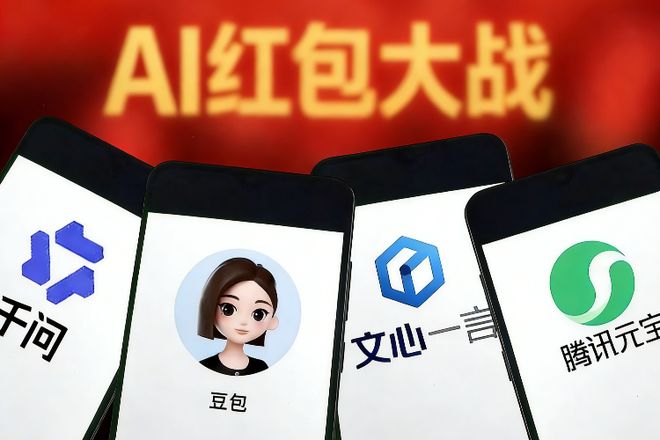
马年春节 AI走出“五环”
Nan Fang Du Shi Bao· 2026-02-19 15:43
Core Insights - The competition for AI user engagement in China is intensifying, with significant user growth in lower-tier cities, while major companies are investing heavily to increase their active user base [1][2] Group 1: User Engagement and Growth - Tencent Yuanbao reported over 50 million daily active users and 114 million monthly active users, while ByteDance's Doubao achieved 1.9 billion interactions during the Spring Festival [1] - Alibaba's Qianwen facilitated AI shopping experiences for 130 million users, with growth primarily from outside first and second-tier cities [1] - AI giants invested over 4.5 billion yuan in red envelopes to boost user engagement, aiming to increase daily active users from 100-200 million to 300-400 million [2] Group 2: Market Challenges - China's AI development faces challenges such as reliance on imported hardware chips and a relatively weak consumer market for AI products, with user willingness to pay only 1/3 to 1/4 of that in the U.S. [1] - The majority of China's AI models adopt a free strategy, contrasting with the U.S. market where over 90% of growth comes from SaaS subscriptions and personal memberships [1] Group 3: Product and Service Innovation - AI companies are focusing on creating real value for users rather than relying solely on promotional tactics, as seen with Doubao's interactive features during the Spring Festival [2] - Alibaba's Qianwen utilized a 3 billion yuan red envelope strategy to encourage users to engage with AI for completing transactions, achieving a 782-fold increase in orders from lower-tier cities [2] Group 4: Safety and Security Concerns - As AI technology becomes more advanced, concerns about security and potential misuse by malicious actors are rising, necessitating adherence to safety standards in AI development [3]
S&P 500 and Nasdaq Hit Record Highs as Kinross Gold Surges on Post-Close Earnings Beat
Stock Market News· 2026-02-18 22:07
Market Performance - U.S. equity markets reached all-time closing highs on February 18th, 2026, driven by a strong "risk-on" appetite and a resurgence in the technology sector [1] - The S&P 500 climbed 0.58% to a record 6,891.40, while the Nasdaq Composite rose 0.79% to close at 24,916.90, indicating bullish sentiment towards large-cap growth stocks [2] - The Dow Jones Industrial Average added 138 points, or 0.28%, ending at 49,707.00, marking its own record [2] - The Russell 2000 index of smaller companies saw a modest uptick of 0.5%, suggesting a positive market breadth [3] Earnings Highlights - Kinross Gold reported adjusted earnings of $0.75 per share, exceeding the consensus estimate of $0.55, with revenue driven by a 40% year-over-year increase in realized gold prices [4] - Medtronic's stock rose after a 4.6% increase in quarterly earnings, surpassing analyst forecasts for the fourth consecutive quarter [5] - Entergy's profits exceeded Wall Street expectations, leading to a rally of over 6% in its stock [6] Technology Sector Insights - Nvidia shares rose 1.2% ahead of its earnings report on February 25th, with analysts focused on updates regarding its next-generation AI chips [7] - Other major tech companies showed mixed results, with Apple and Microsoft posting modest gains, while Google and Meta Platforms experienced slight pullbacks [7] - Tesla gained 1.5% amid reports of expanded manufacturing capacity in international markets [7] Economic Outlook - The market is awaiting the release of the latest Federal Reserve meeting minutes, which may provide insights into the central bank's interest rate path for the remainder of 2026 [8] - Upcoming earnings from Baidu and Vulcan Materials are expected to shed light on global tech demand and domestic infrastructure spending [9] - The focus remains on whether corporate earnings can continue to justify elevated valuations in an environment of persistent 3% inflation [9]