BIDU(09888)

Search documents
2026,物理AI的六大趋势:新物种大爆发,淘汰赛开启
Tai Mei Ti A P P· 2026-01-20 07:36
Core Viewpoint - The next wave of artificial intelligence (AI) will transition from virtual content generation to Physical AI, enabling autonomous completion of complex tasks in the real world by 2026 [1] Group 1: Trends in Physical AI - Trend 1: Robotaxi will move from regional trials to large-scale operations, driven by reduced costs of core hardware and supportive regulations in major markets [3][4] - Trend 2: The shipment volume of humanoid robots is expected to double, leading to a competitive landscape where companies lacking closed-loop evolution capabilities may face challenges [5][7] - Trend 3: AI Agents will evolve from simple Q&A bots to personal intelligent partners, increasing interaction with the real world and intensifying competition between terminal and application manufacturers [8][10] Group 2: Developments in Wearable and Cleaning Devices - Trend 4: A surge of innovative wearable devices will emerge, focusing on specific functions and seamless AI integration for health and interaction [11][13] - Trend 5: AI toys will enhance emotional companionship capabilities, moving away from mere conversation to empathetic interactions [14][15] - Trend 6: The cleaning appliance sector will see accelerated embodiment, with products gaining advanced capabilities to perceive and adapt to their environments [16][17]



消息称百度文心一言月活跃用户突破2亿
Feng Huang Wang· 2026-01-20 07:24
Core Insights - Baidu's AI product, Wenxin Yiyan, has surpassed 200 million monthly active users amid increasing competition in the AI sector [1] Company Summary - Baidu has integrated its flagship search engine and PC applications with the AI-driven Wenxin Yiyan, enhancing user experience [1] - Wenxin Yiyan is linked with popular applications such as JD.com, Meituan, and Ctrip, enabling users to book flights, order takeout, and seek health and legal advice [1] - The AI assistant allows users to generate videos and images, write summaries, and perform various tasks, with options to choose different AI models [1] - Wenxin Yiyan is also connected to Baidu Maps and Baidu Health platforms, expanding its utility [1] Industry Summary - Major Chinese tech companies, including ByteDance, Alibaba, and Tencent, are heavily investing in AI models and applications [1] - Alibaba's Qianwen chatbot has also seen significant growth, reaching over 100 million monthly active users within two months of its launch in November [1]

Baidu's AI Assistant Reaches Milestone of 200 Million Monthly Active Users
WSJ· 2026-01-20 06:34
Group 1 - The company has integrated its artificial intelligence-powered Ernie Assistant into its flagship Baidu search-engine app and on personal computers [1]

萝卜快跑海外启动面向公众全无人驾驶出行服务 首站阿布扎比
Nan Fang Du Shi Bao· 2026-01-20 05:23
Core Insights - The launch of fully autonomous ride-hailing services by the company in Abu Dhabi marks a significant step in the commercialization and internationalization of Chinese autonomous driving technology [2] - The partnership with AutoGo aims to deploy the sixth generation of autonomous vehicles in designated areas, with plans to establish the largest fleet of fully autonomous vehicles in Abu Dhabi by 2026 [2] Group 1 - The service is now available to local residents and tourists through the AutoGo App, starting from Yas Island and planning to expand to more areas in Abu Dhabi [1] - The company has completed full autonomous testing on public roads in Abu Dhabi, validating its deployment capabilities [2] - The company received the first commercial operation license for fully autonomous services in Abu Dhabi in November [2] Group 2 - The company is also expanding its operations in the Middle East, having received the first fully autonomous testing permit from the Dubai Roads and Transport Authority [3] - Plans for Dubai include expanding the fleet of fully autonomous vehicles to over 1,000 [3] - The company has covered 22 cities globally, with a cumulative order volume exceeding 17 million [3]

AI 时代的 Super App 之战打响丨周亚辉投资笔记 AI 时代系列之二
晚点LatePost· 2026-01-20 03:26
Core Viewpoint - The article posits that ByteDance's Zhang Yiming is likely to become the richest person in China over the next decade due to his strong motivation, learning ability, execution power, and the resources of ByteDance, which are expected to drive significant growth in various sectors, including mobile, automotive, and space computing [4][5]. Industry Insights - In the mobile internet era, there were 10 apps in China with over 500 million MAU, but in the AI era, it is anticipated that only 3-4 Super Apps will achieve this milestone [4][5]. - The DAU/MAU ratio is expected to increase, with 500 million MAU likely corresponding to approximately 350 million DAU, enhancing the value of Super Apps compared to the mobile internet era [5]. - The article emphasizes that the value of Super Apps is greater than that of leading robotics companies, as Super Apps control entry points and can generate excess commercial returns [6]. Competitive Landscape - The competition for AI Native Super Apps is intensifying, with Alibaba's Qwen and ByteDance's Doubao positioned as key players. The article highlights the strategic moves of Alibaba to prevent Meituan from launching a competing Super App [8][9]. - Other companies like Tencent, Meituan, Pinduoduo, JD, and Baidu are also seen as potential contenders in the Super App battle, while smaller players may struggle to compete [9][10]. - The article suggests that Meituan's exit from community group buying is part of a broader AI strategy to position itself for the Super App market [10][11]. Future Projections - The article predicts that the AI Native Super App market could reach a revenue potential of 1 trillion RMB, urging companies to act quickly to launch their AI applications [11]. - Huawei is positioned to dominate the automotive sector but is unlikely to enter the Super App market due to its strategic focus on other areas [12]. - Tencent is recognized for its stability and product matrix, with the potential to maintain a significant role in the AI Native Super App landscape, although ByteDance's Doubao is gaining influence among younger users [12].






亚洲互联网2026 前瞻_核心稳健,边缘动态;人工智能实际应用之年-Year Ahead 2026_ Stable Core, Dynamic Edge; Year of Real AI Adoption
2026-01-20 01:50
Summary of Key Points from the Conference Call Industry Overview - **Industry**: Internet sector in Asia Pacific - **Outlook for 2026**: Stable fundamentals with reasonable valuations, driven by steady competition, improving regulatory clarity, and a focus on balancing revenue growth with profitability [1][2] Core Themes and Insights - **AI Adoption**: Transition from hype to real-world adoption of Generative AI (Gen AI) is a key theme, with companies leveraging AI expected to outperform [2][38] - **Competition**: Stable competition across most sectors, with notable exceptions in quick commerce in China and India, and pressure from ByteDance across various sub-sectors [4][9] - **Regulatory Environment**: Key regulations to monitor include the enforcement of the Mobile Software Competition Act in Japan and gig-economy regulations in India [4][10] Preferred Companies and Investment Picks - **Tencent**: Leading in AI-driven growth with stable competition and attractive valuation [3][13] - **Baidu**: Unlocking value through fast-growing cloud services and AI applications [3][13] - **Eternal**: Positioned well in the quick commerce sector in India, with potential for market share increase [3][13] - **Recruit**: Expected rise in average revenue per user (ARPU) due to AI-driven recommendations [3][13] - **Naver**: Anticipated growth in search and commerce business through AI implementation [3][13] Market Dynamics - **China**: Focus on AI deployment, with Tencent, Alibaba, and ByteDance leading the charge. E-commerce remains competitive, but online gaming is preferred for investment [32][38] - **India**: Strong fundamentals but high valuations. Quick commerce expected to rationalize in 2026, with potential consolidation [56][60] - **Australia**: Classifieds sector under pressure from Gen AI narratives, but seen as undervalued with significant moats [21][23] Financial Metrics and Projections - **Valuations**: Most companies in the sector are trading at reasonable multiples, with Tencent and Baidu highlighted for their growth potential [3][13] - **Earnings Growth**: Expected double-digit EPS growth for classifieds in Australia, with SEK projected to deliver the fastest growth [26][29] Risks and Challenges - **Competition from ByteDance**: Increasing pressure on incumbents across various sectors, particularly in e-commerce and online services [39] - **Regulatory Risks**: Potential for stricter regulations impacting profitability and operational flexibility [10][40] - **Market Sentiment**: Concerns over AI's impact on traditional business models, particularly in classifieds and online travel [21][60] Conclusion - The Asia Pacific internet sector is poised for stable growth in 2026, driven by AI adoption and a rationalization of competition in key markets. Investors are encouraged to focus on companies with strong fundamentals and growth potential, while remaining cautious of regulatory changes and competitive pressures.
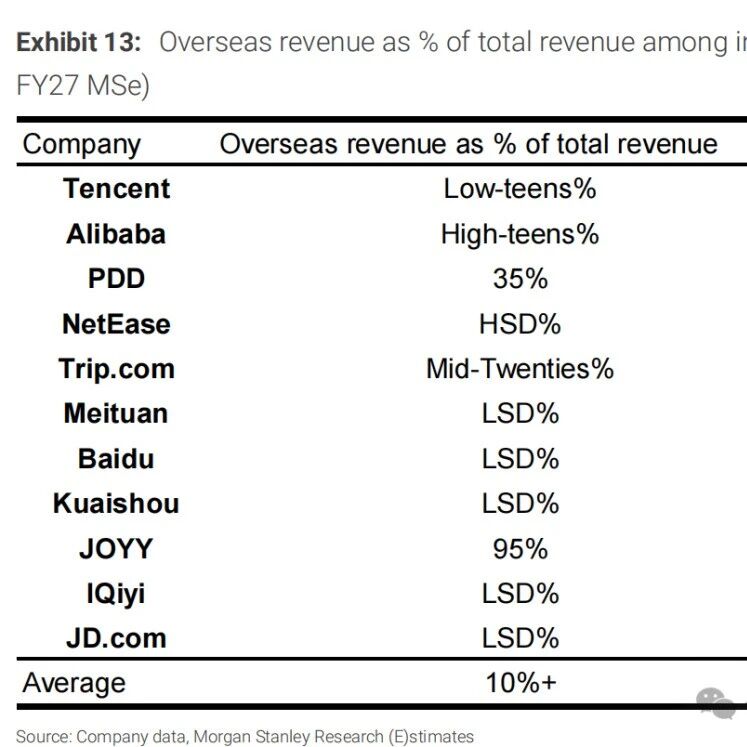
大摩深度解析:中国互联网公司海外收入占比超10%,AI与出海成投资新焦点
傅里叶的猫· 2026-01-19 15:39
Core Insights - The article emphasizes the significance of AI in investment decisions, particularly in the context of Chinese internet companies and their overseas revenue potential [2][3]. Group 1: Overseas Revenue of Chinese Internet Companies - Chinese internet companies have an average overseas revenue exceeding 10%, with Pinduoduo leading at 35% [3]. - Companies like Tencent and Alibaba have low to high teens percentages of overseas revenue, indicating a growing trend towards international markets [3]. Group 2: Cloud Computing Sector - Alibaba Cloud and Tencent Cloud are rapidly expanding their international presence, with Alibaba planning new business regions in Brazil, France, and the Netherlands, and Tencent deploying services in 22 regions globally [4]. - Morgan Stanley projects that Alibaba Cloud's revenue growth will exceed 40% by FY2027, while Tencent's enterprise service revenue is expected to grow by 25% by FY2026 [5]. Group 3: Autonomous Driving Services - Baidu's autonomous driving service, "Luobo Kuaipao," is a leader in the sector, achieving over 250,000 weekly orders in fully autonomous mode as of Q3 2025, and has expanded to 22 cities including Dubai and Switzerland [7]. - Despite its leadership, Morgan Stanley anticipates that Baidu's revenue from this service will remain low and require continued investment [9]. Group 4: AI Models and Applications - Alibaba's Tongyi Qianwen model has gained significant traction globally, becoming the most downloaded AI model with over 700 million downloads by January 2026 [11]. - Kuaishou's Keling is expected to generate substantial revenue from overseas markets, with projections indicating an 80% year-on-year growth to reach $270 million by 2026, driven by B2B customer expansion [14].

OpenAI及谷歌等巨头齐攻AI医疗,健康 160(2656.HK) 与京东健康(6618.HK)等国内龙头如何打造中国方案
Zhong Jin Zai Xian· 2026-01-19 09:16
Core Insights - The global tech giants are intensifying their efforts in the AI healthcare sector, with Chinese companies adopting pragmatic approaches that are becoming essential [1] - The AI healthcare market in China is experiencing rapid growth, driven by an aging population and a structural imbalance in quality medical resources [7] Group 1: Major Players and Their Strategies - OpenAI's ChatGPT Health focuses on consumer engagement, allowing users to upload medical records for personalized health advice, processing over 230 million health interactions weekly [2] - Google has launched the MedGemma 1.5 model, which operates offline and supports 3D scanning and medical text analysis, with a speech-to-text error rate of only 5.2% [2] - Anthropic targets the enterprise market with Claude for Healthcare, emphasizing privacy and compliance, and has partnered with institutions like Boston Children's Hospital [2] Group 2: Chinese Companies' Developments - Health 160 has connected over 44,800 healthcare institutions and developed an AI health management system that covers the entire patient journey, achieving a content click-through rate increase of 90% [3][4] - JD Health aims to evolve AI from a tool to a core engine for personalized health management, launching the "Zhi Yi" AI for evidence-based medicine [5][6] - JD Health's AI initiatives include a comprehensive health service matrix and specialized systems for cancer treatment, showcasing the potential of AI in personalized medicine [6] Group 3: Market Trends and Challenges - The AI medical device market in China is projected to grow from 292 million yuan in 2020 to 24.2 billion yuan by 2025, highlighting the sector's rapid expansion [7] - The competitive focus in AI healthcare is shifting from utility to stable, compliant, and sustainable implementation, with ecological layouts being crucial for achieving these goals [7] - Challenges include data privacy, ethical standards, and the need for improved data quality and interoperability among healthcare systems [8] Group 4: Future Directions - The future of AI healthcare in China will see a complementary relationship between major players' comprehensive strategies and targeted niche developments [9] - As technology matures, AI models are expected to further empower the healthcare industry, shifting the focus from treatment to proactive health management [9]

多家机构看好港股成长板块回撤买入机会!恒生互联网ETF(513330)连续4日净流入
Mei Ri Jing Ji Xin Wen· 2026-01-19 03:04
Group 1 - The core viewpoint of the articles suggests that institutions are recommending attention to the Hong Kong stock growth sector, which has seen relatively less increase in the current rally, indicating potential buying opportunities during suitable pullbacks [1] - Financial conditions are generally loose, with foreign capital and southbound flows returning, and earnings expectations being revised upward, making Hong Kong stocks more attractive in terms of value compared to A-shares [1][2] - The sentiment indicators for Hong Kong stocks have moved out of panic territory, with a noticeable decline in short positions, indicating a potential right-side harvesting period [1] Group 2 - As of last week, foreign net inflows into Hong Kong stocks reached $2.82 billion, compared to $1.54 billion the previous week, with active foreign funds turning into net inflows of $160 million, marking the largest weekly net inflow since September 2024 [2] - Southbound capital saw a net inflow of approximately HKD 10.05 billion last week, primarily flowing into sectors such as media, computing, and retail, with Tencent Holdings, Alibaba, Kuaishou, and Xiaomi Group receiving the most inflows [2] - The Hang Seng Internet ETF has seen net inflows for four consecutive days, being the largest ETF tracking the Hang Seng Internet Technology Index, which focuses on sectors like internet, media, and computing [2]


网络骂战二十年,从没好好说过理
凤凰网财经· 2026-01-18 13:15
Core Viewpoint - The article discusses the evolution of online disputes in China, highlighting how they have escalated from anonymous forum arguments to public confrontations and legal battles, reflecting the growing intensity and complexity of internet culture and conflicts in the digital age [1][2][3][4][5]. Group 1: Historical Context of Online Disputes - The evolution of internet argumentation has progressed from early anonymous exchanges to real-name confrontations and live debates, indicating a shift in how disputes are handled online [3][4]. - Legal frameworks are increasingly relied upon to resolve disputes when consensus cannot be reached, marking a transition from informal to formal resolution mechanisms [5]. Group 2: Notable Disputes - The "Fang-Han War" in 2012, sparked by a blog post questioning the authenticity of writer Han Han, became a significant cultural event, showcasing the power of social media in shaping public opinion [6][7][8]. - The conflict escalated with Han Han offering a reward for evidence of ghostwriting, leading to a split in public opinion and further involvement from prominent figures like Fang Zhouzi, who intensified the scrutiny on Han Han's works [10][16][20]. - The "3Q War" between Tencent and Qihoo 360 highlighted the commercial aspects of online disputes, with both companies engaging in public and legal battles over user privacy and market dominance [21][22][31][32]. Group 3: Personal Confrontations in the Tech Industry - The 2014 live debate between Wang Ziru and Luo Yonghao over the evaluation of the Smartisan phone exemplified how personal and professional conflicts can draw massive public attention, with 2.5 million viewers tuning in [40][47]. - The debate showcased contrasting styles, with Luo presenting a prepared defense while Wang focused on clarifying his evaluation, leading to a heated public discourse [51][52][54]. Group 4: Escalation to Physical Confrontations - The incident between Wu Faitian and journalist Zhou Yan illustrates how online disputes can spill over into physical confrontations, culminating in a chaotic public altercation involving eggs and accusations of organized violence [56][68][75]. - This event reflects a concerning trend where online disagreements transition into real-world conflicts, raising questions about the societal implications of such behavior [78][81]. Group 5: Future of Online Disputes - As the internet matures, there is a movement towards more regulated and structured forms of discourse, with calls for disputes to be handled through media channels rather than public confrontations [81]. - The evolution of online conflict resolution indicates a shift towards a healthier internet ecosystem, where emotional outbursts are replaced by institutional frameworks for discussion and debate [81].