SPD BANK(600000)

Search documents
开年首罚!建行、农行、浦发、江阴农商行等多家银行及负责人被罚,多人禁业!
Xin Lang Cai Jing· 2026-01-05 10:44
Core Viewpoint - The National Financial Supervision Administration has intensified its enforcement actions against multiple banks and responsible individuals for illegal and non-compliant business practices, reflecting a commitment to strengthen financial regulation and maintain market order [2][19]. Summary by Category Administrative Penalties - China Construction Bank's Gansu branch was fined RMB 300,000 for reporting errors in non-site supervision data, and the data management department head was fined RMB 50,000 and warned [2][20]. - Agricultural Bank of China's Fuzhou Taijiang branch was fined RMB 800,000 for illegally processing bank card business, with two individuals banned from the banking industry for five years [5][22]. - Agricultural Bank of China's Chongqing Dazhu branch was fined RMB 300,000 for inadequate loan "three checks," and the deputy branch manager was banned for life from the banking industry [6][23]. - Jiangyin Rural Commercial Bank's Suzhou branch was fined RMB 500,000 for lax ticket business review, with a total of RMB 21,284.75 in illegal gains confiscated [8][25]. - Bank of Communications' Taicang branch was fined RMB 350,000 for inadequate checks on working capital loans, and the deputy branch manager was fined RMB 70,000 [9][27]. - Shanghai Pudong Development Bank's Suzhou branch was fined RMB 1,100,000 for poor ticket business review and personal loan management, with multiple managers receiving warnings and fines [11][28]. - Postal Savings Bank's former employee was banned from the banking industry for five years due to serious misconduct in loan business [12][30]. - Agricultural Development Bank's Jingchuan branch was fined RMB 300,000 for inadequate project capital source review and loan condition enforcement [15][32]. Regulatory Trends - The series of penalties demonstrates a "penetrating supervision" and "accountability for negligence" approach, indicating a shift towards stricter regulatory oversight in the banking sector [17][34]. - Industry insiders suggest that regulatory authorities will maintain a high-pressure stance against financial violations, urging banks to enhance compliance awareness and internal control systems [17][34].






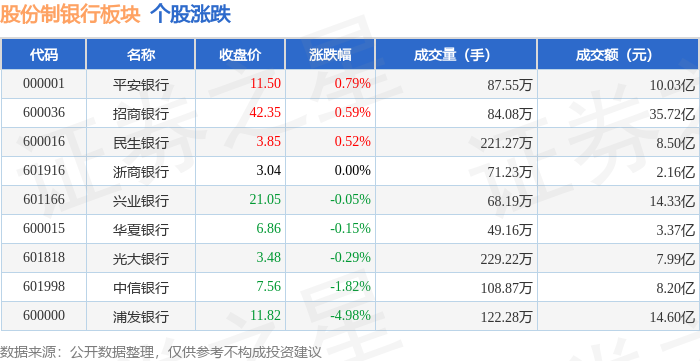
股份制银行板块1月5日跌0.72%,浦发银行领跌,主力资金净流入3.26亿元
Zheng Xing Xing Ye Ri Bao· 2026-01-05 09:09
Group 1 - The banking sector saw a decline of 0.72% on January 5, with Pudong Development Bank leading the drop [1] - The Shanghai Composite Index closed at 4023.42, up 1.38%, while the Shenzhen Component Index closed at 13828.63, up 2.24% [1] - Key stocks in the banking sector showed mixed performance, with Ping An Bank increasing by 0.79% and Pudong Development Bank decreasing by 4.98% [1] Group 2 - The banking sector experienced a net inflow of 326 million yuan from main funds, while retail and speculative funds saw outflows of 134 million yuan and 192 million yuan, respectively [1] - Among individual banks, Industrial Bank had a net inflow of 251 million yuan from main funds, while Ping An Bank and Pudong Development Bank had net outflows from retail investors [2] - The data indicates a significant outflow from Minsheng Bank and China Merchants Bank, with retail investors withdrawing 67.42 million yuan and 1.45 billion yuan, respectively [2]






因票据业务审核不严等,上海浦东发展银行苏州分行被罚110万元
Bei Jing Shang Bao· 2026-01-05 07:00
Core Viewpoint - The article reports on administrative penalties imposed on Shanghai Pudong Development Bank's Suzhou branch and its executives due to violations in bill business review and personal loan management [1] Group 1: Penalties Imposed - Shanghai Pudong Development Bank's Suzhou branch was fined 1.1 million yuan for inadequate review of bill business and poor management of personal loans [1] - Chen Lei, the former branch manager of Shanghai Pudong Development Bank's Changshu branch, and Wu Ping, the branch manager of the Wujiang Shengze branch, were both warned and fined 60,000 yuan each for similar violations in bill business review [1] - Li Jiaping, the general manager of the retail credit department at Shanghai Pudong Development Bank's Suzhou branch, received a warning and was fined 80,000 yuan for inadequate management of personal loans [1]
研报掘金丨浙商证券:浦发银行增长动能优于同业,2026年银行股将重启业绩增长周期
Ge Long Hui· 2026-01-05 06:36
Core Viewpoint - The report from Zheshang Securities indicates that the banking sector will restart its earnings growth cycle in 2026, with a strong recommendation for Shanghai Pudong Development Bank (SPDB), targeting a price of 16.77 yuan per share, representing a 35% upside from the current price [1] Group 1: Banking Sector Outlook - The banking sector is expected to experience a renewed earnings growth cycle in 2026, prompting a reevaluation of the valuation of bank stocks in the capital market [1] - The absolute return potential for bank stocks in 2026 is viewed positively [1] Group 2: Shanghai Pudong Development Bank (SPDB) - SPDB is highlighted as having strong growth momentum compared to its peers, with a favorable operational outlook [1] - The bank leads in market share within the Yangtze River Delta region, which is a key economic growth engine for China, with its loan and deposit scale ranking first among joint-stock banks as of Q2 2025 [1] - SPDB's asset quality is improving, with a declining non-performing loan ratio for eight consecutive quarters since Q3 2023, and an increasing provision coverage ratio for six consecutive quarters since Q2 2024 [1] - The alignment of management philosophy and collaborative management style of the core leadership team has been validated by past operational performance, suggesting a continuation of SPDB's positive operational trend in the future [1]
华创金融红利资产月报(2025年12月):中小银行减量提质加速推进,险资余额保持高增-20260105
Huachuang Securities· 2026-01-04 23:30
Investment Rating - The report maintains a "Recommended" rating for the banking sector, emphasizing continued high growth potential [1]. Core Insights - The banking sector is undergoing a "reduction and quality improvement" process, particularly among small and medium-sized banks, with over 400 banks having been approved for mergers, dissolutions, or cancellations in 2025 alone, surpassing the total from the previous three years [2][7]. - The insurance capital market is expected to see a significant influx of funds, with estimates suggesting an increase of around 1 trillion yuan in 2026, driven by a favorable investment environment and ongoing reforms in public funds [7]. - The investment logic for bank stocks is shifting from a focus on dividends to a dual focus on dividends and growth, with expectations of a recovery in bank valuations in 2026 [7]. Monthly Market Performance - In December 2025, the banking sector experienced a decline of 1.98%, underperforming the CSI 300 index by 4.3 percentage points, ranking 27th among 31 sectors [11][12]. - The valuation of state-owned banks decreased from a price-to-book (PB) ratio of 0.78 to approximately 0.75, while city commercial banks also saw a decline in their PB ratios [13][15]. - Notable stock performances in December included Shanghai Pudong Development Bank (+8.36%) and Xiamen Bank (+4.63%), while Qingdao Bank (-7.44%) and Minsheng Bank (-6.36%) faced significant declines [15][16]. Banking Fundamentals Tracking - The report highlights the ongoing trend of small and medium-sized banks undergoing consolidation and restructuring, with significant regulatory support aimed at enhancing financial stability [2][6]. - The insurance capital allocation is shifting, with a notable increase in the proportion of funds directed towards stocks and mutual funds, indicating a growing confidence in the equity market [2][7]. Investment Recommendations - The report suggests focusing on three main investment themes for 2026: 1. State-owned banks and leading commercial banks as the foundation of credit and dividends. 2. Quality joint-stock banks and city commercial banks that are expected to benefit from improved interest margins and credit cost reductions. 3. City commercial banks that are likely to benefit from regional policies and have significant performance upside [7].



复旦张江(01349)向浦发银行认购总金额为2.1亿元的结构性存款产品
智通财经网· 2026-01-04 10:48
智通财经APP讯,复旦张江(01349)发布公告,近日,公司与浦发银行订立浦发银行结构性存款产品协 议,同意以日常营运产生的自有闲置资金向浦发银行认购总金额为人民币2.1亿元的结构性存款产品。 ...
复旦张江向浦发银行认购总金额为2.1亿元的结构性存款产品
Zhi Tong Cai Jing· 2026-01-04 10:46
复旦张江(01349)发布公告,近日,公司与浦发银行订立浦发银行结构性存款产品协议,同意以日常营 运产生的自有闲置资金向浦发银行认购总金额为人民币2.1亿元的结构性存款产品。 ...
浦发银行(600000):新动能,新浦发
ZHESHANG SECURITIES· 2026-01-04 06:47
新动能,新浦发 ——浦发银行推荐报告 投资要点 ❑ 2026 年银行股重启业绩增长周期,首推增长动能强的浦发银行,空间 35%。 分验证这一管理优势,展望未来,我们认为浦发银行经营向好态势有望延续。 ③新弹药。25Q3 末浦发银行核充率 8.87%,2025 年 10 月转债转股后,静态测算 核充率有望提升 32bp 至 9.19%。新的资本弹药为浦发银行后续扩表打开空间, 也有助于其夯实业绩改善基础、保持经营向好态势的可持续性。 ④新生态。张为忠董事长在 2024 年年报中表示,将以"数智化"推动转型。我 们在 2025 年 4 月 16 日报告中也指出,数智化驱动经营、风控、效率三大革命, 推动 ROE 向同业平均水平靠拢。从 2025 年经营表现看,这一观点正得到验证。 25Q1~3 浦发银行的年化 ROE 同比提升 0.6pc 至 7.6%,与同业差距收窄 1.5pc。 其中,经营革命驱动 25Q3 负债成本率同比下降 44bp 至 1.62%;风控革命驱动 25Q1~3 信用成本率同比下降 2bp 至 1%;效率革命驱动 25Q1~3 成本收入比同比 下降 0.5pc 至 27.5%。展望未来,浦发 ...
优先股隐退永续债上位!银行业资本补充进入密集冲刺期,年利息至少省3%
Xin Lang Cai Jing· 2026-01-04 05:31
Core Viewpoint - The Chinese banking industry is undergoing a significant transformation, with banks redeeming high-cost preferred shares and issuing perpetual bonds as a more cost-effective financing alternative, driven by declining social financing costs and regulatory changes [2][4][11]. Group 1: Redemption of Preferred Shares - By the end of 2025, a total of 9 banks announced the redemption of preferred shares, amounting to 111.8 billion RMB in domestic preferred shares and 5.72 billion USD in foreign preferred shares [4]. - In December 2025 alone, five banks, including Changsha Bank and Beijing Bank, redeemed a total of 45.8 billion RMB in preferred shares [3]. - The redemption of preferred shares is facilitated by their lack of maturity dates but includes redemption clauses, allowing banks to manage capital flexibly [4]. Group 2: Issuance of Perpetual Bonds - As of December 31, 2025, Chinese commercial banks issued 69 perpetual bonds, raising a total of 821.8 billion RMB, marking a historical high in both issuance quantity and scale [5]. - The interest rates for newly issued perpetual bonds generally ranged from 2.0% to 2.9%, the lowest in nearly three years, with a significant issuance peak occurring in the second half of 2025 [5][6]. - The issuance of perpetual bonds is seen as a response to the urgent need for capital replenishment, especially among small and medium-sized banks facing declining capital adequacy ratios [2][6]. Group 3: Cost Savings and Financial Efficiency - By replacing preferred shares with perpetual bonds, banks can save at least 3% annually on interest expenses, significantly reducing their financing costs [8][10]. - For instance, the interest rate on newly issued perpetual bonds is substantially lower than that of previously issued preferred shares, with examples showing potential annual savings of 12.8 million RMB for banks like Industrial Bank [10]. - The transition from preferred shares to perpetual bonds is viewed as a strategic move to optimize capital structure and reduce interest payment burdens, aligning with regulatory requirements [8][10]. Group 4: Regulatory Environment and Market Dynamics - The shift towards perpetual bonds is influenced by regulatory changes that favor capital instruments with loss absorption capabilities, making traditional preferred shares less attractive [11]. - The approval process for issuing perpetual bonds is simpler and faster compared to preferred shares, which require dual regulatory approvals, thus enhancing their appeal to banks [11]. - The current low-interest-rate environment is expected to persist, allowing banks to lock in low financing costs for the next 5 to 10 years, effectively mitigating the pressure from narrowing net interest margins [10].



重拳出击!近30笔千万级罚单!2025年银行业罚单大盘点
券商中国· 2026-01-03 03:33
Core Viewpoint - In 2025, the Chinese banking industry is undergoing significant regulatory scrutiny characterized by "strict regulation, strong accountability, and zero tolerance," leading to a notable increase in both the quantity and amount of penalties imposed on various banking institutions [1]. Regulatory Penalties Overview - The number of penalties exceeding ten million yuan has reached nearly 30, affecting a wide range of institutions including state-owned banks, policy banks, joint-stock banks, city commercial banks, private banks, and bank-affiliated wealth management subsidiaries [1]. - Penalties are not limited to traditional areas like credit management but also extend to corporate governance, related party transactions, anti-money laundering, data security, and wealth management [2]. Corporate Governance and Compliance - Major state-owned banks such as Bank of China, Industrial and Commercial Bank of China, and Agricultural Bank of China have received substantial fines for issues related to corporate governance and business management [3]. - The largest penalty of the year was imposed on Bank of China, amounting to 97.9 million yuan for various management issues [3]. - Regulatory focus has shifted to deeper issues such as the effectiveness of board responsibilities and the integrity of internal control processes [3]. Compliance and Anti-Money Laundering - There has been an intensified crackdown on compliance, particularly in the anti-money laundering sector, with significant fines imposed on banks for failing to adhere to basic financial management regulations [4]. - For instance, China Merchants Bank was fined 68.07 million yuan for violating 11 regulations related to account management and anti-money laundering [4]. Business Management Issues - The primary reasons for penalties in the banking sector include: - Inadequate management across various business areas such as loans, interbank transactions, and wealth management [6]. - Non-compliance with anti-money laundering responsibilities, including failure to identify customers and report suspicious transactions [7]. - Violations in foreign exchange and investment operations, including illegal currency transactions and improper investment disclosures [8]. - Insufficient implementation of regulatory requirements, leading to non-compliance in data reporting and employee management [9]. Emerging Business Areas - New banking business models, including wealth management subsidiaries and direct banks, have also faced penalties, indicating strict regulatory oversight in these emerging sectors [11]. - For example, a wealth management subsidiary was fined 17.5 million yuan for non-compliance in product information disclosure and post-investment management [12]. Double Penalty System - The implementation of a "double penalty system" has become a significant aspect of regulatory actions, where both institutions and responsible individuals face penalties [13]. - This system aims to link the career prospects of involved personnel directly to the compliance performance of their institutions, thereby enhancing accountability [14]. Summary of Penalties - A detailed overview of penalties reveals that various banks have faced significant fines for a range of compliance failures, with amounts often exceeding ten million yuan [15][16].