
CMBC(600016)

Search documents
双十一战局生变 即时零售与“无感省钱”成新焦点
Jing Ji Guan Cha Bao· 2025-11-06 02:51
Group 1 - The 2025 Double Eleven shopping festival has started earlier than in previous years, with Douyin E-commerce and JD.com announcing the event on October 9, followed by Taobao starting from October 15 until November 14, making it a 28-day event [1] - This year's Double Eleven features simplified discount mechanisms, with "official discounts" and "direct price cuts" becoming mainstream, reflecting a shift in consumer preferences towards transparent pricing and efficient shopping experiences [2][3] - Instant retail has emerged as a new highlight for this year's event, with JD.com incorporating its "JD Instant Delivery" into the promotions, and Alibaba announcing thousands of brands joining Taobao Flash Sale, offering rapid delivery options [2] Group 2 - The Minsheng Bank Credit Card Center has launched various promotional activities in collaboration with major platforms like JD.com, Douyin, and Alipay, providing consumers with opportunities to receive up to 298 yuan in benefits through binding payment methods [3][4] - The Minsheng Sam's Club co-branded card offers discounts across multiple well-known brands and cashback for purchases made through specified payment channels, enhancing the consumer experience [4] - The collaboration between banks and internet platforms is creating a closed-loop ecosystem that enhances financial services and meets consumer needs, thereby stimulating market vitality [5] Group 3 - The contribution of final consumption expenditure to economic growth reached 53.5% in the first three quarters of 2025, highlighting the increasing importance of consumption in driving economic growth [6] - The State Council has issued guidelines to further unleash consumption potential, emphasizing the role of consumption as a key driver of domestic circulation and economic sustainability [6] - Financial institutions are actively enhancing their service offerings through technology and digital finance, with Minsheng Bank's Credit Card Center responding by launching multi-scenario consumption incentive activities [6][7] Group 4 - The "Universal Housekeeper" initiative extends discounts to daily life services, allowing users to enjoy benefits on various everyday expenses, demonstrating the integration of financial services into consumer lifestyles [7] - The Double Eleven event serves as a critical point for stimulating market activity and aligning financial services with consumer needs, showcasing the role of financial services in enhancing consumer confidence and vitality [7]

翻遍9家银行财报,我发现行业洗牌的秘密藏在这些数字里
3 6 Ke· 2025-11-06 02:03
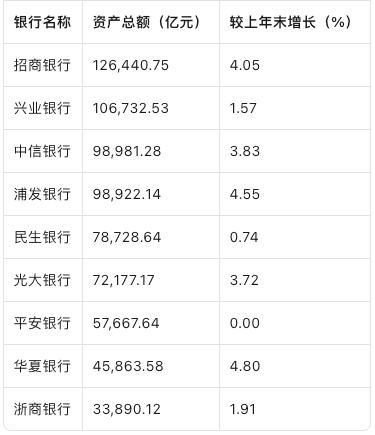
Core Insights - The overall performance of the nine listed joint-stock banks in China showed a decline in both revenue and net profit for the first three quarters of the year, with total operating income at 1.12 trillion yuan, down 2.56% year-on-year, and net profit at 406.1 billion yuan, down nearly 1% [1][3] Group 1: Performance Overview - Among the nine banks, four experienced declines in both revenue and net profit, while some banks managed to achieve growth in both metrics [1][4] - The top joint-stock banks by asset size are China Merchants Bank (12.64 trillion yuan), Industrial Bank (10.67 trillion yuan), and CITIC Bank, with Shanghai Pudong Development Bank showing the fastest growth rate at 4.55% [1][2] Group 2: Revenue and Profit Analysis - Only Minsheng Bank and Shanghai Pudong Development Bank reported year-on-year revenue growth, with increases of 6.74% and 1.88%, respectively; the remaining seven banks saw revenue declines, with Ping An Bank experiencing the largest drop at 9.8% [3][4] - In terms of net profit, only four banks, including Shanghai Pudong Development Bank, reported growth, with the latter achieving a 10.21% increase, making it the leader in profit growth among joint-stock banks [4] Group 3: Net Interest Income and Margin - Net interest income, a key indicator of banks' operating income, showed mixed results, with only three banks reporting growth; China Merchants Bank led with 160.04 billion yuan, up 1.74% [5][6] - The net interest margin (NIM) faced pressure, with most banks experiencing declines; China Merchants Bank maintained the highest NIM at 1.87%, while CITIC Bank saw the largest drop of 16 basis points [7] Group 4: Asset Quality and Risk Management - The non-performing loan (NPL) ratio improved for most banks, with China Merchants Bank having the lowest NPL ratio at 0.94% [9][10] - However, the provision coverage ratio decreased for seven banks, with Ping An Bank showing the largest decline of 21.11 percentage points; Shanghai Pudong Development Bank's coverage ratio increased by 11.08 percentage points, indicating enhanced risk mitigation [10][11]






罚没总额超9000万,民生银行业绩连降、频繁违规
阿尔法工场研究院· 2025-11-06 00:07
Core Viewpoint - The article discusses the significant regulatory penalties imposed on China Minsheng Bank, highlighting ongoing compliance issues and challenges in financial performance, including declining profits and increasing credit impairment losses [5][13][17]. Regulatory Penalties - Recently, the National Financial Supervision Administration fined China Minsheng Bank 58.65 million yuan for imprudent management of loans, bills, and interbank business, as well as non-compliance in regulatory data reporting [5][6]. - This is the second major penalty for the bank this year, following a fine of 17.05 million yuan in January for multiple violations, including account management and anti-money laundering regulations [5][10]. - Since 2008, the total fines against China Minsheng Bank have reached 504 million yuan, with 72 penalties issued in 2025 alone, totaling 94.90 million yuan [10][11]. Financial Performance - For the first three quarters of 2025, China Minsheng Bank reported revenue of approximately 108.51 billion yuan, a year-on-year increase of 6.74%, but the net profit attributable to shareholders decreased by 6.38% [13]. - The bank has experienced negative growth in net profit for seven consecutive quarters since Q1 2024 [13]. - As of September 30, 2025, the bank's total assets were 7.87 trillion yuan, a slight increase of 0.74% from the previous year, while total loans and advances decreased by 0.31% [17]. Loan Quality and Credit Impairment - The bank's non-performing loans totaled 65.86 billion yuan, with a non-performing loan ratio of 1.48%, slightly up from the previous year [17]. - Credit impairment losses surged significantly, with the bank reporting 38.80 billion yuan in losses for the first nine months of 2025, an increase of 28.36% year-on-year [17][18]. - The average return on total assets was 0.49%, with a net interest margin of 1.42% for the same period [15]. Operational Challenges - The bank's operational challenges include a decline in personal loans by 3.17% and a decrease in corporate deposits by 2.65% [17]. - The bank's average total assets yield dropped to 0.36% in Q3 2025, indicating potential issues in asset management and profitability [15].

外资A股最新持仓曝光,行业龙头仍是“聪明钱”的最爱
Di Yi Cai Jing· 2025-11-05 23:49
Group 1 - The A-share market has significantly rebounded since the third quarter, with active trading and foreign capital continuing to buy aggressively [1][2] - Leading companies such as Kweichow Moutai, Ping An Insurance, and Wuliangye have attracted over 80 foreign institutional investors each, indicating strong foreign interest in industry leaders [1][2] - As of the end of September, the top three foreign-held A-shares by market value are CATL, Kweichow Moutai, and Midea Group, with values of 265.66 billion, 88.14 billion, and 71.65 billion respectively [1][2] Group 2 - Foreign investment is particularly focused on industry leaders, "Chinese state-owned enterprises," and bank stocks, with major banks holding significant foreign shares [2][3] - As of September 30, 2023, 32 foreign investors collectively held 2.36 billion shares of Nanjing Bank, while 42 foreign investors held 1.60 billion shares of Ningbo Bank [2] - A total of 42 A-shares have foreign holdings exceeding 10 billion, including Zijin Mining, Hengrui Medicine, BYD, and Fuyao Glass [2] Group 3 - The number of foreign investors in China Shipbuilding has increased by over 40% from the end of June, reaching 68 by the end of September [3] - Other companies such as Kweichow Moutai, BYD, and Yangtze Power have also seen an increase in foreign holdings compared to the end of June [3] Group 4 - Foreign investors have shown a preference for specific stocks, with UBS significantly increasing its stake in RuiNeng Technology, becoming the third-largest shareholder by the end of September [4][5] - UBS held 1.15 million shares of RuiNeng Technology, a 130.2% increase from the previous quarter, while Goldman Sachs, JPMorgan, and Merrill Lynch entered the top ten shareholders [5] Group 5 - RuiNeng Technology's stock has seen a significant rise, reaching a peak of 24.43 yuan, with a cumulative increase of over 40% since mid-October [7] - Despite a 12.95% year-on-year revenue growth, RuiNeng Technology's net profit decreased by 32.73% to 40.75 million [7] Group 6 - Foreign investors are optimistic about the long-term performance of the A-share market, with UBS forecasting a 6% year-on-year growth in total A-share earnings by 2025 [8] - UBS noted that 60% of industries recorded year-on-year profit growth in the third quarter, with sectors like non-ferrous metals and non-bank financials achieving over 30% growth [8] Group 7 - Goldman Sachs predicts a sustained upward trend in the Chinese stock market, expecting major indices to rise by about 30% by the end of 2027 [9] - Factors supporting this bullish outlook include favorable policy developments, accelerating earnings growth, and strong capital inflows [9] Group 8 - As the bull market unfolds, Goldman Sachs advises investors to shift their strategy from "selling on highs" to "buying on lows" [10]




翻遍9家银行财报,我发现行业洗牌的秘密藏在这些数字里
凤凰网财经· 2025-11-05 13:27
Core Viewpoint - The overall performance of the nine listed joint-stock banks in China showed a decline in both revenue and net profit for the first three quarters, indicating a challenging environment for the banking sector [2][5]. Group 1: Overall Performance - The nine joint-stock banks collectively achieved an operating income of 1.12 trillion yuan, a year-on-year decrease of 2.56%, and a net profit of 406.1 billion yuan, down nearly 1% year-on-year [2][5]. - There is a notable divergence in performance among the banks, with four banks experiencing declines in both revenue and profit, while others managed to achieve growth [2][5]. Group 2: Individual Bank Performance - As of the end of Q3, China Merchants Bank led with total assets of 12.64 trillion yuan, followed by Industrial Bank at 10.67 trillion yuan, with Shanghai Pudong Development Bank showing the fastest growth rate of 4.55% [3][4]. - Only Minsheng Bank and Shanghai Pudong Development Bank reported year-on-year revenue growth of 6.74% and 1.88%, respectively, while the remaining seven banks saw declines, with Ping An Bank experiencing the largest drop at 9.8% [7][8]. Group 3: Net Interest Income - Among the nine banks, only three reported an increase in net interest income, with China Merchants Bank leading at 160.04 billion yuan, a growth of 1.74% [11][12]. - The net interest margin pressure remains a common challenge, with most banks experiencing a decline in this metric, except for Minsheng Bank, which saw a slight increase [13][14]. Group 4: Asset Quality - Most banks reported a decrease in non-performing loan (NPL) ratios, with China Merchants Bank having the lowest at 0.94%, while the others ranged between 1% and 1.5% [15][16]. - The provision coverage ratio decreased for most banks, with Ping An Bank showing the largest decline of 21.11 percentage points [17]. Group 5: Future Outlook - The banks face challenges in narrowing net interest margins in a low-interest-rate environment, and the potential impact of "deposit migration" due to stock market recovery will test their adaptability [17].

翻遍9家银行财报,行业洗牌的秘密藏在这些数字里
Feng Huang Wang Cai Jing· 2025-11-05 13:19
Core Insights - The overall performance of the nine listed joint-stock banks in China showed a decline in both revenue and net profit for the first three quarters, with total operating income of 1.12 trillion yuan, down 2.56% year-on-year, and net profit of 406.1 billion yuan, down nearly 1% [1][4] Group 1: Performance Overview - Four banks experienced a decline in both revenue and net profit, while two banks, Minsheng Bank and Pudong Development Bank, achieved revenue growth [1][4] - Among the nine banks, only Pudong Development Bank reported both revenue and net profit growth, with a net profit increase of 10.21%, making it the leader in profit growth among joint-stock banks [5][11] Group 2: Asset Scale and Growth - As of the end of Q3, China Merchants Bank led with total assets of 12.64 trillion yuan, followed by Industrial Bank at 10.67 trillion yuan, with Pudong Development Bank showing the fastest growth rate of 4.55% [2][3] Group 3: Revenue and Profit Analysis - Revenue performance varied significantly, with only Minsheng Bank and Pudong Development Bank achieving positive year-on-year growth rates of 6.74% and 1.88%, respectively [4][5] - The largest revenue declines were observed in Ping An Bank and Everbright Bank, with decreases exceeding 6%, and Ping An Bank experiencing a 9.78% drop [4][5] Group 4: Net Interest Income and Margin - Net interest income showed a mixed performance, with only three banks reporting growth, while six banks saw declines, the largest drop being 8.25% at Ping An Bank [6][7] - The net interest margin pressure remains a challenge for all listed joint-stock banks, with only Minsheng Bank showing a slight increase in net interest margin [8] Group 5: Asset Quality - Most banks reported a decrease in non-performing loan (NPL) ratios, with China Merchants Bank having the lowest NPL ratio at 0.94% [9][10] - The provision coverage ratio declined for seven banks, with Ping An Bank experiencing the largest drop of 21.11 percentage points [10][11] Group 6: Future Outlook - The banks face challenges in narrowing net interest margins in a low-interest-rate environment, and the upcoming year-end performance will be critical for their strategies [11]
外资A股最新持仓曝光
第一财经· 2025-11-05 11:45
Core Viewpoint - The A-share market has shown significant recovery since the third quarter, with active trading and continued foreign investment, particularly in industry leaders and state-owned enterprises [3][5][14]. Group 1: Foreign Investment Trends - As of the end of September, major industry leaders such as Kweichow Moutai, China Ping An, and Wuliangye attracted over 80 foreign institutional investors each [6][5]. - The top three foreign-held A-shares by market value are CATL (265.66 billion), Kweichow Moutai (88.14 billion), and Midea Group (71.65 billion) [6][5]. - Foreign investment in "Chinese state-owned enterprises" has increased, with China Shipbuilding attracting 68 foreign investors, a rise of over 40% from the end of the first half [7][5]. Group 2: Sector Preferences - Foreign investors favor industry leaders, state-owned enterprises, and bank stocks, with seven of the top ten foreign-held A-shares being banks [6][5]. - Notable bank stocks include Nanjing Bank (2.36 billion shares held by 32 foreign investors) and Ningbo Bank (1.60 billion shares held by 42 foreign investors) [6][5]. Group 3: Individual Stock Movements - UBS significantly increased its stake in RuiNeng Technology, becoming the third-largest shareholder, while Goldman Sachs, JPMorgan, and Merrill Lynch entered the top ten shareholders [9][10]. - RuiNeng Technology's stock price has surged over 40% since mid-October, despite a 32.73% decline in net profit year-on-year [12][10]. Group 4: Market Outlook - UBS analysts remain optimistic about the medium-term outlook for the A-share market, citing a 12% year-on-year profit growth for all A-shares in the third quarter [15][14]. - Goldman Sachs predicts a 30% increase in major stock indices by the end of 2027, indicating a potential long-term bull market for A-shares [16][14].



10月6家银行收到超千万罚单,有行长任职资格罕见被否
21世纪经济报道· 2025-11-05 11:29
Core Viewpoint - In October, financial institutions received 489 fines, a year-on-year decrease of 2.59%, but the total penalty amount reached 378 million yuan, a significant increase of 223.08% compared to the previous year [2]. Group 1: Penalty Overview - The number of fines in October decreased significantly compared to the first three months of the year, but the total penalty amount remains high, with October being the second highest this year after September [4]. - Regulatory bodies such as the National Financial Supervision Administration, the People's Bank of China, the China Securities Regulatory Commission, and the State Administration of Foreign Exchange all issued fewer fines in October [7]. - Banks received a total of 310 fines, a month-on-month decrease of 24.39%, while insurance companies received 108 fines, down 16.92%, and securities firms received 16 fines, down 42.86% [9]. Group 2: Major Fines - In October, six fines exceeded 10 million yuan, with the largest fine against a bank for issues related to corporate governance, loans, interbank transactions, bills, asset quality, and non-performing asset management [12]. - The largest fine was against the Bank of China, amounting to 97.9 million yuan, for various management failures [13]. - Other significant fines included China Minsheng Bank (28.62 million yuan), Agricultural Bank of China (27.2 million yuan), and Ping An Bank (18.8 million yuan) for similar management issues [14]. Group 3: Compliance Cases - Five Mining Securities was criticized for publishing incorrect coupon rates and issuance results during a bond issuance process, failing to comply with relevant regulations [15][16]. - Tianjin Investment Futures was ordered to rectify its operations due to ineffective risk isolation between its brokerage and proprietary trading businesses, leading to significant losses [17]. - A rare case occurred where the qualification of a bank president was denied due to non-compliance with regulatory requirements, highlighting increased scrutiny on corporate governance in small and medium-sized banks [18]. Group 4: Compliance Characteristics - There was a more than double increase in fines for illegal loan issuance, with 19 fines issued in October, reflecting a year-on-year increase of 111.11% [21]. - Fines related to internal control management also increased, with 32 fines issued in October, a month-on-month increase of 52.38% [23]. Group 5: Penalty Rankings - China Agricultural Development Bank had the highest penalty amount in the third quarter and continued to lead in October [27]. - Zhongcheng Trust received the largest penalty among non-bank institutions in October, with a fine of 6.6 million yuan for various violations [29].
透视银行三季报:超30家净息差收窄 债市波动拖累非利息收入
Bei Ke Cai Jing· 2025-11-05 11:12
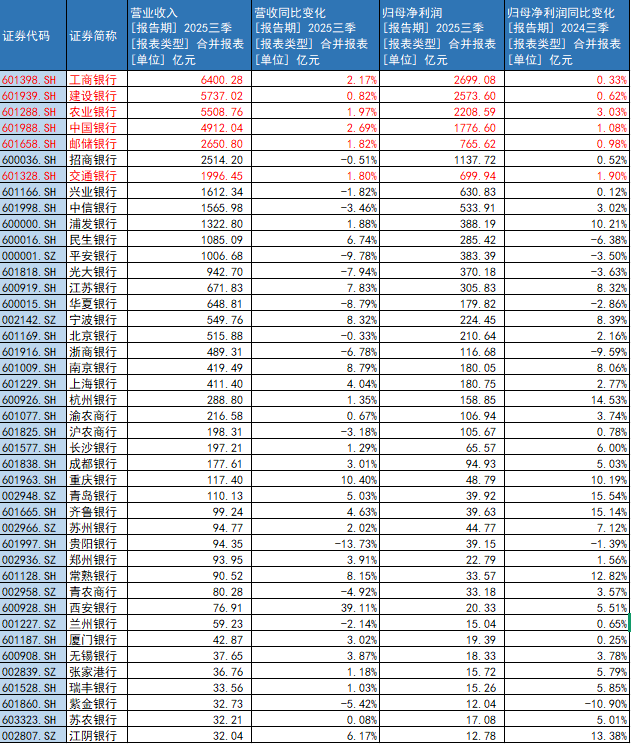
Core Insights - The overall performance of A-share listed banks in the first three quarters of the year is positive, with over 80% achieving year-on-year growth in net profit attributable to shareholders [2][3] - The growth in net profit is primarily driven by stable net interest income and improved asset quality, despite a decline in non-interest income due to bond market fluctuations [2][3] - The six major banks collectively reported over 1 trillion yuan in net profit, marking a significant milestone [3][4] Financial Performance - Among the 42 listed banks, 35 reported year-on-year growth in net profit, while only 7 experienced a decline [3][4] - The top four state-owned banks (Industrial and Commercial Bank of China, China Construction Bank, Agricultural Bank of China, and Bank of China) all achieved growth in both revenue and net profit [4][5] - Industrial and Commercial Bank of China led in revenue with 640.03 billion yuan, a 2.17% increase year-on-year, and a net profit growth of 0.33% [4][6] Non-Interest Income and Market Impact - Many banks faced a decline in non-interest income due to volatility in the bond market, with several banks reporting significant losses in fair value changes [9][10] - For instance, China Merchants Bank reported a fair value loss of 8.83 billion yuan, transitioning from profit to loss [10][12] - The decline in non-interest income is attributed to reduced earnings from bond and fund investments [10][13] Interest Income Trends - Some banks, particularly city commercial banks, saw substantial growth in interest income, with Xi'an Bank's interest income increasing over 60% [7][8] - Conversely, banks like Guiyang Bank and Capital Bank reported declines in interest income of 12.29% and 17.34%, respectively [8][9] Net Interest Margin - The overall net interest margin for listed banks has narrowed compared to the end of the previous year, although some banks have seen a recovery from the second quarter [16][20] - As of the end of the third quarter, Xi'an Bank's net interest margin was 1.79%, reflecting a 0.43% increase from the end of the previous year [16][17] - The stability of net interest margins in the fourth quarter will depend on the banks' ability to optimize their liability structures and find high-quality investment opportunities [20]




民生银行(01988) - 截至二零二五年十月三十一日止股份发行人的证券变动月报表
2025-11-05 11:00
股份發行人及根據《上市規則》第十九B章上市的香港預託證券發行人的證券變動月報表 截至月份: 2025年10月31日 狀態: 新提交 呈交日期: 2025年11月5日 FF301 | | 法定/註冊股份數目 | | 面值 | | 法定/註冊股本 | | --- | --- | --- | --- | --- | --- | | 上月底結存 | 200,000,000 | RMB | 100 | RMB | 20,000,000,000 | | 增加 / 減少 (-) | 0 | | | RMB | 0 | | 本月底結存 | 200,000,000 | RMB | 100 | RMB | 20,000,000,000 | I. 法定/註冊股本變動 | 1. 股份分類 | 普通股 | 股份類別 | H | | 於香港聯交所上市 (註1) | | 是 | | | --- | --- | --- | --- | --- | --- | --- | --- | --- | | 證券代號 (如上市) | 01988 | 說明 | H 股 | | | | | | | | | 法定/註冊股份數目 | | | 面值 | | 法 ...