
CMBC(600016)

Search documents
民生银行(01988) - 董事会会议召开日期
2026-03-18 09:00
(股份代號:01988) 董事會會議召開日期 香港交易及結算所有限公司及香港聯合交易所有限公司對本公告的內容概不負責,對其準確性 或完整性亦不發表任何聲明,並明確表示,概不對因本公告全部或任何部分內容而產生或因倚 賴該等內容而引致之任何損失承擔任何責任。 中國民生銀行股份有限公司 CHINA MINSHENG BANKING CORP., LTD. (在中華人民共和國註冊成立的股份有限公司) 中國民生銀行股份有限公司 董事長 高迎欣 中國,北京 2026年3月18日 於本公告日期,本行執行董事為高迎欣先生、王曉永先生及張俊潼先生;非執行 董事為劉永好先生、史玉柱先生、宋春風先生、梁鑫傑先生、林立先生及鄭海陽 先生;獨立非執行董事為曲新久先生、溫秋菊女士、宋煥政先生、楊志威先生、 程鳳朝先生及劉寒星先生。 中國民生銀行股份有限公司(「本行」)董事會(「董事會」)茲通告謹定於2026年3月 30日(星期一)舉行董事會會議,藉以(其中包括)審議及批准刊發本行及其附屬 公司截至2025年12月31日止年度之合併業績公告,及審議派發末期股息(如有) 之建議。 承董事會命 ...
银行业2026年投资策略:息差企稳,把握两条投资主线
Hua Yuan Zheng Quan· 2026-03-18 08:08
Group 1 - The banking operating environment is characterized by a shift to a "quality over quantity" approach in credit growth, with a slowdown in RMB loan growth to 6% as of February 2026, influenced by weak credit demand and a focus on state-supported industries [4][14] - Fiscal policy remains proactive, with a projected general deficit rate of approximately 8.0% in 2026, which is expected to maintain a strong leverage effect on credit demand similar to 2025 [31][32] - The profitability of banks is gradually stabilizing, with state-owned banks showing positive profit growth due to fiscal policies, while smaller banks face operational pressures [7][35] Group 2 - Retail credit risk remains under pressure, with an increase in non-performing loans, particularly among smaller banks, although there is optimism for state-owned banks' asset quality [7][26] - The investment strategy emphasizes two main lines: focusing on wealth management capabilities in joint-stock banks and identifying city and rural commercial banks with controllable risks and strong profit certainty [6][35] - The credit growth momentum is shifting from traditional industries to emerging sectors supported by government policies, with significant growth in loans to green and high-tech enterprises [19][20]





宁波联合集团股份有限公司关于全资子公司 为参资公司提供担保的进展公告
Zhong Guo Zheng Quan Bao - Zhong Zheng Wang· 2026-03-17 23:39
Summary of Key Points Core Viewpoint - The company has provided guarantees for its subsidiary, Ningbo Economic and Technological Development Zone Thermal Power Co., Ltd. (referred to as "Thermal Power Company"), to support the financing needs of Ningbo Jintong Financing Leasing Co., Ltd. (referred to as "Jintong Leasing") through various guarantee contracts totaling up to 36 million RMB [1][3]. Group 1: Guarantee Overview - On March 16, 2026, Thermal Power Company signed a maximum guarantee contract with China Minsheng Bank Ningbo Branch, providing an irrevocable joint liability guarantee for Jintong Leasing's debt up to 20 million RMB, with Thermal Power's share being 2 million RMB [1][4]. - The total guarantee amount approved by the company's 2024 annual general meeting is within the limit of 36 million RMB, with Thermal Power Company providing a 10% guarantee based on its equity stake [2][3]. Group 2: Internal Decision-Making Process - The company held its 2024 annual general meeting on May 9, 2025, where it approved the proposal for Thermal Power Company to provide guarantees for Jintong Leasing's external financing [3]. - The guarantee is structured as a joint liability guarantee and is effective from the date of approval until the next annual general meeting in 2025 [3]. Group 3: Details of Guarantee Contracts - The first guarantee contract specifies that the creditor is China Minsheng Bank Ningbo Branch, with a guarantee period from March 16, 2026, to March 15, 2029, covering principal, interest, and other related costs [4][5]. - The second guarantee contract involves Ningbo Bank Jiangbei Branch, with a maximum debt limit of 20 million RMB, effective from March 18, 2026, to March 17, 2029 [8][9]. Group 4: Guarantee Responsibility Distribution - The distribution of guarantee responsibility among the guarantors is as follows: Ningbo Energy Group Co., Ltd. 46%, Ningbo Economic and Technological Development Zone Holding Co., Ltd. 40%, Thermal Power Company 10%, and Ningbo Meishan Free Trade Port Area Jinyuan Enterprise Management Consulting Partnership (Limited Partnership) 4% [6][10].




大额买入与资金流向跟踪(20260309-20260313)
GUOTAI HAITONG SECURITIES· 2026-03-17 08:47
- The report focuses on tracking large buy orders and net active buy orders using transaction detail data[1][2] - Two key indicators are used: the proportion of large buy order transaction amounts and the proportion of net active buy order amounts[7] - The proportion of large buy order transaction amounts reflects the buying behavior of large funds[7] - The proportion of net active buy order amounts reflects investors' active buying behavior[7] - The report provides rankings for stocks, industries, and ETFs based on these indicators over the past 5 trading days (20260309-20260313)[4][6] Quantitative Models and Construction Methods 1. **Model Name**: Large Buy Order Transaction Amount Proportion - **Construction Idea**: To track the buying behavior of large funds[7] - **Construction Process**: - Restore transaction data to buy and sell order data using the buy and sell sequence numbers in the transaction detail data - Filter out large orders based on transaction volume - Calculate the proportion of large buy order transaction amounts to the total transaction amount of the day[7] - **Evaluation**: This indicator effectively captures the buying behavior of large funds[7] 2. **Model Name**: Net Active Buy Order Amount Proportion - **Construction Idea**: To track investors' active buying behavior[7] - **Construction Process**: - Identify each transaction as either an active buy or an active sell using the buy and sell markers in the transaction detail data - Subtract the transaction amounts of active sells from active buys to get the net active buy amount - Calculate the proportion of net active buy amounts to the total transaction amount of the day[7] - **Evaluation**: This indicator effectively captures investors' active buying behavior[7] Model Backtest Results 1. **Large Buy Order Transaction Amount Proportion** - **Top 5 Stocks**: - Jiugang Hongxing: 87.2%, 90.5%[9] - Wentou Holdings: 86.6%, 97.1%[9] - Jinbin Development: 86.3%, 86.4%[9] - Ningbo Construction: 85.6%, 98.8%[9] - Xining Special Steel: 85.3%, 97.9%[9] - **Top 5 Industries**: - Banking: 81.3%, 61.3%[13] - Real Estate: 79.8%, 51.0%[13] - Construction: 78.5%, 88.9%[13] - Comprehensive: 77.9%, 46.1%[13] - Steel: 77.7%, 35.4%[13] - **Top 5 ETFs**: - Guotai SSE 10-Year Treasury Bond ETF: 95.4%, 99.6%[15] - Huatai-PineBridge MSCI China A50 Interconnection ETF: 94.0%, 93.4%[15] - Huatai-PineBridge CSI A500 ETF: 93.2%, 90.9%[15] - Guotai CSI A500 ETF: 92.5%, 53.9%[15] - Huaxia CSI A500 ETF: 92.0%, 97.5%[15] 2. **Net Active Buy Order Amount Proportion** - **Top 5 Stocks**: - Minsheng Bank: 22.2%, 98.8%[10] - SDIC Power: 21.8%, 97.1%[10] - Everbright Bank: 19.5%, 99.6%[10] - Zhejiang Bank: 19.2%, 96.3%[10] - Shangtai Technology: 18.9%, 100.0%[10] - **Top 5 Industries**: - Banking: 10.5%, 64.2%[13] - Food & Beverage: 4.7%, 56.0%[13] - Real Estate: 2.5%, 50.2%[13] - Construction: 0.4%, 72.4%[13] - Basic Chemicals: -0.9%, 75.7%[13] - **Top 5 ETFs**: - Harvest CSI Green Power ETF: 35.4%, 98.4%[16] - E Fund CSI Dividend Low Volatility ETF: 21.6%, 97.9%[16] - Huatai-PineBridge CSI All Index Power Utilities ETF: 18.7%, 97.9%[16] - Southern S&P China A-Share Large Cap Dividend Low Volatility 50 ETF: 15.7%, 96.7%[16] - GF GEM ETF: 13.8%, 90.9%[16]


中国民生银行发布代理个人贵金属交易业务调整公告
Jin Tou Wang· 2026-03-17 03:32
Group 1 - The core point of the announcement is that China Minmetals Bank has closed the buying and opening trading functions for personal precious metals spot and deferred trading as of July 22, 2022, and will continue to push for the termination of agency precious metals business for clients without inventory or deferred positions [1] - The bank has reminded individual clients who have not completed the termination process to promptly handle the closing of deferred contracts, inventory sales, withdrawals, and termination operations due to the current volatility in the precious metals market [1] - The bank's actions are aimed at mitigating market risks associated with the precious metals market [1]
覆盖重点人群 延伸服务触角 民生银行织密金融消保“守护网”
Jin Rong Shi Bao· 2026-03-17 02:03AI Processing
近期,金融监管总局在全国范围内组织金融行业开展了以"清朗金融网络 守护安心消费"为主题的2026 年"3·15"金融消费者权益保护教育宣传活动。民生银行(600016)积极响应政策要求,聚焦数智赋能、 重点群体和便民服务三大领域,开展了覆盖广泛、形式多样、内容丰富的金融消保活动。 数智赋能提升服务可及性 在数字技术快速发展并已广泛应用于各行各业的当下,如何让老年人、残障人士等特殊群体平等享受数 智化金融服务,成为金融机构普遍面临的重要课题。 依靠在金融科技领域深耕的优势,民生银行指导各地分支机构进行一系列探索,推动金融服务向更广泛 受众延伸,让技术真正服务于人。 如今,手机银行"长辈版"已经成为民生银行服务老年客群的重要渠道之一。为更贴合老年人使用习惯, 界面采用全屏大字体、大菜单设计,核心功能一键直达,还增设了一键拨打客服、远程协助等功能,助 力解决老年客户使用数字工具的痛点。 民生银行温州分行充分利用该行手机银行"长辈版"提供的便利条件,向辖内老年客群提供更全面的金融 服务。对于行动不便的老年客户,该行提供远程视频辅导或预约上门服务,客户经理"手把手"帮助老年 客户掌握数字工具使用方法。同时,在辖内启动适 ...
民生银行南京分行:数智筑防线 消保暖民心
Jiang Nan Shi Bao· 2026-03-16 03:17
Group 1 - The core viewpoint of the articles emphasizes the integration of digital finance into daily life and the importance of ensuring that online financial services are user-friendly and secure for consumers [1][2] - Minsheng Bank's Nanjing branch focuses on local financial needs, utilizing digital innovation to enhance service upgrades and consumer rights protection, thereby extending the benefits of digital finance to a broader audience [1] - The bank has implemented a "senior mode" in its mobile banking app, featuring large text, voice navigation, and simplified processes to assist elderly users in overcoming digital barriers [1] Group 2 - Minsheng Bank has established a dual risk control mechanism of "intelligent monitoring + manual verification" to ensure the security of funds, enabling dynamic management of account transactions and quick identification of abnormal activities [2] - The bank integrates consumer rights protection throughout the digital finance development process, conducting compliance reviews from the product development stage and utilizing smart tools for real-time monitoring across all business channels [2] - The bank plans to continue deepening digital financial innovation, optimizing services, and enhancing security measures to provide residents of Nanjing with both convenience and a sense of safety in their financial transactions [2]
金融知识“上门”快递员,民生银行护航新市民
2 1 Shi Ji Jing Ji Bao Dao· 2026-03-16 02:35
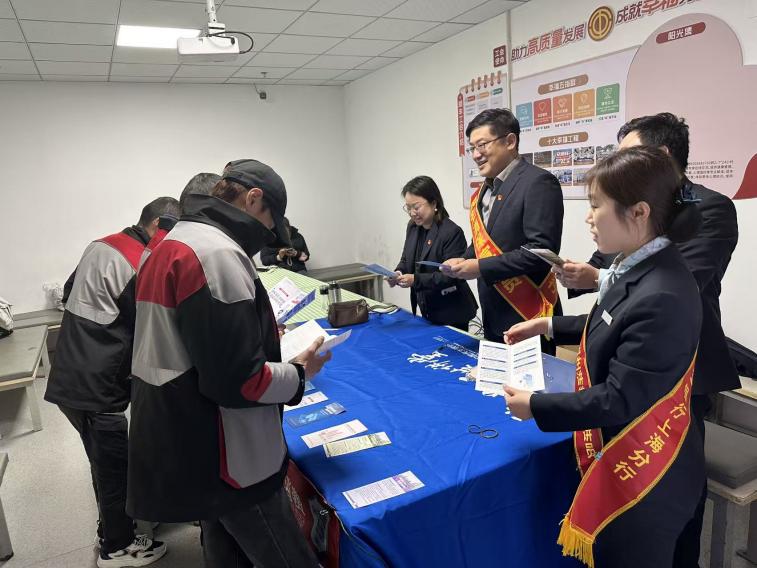
Core Viewpoint - The article highlights a financial literacy initiative by Minsheng Bank's Shanghai Jing'an branch aimed at protecting the financial rights of new employment form workers, particularly couriers, through education on financial risks and consumer rights [1][3]. Group 1: Financial Literacy Initiative - Minsheng Bank's Shanghai Jing'an branch organized a financial knowledge campaign titled "Financial Knowledge into Express Delivery, Protecting Couriers' Wallets" to enhance financial risk awareness among couriers [1]. - The initiative focuses on educating couriers about prevalent financial risks such as telecom fraud, illegal fundraising, and scams related to package delivery [1][3]. - Volunteers provided practical advice on recognizing and handling suspicious situations encountered during their work, thereby improving their risk identification and emergency response capabilities [1]. Group 2: Consumer Rights and Financial Products - The campaign included discussions on the eight rights of financial consumers, personal credit protection, and the importance of deposit insurance [3]. - Financial products tailored for new citizens, such as convenient account opening, salary distribution, and small loans, were introduced to the courier group [3]. - The initiative utilized interactive methods like distributing brochures, Q&A sessions, and case studies to ensure that financial knowledge is accessible and applicable for the participants [3]. Group 3: Future Plans and Community Engagement - Minsheng Bank plans to extend its financial education efforts to communities, campuses, and areas with high concentrations of new citizens, aiming for a continuous and localized approach to financial literacy [3]. - The bank emphasizes the importance of creating a safe and orderly financial consumption environment to support high-quality local economic development [3].

金融行业周报(2026、03、15):重申保险板块攻守兼备属性,息差趋势企稳有望驱动银行业绩修复-20260315
Western Securities· 2026-03-15 10:35
Investment Rating - The report maintains a positive outlook on the insurance sector, indicating a high cost-performance ratio for investment opportunities [2][11] Core Views - The insurance sector has experienced significant adjustments due to pessimistic narratives surrounding AI, geopolitical conflicts, and investor concerns about the investment performance of the insurance sector. However, the valuation has dropped to historically low levels, suggesting a high cost-performance ratio for investment [2][11] - The banking sector is expected to see a stabilization in interest margins due to marginal improvements in both assets and liabilities, with non-interest income likely to recover as the equity market rebounds [3][20] Summary by Sections Insurance Sector - The insurance sector's index fell by 2.10%, underperforming the CSI 300 index by 2.28 percentage points. The sector has seen a cumulative decline of over 9% this year, with current valuations indicating significant room for recovery [2][11] - The sector's price-to-earnings value (PEV) is at 0.65x for A-shares and 0.42x for H-shares, indicating potential recovery spaces of 53% and 137% respectively [11] - The long-term core logic of improvement in both assets and liabilities remains unchanged, with expectations for dual recovery in valuation and performance as market sentiment improves [2][11] Brokerage Sector - The brokerage sector index decreased by 1.75%, underperforming the CSI 300 index by 1.94 percentage points. The sector's price-to-book (PB) ratio is at 1.27x, indicating a significant mismatch between earnings and valuation [17][18] - The "14th Five-Year Plan" emphasizes the need for comprehensive reforms in the capital market, which will benefit leading brokerages with strong service capabilities [17][18] - Recommendations include focusing on large brokerages with strong fundamentals and low valuations, as well as those undergoing mergers or restructuring [18][19] Banking Sector - The banking sector index increased by 1.39%, outperforming the CSI 300 index by 1.20 percentage points. The sector's PB ratio is at 0.52x [20][21] - Expected improvements in both asset and liability sides are anticipated to stabilize interest margins, with a projected decrease in the average cost of interest-bearing liabilities by 40 basis points in 2025 [20][21] - The overall asset quality is expected to remain stable, with non-performing loans in corporate real estate and non-real estate consumer credit anticipated to stabilize at high levels [22][23] - Recommendations include focusing on high-dividend large banks and those with strong recovery potential in performance [23]



银行2月资金月报:受季节因素影响,机构资金流出,散户资金流入较多





ZHONGTAI SECURITIES· 2026-03-14 13:20
Investment Rating - The report maintains an "Overweight" rating for the banking sector [2] Core Insights - The banking sector experienced a decline of -0.55% in February, underperforming the CSI 300 index by 0.64 percentage points, ranking 28th among 31 first-level industries [5][11] - Institutional funds saw a net outflow due to profit-taking and portfolio adjustments before the Spring Festival, while retail investors actively entered the market, particularly in city commercial banks and joint-stock banks [5][6][11] - The macroeconomic environment remains relatively loose, with the central bank's net fund injection reaching 900 billion yuan in February, indicating a stable liquidity situation [5][6] Summary by Sections 1. Banking Sector Performance - The banking sector's total market capitalization is approximately 147,098.51 billion yuan, with a circulating market value of 140,825.95 billion yuan [2] - The top three performing bank stocks in February were Nanjing Bank (+6.84%), Huaxia Bank (+5.52%), and Shanghai Bank (+4.76%) [5][11] - The highest turnover rates were observed in Qingdao Bank (51.80%), Xi'an Bank (37.35%), and Zhengzhou Bank (28.65%) [5][11] 2. Fund Flows - Institutional funds experienced a net outflow, particularly in city commercial banks, while retail funds saw significant inflows [5][6][11] - The total number of retail investors increased, contributing to a total inflow of 1.1 trillion yuan into the capital market in January and February, a year-on-year increase of 791 billion yuan [6][11] 3. Macro Environment - The central bank's monetary policy remains accommodative, with a year-on-year high in fund injections [5][6] - Interest rates for DR001 and DR007 decreased to 1.33% and 1.49%, respectively, indicating a more favorable funding environment [5] 4. Investment Recommendations - The report suggests focusing on banks with regional advantages and strong certainty, particularly city and rural commercial banks in regions like Jiangsu, Shanghai, Chengdu, and Shandong [6] - It also highlights the attractiveness of high-dividend large banks, recommending major banks such as Agricultural Bank, Construction Bank, and Industrial and Commercial Bank [6]