
China Spacesat(600118)

Search documents
商业航天概念表现活跃 西部材料涨停
Mei Ri Jing Ji Xin Wen· 2026-02-02 01:41
Group 1 - The commercial aerospace sector showed active performance on February 2, with notable stock movements [1] - Western Materials (002149) reached the daily limit increase, indicating strong investor interest [1] - Tianyin Electromechanical (300342) saw a rise of over 13%, reflecting positive market sentiment [1] Group 2 - Other companies in the sector, including China Satellite (600118), Zaiseng Technology (603601), Fenghuo Communication (600498), Huali Chuantong (300045), and Tongyu Communication (002792), also experienced upward trends [1]


中国卫星:公司的订单情况及相关财务数据,请参阅公司披露的定期报告及相关公告
Zheng Quan Ri Bao· 2026-01-30 13:13
(文章来源:证券日报) 证券日报网讯 1月30日,中国卫星在互动平台回答投资者提问时表示,公司的订单情况及相关财务数 据,请参阅公司披露的定期报告及相关公告。 ...

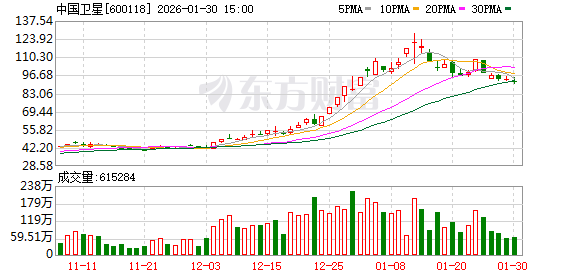
中国卫星:公司尚未触发交易所规定的停牌情形
Zheng Quan Ri Bao Zhi Sheng· 2026-01-30 11:12
证券日报网讯 1月30日,中国卫星在互动平台回答投资者提问时表示,根据《上海证券交易所上市公司 自律监管指引第4号——停复牌》《上海证券交易所股票上市规则》等相关规定,截至目前公司尚未触 发交易所规定的停牌情形。公司已多次以股票交易异常波动公告、股票交易风险提示公告的形式,来回 应市场情绪,及时提醒广大投资者理性投资,注意投资风险。公司会严格遵守上交所规则要求,以保障 公司股东,尤其是中小股东交易的权利。 (编辑 王雪儿) ...
航天装备板块1月30日跌0.84%,航天环宇领跌,主力资金净流出6.61亿元
Zheng Xing Xing Ye Ri Bao· 2026-01-30 09:00
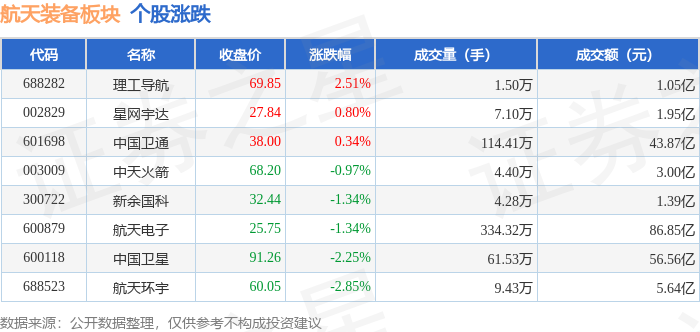
Market Overview - The aerospace equipment sector experienced a decline of 0.84% on January 30, with Aerospace HuanYu leading the drop [1] - The Shanghai Composite Index closed at 4117.95, down 0.96%, while the Shenzhen Component Index closed at 14205.89, down 0.66% [1] Stock Performance - Key stocks in the aerospace equipment sector showed varied performance: - Ligong Navigation (688282) closed at 69.85, up 2.51% with a trading volume of 15,000 shares and a turnover of 105 million yuan [1] - Xingwang Yuda (002829) closed at 27.84, up 0.80% with a trading volume of 71,000 shares and a turnover of 195 million yuan [1] - China Satellite (600118) closed at 91.26, down 2.25% with a trading volume of 615,300 shares and a turnover of 5.656 billion yuan [1] - Aerospace Electronics (600879) closed at 25.75, down 1.34% with a trading volume of 3,343,200 shares and a turnover of 8.685 billion yuan [1] Capital Flow - The aerospace equipment sector saw a net outflow of 661 million yuan from institutional investors, while retail investors contributed a net inflow of 453 million yuan [1] - Detailed capital flow for key stocks includes: - China Satellite (600118) had a net outflow of 290 million yuan from institutional investors and a net inflow of 205 million yuan from retail investors [2] - Aerospace HuanYu (688523) experienced a significant net outflow of 68.81 million yuan from institutional investors, with a net inflow of 60.56 million yuan from retail investors [2] - Ligong Navigation (688282) had a net inflow of 11.93 million yuan from institutional investors, but a net outflow from retail investors [2]





多视角解锁中国商业航天规划未来新图景 | 如何干?一文梳理↓
Yang Shi Wang· 2026-01-30 05:37
Core Viewpoint - The Commercial Space Industry Chain Conference held in Shanghai announced significant developments, including the potential reduction of launch costs, promotion of space tourism, resource development, and space traffic management [1] Group 1: Launch Cost Reduction - The vision report projects that by 2030, the low Earth orbit constellation will be largely established, and the cost of launching will decrease to below 10,000 yuan per kilogram, down from the current approximately 70,000 yuan per kilogram [7] - The advancement of reusable rocket technology and new applications could significantly expand the range of application scenarios in the commercial space sector [7] Group 2: Communication Coverage - The vision report highlights plans for achieving full communication coverage in remote areas, with further integration of Tian Tong and Bei Dou terminals to eliminate communication blind spots in oceans and deserts [9] - Centimeter-level positioning will be realized to ensure no blind spots in coverage, benefiting tourists and workers in remote areas [9] Group 3: New Development Areas - During the 14th Five-Year Plan period, the industry aims to promote new fields such as space tourism, space digital infrastructure, space resource development, and space traffic management [11] - The construction of gigawatt-level space digital infrastructure is planned to enable comprehensive data processing capabilities [11] Group 4: Space Resource Development - The "Tian Gong Kai Wu" major special project will focus on key technologies for resource exploration, intelligent autonomous mining, low-cost transportation, and in-orbit processing of small celestial bodies [12] - Recent discoveries of natural single-walled carbon nanotubes and graphite carbon in lunar samples suggest the potential for high-value materials on the moon and other celestial bodies [15] Group 5: Space Traffic Management - The industry will address the growing challenges of space traffic safety by developing key technologies for monitoring, warning, and clearing space debris [17] - This initiative aims to establish a solid foundation for China's active role in international space traffic management regulations and ensure the safe operation of space infrastructure [17]
我国将布局更多 “太空+”未来产业
Xin Lang Cai Jing· 2026-01-30 04:12
新华社上海1月29日电(记者 张建松)记者从29日在沪召开的商业航天器及应用产业链共链行动大会获 悉,我国将布局更多"太空+"未来产业。 (来源:廊坊日报) 转自:廊坊日报 在太空数智基础设施方面,将建设吉瓦级太空数智基础设施,创建云、边、端一体的新型太空体系架 构,实现算力、存力、运力等深度融合,赋能"天数天算""地数天算""天地同算"。 在太空资源开发方面,将开展"天工开物"重大专项论证,建设太空资源开发综合实验和地面支持系统, 重点突破小天体资源勘查、智能自主开采、低成本转移运输、在轨处理等关键技术。 在太空旅游方面,将加快迭代形成亚轨道和轨道太空旅游飞行器产品,完成相关无人或有人飞行验证, 建立完善的太空旅游运营体系,实现亚轨道太空旅游航班化运营,逐步发展轨道太空旅游。 据介绍,中国航天科技集团作为我国商业航天器及应用产业链"链长"单位,将在"十五五"期间围绕发展 商业航天国家战略部署,发挥中央企业战略引领、生态构建等职能,带动产业链上中下游企业共谋新发 展、共建新能力、共筑新生态,实施五大工程。其中,包括实施未来产业发展培育工程,谋划推动太空 数智基础设施、太空资源开发、太空交通管理、太空旅游等新领 ...
千亿商业航天产业蓄势待发,航空航天ETF(159227)近1周份额增长1.7亿份
Xin Lang Cai Jing· 2026-01-30 03:06
Group 1 - The China Aerospace Science and Technology Corporation plans to enhance commercial launch capabilities and develop competitive commercial rockets for regular transportation, aiming for reusable rockets to achieve scalable and mature commercial applications [2] - Shanghai is focused on becoming a national hub for the commercial aerospace industry, targeting an industry scale of approximately 100 billion yuan by 2027, with a planned area of about 9.3 square kilometers for the "Rocket Star City" [2] - The East Wu Securities report highlights that SpaceX is set to enter a quiet period ahead of its IPO, aiming to raise over $30 billion, with part of the funds allocated for developing space-based data centers [2] Group 2 - The Aerospace ETF (159227) closely tracks the China Aerospace Index, covering key industry chain segments such as aerospace equipment, satellite navigation, and new materials, with a high weight of 70% in commercial aerospace concepts [3] - The top ten holdings in the Aerospace ETF include industry leaders such as Aerospace Development, China Satellite, and Aerospace Electronics [3] Group 3 - As of January 30, 2026, the China Aerospace Industry Index (CN5082) showed mixed performance among its constituent stocks, with Beimo High-Tech leading at an increase of 8.87% [1] - The Aerospace ETF recorded a turnover rate of 7.49% and a trading volume of 244 million yuan, with an average daily trading volume of 732 million yuan over the past month [1] - The Aerospace ETF experienced a significant increase in shares, growing by 170 million shares in the past week, with a net inflow of 131 million yuan recently [1]


影响市场重大事件:航天国家队谋划“十五五”,旅游、采矿有望向太空进发;上海市商业航天“火箭星城”建设方案发布;国家航天局表态,持续优化商业航天发展政策环境
Mei Ri Jing Ji Xin Wen· 2026-01-29 22:26
Group 1: Aerospace Industry Developments - China Aerospace Science and Technology Corporation plans to promote the development of new fields such as space tourism, space digital infrastructure, space resource development, and space traffic management during the "14th Five-Year Plan" period [1] - The company aims to accelerate the iteration of suborbital and orbital space tourism vehicles, complete relevant unmanned or manned flight verification, and establish a comprehensive space tourism operation system [1] - Domestic commercial aerospace companies like Xinghe Power, Blue Arrow Aerospace, and CAS Space have expressed plans related to space tourism, indicating a strong expectation for the sector's growth [1] Group 2: Commercial Aerospace Policy and Standards - The "Chain Gathering Industry Synergy, Building a Strong Aerospace Nation" conference in Shanghai released several key documents, including the "14th Five-Year Plan" vision report for China's commercial aerospace industry and a major supply-demand information report [2][3] - The National Space Administration's Deputy Director emphasized the need for innovation-driven, collaborative, and safe development to enhance the core competitiveness of the industry chain and optimize the policy environment for commercial aerospace [3] Group 3: Gold Market Insights - The World Gold Council's report indicates that China's gold jewelry consumption may see a quarter-on-quarter rebound in Q1 2026, supported by seasonal purchasing during the Spring Festival [4] - The report also forecasts that global gold demand reached a record high of 5002 tons in 2025, driven by significant geopolitical and economic uncertainties, with total demand valued at $555 billion [6] - The report highlights that North America shows strong demand for gold ETFs, while Asia's demand is just beginning to grow, indicating potential for future increases in holdings [9]
240吨级商业重复使用高压补燃液氧煤油发动机长程试车成功
Yang Shi Xin Wen Ke Hu Duan· 2026-01-29 19:08
Core Viewpoint - The China Aerospace Science and Technology Corporation's Sixth Academy successfully conducted a 200-second long test of a 240-ton class commercial reusable high-pressure staged combustion liquid oxygen-kerosene engine, achieving performance indicators that meet international leading standards [1] Group 1 - The engine is developed for domestic commercial users and is intended for medium to large reusable launch vehicles [1] - The successful test marks a significant milestone in the development of advanced propulsion systems in the aerospace industry [1]
多枚可重复使用火箭今年有望首飞
Zheng Quan Ri Bao· 2026-01-29 17:29
Core Viewpoint - The Chinese commercial rocket industry is poised for significant advancements in reusable rocket technology, with multiple launches and recovery attempts expected in 2026, marking a critical year for the sector [1][4]. Group 1: Company Developments - China Aerospace Science and Technology Corporation (CASC) emphasizes the importance of 2026 as a foundational year for the commercial rocket sector, focusing on resource integration and successful launches and recoveries [1]. - The successful launch of the Zhuque-3 rocket by private company Landspace and the Long March 12 rocket by CASC highlights the collaborative efforts between state-owned and private enterprises in advancing reusable rocket technology [2][3]. - The Long March 12 rocket, measuring approximately 70.4 meters in length and weighing about 437 tons, aims for "first-stage reuse" as a core feature, although it did not achieve the recovery goal during its recent flight [2]. Group 2: Industry Trends - The collaboration between state-owned and private enterprises is fostering a strong synergy in the development of reusable rockets, combining the technical expertise of state firms with the agility of private companies [3]. - The anticipated launches of multiple domestic reusable rockets, including the Hyperbola-3 and Xingyun-1, are expected to occur in 2026, further pushing the boundaries of China's capabilities in this field [4]. - The breakthrough in reusable rocket technology is seen as a key factor in reducing launch costs, which could lead to new opportunities in satellite networking and space infrastructure [5]. Group 3: Future Opportunities - The successful recovery of reusable rockets is expected to open up new avenues in the commercial space sector, with companies actively preparing for developments such as space tourism [5][6]. - The Lihong-2 vehicle is set to conduct a 100-kilometer recovery technology verification in 2026, aiming to significantly lower launch costs and validate recovery technologies [6]. - Ongoing research and development in commercial space technology will require substantial investment and collaboration among government, local authorities, and private capital to achieve breakthroughs in core technologies [6].