
GYBYS(600332)

Search documents
白云山(600332.SH):子公司王老吉药业药物进入III期临床试验
Ge Long Hui A P P· 2025-10-17 08:46
Core Viewpoint - Guangzhou Pharmaceutical Holdings Limited's subsidiary, Wanglaoji Pharmaceutical, has officially launched a Phase III clinical trial for its product, Keguanli Throat Oral Solution, aimed at treating acute pharyngitis [1] Group 1: Clinical Trial Details - The Phase III clinical trial for Keguanli Throat Oral Solution was initiated recently [1] - The product received its new drug certificate and production approval in 1997 and is listed in the 2025 edition of the Pharmacopoeia of the People's Republic of China [1] - The solution is indicated for symptoms related to wind-heat invasion and internal heat disturbance, primarily used for colds [1] Group 2: Regulatory Approvals - Wanglaoji Pharmaceutical obtained the clinical trial approval notice from the National Medical Products Administration in February 2024 [1] - The approval allows the company to conduct confirmatory clinical trials for acute pharyngitis [1]
白云山:子公司药物克感利咽口服液进入III期临床试验
Xin Lang Cai Jing· 2025-10-17 08:37
Core Viewpoint - The announcement indicates that Guangzhou Wanglaoji Pharmaceutical Co., Ltd., a subsidiary of Baiyunshan, has officially launched the Phase III clinical trial for the drug Kegang Liyan Oral Liquid, aimed at treating acute pharyngitis [1] Group 1: Product Details - Kegang Liyan Oral Liquid is classified as a Class 2.3 new drug, with a specification of 10 mL per bottle, designed to dispel wind, clear heat, and detoxify [1] - The projected sales revenue for Kegang Liyan Oral Liquid in 2024 is estimated at RMB 18.2852 million [1] Group 2: Financial Investment - As of September 2025, the project has incurred research and development expenses of approximately RMB 18.1542 million (unaudited) [1]
王老吉加多宝“20年缠斗”,鹿死谁手?
3 6 Ke· 2025-10-17 07:58
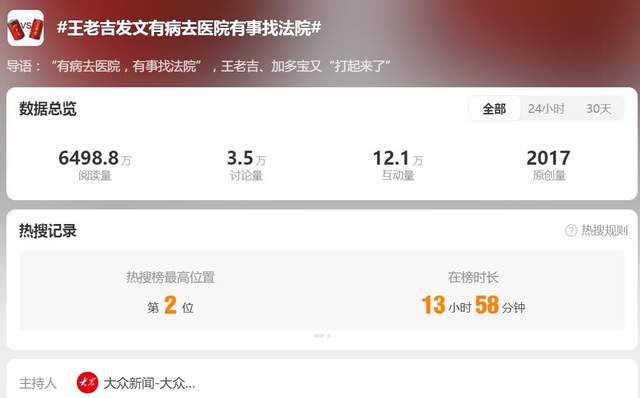
Group 1 - Wanglaoji and JDB have resumed their public feud, trending on social media with topics like "Wanglaoji has a problem, go to the hospital" and "Wanglaoji is the first to get angry" [1] - The conflict has escalated with both companies making statements regarding trademark disputes, particularly concerning the overseas rights to the Wanglaoji brand [4][10] - JDB claims to have successfully defended its overseas trademark rights in multiple lawsuits, marking a significant step in its international branding strategy [4][8] Group 2 - Wanglaoji's parent company, Baiyunshan, asserts that it holds the legal rights to the Wanglaoji trademark globally, having registered it in over 100 countries [10][11] - Both companies have been engaged in a long-standing trademark dispute, with JDB emphasizing its acquisition of the Wanglaoji brand's overseas rights in the early 2000s [10][14] - The ongoing rivalry has implications for both companies' market performance, with potential impacts on their respective sales and brand positioning [14][16] Group 3 - The herbal tea market remains a viable business opportunity, with significant growth potential in overseas markets despite a slowdown in domestic growth [14][15] - Wanglaoji reported a revenue of 6.499 billion yuan in the first half of 2025, a year-on-year increase of 8.38%, and a net profit of 1.295 billion yuan, up 15.87% [14] - JDB has also been expanding its market presence, with a reported 28.31% market share in the domestic plant beverage category, closely following Wanglaoji's 46.33% [16]

王老吉和加多宝都上火了
3 6 Ke· 2025-10-16 04:03
Core Viewpoint - The ongoing rivalry between Wanglaoji and Jia Duo Bao, two major herbal tea brands in China, has escalated from domestic disputes to international markets, highlighting the challenges and strategic choices both companies face in their globalization efforts [1][2][3]. Group 1: Historical Context - The conflict between Wanglaoji and Jia Duo Bao dates back over a decade, marked by the "red can dispute," which has become a classic case in Chinese business history [1]. - Recent tensions reignited on September 30, when Jia Duo Bao claimed victory in international trademark disputes, asserting ownership of the "Wanglaoji" trademark in over 60 countries [3][4]. - Wanglaoji responded by accusing Jia Duo Bao of maliciously registering trademarks abroad and announced its own trademark registrations in over 100 countries by September 2025 [3][4]. Group 2: Strategic Moves - Both companies are targeting international markets as domestic growth stagnates, with Wanglaoji and Jia Duo Bao recognizing the necessity of expanding overseas to seek new growth opportunities [2][10]. - Wanglaoji has been actively promoting its brand internationally since 2013, establishing a presence in the U.S. and launching its international brand "WALOVI" in 2023 [9][10]. - Jia Duo Bao has also made strides in international markets, establishing production bases in Malaysia and signing agreements for further expansion [9]. Group 3: Market Dynamics - The herbal tea market in China has shown signs of saturation, with retail sales fluctuating since 2016 and a growth rate of approximately 20% over the past decade [10][13]. - Both companies face competition from emerging beverage brands and traditional tea products, which have diversified consumer preferences and fragmented the market [14][15]. - The global plant-based beverage market is experiencing significant growth, with a compound annual growth rate of nearly 10% from 2019 to 2024, presenting opportunities for both brands [13]. Group 4: Internal Challenges - The prolonged legal battles between Wanglaoji and Jia Duo Bao have diverted resources and attention from product innovation and market expansion, leading to stagnation in their respective growth strategies [17][18]. - Both companies are struggling to diversify beyond the herbal tea category, which limits their potential in international markets [17]. - A collaborative approach to promote "Chinese herbal tea" as a category could benefit both companies and enhance their global presence, rather than continuing their competitive rivalry [17][18].
王老吉加多宝海外商标战:凉茶双雄的出海“生死局”
2 1 Shi Ji Jing Ji Bao Dao· 2025-10-15 13:12
Core Viewpoint - The ongoing trademark dispute between Wanglaoji and Jia Duo Bao highlights the complexities of intellectual property rights as Chinese brands expand internationally, with both companies asserting their claims over the "Wanglaoji" trademark in various global markets [1][3][6]. Group 1: Trademark Dispute Developments - On September 30, Jia Duo Bao announced victories in multiple lawsuits in Canada and the EU, claiming to protect its overseas trademark rights for "Wanglaoji," asserting ownership since the early 2000s and registration in over 60 countries [1]. - Wanglaoji quickly countered, accusing Jia Duo Bao of misleading the public and revealing that it has initiated trademark protection actions in 21 countries, with some jurisdictions already ruling in favor of Wanglaoji [2]. - The trademark conflict stems from over two decades of partnership and subsequent legal battles, with a recent ruling ordering Jia Duo Bao to pay Wanglaoji 317 million yuan for trademark infringement [3]. Group 2: Market Context and Growth Challenges - Despite dominating the domestic herbal tea market, both companies face stagnation as new beverage categories divert consumer interest, prompting a focus on international expansion [4]. - Wanglaoji has seen its overseas market grow 6.5 times over the past decade, with a compound annual growth rate exceeding 25%, and has registered its trademarks in over 100 countries [4]. - Both companies are establishing local production bases to enhance their market presence, with Wanglaoji partnering with local firms to build an 800 million can annual capacity in Malaysia [4]. Group 3: Intellectual Property Challenges - The trademark battle reflects broader challenges faced by Chinese companies in protecting their intellectual property abroad, with over 2,000 instances of trademark registration disputes reported since the 1980s, leading to significant asset losses [6][7]. - The regional nature of trademark laws complicates enforcement, as different jurisdictions have varying principles regarding trademark rights, impacting both companies' strategies [6][7]. - The difficulty in proving malicious registration adds to the complexity, as companies must gather evidence across borders, which can be costly and time-consuming [7]. Group 4: Strategic Recommendations - Experts suggest that traditional brands must integrate intellectual property into their core strategies, emphasizing the importance of comprehensive planning and proactive trademark registration [2][8]. - Companies are advised to enhance their brand narratives and cultural heritage to secure broader trademark protections and avoid potential conflicts in international markets [8]. - The case serves as a cautionary tale for Chinese enterprises aiming for global expansion, underscoring the necessity of clarifying trademark rights before entering new markets [9].
白云山投资成立分子科技公司,注册资本5亿元
Sou Hu Cai Jing· 2025-10-15 05:52
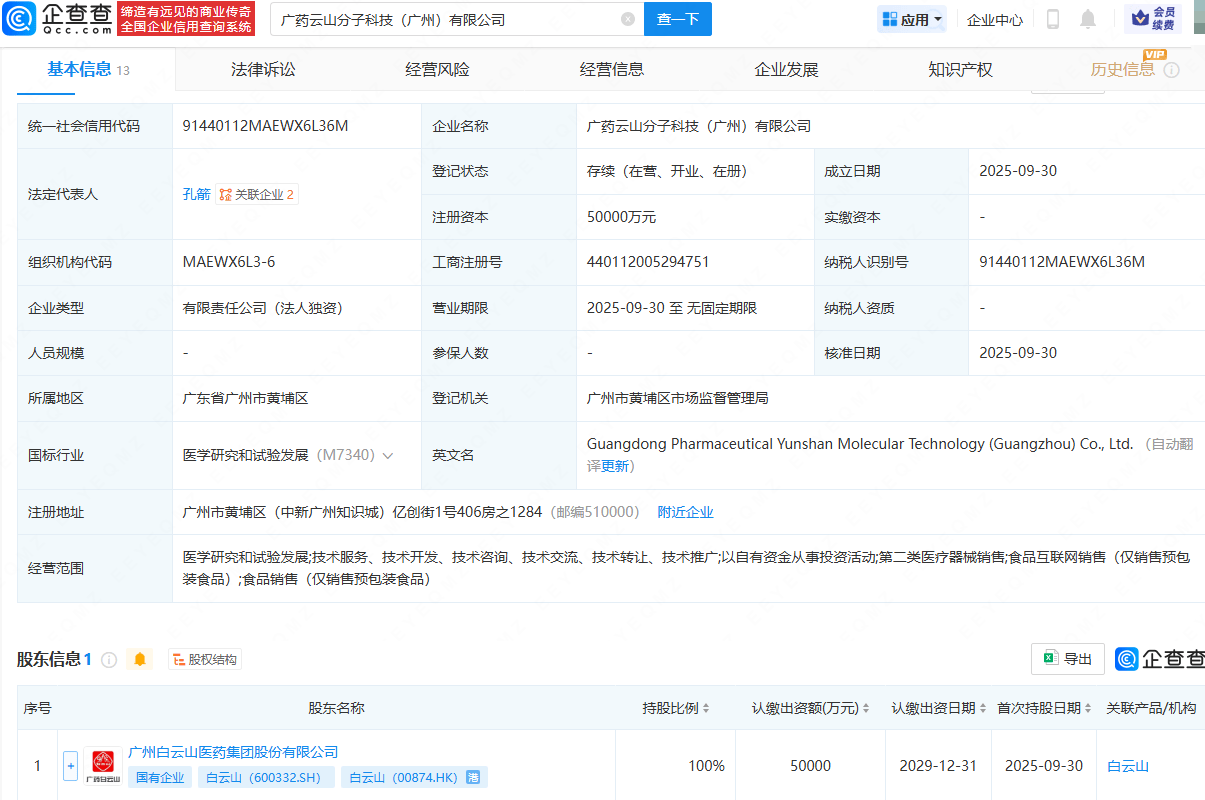
Core Insights - Guangdong Pharmaceutical Yunshan Molecular Technology (Guangzhou) Co., Ltd. has been established with a registered capital of 500 million yuan, focusing on medical research and development, investment activities, and sales of Class II medical devices [1][2]. Company Information - The legal representative of the company is Kong Jian, and it is wholly owned by Baiyunshan (600332) [1]. - The company is registered in Huangpu District, Guangzhou, Guangdong Province, with a business scope that includes medical research and experimental development, technology services, and sales of medical devices [2]. Registration Details - The company was registered with a unified social credit code of 91440112MAEWX6L36M and has a business duration until September 30, 2025, with no fixed term thereafter [2]. - The registration address is located at Yichuang Street, Knowledge City, Huangpu District, Guangzhou [2].
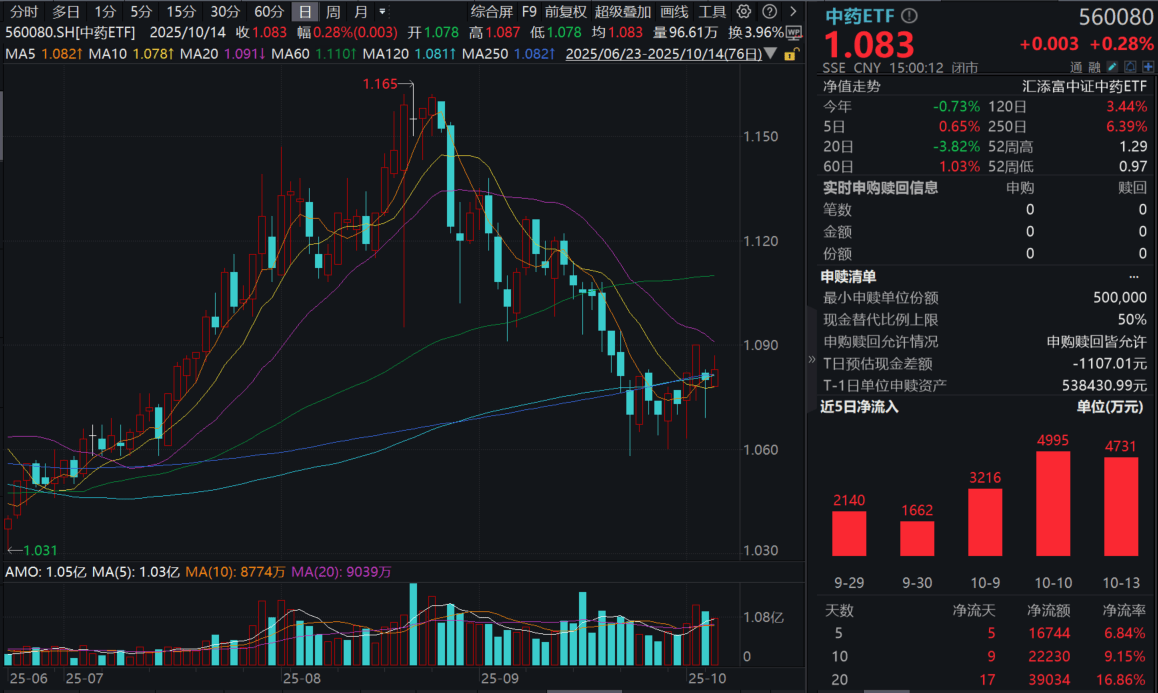
中药逆市收红!东阿阿胶、太极集团涨超1%!中药ETF(560080)收涨0.28%,连续9日“吸金”!融资余额接连攀升!机构盘点产业两大发展趋势
Sou Hu Cai Jing· 2025-10-14 09:45
Core Viewpoint - The Chinese medicine sector shows resilience with the Chinese Medicine ETF (560080) rising by 0.28% despite market fluctuations, indicating strong investor interest and a net inflow of over 220 million yuan in the past 10 days [1][3]. Market Performance - The Chinese Medicine ETF (560080) has maintained a premium, closing with a premium rate of 0.14%, and has seen a total trading volume exceeding 1 billion yuan [1]. - Major stocks within the ETF, such as Dong'e Ejiao and Yunnan Baiyao, have shown positive performance, with Dong'e Ejiao increasing by over 1% [3][4]. Index Performance - The Chinese medicine index has experienced a negative return of -2.86% year-to-date, with a decline of 8.13% projected for 2024 [4]. - The index has shown a pattern of alternating performance, with three consecutive years of gains from 2019 to 2021, followed by three years of declines from 2016 to 2018 [4]. Valuation Metrics - The TTM price-to-earnings ratio for the Chinese Medicine ETF (560080) stands at 24.86, placing it at the 20.6% percentile of the past decade, suggesting a favorable valuation [6]. Financing and Investment Trends - Leveraged funds are increasingly utilizing the ETF for exposure to the higher-value Chinese medicine consumer sector, with the latest financing balance exceeding 91 million yuan, maintaining historical highs [7]. - The overall sentiment in the Chinese medicine sector is expected to improve, driven by stable market demand and accelerated innovation [9]. Future Outlook - The Chinese medicine sector is anticipated to benefit from innovation and transformation, with a focus on new product development and cost reductions in raw materials [9][10]. - The sector is positioned to leverage its advantages in preventive healthcare and as a complementary treatment alongside Western medicine [10]. Corporate Governance and Incentives - Recent corporate governance improvements and incentive plans in state-owned enterprises are expected to drive growth in the Chinese medicine sector, with companies like Huaren Sanjiu and Jiangzhong Pharmaceutical implementing effective incentive programs [11][12]. Dividend Yield - Several Chinese medicine companies are projected to have dividend yields exceeding 3% in 2024, with state-owned enterprises leading in this regard, indicating strong cash flow and shareholder returns [13][14].


白云山(600332) - H股公告(董事会召开日期)
2025-10-14 09:15
香港交易及結算所有限公司及香港聯合交易所有限公司對本公告的內容概不負責,對其準確性或完 整性亦不發表任何聲明,並明確表示,概不對因本公告全部或任何部份內容而產生或因倚賴該等內 容而引致的任何損失承擔任何責任。 董事會會議召開日期 董事會 中國廣州,2025年10月14日 於本公告日,本公司董事會成員包括執行董事李小軍先生、陳傑輝先生、程寧女士、程洪進先生、 唐和平先生與黎洪先生,及獨立非執行董事陳亞進先生、黃民先生、黃龍德先生與孫寶清女士。 廣州白雲山醫藥集團股份有限公司(「本公司」)董事會(「董事會」)茲通告謹定於2025年10月28日(星期 二)舉行董事會會議,藉以審議及批准本公司及其附屬公司截至2025年9月30日止九個月未經審計財 務業績及處理其他事項(如有)。 廣州白雲山醫藥集團股份有限公司 ...
白云山10月28日举行董事会会议审议及批准前三季度业绩
Ge Long Hui· 2025-10-14 09:12
格隆汇10月14日丨白云山(00874.HK)公布,谨定于2025年10月28日(星期二)举行董事会会议,藉以审议 及批准公司及其附属公司截至2025年9月30日止九个月未经审计财务业绩及处理其他事项(如有)。 ...
白云山(00874.HK)10月28日举行董事会会议审议及批准前三季度业绩
Ge Long Hui· 2025-10-14 08:44
格隆汇10月14日丨白云山(00874.HK)公布,谨定于2025年10月28日(星期二)举行董事会会议,藉以审议 及批准公司及其附属公司截至2025年9月30日止九个月未经审计财务业绩及处理其他事项(如有)。 ...