Gemdale(600383)

Search documents
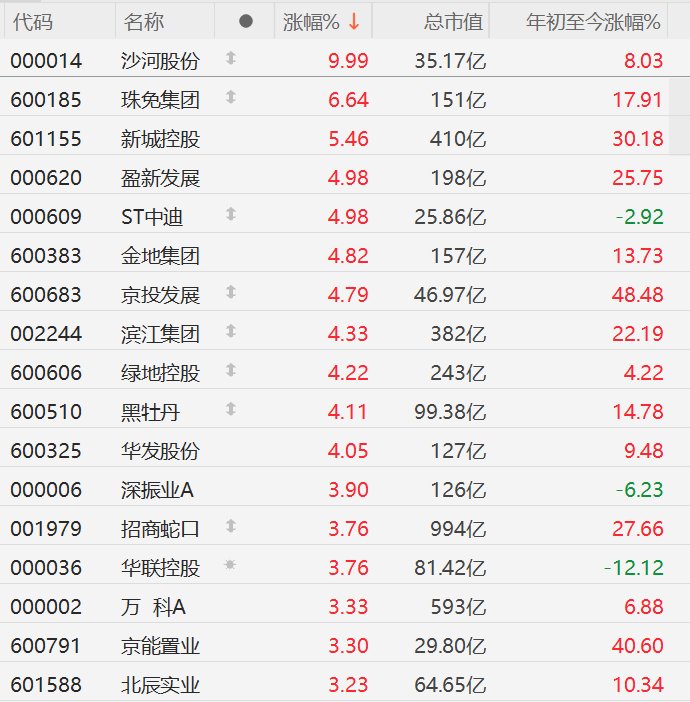
A股异动丨房地产股走强,新城控股涨超5%,招商蛇口涨超3%
Ge Long Hui A P P· 2026-02-09 02:03
Core Viewpoint - The A-share market is experiencing a strong performance in the real estate sector, with several companies seeing significant stock price increases due to supportive government policies aimed at stabilizing and boosting the real estate market [1] Group 1: Market Performance - Shahe Co., Ltd. reached the daily limit up with a 9.99% increase, bringing its total market value to 3.517 billion [2] - Zhuan Mian Group saw a rise of 6.64%, with a total market value of 15.1 billion [2] - New Town Holdings increased by 5.46%, with a market capitalization of 41 billion [2] - Other notable performers include Yingxin Development (+4.98%), Jindi Group (+4.82%), and Jingtou Development (+4.79%) [2] Group 2: Government Policies - Jiangsu Province government held a meeting to discuss policies to stabilize and boost the real estate market [1] - A closed-door seminar ahead of the National Two Sessions suggested measures such as issuing additional government bonds, lowering interest rates, and stabilizing the housing market [1] - Fujian Province issued implementation opinions to promote high-quality urban development, focusing on the renovation of urban villages and old housing [1] - Shenzhen City emphasized the need for organic urban renewal to accelerate the construction of safe, comfortable, green, and smart housing [1]






2025A股上市房企众生相:超七成预亏,净利失血超1700亿,五家亏损逾百亿
Xin Lang Cai Jing· 2026-02-05 02:17
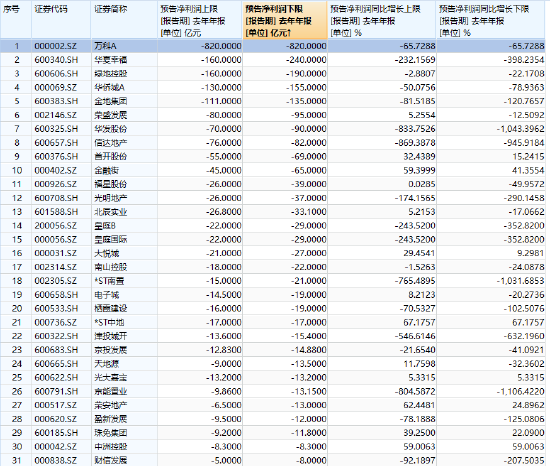
Core Viewpoint - The real estate sector in A-shares is facing significant financial challenges, with over 70% of listed companies expected to report losses for 2025, leading to a total projected loss of approximately 2,092.35 billion yuan across 60 companies, and a net profit loss exceeding 1,700 billion yuan for the entire sector [1][4]. Group 1: Financial Performance - Out of 81 listed real estate companies, only 21 are expected to be profitable in 2025, indicating a severe downturn in the industry [1][4]. - Vanke A is projected to incur the largest loss, with an estimated net profit loss of about 820 billion yuan, representing a year-on-year increase of approximately 65.7% [5]. - Other companies, including China Fortune Land Development, Greenland Holdings, Overseas Chinese Town A, and JinDi Group, are also expected to report losses exceeding 100 billion yuan [5]. Group 2: Reasons for Losses - China Fortune Land Development attributes its significant loss to a slowdown in project turnover, insufficient progress in debt restructuring, and increased financial costs due to lower interest capitalization rates [5]. - Greenland Holdings cites factors such as declining asset prices, intensified promotional efforts, extended project timelines, and reduced gross margins as contributors to its financial difficulties [5]. Group 3: Loss Distribution - The distribution of losses among real estate companies shows a clear hierarchy: 5 companies are expected to lose between 50 billion to 100 billion yuan, 8 companies between 20 billion to 50 billion yuan, 11 companies between 10 billion to 20 billion yuan, and 23 companies between 1 billion to 10 billion yuan [2][5]. - This wave of losses is affecting all tiers of the industry, from leading firms to smaller developers, highlighting widespread profitability challenges [2][5].


2025年A股1442家公司预亏,行业“亏损王”浮出
Di Yi Cai Jing Zi Xun· 2026-02-04 15:12
Core Insights - Nearly 50% of the 2957 A-share listed companies that disclosed their 2025 annual performance forecasts are expected to incur losses [2][3] - The real estate sector is identified as the most affected, with Vanke A (000002.SZ) being the largest loss-maker, projecting a net loss of approximately 82 billion yuan [6][7] Provincial Distribution of Losses - The provinces with the highest proportion of companies expecting losses are Hainan (44.44%), Jilin (41.67%), and Qinghai (40%) [4][5] - Guangdong has the highest number of companies expecting losses at 257, followed by Beijing (172), Jiangsu (160), and Zhejiang (133) [3][4] Industry Analysis - The IT services and software development sectors have the highest number of companies forecasting losses, with 60 companies each, followed by the real estate sector with 54 companies [6] - The top ten companies with the highest expected losses include five from the real estate sector, with Vanke A leading the list [6][7] Notable Loss-Makers - Vanke A is projected to incur a net loss of about 82 billion yuan due to decreased project settlement scale and increased business risks [6][7] - Other significant loss-makers in the real estate sector include China Fortune Land Development (华夏幸福) with expected losses between 16 billion to 24 billion yuan and Greenland Holdings (绿地控股) with losses of 16 billion to 19 billion yuan [7] - In the retail sector, M.K. Home (美凯龙) is expected to report a loss of 15 billion to 22.5 billion yuan, primarily due to investment property valuation losses [7][8] Sector-Specific Losses - The home appliance sector's largest loss-maker is Shenzhen Konka (深康佳A), projecting losses of 12.58 billion to 15.57 billion yuan [8] - The vaccine leader Zhifei Biological Products (智飞生物) is also expected to report a first-time loss of 10.7 billion to 13.73 billion yuan due to decreased public vaccination willingness [8] - In the photovoltaic sector, Tongwei Co. (通威股份) is projected to incur losses of 9 billion to 10 billion yuan due to industry oversupply and rising raw material costs [9]



A股2025亏损画像:1442家公司预亏,行业“亏损王”浮出
Di Yi Cai Jing· 2026-02-04 13:07
Core Viewpoint - Nearly half of the A-share listed companies are expected to report losses for the 2025 fiscal year, with significant regional and industry disparities in the distribution of these losses [2][3]. Group 1: Regional Distribution of Losses - A total of 2,957 A-share companies disclosed their performance forecasts, with 1,442 companies expected to incur losses, representing 49% of the total [3]. - Hainan, Jilin, and Qinghai have the highest proportions of companies forecasting losses, exceeding 40%, with Hainan at 44.44% [4][5]. - Guangdong has the highest number of loss-making companies at 257, followed by Beijing (172), Jiangsu (160), and Zhejiang (133) [4]. Group 2: Industry Analysis - The real estate sector is the most affected, producing the highest number of loss-making companies, including the "loss king" Vanke A, which is expected to report a loss of approximately 82 billion yuan [7][8]. - Other industries with significant losses include IT services, semiconductors, and chemical pharmaceuticals, with 60, 50, and 40-50 companies respectively forecasting losses [7]. - The top ten companies with the highest expected losses include five from the real estate sector, with notable losses from China Fortune Land Development and Greenland Holdings [7][8]. Group 3: Specific Company Losses - Vanke A's losses are attributed to a significant decline in project settlement scale and increased business risks, leading to credit and asset impairment provisions [7]. - Other major loss-makers include China Fortune Land Development, expected to lose between 16 billion to 24 billion yuan, and Greenland Holdings, with losses projected between 16 billion to 19 billion yuan [8]. - In the retail sector, M.K. Home is expected to report losses of 15 billion to 22.5 billion yuan due to investment property valuation losses [8]. - Semiconductor company Wentech Technology anticipates losses of 9 billion to 13.5 billion yuan, primarily due to significant investment losses and asset impairments [9].


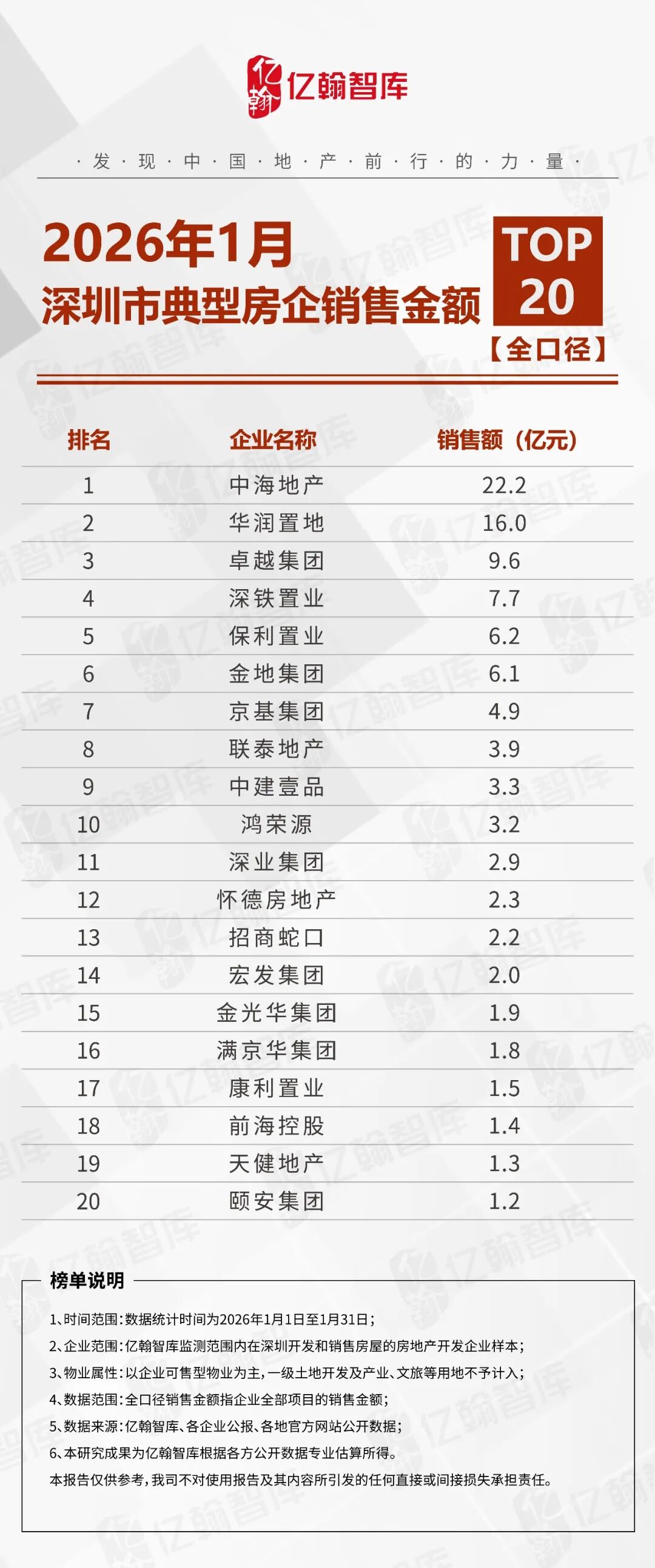
2026年1月深圳典型房企销售金额TOP20【全口径】
Xin Lang Cai Jing· 2026-02-04 12:20
Group 1: Sales Performance of Real Estate Companies - In January 2026, the top three real estate companies in Shenzhen by sales were China Overseas Land & Investment with 22.2 billion yuan, China Resources Land with 16.0 billion yuan, and Excellence Group with 9.6 billion yuan [2][5][18] - The sales threshold for the top 5 companies reached 6.1 billion yuan, while the top 10 and top 20 thresholds were 3.2 billion yuan and 1.2 billion yuan, respectively [5][18] Group 2: Policy Dynamics - Shenzhen introduced a management method for allocated affordable housing, effective from March 1, 2026, which prohibits any conversion of allocated affordable housing into commercial housing [5][19] - The application conditions for allocated affordable housing include having Shenzhen household registration, no self-owned housing in Shenzhen, and at least five years of social insurance contributions [6][23] Group 3: Market Performance - In January 2026, the number of new residential units signed in Shenzhen was 2,579, a decrease of 10.7% month-on-month and 49.3% year-on-year, attributed to a slowdown in new project launches [9][24] - The second-hand residential transactions saw an increase, with 5,281 units transferred, marking a year-on-year growth of 15.96% and a month-on-month increase of 6.88% [11][26] - As of the end of January, the inventory of new residential units in Shenzhen was 29,950, a decrease of 380 units from the previous month, due to a reduction in new launches and some inventory being converted to sales [13][28] Group 4: Market Outlook - The Shenzhen real estate market continued to show signs of recovery in January, with strong sales performance from quality projects indicating a gradual increase in market confidence [15][30] - The market is expected to maintain a "steady progress with quality first" trend as the traditional peak season for property transactions approaches after the Spring Festival [30]



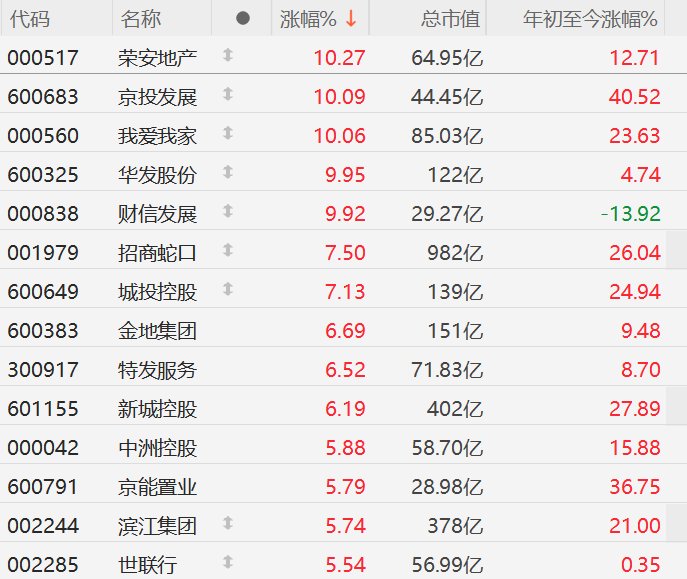
A股异动丨地产股涨幅进一步扩大,我爱我家、华发股份涨停
Xin Lang Cai Jing· 2026-02-04 06:04
Core Viewpoint - The A-share real estate sector has seen significant gains, particularly driven by the launch of a program in Shanghai to acquire second-hand housing for affordable rental housing projects, targeting new citizens, young people, and graduates [1] Group 1: Market Performance - Real estate stocks in the A-share market experienced substantial afternoon gains, with notable performers including I Love My Home and Huafa Co., which hit the daily limit [1] - Other companies such as Rong'an Real Estate, Jingtou Development, and Caixin Development also reached their daily limit previously, while China Merchants Shekou and City Investment Holdings rose over 7% [1] - The following companies showed significant increases: Jindi Group and Tefa Service over 6%, and Zhongzhou Holdings, Jingneng Real Estate, Binjiang Group, and Shilianhang over 5% [1] Group 2: Company Data - Rong'an Real Estate: 10.27% increase, market cap of 6.495 billion [2] - Jingtou Development: 10.09% increase, market cap of 4.445 billion [2] - I Love My Home: 10.06% increase, market cap of 8.503 billion [2] - Huafa Co.: 9.95% increase, market cap of 12.2 billion [2] - Caixin Development: 9.92% increase, market cap of 2.927 billion [2] - China Merchants Shekou: 7.50% increase, market cap of 98.2 billion [2] - City Investment Holdings: 7.13% increase, market cap of 1.39 billion [2] - Jindi Group: 6.69% increase, market cap of 15.1 billion [2] - Tefa Service: 6.52% increase, market cap of 7.183 billion [2] - New Town Holdings: 6.19% increase, market cap of 40.2 billion [2] - Zhongzhou Holdings: 5.88% increase, market cap of 5.87 billion [2] - Jingneng Real Estate: 5.79% increase, market cap of 2.898 billion [2] - Binjiang Group: 5.74% increase, market cap of 37.8 billion [2] - Shilianhang: 5.54% increase, market cap of 5.699 billion [2]


金地集团:公司已构建规范的财务管理制度和流程体系
Zheng Quan Ri Bao Wang· 2026-02-02 13:40
Core Viewpoint - The company emphasizes the establishment of a standardized financial management system and process framework, highlighting its commitment to digitalization and intelligent construction to ensure stable operations [1] Group 1 - The company has built a standardized financial management system and process framework [1] - The company places importance on digitalization and intelligent construction [1] - The integration of financial management with business management is continuously promoted to provide a solid guarantee for stable operations [1]
中国地产:1 月房企销售额跌幅仍较大;预计一季度将进一步下滑-China Property-Developers‘ Sales Decline Remained Deep in January; We Expect Further Drop in 1Q
2026-02-02 02:42
Summary of Conference Call on China Property Market Industry Overview - The conference call focused on the **China Property** market, specifically the performance of major property developers in January 2026 and expectations for the first quarter of 2026 [1][2]. Key Points Sales Performance - Contracted sales for the 25 major developers tracked fell **32% year-on-year (y-y)** in January 2026, despite a low base due to the Chinese New Year (CNY) calendar effect [1][2]. - The top 50 and top 100 developers experienced declines of **26% and 29% y-y**, respectively, in January, compared to **-22% and -29%** in December [2]. Divergence in Developer Performance - State-Owned Enterprises (SOEs) outperformed other developers with milder declines. Notable performers included: - **China Overseas Land & Investment (COLI)**: +20% y-y - **Jinmao**: +14% y-y - **CR Land**: +0.4% y-y - Conversely, developers like **Sunac**, **Shimao**, **CIFI**, **Midea RE**, and **GZ R&F** reported declines exceeding **50% y-y** [3]. Market Outlook - The physical property market is expected to continue its downtrend in 2026-27, with projected declines of **8% and 6% y-y** in secondary home prices [4]. - A meaningful nationwide housing policy is anticipated to remain muted in the coming months, contributing to fragile buyer sentiment and increased inventory [4]. Investment Sentiment - Recent sentiment-driven outperformance in the China property industry is viewed as unsustainable, with expectations of a sector pullback as results season approaches [5]. - The focus remains on quality names with credible self-help stories, such as: - **CR Land (1109.HK)** - **Seazen (601155.SS)** - **C&D International (1908.HK)**, which is seen as a consolidator in the residential market with optimized landbanks [6]. Additional Insights - The analysis indicates that home prices in tier 1 and select tier 2 cities could stabilize in the second half of 2027 if the macro environment remains resilient [4]. - The overall sentiment in the market is cautious, with expectations of continued challenges for developers, particularly those with weaker brand recognition and fewer saleable resources [5][6].
房地产行业2025年业绩预告分析及前瞻:目前板块业绩仍然承压,但最困难时期或将逐渐过去
Shenwan Hongyuan Securities· 2026-02-01 05:30
Investment Rating - The report maintains an "Overweight" rating for the real estate industry, indicating a positive outlook for the sector despite current performance pressures [3][4]. Core Insights - Mainstream real estate companies are forecasting a decline or losses in 2025, but the report suggests that the most challenging period may be coming to an end. The report highlights significant declines in new construction and second-hand housing prices, indicating that the industry is nearing a bottom [3][4]. - The central government has emphasized stabilizing the real estate market, with recent policy statements reflecting a more proactive approach to addressing risks and supporting the sector [3][4]. - While overall performance for mainstream real estate companies is expected to remain under pressure in 2025, the report anticipates a recovery in profitability for quality firms, driven by improved sales and operational performance [3][4]. Summary by Sections Performance Forecasts - Major companies are expected to report significant losses in 2025, with Vanke A forecasting a loss of 82 billion RMB and China Overseas Development projecting a decline of 20% to 0% in net profit [4][6]. - The report categorizes companies based on expected profit growth rates, with some firms like Binjiang Group and New Town Holdings expected to see slight growth, while others like China Jinmao and Vanke A are projected to incur substantial losses [6][7]. Asset and Credit Impairment - The report details the cumulative asset and credit impairment losses for major firms, indicating that some companies have experienced significant write-downs, with New Town Holdings at 27% and Goldfield Group at 25% of their inventory [5][6]. Valuation Metrics - The report provides valuation metrics for major real estate companies, showing that many are trading at historical lows in terms of price-to-book ratios, suggesting potential investment opportunities [7][8]. - The average price-to-earnings ratio for the sector is noted, with some companies like Poly Development and Binjiang Group showing varying earnings per share forecasts for 2025 and 2026 [7][8].


A股52家上市房企:5家预亏超百亿,12家预计盈利!
Sou Hu Cai Jing· 2026-01-31 13:15
Core Viewpoint - The majority of A-share listed real estate companies are expected to report significant losses for the year 2025, indicating a challenging market environment for the industry [1][2]. Group 1: Loss Predictions - Out of 52 listed real estate companies, 40 are expected to report losses for 2025, which means over 80% of these companies are projected to be in the red [1]. - Five companies are expected to report losses exceeding 10 billion yuan, with Vanke leading at a projected loss of 820 billion yuan, followed by China Fortune Land Development, Greenland Holdings, Overseas Chinese Town, and Gemdale [2][3]. - Vanke's cumulative losses for 2024 and 2025 are projected to be nearly 1,315 billion yuan, surpassing the total profits from 2019 to 2023 [3]. Group 2: Reasons for Losses - The losses are attributed to declining property prices and significant impairment provisions that companies have had to make over the past two years [9][10]. - Many companies had previously anticipated a market recovery and began to recognize inventory impairments, but the continued market downturn has forced them to increase these provisions [10]. Group 3: Companies Reporting Profits - Twelve companies are expected to report profits, with Jinke Real Estate projected to achieve a net profit of 300 billion to 350 billion yuan, primarily due to successful restructuring [12][13]. - Poly Developments and China Merchants Shekou are also expected to report profits, albeit with significant declines compared to 2024, primarily due to impairment provisions [16][17]. Group 4: Market Dynamics - The list of loss-making companies includes a mix of private, state-owned, and central enterprises, indicating that the nature of the company does not correlate with the likelihood of losses [7]. - State-owned platform companies, which previously supported land acquisitions, are now facing increased pressure due to the ongoing market decline [8]. Group 5: Future Outlook - The upcoming annual report season in March and April 2025 will provide more detailed insights into the operational conditions of these companies [25].