
HUALU-HENGSHENG(600426)

Search documents
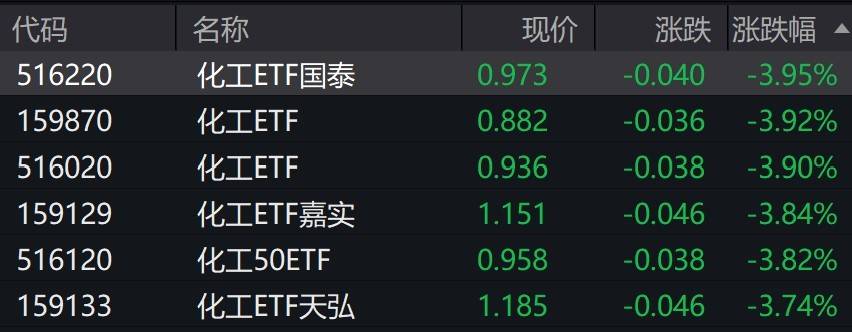
化工概念股走低,相关ETF跌近4%
Sou Hu Cai Jing· 2026-02-02 02:55
Group 1 - Chemical concept stocks declined, with Wanhua Chemical, Hengli Petrochemical, and Baofeng Energy dropping over 6%, while Hualu Hengsheng fell over 5% and Yuntianhua decreased over 4% [1] - Affected by the market, chemical-related ETFs fell nearly 4% [1] Group 2 - Various chemical ETFs reported declines, with the Guotai Chemical ETF at 0.973 (-3.95%), the Chemical ETF at 0.882 (-3.92%), and the Chemical 50 ETF at 0.958 (-3.82%) [2] - Analysts indicate that the chemical industry, being a typical cyclical sector, usually follows a five-year cycle consisting of "profit upturn - capacity expansion - profit bottoming - capacity clearance/demand expectation improvement" [2] - Current industry conditions are at the cycle bottom, with expectations for supply-demand dynamics to improve and accelerate the recovery of industry prosperity [2]



政策导向推动供给侧优化,龙头企业竞争优势凸显,石化ETF(159731)连续18天净流入
Xin Lang Cai Jing· 2026-02-02 02:28
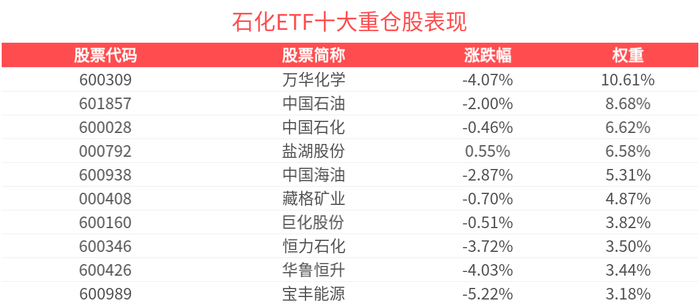
Core Viewpoint - The petrochemical industry is experiencing fluctuations in stock performance, with significant policy changes expected to optimize supply-side dynamics and enhance the competitive advantages of leading enterprises [2]. Group 1: Market Performance - As of February 2, 2026, the China Securities Petrochemical Industry Index has decreased by 2.78%, with mixed performance among constituent stocks [1]. - The top-performing stock is Sanmei Co., which increased by 1.75%, while Luxi Chemical led the decline with an 8.18% drop [1]. - The Petrochemical ETF (159731) has fallen by 2.79%, with a latest price of 1.01 yuan and a turnover rate of 6.58% [1]. Group 2: Fund Flows and ETF Performance - The Petrochemical ETF has seen continuous net inflows over the past 18 days, with a peak single-day net inflow of 348 million yuan, totaling 1.351 billion yuan [1]. - As of January 30, 2026, the Petrochemical ETF's net value has increased by 69.05% over the past two years [2]. - The ETF has achieved a maximum monthly return of 15.86% since its inception, with the longest streak of monthly gains lasting 9 months and an average monthly return of 5.59% [2]. Group 3: Policy Impact - Recent government policies aimed at "decarbonization," "environmental protection," and "cancellation of export tax rebates" are expected to suppress low-level redundant construction and disorderly expansion in the chemical industry [2]. - The policies are part of a broader strategy to optimize supply-side dynamics and enhance the competitive advantages of leading enterprises in the petrochemical sector [2]. Group 4: Index Composition - As of January 30, 2026, the top ten weighted stocks in the China Securities Petrochemical Industry Index account for 55.71% of the index, with Wanhua Chemical and China Petroleum being the top two [2].


百利天恒目标价涨幅近376% 金辰股份评级被调低丨券商评级观察
2 1 Shi Ji Jing Ji Bao Dao· 2026-02-02 01:31
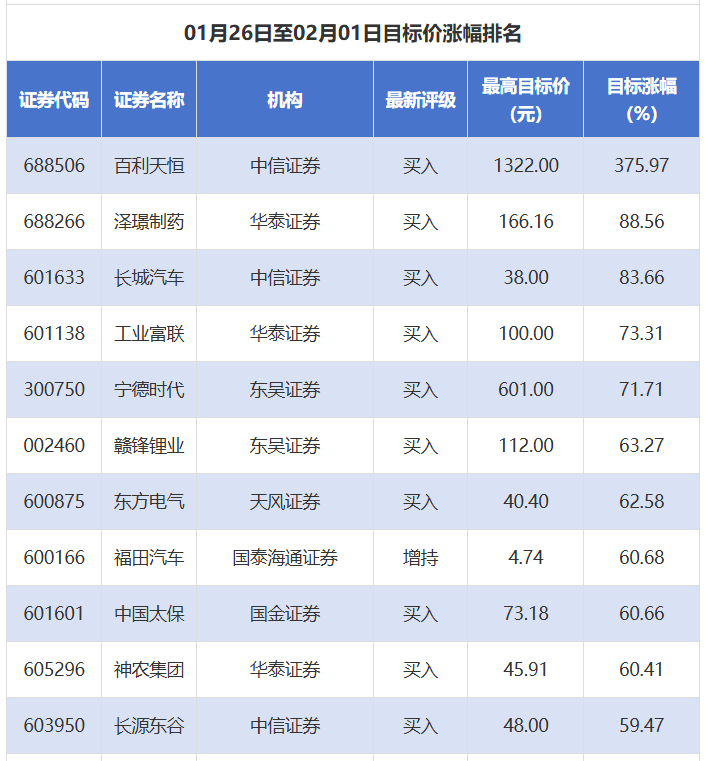
Core Viewpoint - The report highlights significant target price increases for several listed companies from January 26 to February 1, with notable mentions including Baili Tianheng, Zexing Pharmaceutical, and Great Wall Motors, indicating strong bullish sentiment in the market for these stocks [1][2]. Target Price Increases - Baili Tianheng (688506) has a target price increase of 375.97%, with a highest target price set at 1322.00 yuan [2]. - Zexing Pharmaceutical (688266) shows a target price increase of 88.56%, with a highest target price of 166.16 yuan [2]. - Great Wall Motors (601633) has a target price increase of 83.66%, with a highest target price of 38.00 yuan [2]. - Other companies with notable target price increases include Industrial Fulian (601138) at 73.31% and CATL (300750) at 71.71% [2][3]. Broker Recommendations - A total of 265 listed companies received broker recommendations during the period, with Qingdao Bank receiving the highest number of recommendations at 8 [3][4]. - Other companies with multiple recommendations include Xian Dao Intelligent and Wancheng Group, each receiving 5 recommendations [3][4]. Rating Adjustments - Eight companies had their ratings upgraded, including Shanghai Jahwa (600315) from "Hold" to "Buy" and ZTE Corporation (000063) from "Cautious Buy" to "Buy" [5][6]. - Two companies had their ratings downgraded, including Jincheng Shares (603396) from "Buy" to "Hold" and Huasheng Group (603018) from "Buy" to "Hold" [6]. First-Time Coverage - During the same period, 75 instances of first-time coverage were reported, with notable ratings including Shaanxi Tourism (603402) receiving a "Outperform Industry" rating and Bichu Electronics (688188) receiving a "Buy" rating [7].





农化产业链迎布局机遇期
Orient Securities· 2026-02-01 09:14
Investment Rating - The industry investment rating is maintained as "Positive" [5] Core Viewpoints - The agricultural chemical industry is entering a period of layout opportunities, driven by the increasing importance of food security amid geopolitical fluctuations. The focus is on enhancing planting efficiency through technological empowerment [8] - The report emphasizes the growth potential of leading companies in the agricultural chemical sector, particularly those focused on technology services, including plant growth regulators, compound fertilizers, and pesticide formulations [3][8] - The report highlights the recovery opportunities in various sub-sectors of the chemical industry, including MDI, PVC, and refining, with specific companies recommended for investment [3][8] Summary by Relevant Sections Agricultural Chemical Sector - The report identifies growth opportunities in the agricultural chemical sector, particularly for companies that provide technology-driven services. Key areas include: 1. Plant growth regulators, which are characterized by low usage, high effectiveness, and cost efficiency, are seen as essential for modern agriculture [8] 2. Compound fertilizers are crucial for providing precise nutrient ratios to crops, with room for growth in China's compound fertilizer application rates compared to developed countries [8] 3. The potential for Chinese pesticide formulation companies to expand internationally, breaking the monopoly of traditional multinational corporations [8] Chemical Industry Recovery - The report notes a positive outlook for the recovery of various chemical sub-sectors, including: - MDI leader Wanhua Chemical (600309, Buy) [3] - PVC industry players such as Zhongtai Chemical (002092, Not Rated) and Xinjiang Tianye (600075, Not Rated) [3] - Refining sector leaders like Sinopec (600028, Buy) and Rongsheng Petrochemical (002493, Buy) [3] - The report anticipates continued price increases for high-energy products, particularly in the PVC sector, due to supply constraints and structural demand shifts [8]





基础化工周报:工厂挺价意愿强,固体蛋氨酸价格回升-20260201
Soochow Securities· 2026-02-01 06:05
Investment Rating - The industry investment rating is "Overweight," indicating an expected outperformance of the industry index relative to the benchmark by more than 5% over the next six months [66]. Core Insights - The report highlights strong price support from factories, with solid methionine prices rebounding [1]. - The average prices for various chemical products are provided, showing fluctuations in pricing and profitability across different segments [2]. - The report identifies key listed companies in the chemical sector, including Wanhua Chemical, Baofeng Energy, and others [2]. Summary by Sections 2.1 Basic Chemical Index Trends - The report includes a weekly overview of the basic chemical index trends, indicating overall market movements [10]. 2.2 Polyurethane Sector - The average prices for pure MDI, polymer MDI, and TDI are reported as 17,543, 13,864, and 14,085 CNY/ton respectively, with changes of -171, -36, and +110 CNY/ton [2]. - The gross margins for these products are 4,171, 1,493, and 2,363 CNY/ton, reflecting changes of -332, -196, and -15 CNY/ton [2]. 2.3 Oil, Coal, and Olefin Sector - Average prices for ethane, propane, thermal coal, and naphtha are reported as 1,416, 4,349, 520, and 4,074 CNY/ton respectively, with increases of +147, +52, +0, and +171 CNY/ton [2]. - The average price for polyethylene is 7,162 CNY/ton, showing a rise of +62 CNY/ton [2]. - The theoretical profits for ethane cracking, CTO, and naphtha cracking for polyethylene production are reported as 694, 1,438, and -245 CNY/ton, with respective changes of -161, +41, and -127 CNY/ton [2]. 2.4 Coal Chemical Sector - Average prices for synthetic ammonia, urea, DMF, and acetic acid are 2,184, 1,745, 3,962, and 2,579 CNY/ton respectively, with changes of -27, +5, +68, and -21 CNY/ton [2]. - The gross margins for these products are 199, 72, -92, and 445 CNY/ton, reflecting changes of -21, +1, +10, and -8 CNY/ton [2]. 2.5 Animal Nutrition Sector - Average prices for VA, VE, solid methionine, and liquid methionine are reported as 61.5, 55.1, 17.9, and 14.2 CNY/kg respectively, with changes of -0.7, +0.6, +0.3, and +0.0 CNY/kg [2].


趋势研判!2026年中国草酸行业生产方法、产业链、产销量、市场规模、进出口贸易、竞争格局及发展趋势:工艺低碳化,头部集中度提升,市场应用拓展[图]
Chan Ye Xin Xi Wang· 2026-01-31 02:33
Core Viewpoint - The oxalic acid industry is experiencing a recovery in demand due to improved operating rates in the pharmaceutical sector and a more favorable competitive landscape in the rare earth industry, following a significant decline in demand in 2020 due to regulatory impacts [1][8]. Group 1: Industry Overview - Oxalic acid is a widely used organic chemical raw material, significantly influenced by national macroeconomic policies [1][8]. - In 2024, China's oxalic acid production is projected to reach 785,700 tons, with a demand of 419,800 tons and a market size of 1.688 billion yuan; by 2025, production is expected to remain at 785,700 tons, while demand will increase to approximately 512,700 tons, resulting in a market size of about 1.912 billion yuan [1][9]. Group 2: Production and Supply - China accounts for over 85% of global oxalic acid production, with major producers including Hualu Hengsheng, Longxiang Industrial, Fengyuan Co., and Tongliao Jinmei [9]. - The primary production methods in China are the carbohydrate oxidation method and the sodium formate method, which together account for about 80% of total production [4]. Group 3: Industry Chain - The upstream of the oxalic acid industry includes raw materials such as starch, glucose, nitric acid, sulfuric acid, coal, caustic soda, vanadium pentoxide, nitrous esters, and carbon monoxide; the midstream involves oxalic acid production, while the downstream applications span pharmaceuticals, rare earths, fine chemicals, daily chemicals, metallurgy, and new energy [7][8]. Group 4: Trade Dynamics - China's oxalic acid export scale has been expanding, with Southeast Asian countries becoming the largest import region due to rapid chemical industry development; the European market's high environmental standards are driving exports of high-purity oxalic acid [10]. - In 2024, China's oxalic acid exports are expected to reach 278,100 tons, generating an export value of 958 million yuan, while imports will be minimal at 10 tons, valued at 300,000 yuan [10]. Group 5: Competitive Landscape - The oxalic acid industry in China has developed a concentrated market structure dominated by leading companies such as Hualu Hengsheng and Fengyuan Co., with production capacity increasingly focused on these top players due to stringent environmental regulations [11][12]. - Fengyuan Co. has a total oxalic acid production capacity of 120,000 tons, while Hualu Hengsheng's acetic acid and derivatives production capacity is designed for 1.5 million tons [12][13]. Group 6: Industry Trends - The oxalic acid industry is entering a phase characterized by stable overall growth, high-end structural development, and low-carbon processes, driven by environmental pressures, industrial upgrades, and emerging applications, with a focus on new energy and electronic-grade demand as core growth areas [14][15].


2026年第2期:2月1日-2月28日:申万宏源十大金股组合
Shenwan Hongyuan Securities· 2026-01-30 13:28
Group 1 - The report presents the "Shenwan Hongyuan Top Ten Gold Stocks" for February 2026, reflecting the firm's market outlook and stock selection capabilities [1][10] - The previous gold stock combination from January 2026 achieved a return of 16.89%, outperforming the Shanghai Composite Index by 13.61 percentage points and the CSI 300 Index by 15.72 percentage points [7] - Since the inception of the gold stock initiative on March 28, 2017, the cumulative return has reached 486.47%, with the A-share combination up 361.41% and the Hong Kong stock combination up 1373.67% [7] Group 2 - The current market strategy indicates a continuation of the spring market trend, with a focus on cyclical sectors for alpha opportunities, while acknowledging increasing resistance to upward movement as profit effects spread [12] - Recommended sectors for investment include food and beverage, real estate, and cyclical sectors with both beta elasticity and alpha value [12] - The report emphasizes the importance of identifying bottom assets and suggests a rotation in market focus as the trading environment stabilizes [12] Group 3 - The top ten gold stocks for this period include Guizhou Moutai, Hualu Hengsheng, and Dier Laser, with a focus on their growth potential and market strategies [15][16] - Guizhou Moutai is expected to benefit from market reforms and increased consumer access ahead of the Spring Festival, while Hualu Hengsheng is positioned to capitalize on favorable industry policies [15][16] - Dier Laser is noted for its strong competitive position in the photovoltaic sector and potential growth in non-photovoltaic businesses [15][16] Group 4 - The report includes detailed performance metrics for each stock, highlighting their market capitalization, price changes, and excess returns compared to benchmarks [13][18] - For instance, Guizhou Moutai has a market cap of 175.44 billion RMB and is projected to see a net profit growth of 5.0% in 2026 [18] - The report also provides valuation and profit forecasts for the recommended stocks, indicating strong growth prospects for several companies [18]




2026年第2期:“申万宏源十大金股组合”
Shenwan Hongyuan Securities· 2026-01-30 13:10
Group 1: Core Insights - The report indicates that the "Top Ten Gold Stocks" from Shenwan Hongyuan for the period of January 1 to January 30, 2026, achieved a return of 16.89%, outperforming the Shanghai Composite Index and the CSI 300 Index by 13.61 and 15.72 percentage points respectively [8][19] - Since the first release of the gold stock list on March 28, 2017, the cumulative return of the gold stock portfolio has reached 486.47%, with the A-share portfolio up by 361.41% [8][19] - The strategy judgment for the upcoming month suggests a continuation of the spring market trend, with a focus on cyclical sectors for Alpha opportunities, while also indicating that upward resistance is increasing as the market transitions into a phase of sector rotation [8][16] Group 2: Investment Strategy - The report recommends focusing on the main catalysts for February and seizing opportunities in style rotation, particularly in the food and beverage and real estate sectors [16] - In the cyclical sector, it is advised to continue monitoring quality targets that exhibit both Beta elasticity and Alpha value [16] - The report highlights the "Iron Triangle" stocks: Guizhou Moutai, Hualu Hengsheng, and Dier Laser as top picks, alongside other recommended stocks including Huayou Cobalt, Longsheng Technology, Foster, New City Holdings, Dingjie Smart, Alibaba-W (Hong Kong), and Tencent Holdings (Hong Kong) [8][19] Group 3: Stock Performance and Recommendations - The top ten gold stocks include Guizhou Moutai, Hualu Hengsheng, Dier Laser, Huayou Cobalt, Longsheng Technology, Foster, New City Holdings, Dingjie Smart, Alibaba-W (Hong Kong), and Tencent Holdings (Hong Kong) [19][20] - Guizhou Moutai is noted for its market reform and potential for exceeding sales expectations during the upcoming Spring Festival [20] - Hualu Hengsheng is expected to benefit from domestic chemical industry policies that enhance market structure, while Dier Laser is recognized for its strong competitiveness in the photovoltaic sector [20][22]
化工“双碳”:政策擎双碳,化工领方向
Guolian Minsheng Securities· 2026-01-30 12:49
Investment Rating - The report maintains a positive investment rating for the chemical industry, highlighting the potential benefits from the "dual carbon" policy implementation [5]. Core Insights - The "dual carbon" policy is expected to significantly impact the chemical industry, with a focus on carbon emissions control becoming a rigid constraint during the 14th Five-Year Plan period [6][14]. - The report identifies that the attention towards "dual carbon" from provincial leaders has increased by 137% since September 2025, indicating a shift in focus towards carbon emissions as a critical performance metric [7][18]. - The chemical industry is anticipated to undergo structural changes, with high carbon intensity sectors facing supply constraints, while low-carbon leaders are expected to benefit from the transition [8][30]. Summary by Sections 1. "14th Five-Year Plan": Carbon Peak Closing Battle - Local carbon assessments may treat carbon emissions as an equally important rigid constraint [15]. - High carbon intensity sectors such as ammonia fertilizer, coal chemical, and chlorine-alkali are likely to face capacity constraints first [29][30]. 2. Petrochemical "Dual Carbon" Opportunities - The petrochemical sector is expected to undergo a transformation driven by the "dual carbon" goals, with a focus on optimizing supply and demand structures [38]. - Refining sector dynamics are shifting towards improved supply-demand balance due to stringent approval processes for new projects and the elimination of high-energy-consuming capacities [38]. 3. Basic Chemical "Dual Carbon" Opportunities - Coal chemical industry is projected to stabilize supply under carbon limits, driving quality improvements in the sector [3.1]. - Carbon fiber and fluorochemical sectors are expected to benefit from process optimization and green transitions [3.2][3.3]. 4. Investment Recommendations - The report suggests focusing on three categories of leading companies: 1. Integrated leaders in the oil chemical sector with scale and efficiency advantages [8]. 2. Coal chemical leaders with advanced processes and low emissions [8]. 3. High-quality firms in fluorochemical and carbon fiber sectors that align with "dual carbon" goals [8].


周期全面进攻,化工&建材买什么?
2026-01-30 03:11
Summary of Conference Call on Chemical and Building Materials Industry Industry Overview - The conference focused on the chemical and building materials industry, emphasizing the investment opportunities in midstream leading companies despite market adjustments [1][2]. Key Points and Arguments 1. **Investment Strategy**: The company remains committed to recommending core midstream leading stocks, especially in the chemical sector, as they believe these stocks will perform well even during market adjustments [1]. 2. **Price Trends**: Some chemical products are experiencing price increases, but the current market is more about capital allocation rather than a price-driven rally [2]. 3. **Global Demand**: The demand for chemicals is increasingly global and diversified, making it a more stable investment compared to real estate, which has uncertain demand [2]. 4. **Supply Dynamics**: There has been a significant exit of overseas production capacity, particularly in Europe due to high energy prices and increased labor costs, which has strengthened domestic companies' confidence [2]. 5. **Capital Expenditure Trends**: Domestic capital expenditure in the basic chemical sector is expected to decline by approximately 16% year-on-year in 2024, with a smaller decline of 5-6% in the first three quarters of 2025, indicating a downward trend [3]. 6. **Government Policies**: The government's focus on "anti-involution" reflects an awareness of low product prices, which may lead to adjustments in operating rates to balance supply and demand [3][4]. 7. **Carbon Neutrality Initiatives**: The upcoming carbon neutrality policies will significantly impact the chemical industry, with expectations for peak carbon emissions by 2030, which will drive changes in production practices [5]. 8. **Market Recovery**: The chemical market is expected to recover as supply contracts and demand stabilizes, with a focus on leading companies that dominate domestic production [6][7]. 9. **Stock Recommendations**: Specific companies such as Wanhua, Hualu, and others in the polyester and organic silicon sectors are highlighted for their potential growth in production capacity and profitability [8][9]. 10. **Profitability Projections**: The profitability of leading companies is projected to improve significantly, with expectations that earnings could return to historical midpoints, even if product prices do not reach previous highs [10][11]. 11. **Valuation Metrics**: Current valuations for leading companies are considered attractive, with expected price-to-earnings ratios around 15-17 times under neutral performance expectations [28]. Additional Important Insights - **Sector Performance**: The chemical sector has underperformed for several years, contrasting with the metals sector, which has seen price increases [6]. - **Investment Timing**: The timing of investments in leading companies is crucial, as they are expected to benefit from market recovery and improved pricing power [27]. - **Emerging Opportunities**: There are emerging opportunities in agricultural chemicals, particularly in phosphate and potash sectors, which are expected to see volume growth despite price stability [13][31]. - **Regulatory Changes**: Recent regulatory changes regarding PVC production may lead to increased capital expenditures and potential industry consolidation, optimizing supply-demand dynamics [14]. This summary encapsulates the key discussions and insights from the conference call, providing a comprehensive overview of the current state and future outlook of the chemical and building materials industry.


