工业级磷酸一铵

Search documents
川发龙蟒(002312) - 002312川发龙蟒投资者关系管理信息20260401
2026-04-01 08:56
Group 1: Company Overview and Strategic Initiatives - Sichuan Development Longmang Co., Ltd. is focused on its core business, major projects, mineral resources, strategic planning, and core advantages [2] - The company plans to invest CNY 120 million in the extension project of the northern section of the Baizhu Phosphate Mine, which will enhance the mine's service life and support sustainable development [3] - The total phosphate resource reserves of the company’s subsidiaries amount to approximately 130 million tons, with an annual production capacity of 4.1 million tons [3] Group 2: Cost Management and Market Response - The company faces increased cost pressures due to rising prices of raw materials like phosphate rock and sulfur, driven by macroeconomic factors and supply-demand changes [4] - To manage these pressures, the company optimizes internal cost control and adjusts operational strategies based on market conditions [4] Group 3: New Energy Materials Development - New energy materials are a key part of the company's strategic development, extending into lithium iron phosphate and lithium dihydrogen phosphate [5] - The company’s 60,000 tons/year lithium iron phosphate facility has achieved production, while a 100,000 tons/year lithium dihydrogen phosphate project is progressing smoothly [5] Group 4: Market Dynamics and Product Pricing - The market for industrial-grade monoammonium phosphate is growing due to demand from the new energy sector, with the current average market price around CNY 6,859 per ton [6] - The company benefits from an integrated supply chain and strong product quality control, positioning it well in a competitive market [6] Group 5: Export Policies and Market Adaptability - The company adheres to legal regulations and industry standards in its export operations, demonstrating strong market adaptability [7] - It can adjust product structures and sales strategies in response to domestic and international market changes [7]

磷资源战略重估下,看好三大弹性方向
Guotou Securities· 2026-03-18 11:10
Investment Rating - The report maintains an investment rating of "Outperform the Market - A" [5] Core Insights - The report highlights the strategic reassessment of phosphorus resources, emphasizing their geopolitical significance and potential for valuation restructuring due to supply constraints and rising prices [1][15] - The demand for phosphate rock is expected to tighten, driven by the increasing production of iron phosphate, which is projected to boost phosphate rock demand significantly in 2026-2027 [24][25] - The report identifies three key elastic directions in the phosphate chemical sector: industrial-grade monoammonium phosphate, yellow phosphorus, and export phosphoric acid [1] Summary by Sections 1. Strategic Value of Phosphate Rock - Phosphate rock is being recognized for its strategic value akin to rare earth elements, characterized by scarcity and non-renewability [16] - The supply of phosphate rock is expected to remain tight due to limited new domestic production capacity and regulatory constraints [24][25] - The anticipated increase in iron phosphate production will lead to a demand increase of approximately 494,000 tons in 2026 and 460,000 tons in 2027 [25] 2. Ammonium Phosphate and Iron Phosphate - The total capacity of ammonium phosphate is projected to grow from 2.29 million tons in 2021 to 4.84 million tons by 2025, with a CAGR of 20.57% [2] - The demand for industrial-grade monoammonium phosphate is closely linked to the expansion of iron phosphate production, which is expected to drive consumption growth [30] - The report forecasts a supply-demand gap for ammonium phosphate of -29, -69, and -116 thousand tons from 2026 to 2028, indicating a shift towards a resource-driven strategic material [39] 3. Export Opportunities - The report notes that international phosphate prices remain high due to supply constraints from major exporting countries, creating arbitrage opportunities for Chinese exporters [10][41] - China's phosphate exports increased significantly in 2025, with a notable growth of 290,000 tons, reflecting the country's ability to fill global supply gaps [10][41] 4. Yellow Phosphorus Market - The report indicates that new capacity for yellow phosphorus will be strictly controlled due to regulatory policies, which may lead to price increases in the short term [11] - The high price of sulfur is expected to drive demand for yellow phosphorus as a substitute in certain applications [11]
重磅专家-磷矿供需梳理及产业链更新
2026-03-01 17:23
Summary of Key Points from the Conference Call on Phosphate Industry Industry Overview - The phosphate rock industry is characterized by high dependence on imports for key agricultural herbicides like glyphosate, with domestic phosphate resources facing depletion, highlighting strategic value [1][3] - Global phosphate rock reserves are concentrated in Morocco, with China holding only 5% of the total reserves, but China accounts for nearly half of the global production in 2024 [1][5][6] Core Insights and Arguments - **Supply and Demand Dynamics**: - China's phosphate rock production is expected to grow to approximately 130 million tons in 2025, driven mainly by the southwestern regions, particularly Hubei and Yunnan [1][7] - The domestic phosphate rock price is projected to remain high due to tight supply, increased downstream demand, and reluctance from leading companies to sell [1][10] - The phosphate fertilizer sector remains stable, but there are concerns about overcapacity and reduced export quotas [1][11] - **Strategic Importance of Phosphate**: - The U.S. has classified phosphate and glyphosate as critical strategic materials due to its weak domestic supply chain and the essential role of phosphate in agriculture and defense [3] - The U.S. phosphate self-sufficiency is below 5%, with over 90% of its glyphosate needs met through imports, primarily from China [3] - **Market Trends**: - The phosphate chemical industry is seeing a shift towards integrated supply chains, with new energy companies beginning to invest in mineral resources [1][8] - The demand for phosphate from the new energy sector, particularly for iron phosphate and lithium iron phosphate, is growing rapidly, although production capacity is expanding faster than demand, leading to fluctuations in operating rates [2][13] Additional Important Insights - **Regional Production Characteristics**: - The main production areas in China are Yunnan, Hubei, Sichuan, and Guizhou, which together account for over 92% of the total reserves [5][7] - The production capacity in 2025 is expected to be significantly lower than planned due to regulatory and environmental constraints [8][17] - **Price Trends**: - The average market price for phosphate rock is expected to stabilize at high levels, with the price for 30% grade phosphate rock rising from 350 RMB to around 1,000 RMB from 2021 to 2025 [10][20] - The price dynamics are influenced by the scarcity of high-grade phosphate rock and the strategic control exercised by leading companies [20][23] - **Future Projections**: - The phosphate market is expected to maintain a tight balance between supply and demand, with significant growth in demand from the new energy sector [16][30] - The integration of resources and production capabilities among leading companies is likely to enhance their competitive advantage in the global market [15][16] - **Environmental and Regulatory Factors**: - Stricter environmental regulations and resource protection measures are expected to impact the pace of new capacity additions in the phosphate industry [17][19] - **Import Dynamics**: - While domestic phosphate rock imports have increased, they still account for less than 2% of total production, with primary sources being Egypt, Jordan, and Pakistan [9][31] This summary encapsulates the critical insights and trends discussed in the conference call regarding the phosphate industry, highlighting the strategic importance, supply-demand dynamics, and future outlook.
A股高开,周期股爆发,“三桶油”集体上涨
Zhong Guo Zheng Quan Bao· 2026-02-24 02:21
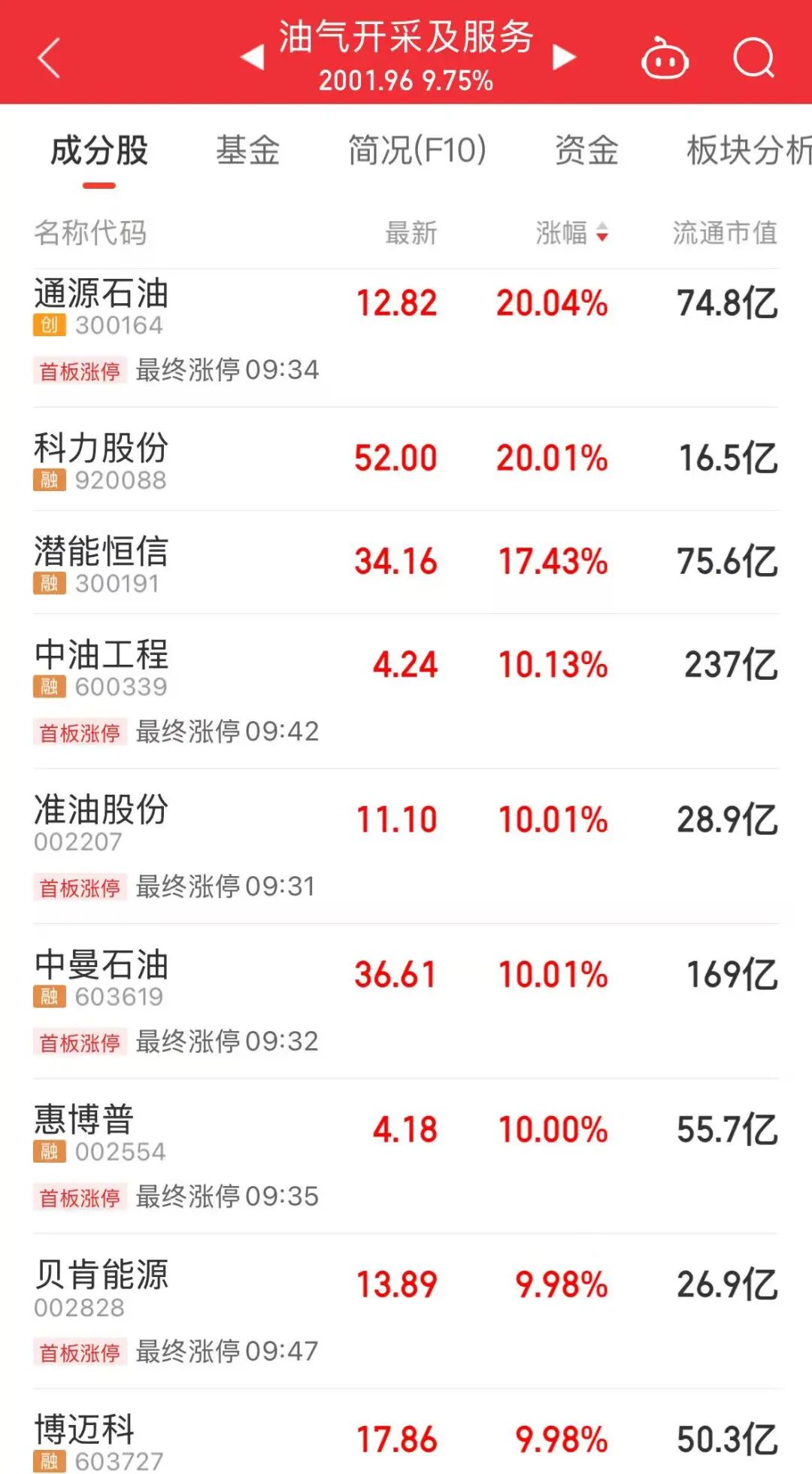
Group 1: Market Overview - On the first trading day of the Year of the Rabbit, A-shares opened higher across the board, with the Shanghai Composite Index rising by 0.59%, the Shenzhen Component Index by 0.93%, and the ChiNext Index by 0.67%, while the Sci-Tech Innovation Index fell by 1.26% [1] - Cyclical stocks led the gains in the morning session, influenced by geopolitical events, with significant increases in oil and gas extraction, non-ferrous metals, and port shipping sectors [1] Group 2: Sector Performance - The oil and gas extraction and service sector saw a notable increase of 9.75%, with individual stocks like Tongyuan Petroleum rising by 20.04%, Keli Co. by 20.01%, and Qianeng Hengxin by 17.43% [2] - Major oil companies collectively saw significant gains, with China National Offshore Oil Corporation (CNOOC) rising over 7% [1] Group 3: Geopolitical Impact - Concerns over reduced oil supply due to geopolitical conflicts have led to a rise in oil prices, with global oil and gas capital expenditures at low levels, indicating potential for upward recovery [5] - The European Union has extended its naval operation in the Red Sea until February 28, 2027, allocating nearly €15 million for operational costs, aimed at maintaining maritime security and ensuring freedom of navigation [5] Group 4: Chemical Sector Insights - The chemical sector showed active performance, particularly in titanium dioxide, glyphosate, and phosphorus chemical industries, with expectations of steady improvement in capacity utilization for phosphoric acid [6] - The supply-demand dynamics for feed-grade calcium phosphate are expected to tighten, with prices anticipated to trend upward due to structural shortages in industrial-grade phosphoric acid [6]

川发龙蟒股价涨5.6%,南方基金旗下1只基金位居十大流通股东,持有1646.29万股浮盈赚取1070.09万元
Xin Lang Cai Jing· 2026-02-24 01:49
Group 1 - The core point of the news is that Sichuan Development Longmang Co., Ltd. experienced a stock price increase of 5.6%, reaching 12.25 CNY per share, with a total market capitalization of 23.124 billion CNY [1] - The company, established on May 20, 1997, and listed on December 3, 2009, operates in financial service outsourcing, express delivery services, and phosphate fertilizer production [1] - The revenue composition of the company includes fertilizer products (45.58%), industrial-grade monoammonium phosphate (22.61%), feed-grade dicalcium phosphate (12.62%), other products (9.04%), trading products (8.44%), and new energy materials (1.71%) [1] Group 2 - Southern Fund's Southern CSI 500 ETF (510500) is among the top ten circulating shareholders of Sichuan Development Longmang, having reduced its holdings by 363,700 shares to 16.4629 million shares, representing 0.87% of circulating shares [2] - The Southern CSI 500 ETF has achieved a year-to-date return of 11.22% and a one-year return of 43.16%, ranking 697 out of 5580 and 1275 out of 4297 respectively [2] - The fund manager, Luo Wenjie, has a tenure of 12 years and 312 days, with the fund's total asset size at 171.358 billion CNY and a best return of 185.44% during his management [3]
川发龙蟒(002312) - 002312川发龙蟒投资者关系管理信息20260206
2026-02-06 09:16
Group 1: Company Overview - Sichuan Development Longmang Co., Ltd. introduced its main business, recent major projects, mineral resources, strategic planning, and core advantages during the investor relations activity [2][3]. Group 2: Product Pricing and Market Conditions - The current market price for 73% industrial-grade monoammonium phosphate is approximately ¥6,500 per ton, while feed-grade dicalcium phosphate is around ¥3,900 per ton [3]. - The company faces increased cost pressure due to rising sulfur prices, which are influenced by supply-demand dynamics [3]. Group 3: Phosphate Resource and Production Capacity - The company has a total phosphate resource reserve of approximately 1.3 billion tons, with an annual production capacity of 4.1 million tons [3]. - The price of 30% grade phosphate rock is expected to maintain a high level, with a projected average price of ¥1,016 per ton in 2025 [3]. Group 4: Strategic Asset Acquisition - The company acquired a 10% stake in Tian Sheng Mining, a subsidiary of its controlling shareholder, which includes a phosphate mine with an estimated resource of approximately 1 billion tons and a designed production capacity of 4.55 million tons per year [3]. - The company is also involved in the Tiger Cave phosphate mine, which has a resource reserve of about 0.75 billion tons and a designed capacity of 3.75 million tons per year [3]. Group 5: Lithium and New Energy Projects - The company is investing ¥366 million in a 100,000 tons/year lithium dihydrogen phosphate project to enhance its new energy materials business [4]. - The company has successfully launched a 60,000 tons/year lithium iron phosphate facility and is collaborating on a 175,000 tons/year high-density lithium iron phosphate project [4]. Group 6: Lithium Resource Development - The company is focusing on securing lithium resources, with ongoing exploration at the Simaozuo lithium spodumene mine, which has an estimated Li2O resource of 14,927 tons [4].
云图控股:依托磷矿资源打造“磷矿—磷酸—磷酸铁/磷复肥”产业链,把磷资源价值“吃干榨尽”
2 1 Shi Ji Jing Ji Bao Dao· 2026-02-05 09:36
Core Viewpoint - The company, Yuntu Holdings, has established a comprehensive industrial chain for phosphoric acid production, maximizing the value of phosphorus resources through a wet phosphoric acid process [1] Group 1: Production Process - The company utilizes phosphate rock and sulfuric acid as raw materials to produce phosphoric acid, which is then classified based on concentration and purity [1] - The industrial chain includes the production of refined phosphoric acid, water-soluble monoammonium phosphate, industrial-grade monoammonium phosphate, iron phosphate, and compound fertilizers [1] Group 2: Sulfuric Acid Production - The wet phosphoric acid production is supported by upstream sulfuric acid capacity, with established production lines for sulfuric acid from both sulfur sand and sulfur [1] - The annual production capacity for sulfuric acid from sulfur sand is 1.35 million tons, while from sulfur it is 1.6 million tons, totaling an annual sulfuric acid capacity of 2.95 million tons [1]

川发龙蟒股价跌5.03%,鹏华基金旗下1只基金位居十大流通股东,持有1698.96万股浮亏损失1053.36万元
Xin Lang Cai Jing· 2026-02-02 06:14
Group 1 - Sichuan Development Longmang Co., Ltd. experienced a decline of 5.03%, with a current stock price of 11.71 yuan per share, a trading volume of 597 million yuan, a turnover rate of 2.66%, and a total market capitalization of 22.105 billion yuan [1] - The company, established on May 20, 1997, and listed on December 3, 2009, is located in Chengdu, Sichuan Province, and its main business includes financial service outsourcing, express delivery services, and phosphate fertilizers [1] - The revenue composition of the company's main business includes: fertilizer products 45.58%, industrial-grade monoammonium phosphate 22.61%, feed-grade dicalcium phosphate 12.62%, other products 9.04%, trading products 8.44%, and new energy materials 1.71% [1] Group 2 - Penghua Fund's Penghua CSI Sub-Industry Chemical Theme ETF Link A (014942) entered the top ten circulating shareholders of Sichuan Development Longmang, holding 16.9896 million shares, accounting for 0.9% of circulating shares, with an estimated floating loss of approximately 10.5336 million yuan [2] - The fund was established on March 8, 2022, with a latest scale of 116 million yuan, and has achieved a year-to-date return of 10.52%, ranking 1107 out of 5580 in its category, and a one-year return of 55.35%, ranking 980 out of 4286 [2] Group 3 - The fund manager of Penghua CSI Sub-Industry Chemical Theme ETF Link A is Yan Dong, who has a cumulative tenure of 6 years and 323 days, with a total fund asset size of 21.796 billion yuan [3] - During Yan Dong's tenure, the best fund return was 456.3%, while the worst return was -40.74% [3]
云图控股:建成从湿法磷酸到磷酸铁、复合肥的磷酸分级利用产业链
2 1 Shi Ji Jing Ji Bao Dao· 2026-01-30 08:43
Core Viewpoint - Yuntu Holdings has established a comprehensive phosphate utilization industrial chain, enhancing resource efficiency and product structure while extending the phosphate industry towards higher value-added products [1] Group 1 - The company has developed a phosphate utilization chain that includes wet-process phosphoric acid, refined phosphoric acid, water-soluble monoammonium phosphate, industrial-grade monoammonium phosphate, iron phosphate, and compound fertilizers [1] - Through multi-path conversion of wet-process phosphoric acid and efficient utilization of by-product resources, the company has improved phosphate resource utilization [1] - The optimization of product structure is aimed at promoting the phosphate industry chain towards high value-added extensions [1]
汶川大地震18年后,这个极重灾区要全力冲刺全国“百强县”
Di Yi Cai Jing· 2026-01-18 04:03
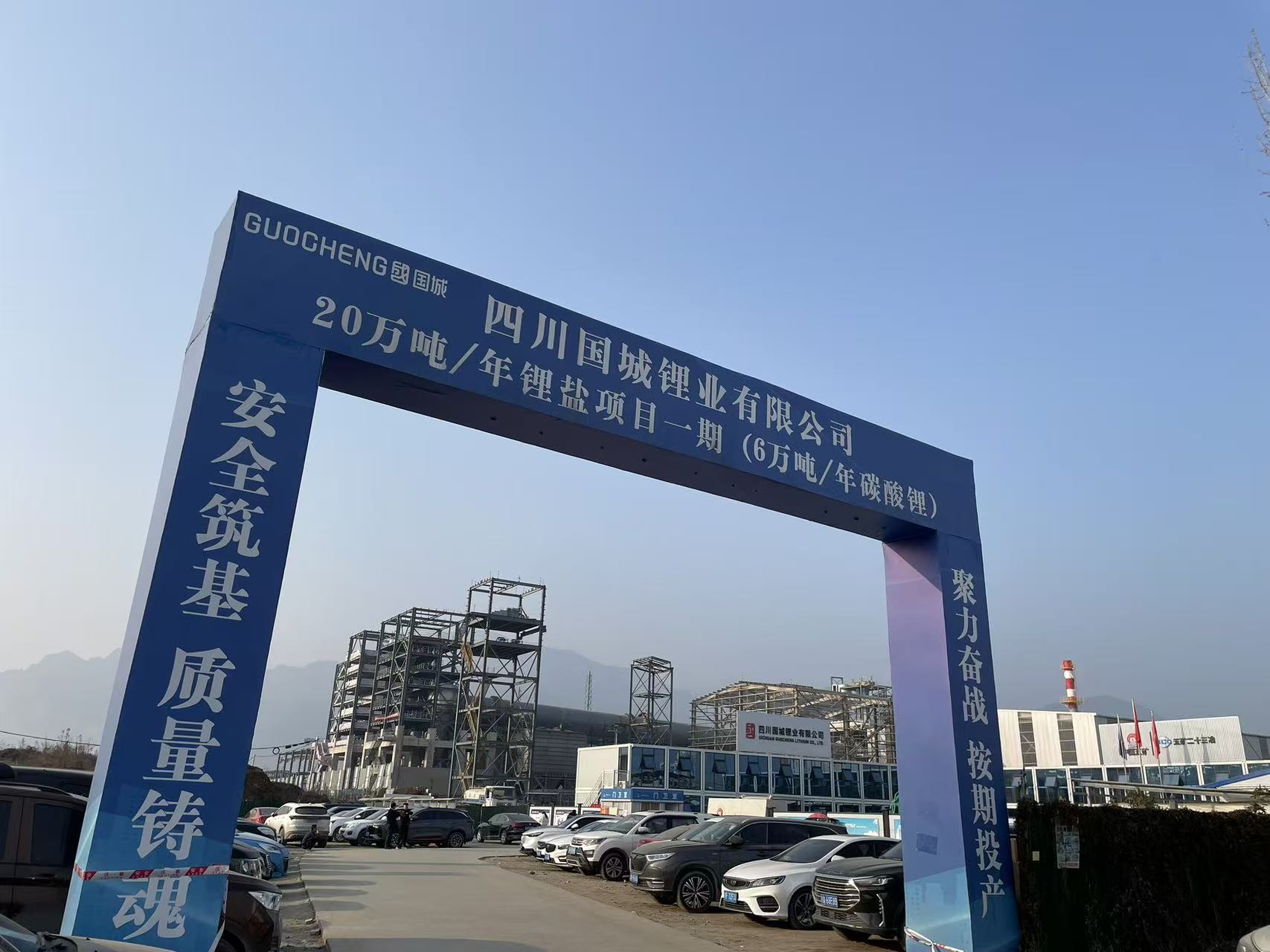
Core Viewpoint - The evolution of Mianzhu's industrial landscape reflects a transition from external support to self-sustaining growth and ultimately to industrial transformation, focusing on lithium battery materials as a strategic industry [1][9]. Group 1: Industrial Development - Mianzhu aims to establish a lithium salt production base with an annual capacity of 200,000 tons, including lithium carbonate, lithium hydroxide, lithium chloride, and lithium metal, with the first phase targeting 60,000 tons of lithium carbonate [1]. - The city has experienced a significant industrial transformation post the Wenchuan earthquake, shifting from traditional industries to a focus on lithium battery materials, positioning itself as a national strategic base for new energy battery materials [1][5]. - The local government plans to achieve a GDP exceeding 50 billion yuan by 2025, with an average annual growth rate of 7.5% during the 14th Five-Year Plan period [10][11]. Group 2: Economic Recovery and Resilience - Mianzhu was historically a strong economic county in Sichuan, but the Wenchuan earthquake caused severe economic and population losses, leading to a significant decline in its economic standing [3][4]. - The relocation of key industrial players like Dongfang Turbine Factory resulted in a loss of over 10,000 jobs and a disruption of the local industrial chain, exacerbating the economic impact on Mianzhu [4]. - The recovery strategy involved not just rebuilding but also restructuring the economy, focusing on high-value industries such as lithium battery materials, leveraging local resources [5][9]. Group 3: Industrial Upgrading and Innovation - Mianzhu is not only developing new industries but also upgrading traditional sectors, particularly in the phosphate mining industry, by focusing on high-end chemical products and establishing a circular economy [7]. - The city has seen significant investments in lithium projects, such as the Sichuan Energy Investment De'a Lithium Industry's 30,000-ton lithium salt project, which is expected to generate an annual output value of approximately 4.5 billion yuan [6]. - The local government is fostering innovation through technology incubators, with 74 companies currently incubated, aiming to enhance the industrial chain through innovation [8]. Group 4: Strategic Goals and Challenges - Mianzhu's government is committed to becoming one of the top 100 counties in China, with a focus on industrial strength, cultural tourism, and quality of life [10][11]. - The city is approaching a GDP of 50 billion yuan, with the competition for inclusion in the national top 100 counties typically requiring a threshold of around 70 billion yuan in the western region [11]. - Challenges include geographic disadvantages that may lead to talent and consumer outflow to larger cities, as well as the cyclical nature of the lithium and chemical materials industries, which could impact economic stability [12].