ZZPZH(600436)
Search documents
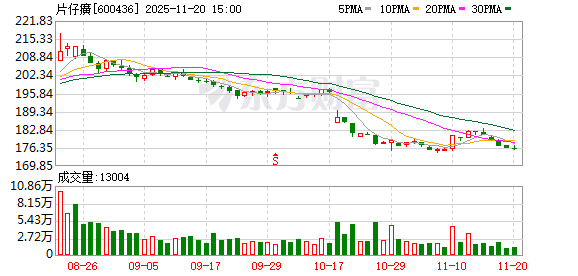
片仔癀涨2.07%,成交额3.28亿元,主力资金净流入1580.65万元
Xin Lang Cai Jing· 2025-11-10 02:54
Core Viewpoint - The stock of Pianzaihuang has shown fluctuations, with a recent increase of 2.07%, but has experienced a year-to-date decline of 15.14% [1] Group 1: Stock Performance - As of November 10, Pianzaihuang's stock price reached 179.30 yuan per share, with a total market capitalization of 108.175 billion yuan [1] - The stock has seen a net inflow of main funds amounting to 15.8065 million yuan, with significant buying and selling activities recorded [1] - Over the past 60 days, the stock has decreased by 10.22%, while it has increased by 0.66% in the last 5 trading days [1] Group 2: Financial Performance - For the period from January to September 2025, Pianzaihuang reported a revenue of 7.442 billion yuan, reflecting a year-on-year decrease of 11.93%, and a net profit of 2.129 billion yuan, down 20.74% year-on-year [2] - Cumulative cash dividends since the A-share listing amount to 8.551 billion yuan, with 4.790 billion yuan distributed in the last three years [3] Group 3: Shareholder Information - As of September 30, 2025, the number of shareholders increased to 130,400, with an average of 4,626 circulating shares per person, a decrease of 8.54% from the previous period [2] - Major shareholders include China Securities Finance Corporation and Hong Kong Central Clearing Limited, with notable changes in their holdings [3]
老登们全崩了
投资界· 2025-11-09 07:47
Group 1: Market Overview - The Shanghai Composite Index is challenging the 4000-point mark, but the market remains highly differentiated, particularly in the traditional high-end consumption sector represented by liquor, which has been stagnant for a long time [4][5] - Despite the overall market conditions, some investors are still betting on liquor stocks, believing that negative news may signal a bottoming out of performance [5][6] Group 2: Liquor Industry Performance - The liquor industry recently reported its worst third-quarter results in history, with 18 listed companies generating a total revenue of 317.65 billion yuan, a year-on-year decline of 5.84%, and a net profit of 122.69 billion yuan, down 6.88% [8][9] - The third quarter saw a significant drop in revenue by 18.42% and a net profit decline of 22.03%, reversing the growth seen in the same period of 2024 [8][9] - Even leading companies like Kweichow Moutai experienced a slowdown, with third-quarter revenue growth dropping to 0.56% and net profit growth to 0.48%, marking their lowest growth rates in recent years [10][11] Group 3: Challenges in the Liquor Market - Kweichow Moutai's pricing strategy has faced challenges, with prices dropping below 1700 yuan, raising concerns among distributors about future business prospects [10][11] - The overall liquor market saw a 20% year-on-year decline in sales during the recent holiday season, indicating persistent issues with high inventory and price discrepancies [11] - The traditional distribution model is under pressure as liquor companies shift towards direct sales and e-commerce, disrupting the established relationships with distributors [11] Group 4: Tea Industry Developments - In contrast to the liquor sector, the high-end tea industry has seen positive developments, with Baima Tea successfully listing on the Hong Kong Stock Exchange after multiple attempts, achieving an 86.7% increase on its first trading day [13][14] - Baima Tea's growth strategy focuses on brand enhancement, standardization, and digitalization, although its performance has shown signs of slowing down with revenue growth dropping to 1.0% [14][15] Group 5: Traditional Medicine Sector - The traditional medicine sector, represented by Pizhou Huang, has also faced significant challenges, reporting a 11.93% decline in revenue and a 20.74% drop in net profit, marking the first time since 2006 that both metrics have decreased [17][19] - The market price of Pizhou Huang has plummeted, with actual prices falling below 600 yuan, a significant drop from its peak [19][20] Group 6: Societal Trends and Consumer Behavior - The changing societal dynamics indicate a shift in consumer preferences, with younger generations moving away from traditional high-end products like liquor and medicine towards more modern and accessible options [21][23] - The established wealth distribution mechanisms are under scrutiny, as the traditional high-end gifts and social currencies lose their appeal among younger consumers [21][23]
老登们的社交货币全崩了
首席商业评论· 2025-11-08 03:50
Group 1: Core Views - The market is experiencing a high degree of differentiation, particularly in the traditional high-end consumer sector represented by liquor, which remains stagnant despite some investors betting on a recovery [4][5]. - The liquor industry has recently faced significant challenges, with major companies reporting substantial declines in revenue and profit, indicating a potential turning point in investor sentiment [7][10]. - In contrast, the high-end tea sector has seen a positive development with the successful IPO of Baima Tea, which experienced a significant stock price increase on its debut, highlighting a shift in investor interest [15][17]. Group 2: Liquor Industry Insights - The liquor industry reported a total revenue of 317.66 billion yuan for the first three quarters of 2025, a year-on-year decline of 5.84%, with net profit down 6.88% to 122.69 billion yuan [7][9]. - The third quarter alone saw a dramatic revenue drop of 18.42% and a net profit decline of 22.03%, reversing the growth trend observed in the previous year [7][10]. - Major players like Kweichow Moutai and Wuliangye have also reported disappointing results, with Moutai's revenue growth slowing to 0.56% and net profit growth to 0.48%, marking the lowest growth rates in recent years [10][11]. Group 3: Tea Industry Developments - Baima Tea's IPO was met with overwhelming demand, achieving over 2680 times subscription, and its stock price surged by 86.7% on the first trading day, indicating strong market interest [15][17]. - The company aims to address industry pain points through brand enhancement and digital transformation, although it faces challenges with a slight contraction in its franchise system [17][18]. - The high-end tea market's success is closely tied to the gifting culture, where the value of products often hinges on social connections rather than the intrinsic quality of the tea itself [18][20]. Group 4: Traditional Medicine Sector - The traditional medicine sector, represented by Pizhou Huang, has also faced significant declines, with a reported revenue of 7.44 billion yuan for the first three quarters, down 11.93%, and net profit down 20.74% [22][25]. - The market price of Pizhou Huang has plummeted, with actual prices falling below 600 yuan, reflecting a significant drop from previous highs [25][26]. - The changing social dynamics and consumer preferences are impacting the perceived value of high-end products in this sector, similar to trends observed in liquor and tea [26][28].
11月7日医疗健康R(480016)指数跌0.39%,成份股泽璟制药(688266)领跌
Sou Hu Cai Jing· 2025-11-07 09:57
Core Viewpoint - The Medical Health R Index (480016) closed at 7535.01 points, down 0.39%, with a trading volume of 21.869 billion yuan and a turnover rate of 0.89% on November 7 [1] Group 1: Index Performance - The index had 26 stocks rising, with Xinhecheng leading at a 4.9% increase, while 23 stocks fell, with Zaiqing Pharmaceutical leading the decline at 4.35% [1] - The top ten constituent stocks of the Medical Health R Index are primarily in the pharmaceutical and medical sectors, with notable weights and market capitalizations [1] Group 2: Key Constituents - WuXi AppTec (sh603259) holds a weight of 13.66% with a market cap of 282.98 billion yuan, closing at 94.84 yuan, down 0.89% [1] - Hengrui Medicine (sh600276) has an 11.00% weight, a market cap of 408.72 billion yuan, and closed at 61.58 yuan, down 1.35% [1] - Mindray Medical (sz300760) has a weight of 7.57%, a market cap of 249.51 billion yuan, and closed at 205.79 yuan, down 0.27% [1] - Other notable constituents include United Imaging Healthcare (sh688271), Pianzai Shou (sh600436), and Xinhecheng (sz002001), which saw a 4.9% increase [1] Group 3: Capital Flow - The Medical Health R Index constituents experienced a net outflow of 240 million yuan from institutional investors and 119 million yuan from retail investors, while retail investors saw a net inflow of 359 million yuan [1] - Specific stocks like Huazhong Pharmaceutical (000999) and Yuyue Medical (002223) showed significant net inflows and outflows among different investor types [2]
老登们的社交货币全崩了
投中网· 2025-11-07 06:46
Group 1: Market Overview - The Shanghai Composite Index is challenging the 4000-point mark, but the market remains highly differentiated, particularly in the traditional high-end consumption sector represented by liquor, which is in a prolonged stagnation phase [6][11]. - Despite limited market funds seemingly abandoning the shift from tech stocks to traditional consumer stocks, some investors are still betting on liquor stocks, believing in a potential recovery after significant negative news [7][11]. Group 2: Liquor Industry Performance - The liquor industry recently reported its worst third-quarter performance, with 18 listed companies achieving a total revenue of 317.66 billion yuan, a year-on-year decline of 5.84%, and a net profit of 122.69 billion yuan, down 6.88% [11][12]. - The third quarter saw a dramatic year-on-year revenue drop of 18.42% and a net profit decline of 22.03%, reversing the growth trend observed in the same period of the previous year [11][12]. - Even leading companies like Kweichow Moutai experienced a significant slowdown, with third-quarter revenue growth dropping to 0.56% and net profit growth to 0.48%, marking the lowest growth rates in recent years [12][14]. Group 3: Challenges in the Liquor Market - Kweichow Moutai's pricing issues are emblematic of broader operational challenges, with its flagship product's price falling below 1700 yuan, a significant drop from previous highs [14][15]. - The overall liquor market is facing a decline in sales volume, with a 20% drop during key festive periods, and high inventory levels leading to price inversions affecting half of the companies [16]. - The traditional distribution model is under strain as companies like Moutai shift towards direct sales and e-commerce, disrupting the established dealer network and altering market dynamics [16]. Group 4: Tea Industry Developments - In contrast to the liquor sector, the high-end tea industry has seen positive developments, with Baima Tea successfully listing on the Hong Kong Stock Exchange after multiple failed attempts, achieving an impressive 86.7% increase on its first trading day [18][19]. - Baima Tea's growth strategy focuses on brand enhancement, digitalization, and addressing industry pain points, although its franchise system has shown slight contraction [19]. - The high-end tea market heavily relies on the gift market, and the performance of tea companies is closely tied to their ability to navigate complex social and business relationships [20][22]. Group 5: Broader Consumer Trends - The liquor and tea industries are both attempting to connect with younger consumers, while traditional products like Pizhou Huang are struggling, with significant declines in revenue and profit [23][26]. - The market for high-end gifts and social currencies like liquor and traditional medicine is under pressure as societal dynamics shift, leading to a reevaluation of their long-term appeal [28][30].
中老年投资者们的社交货币玩不转了
Xin Lang Cai Jing· 2025-11-07 03:05
Group 1: White Wine Industry - The white wine industry reported a significant decline in performance, with total revenue for the first three quarters of 2025 reaching 317.66 billion yuan, a year-on-year decrease of 5.84%, and net profit totaling 122.69 billion yuan, down 6.88% [5] - The third quarter alone saw a dramatic drop in revenue by 18.42% and net profit by 22.03%, reversing the growth trend observed in the same period of 2024 [5] - Major companies like Kweichow Moutai and Wuliangye experienced varying degrees of decline, with Moutai's revenue growth slowing to 0.56% and net profit growth to 0.48%, marking the lowest growth rates in recent years [7][8] - The overall market for white wine is facing challenges, including high inventory levels, price inversions, and a significant drop in sales during key festive periods, with a reported 20% decline in sales volume [9][10] Group 2: Tea Industry - In contrast to the white wine sector, the high-end tea industry saw a positive development with the successful IPO of Baima Tea, which achieved an impressive 86.7% increase on its first trading day, reaching a market value close to 8 billion HKD [10][11] - Baima Tea aims to address industry pain points through brand standardization and digitalization, although it has faced a slight contraction in its franchise system [11] - The company's performance has shown signs of slowing growth, with a projected revenue increase of only 1.0% for 2024, and a decline in both revenue and net profit in the first half of the year [11] Group 3: Traditional Chinese Medicine - The traditional Chinese medicine sector, represented by Pianzaihuang, reported its worst performance in history, with revenue of 7.44 billion yuan and a net profit of 2.13 billion yuan, both down significantly year-on-year [15][16] - The market price of Pianzaihuang has plummeted, with actual market prices dropping below 600 yuan, reflecting a more than 60% decline from its peak [19][20] - The changing market dynamics indicate a shift in consumer perception and demand for high-end gifts and social currencies, suggesting a downward trend in prices for these products [21]
片仔癀、安宫牛黄丸量价齐跌,高价中药消费逻辑生变
Sou Hu Cai Jing· 2025-11-06 10:17
Core Insights - The high-priced traditional Chinese medicine (TCM) products, such as An Gong Niu Huang Wan and Pian Zai Huang, are experiencing a decline in both sales and prices, prompting investors to reconsider the consumption logic of these products [2][3][4]. Group 1: Sales and Price Trends - An Gong Niu Huang Wan and Pian Zai Huang have seen a significant drop in sales and prices, with Pian Zai Huang's revenue decreasing by 11.93% and net profit down by 20.74% in the first three quarters of the year [4]. - The retail price of Pian Zai Huang has fallen below the official guidance price of 760.00 yuan per piece, with online platforms offering prices as low as 588.60 yuan [4][5]. - An Gong Niu Huang Wan is also facing price declines, with sales figures indicating a broader trend affecting high-priced TCM products [5]. Group 2: Market Dynamics - The decline in high-priced TCM sales is attributed to a fundamental change in consumer behavior, shifting from luxury and gift-giving to a focus on genuine patient needs [5][10]. - Tightening medical insurance policies have also impacted sales, as certain high-priced products are not fully covered, affecting consumer purchasing decisions [5][10]. - Despite the decline in high-priced TCM, there is a growing demand for anti-aging and health supplement products, which are becoming key drivers of growth in the health market [9][10]. Group 3: Growth in Alternative Products - Products like Gui Ling Ji and Ba Zi Bu Shen capsules are witnessing steady price and sales increases, indicating a shift in consumer preference towards health and wellness products [1][10]. - The market for health supplements, particularly those targeting the aging population, is expanding, with significant growth reported in products like Ejiao, which saw a 16.48% increase in sales in 2024 [11][14]. - The aging population in China is projected to reach 310.31 million by the end of 2024, representing 22.0% of the total population, further driving demand for health-related products [10].
老登们的社交货币全崩了
虎嗅APP· 2025-11-06 09:34
Group 1: Core Views - The market is experiencing a significant divergence, particularly in the traditional high-end consumption sector represented by liquor, which has been stagnant for a long time [4][5]. - Despite the challenges, some investors are optimistic about traditional liquor stocks, as evidenced by the surge in the liquor sector following negative news about Wuliangye [5][6]. - The generational divide in investment preferences is becoming more pronounced, with younger investors favoring emerging industries and high valuations, while older investors remain committed to traditional sectors [5][7]. Group 2: Liquor Industry - The liquor industry has reported its worst third-quarter performance, with 18 listed companies generating a total revenue of 317.66 billion yuan, a year-on-year decline of 5.84%, and a net profit of 122.69 billion yuan, down 6.88% [9][11]. - The third quarter saw a dramatic revenue drop of 18.42% and a net profit decline of 22.03%, reversing the growth trend seen in 2024 [9][11]. - Even leading companies like Kweichow Moutai are facing challenges, with third-quarter revenue growth slowing to 0.56% and net profit growth to 0.48%, marking their lowest growth rates in recent years [11][13]. Group 3: Tea Industry - The high-end tea sector has seen positive developments, with Baima Tea successfully listing on the Hong Kong Stock Exchange after multiple failed attempts, achieving an 86.7% increase on its first trading day [18][19]. - Despite the initial success, Baima Tea's performance is showing signs of slowing growth, with a projected revenue growth of only 1.0% for 2024 and a decline in revenue and net profit in the first half of the year [20][19]. - The business model of Baima Tea relies heavily on high-end gift markets, which may not be sustainable in the long term [20][22]. Group 4: Traditional Medicine - The traditional medicine sector, represented by Pianzaihuang, is struggling, with a reported revenue of 7.44 billion yuan for the first three quarters, down 11.93%, and a net profit of 2.13 billion yuan, down 20.74% [24][25]. - The market price of Pianzaihuang has significantly dropped, with some platforms reporting prices below 600 yuan, a decline of over 60% from its peak [27][28]. - The changing market dynamics suggest that the value of high-end gifts and social currencies like liquor and traditional medicine may continue to decline as consumer preferences shift [29][30].
4年跌去1800亿,“药茅”片仔癀跌落神坛?
Ge Long Hui· 2025-11-05 11:55
Core Viewpoint - The myth surrounding the "medicine Maotai" is gradually collapsing, as evidenced by the significant decline in the prices and performance of Pizhouhuang, a well-known traditional Chinese medicine [1][2]. Group 1: Price and Performance Decline - Pizhouhuang's price has dropped from a peak of 1600 yuan per piece to around 600 yuan, even below the official guidance price of 760 yuan [2][10]. - Since its historical high in July 2021, Pizhouhuang's stock price has decreased by 60%, with its market capitalization shrinking from nearly 300 billion yuan to approximately 105.9 billion yuan, resulting in a loss of over 180 billion yuan [3][12]. - The company reported its worst performance ever in Q3 2025, with revenue down 11.93% and net profit down 20.74% year-on-year [12][16]. Group 2: Cost and Margin Pressures - The gross margin of Pizhouhuang has fallen below 40% for the first time in a decade, with the gross margin of its core product series dropping nearly 10 percentage points [17][18]. - The price of key raw materials, such as natural bezoar, has surged over 400% since 2019, while the price of natural musk has also increased by over 200% in recent years [19][20]. Group 3: Market Dynamics and Sales Challenges - The decline in sales volume has led to a price inversion in the retail market, where high prices have resulted in lower sales, creating a vicious cycle [20][22]. - The market's enthusiasm for Pizhouhuang has waned following the end of speculative trading, contributing to the company's struggles [23][28]. Group 4: Strategic Challenges and Future Outlook - Pizhouhuang's efforts to diversify its product line have not yet yielded significant results, with its cosmetics business revenue declining by 23.82% in Q3 2025 [31][35]. - The company has made several acquisitions and investments to seek new growth avenues, but these initiatives have not produced notable outcomes so far [39][41]. - Despite the challenges, Pizhouhuang retains its status as a leading player in the liver disease treatment market, with its unique formula and brand still providing a competitive edge [45][46].
老登们的社交货币全崩了
3 6 Ke· 2025-11-05 10:29
Group 1: Market Overview - The Shanghai Composite Index is challenging the 4000-point mark, but the market remains highly differentiated, particularly in the traditional high-end consumption sector represented by liquor, which has been stagnant for a long time [1][4] - Limited market funds seem to have completely abandoned the shift from technology stocks back to traditional consumer stocks, although some investors are still betting on liquor stocks for a brighter future [1][4] - The liquor sector experienced a significant surge despite the historical negative news from Wuliangye, reflecting an optimistic investment sentiment that the bottom has been established [1][4] Group 2: Liquor Industry Performance - The liquor industry reported its worst third-quarter results in history, with 18 listed companies achieving a total revenue of 317.66 billion yuan, a year-on-year decline of 5.84%, and a net profit of 122.69 billion yuan, down 6.88% [5][4] - The third quarter saw a dramatic revenue drop of 18.42% and a net profit decline of 22.03%, significantly worse than the average decline in the first three quarters [5][4] - Even leading companies like Kweichow Moutai reported a third-quarter revenue growth rate of only 0.56% and a net profit growth rate of 0.48%, marking their lowest growth rates in recent years [8][9] Group 3: Kweichow Moutai's Challenges - Kweichow Moutai is facing severe operational issues, with its flagship product's price dropping below 1700 yuan, a significant decline during peak consumption seasons [9][8] - The traditional distribution model is under pressure as the company shifts towards direct sales and e-commerce platforms, disrupting the traditional dealer system [9][12] - The liquor industry's long-standing "strong factory, weak dealer" situation is being challenged as the market dynamics shift [11][12] Group 4: Tea Industry Developments - In contrast to the liquor sector, the high-end tea industry has seen positive developments, with Baima Tea successfully listing on the Hong Kong Stock Exchange, achieving an 86.7% increase on its first trading day [13][15] - Baima Tea aims to address industry pain points through brand upgrading and digitalization, although its performance has shown signs of slowing growth [15][13] - The high-end tea market is characterized by a complex relationship between product value and social connections, with the actual value often tied to the networking opportunities it provides [16][15] Group 5: Traditional Chinese Medicine - The traditional Chinese medicine sector, represented by Pian Zai Huang, reported its worst performance in history, with a revenue of 7.442 billion yuan, down 11.93%, and a net profit of 2.129 billion yuan, down 20.74% [19][22] - The market price of Pian Zai Huang has significantly dropped, reflecting a broader decline in the perceived value of high-end medicinal products [22][23] - The changing social dynamics and consumer preferences are leading to a reevaluation of the value of traditional high-end products like liquor and medicine [24][25]