
TJPC(600488)

Search documents
3.62亿天价罚单!医药垄断黑幕曝光,幕后操盘手竟是“药贩子”
Xin Lang Zheng Quan· 2025-06-18 09:34
Core Viewpoint - The recent penalty imposed by the State Administration for Market Regulation has exposed a hidden monopoly network in the pharmaceutical industry, with significant financial repercussions for the involved parties [1]. Group 1: Monopoly Scheme - A gathering organized by an individual named Guo in November 2021 led to a verbal agreement among four pharmaceutical companies to stop price competition and collectively raise prices [2]. - To evade regulatory scrutiny, the companies coordinated price hikes through Guo, using communication methods such as WeChat and phone calls [2]. Group 2: Price Surge - Following the agreement, the four companies collectively halted supply in January 2022, causing a severe market supply shortage [3]. - The price of the raw material dexamethasone skyrocketed from 8,000 yuan per kilogram to 13,800 yuan, marking a 72% increase [3]. - The price of dexamethasone injection surged from 0.35 yuan per unit to nearly 100 yuan, with some hospitals in Guangxi purchasing it at 60 yuan per unit, reflecting an alarming increase [3]. Group 3: Penalties and Legal Framework - The leniency policy in antitrust cases played a crucial role, with Tianyao Pharmaceutical receiving an 80% reduction in fines after self-reporting and providing key evidence, resulting in a total penalty of 69.19 million yuan [4]. - In contrast, Xianju Pharmaceutical faced a maximum fine of nearly 195 million yuan due to its failure to apply for leniency [4]. - All responsible individuals from the four companies were fined 600,000 yuan each [4]. Group 4: Regulatory Environment - The case is part of a broader trend, with multiple antitrust cases in the pharmaceutical sector being investigated in recent years, including those involving acetic acid and other raw materials [5]. - The regulatory framework has been strengthened with the introduction of the "Raw Material Drug Antitrust Guidelines" in 2021 and the "Drug Sector Antitrust Guidelines" set for 2025, establishing a comprehensive regulatory system [5]. - Antitrust enforcement is increasingly focused on essential sectors like pharmaceuticals, with new major cases leading to price reductions of up to 62% for involved drugs [5].


因垄断地塞米松原料价格 津药药业等四家药企被罚3.62亿元
Huan Qiu Wang· 2025-06-17 09:28
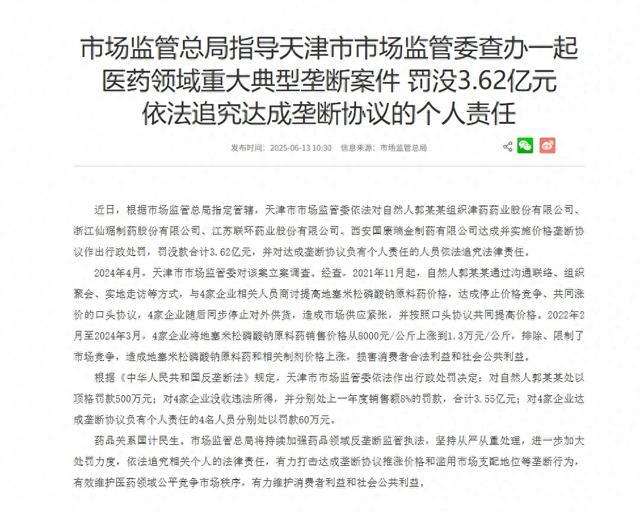
Core Viewpoint - Four pharmaceutical companies, including Tianjin Pharmaceutical Co., Ltd. (Tianjin Pharma), Zhejiang Xianju Pharmaceutical Co., Ltd. (Xianju Pharma), Jiangsu Lianhuan Pharmaceutical Co., Ltd. (Lianhuan Pharma), and Xi'an Guokang Ruijin Pharmaceutical Co., Ltd., were fined a total of 362 million yuan for price-fixing of dexamethasone raw materials, with Tianjin Pharma being penalized for the fourth time for similar monopolistic behavior [1][2][4]. Group 1: Companies Involved - Tianjin Pharma, Xianju Pharma, Lianhuan Pharma, and Xi'an Guokang Ruijin Pharma were involved in a price-fixing scheme for dexamethasone, leading to a significant increase in prices from 8,000 yuan/kg to 13,000 yuan/kg between February 2022 and March 2024 [2][4]. - Tianjin Pharma has a history of monopolistic practices, having been penalized multiple times since 2021 for various violations of antitrust laws [4][5]. - Lianhuan Pharma's fine represents 72.53% of its net profit, significantly impacting its financial performance [6][8]. Group 2: Regulatory Actions - The Tianjin Municipal Market Supervision Administration imposed fines based on the companies' previous year's sales, totaling 355 million yuan, along with confiscation of illegal gains [2][7]. - The regulatory body emphasized the importance of maintaining fair competition in the pharmaceutical sector and indicated a commitment to stricter enforcement of antitrust laws [2][4]. - Lianhuan Pharma has submitted a hearing request to reduce its penalties, but the regulatory authority rejected its arguments, affirming the validity of the evidence against the company [7]. Group 3: Financial Impact - Lianhuan Pharma reported revenues of 2.174 billion yuan and 2.160 billion yuan for 2023 and 2024, respectively, with net profits declining by 4.5% and 37.66% [6][8]. - The fine imposed on Lianhuan Pharma will reduce its net profit for 2025 by approximately 61.04 million yuan [8]. - Tianjin Pharma's market influence is significant, with a strong presence in the domestic market for steroid hormone raw materials [5].


四药企串通抬价被罚3.55亿,个人顶格罚500万
Bei Jing Wan Bao· 2025-06-17 06:16
Core Viewpoint - The National Market Supervision Administration has imposed a total fine of 355 million yuan on four pharmaceutical companies for colluding to raise the price of dexamethasone phosphate raw materials, which saw a price increase of up to 282 times [1] Group 1: Companies Involved - Four companies involved in the price-fixing scheme include Tianjin Pharmaceutical Co., Jiangsu Lianhuan Pharmaceutical Co., Xi'an Guokang Ruijin Pharmaceutical Co., and Zhejiang Xianju Pharmaceutical Co. [1] - The organizer of the collusion, identified as Guo, was fined the maximum amount of 5 million yuan, while four responsible individuals from the companies were fined 600,000 yuan each [1] Group 2: Price Increases - Dexamethasone phosphate raw material prices were raised significantly, with Tianjin Pharmaceutical increasing prices from 9,000 yuan/kg to 13,800 yuan/kg, and Xi'an Guokang Ruijin raising prices from 7,900 yuan/kg to between 10,000 and 38,000 yuan/kg [1] - Zhejiang Xianju Pharmaceutical raised prices from 8,200 yuan/kg to 10,000 yuan/kg, while Jiangsu Lianhuan increased prices from 7,800 yuan/kg to 15,000 yuan/kg [1] Group 3: Market Impact - The collusion led to a severe market supply shortage, with the price of dexamethasone phosphate injection skyrocketing from 0.35 yuan per dose to 98.76 yuan per dose, marking a staggering increase of 282 times [1] - As of March 7, 2024, the monopolistic pricing of dexamethasone phosphate raw materials was still being enforced [1] Group 4: Legal Consequences - The total illegal gains from the price-fixing scheme were calculated as follows: Tianjin Pharmaceutical Co. 42,764,400 yuan, Zhejiang Xianju Pharmaceutical Co. 23,746,680 yuan, Xi'an Guokang Ruijin Pharmaceutical Co. 24,763,156 yuan, and Jiangsu Lianhuan Pharmaceutical Co. 17,899,200 yuan [1] - The fines imposed on the four companies amounted to 355 million yuan, which includes the confiscation of illegal gains and an additional penalty of 8% of the previous year's sales [1]
津药药业四年4起垄断被罚没1.7亿 时任代理董事长刘欣领罚60万
Chang Jiang Shang Bao· 2025-06-16 01:23
Core Viewpoint - Tianjin Pharmaceutical Industry (津药药业) has repeatedly violated antitrust laws, resulting in significant administrative penalties totaling 362 million yuan for price-fixing agreements with other companies in the industry [1][2][10]. Summary by Relevant Sections Antitrust Violations and Penalties - On June 13, the State Administration for Market Regulation announced penalties against Tianjin Pharmaceutical and three other companies for engaging in price-fixing agreements, with a total fine of 362 million yuan [1]. - The company has been penalized a total of 171 million yuan over four antitrust violations in the past four years [2][10]. Price Increases - On February 21, 2022, Tianjin Pharmaceutical raised the price of dexamethasone phosphate raw materials from 9,000 yuan per kilogram to 13,800 yuan per kilogram, an increase of over 53% [4][5]. Management Accountability - Liu Xin, the general manager of Tianjin Pharmaceutical, was fined 600,000 yuan for his role in the antitrust violations [5][6]. - Following the penalties, Liu Xin was no longer listed among the company's executives after a board reshuffle in September 2023 [1][6]. Previous Violations - Since April 2021, Tianjin Pharmaceutical has faced three additional penalties for violating antitrust laws, indicating a pattern of non-compliance [1][7].
天津市市场监督管理委员会行政处罚决定书 津市监垄处〔2025〕1号
Zhong Guo Zhi Liang Xin Wen Wang· 2025-06-13 14:31
Group 1 - The company involved is Tianjin Pharmaceutical Co., Ltd., which is engaged in the production of pharmaceuticals, veterinary drugs, cosmetics, and food additives [1][2] - The company and its representatives are accused of violating the Anti-Monopoly Law by engaging in monopolistic behavior with competitors [2][3] - The investigation was initiated based on a tip-off from the State Administration for Market Regulation, leading to a formal inquiry into the company's practices [2][3] Group 2 - The primary product involved is Dexamethasone Sodium Phosphate, a key raw material for producing Dexamethasone injection, which is used for treating various inflammatory diseases and has been included in COVID-19 treatment protocols [4][6] - The company, along with three other competitors, was found to have a direct competitive relationship in the production and sale of this raw material [6][7] Group 3 - Evidence indicates that the company participated in a price-fixing agreement for Dexamethasone Sodium Phosphate, which included a meeting on November 20, 2021, to discuss price increases and the cessation of price competition [7][8] - The company raised the price of Dexamethasone Sodium Phosphate from 9,000 yuan per kilogram to 13,800 yuan per kilogram in February 2022, following the agreement [7][9] Group 4 - The company reported illegal earnings of 42,764,400 yuan from the price-fixing activities [9] - Following the investigation, the company applied for leniency and began to lower prices in June 2024, indicating a willingness to rectify its actions [10][13] Group 5 - The administrative penalties imposed include the confiscation of illegal earnings and a fine based on the company's sales revenue, with a total penalty amounting to 69,192,350.36 yuan [13][14] - The company's general manager, Liu Xin, was also fined 600,000 yuan for personal responsibility in the monopolistic practices [15]
四家药企联合涨价被罚
券商中国· 2025-06-13 12:56
Core Viewpoint - The article discusses two significant antitrust enforcement cases in the pharmaceutical sector, highlighting the illegal price-fixing activities of four companies regarding the raw material dexamethasone phosphate, which led to substantial fines and penalties [1][2]. Group 1: Antitrust Cases - The first case involves the price-fixing of dexamethasone phosphate raw materials, where four companies collectively raised the price from 8,000 yuan per kilogram to 13,000 yuan, resulting in a total fine and confiscation of 362 million yuan [1]. - The companies involved in the price-fixing scheme include Tianjin Pharmaceutical Co., Zhejiang Xianju Pharmaceutical Co., Jiangsu Lianhuan Pharmaceutical Co., and Xi'an Guokang Ruijin Pharmaceutical Co. [1]. - The investigation revealed that starting from November 2021, an individual named Guo organized meetings and discussions among the companies to agree on price increases, leading to a significant reduction in market competition and increased healthcare costs for consumers [1]. Group 2: Penalties and Enforcement Actions - The Tianjin Market Supervision Administration imposed a maximum fine of 5 million yuan on the individual Guo, while the four companies were fined a total of 354 million yuan based on 8% of their previous year's sales [2]. - Additionally, four responsible individuals from the companies were fined 600,000 yuan each for their roles in the antitrust agreement [2]. - In a related case, a separate antitrust investigation into the injection of neostigmine methylsulfate resulted in fines totaling 223 million yuan, marking the first time personal responsibility for antitrust agreements was pursued against individuals [2].

四家药企联合涨价被罚
Zhong Guo Xin Wen Wang· 2025-06-13 09:56
Group 1 - The State Administration for Market Regulation announced two antitrust enforcement cases in the pharmaceutical sector during a press conference on June 13, 2023 [1] - In the case involving the raw material drug Dexamethasone Sodium Phosphate, four companies collectively raised the price from 8,000 yuan per kilogram to 13,000 yuan, resulting in a total fine of 362 million yuan [1][2] - The companies involved in the price-fixing agreement included Tianjin Jiyuan Pharmaceutical Co., Zhejiang Xianju Pharmaceutical Co., Jiangsu Lianhuan Pharmaceutical Co., and Xi'an Guokang Ruijin Pharmaceutical Co. [1] Group 2 - The Tianjin Market Regulation Commission imposed administrative penalties, including a maximum fine of 5 million yuan on individual Guo, and confiscated illegal gains from the four companies, totaling 354 million yuan [2] - Each of the four companies was fined 8% of their previous year's sales for participating in the price-fixing agreement, and four responsible individuals were fined 600,000 yuan each [2] - In March 2023, authorities also penalized companies involved in a separate case regarding the injection of Neostigmine Methylsulfate, with total fines amounting to 223 million yuan [2]
四药企及组织者因垄断协议被罚3.6亿:首例个人顶格处罚
3 6 Ke· 2025-06-12 23:32
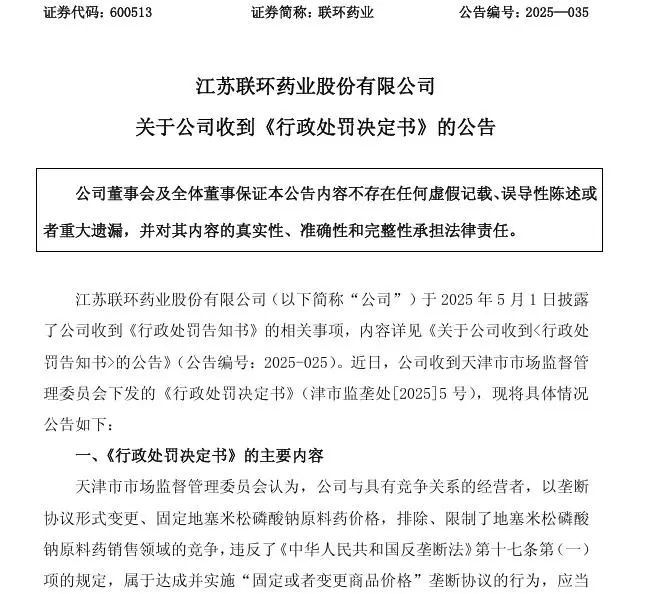
Core Viewpoint - Jiangsu Lianhuan Pharmaceutical Co., Ltd. was fined approximately 61.04 million yuan for violating the Anti-Monopoly Law during the sale of the raw material dexamethasone phosphate sodium, marking a significant enforcement action under the revised law [1][2][4][5]. Summary by Relevant Sections Administrative Penalties - The total fines from this series of cases exceed 360 million yuan, with Lianhuan Pharmaceutical's fine being a substantial part of this total [7]. - Lianhuan Pharmaceutical was fined 61.04 million yuan, which includes the confiscation of illegal gains of 17.89 million yuan and a fine of approximately 43.14 million yuan based on 8% of its 2023 sales [4][8]. Case Background - The case involved four pharmaceutical companies colluding to raise prices of dexamethasone phosphate sodium, a critical drug for treating severe COVID-19 cases, leading to increased costs for patients and healthcare systems [8][10]. - The collusion lasted for about two and a half years, starting from November 20, 2021, when the agreement was made during a meeting organized by an individual named Guo [8][21]. Enforcement Trends - The case highlights a trend of stricter enforcement of anti-monopoly laws, particularly in the pharmaceutical sector, where raw material monopolies have become a focus for regulatory bodies [10][11]. - The penalties reflect a dual approach of strict punishment for violations and incentives for compliance, as seen in the differentiated penalties based on cooperation with investigations [13][14]. Implications for the Industry - The case serves as a warning for pharmaceutical companies regarding the risks of horizontal agreements and the need for comprehensive compliance systems to prevent anti-competitive behavior [14]. - Companies are encouraged to establish internal reporting mechanisms and crisis response strategies to mitigate risks associated with anti-monopoly violations [14].
“救命药”变“暴利药”!3家药企被重罚3.26亿
21世纪经济报道· 2025-06-12 15:39
Core Viewpoint - The article discusses a recent monopoly case in the raw material drug sector, highlighting the significant penalties imposed on several pharmaceutical companies for price manipulation of dexamethasone phosphate sodium, which has seen a dramatic price increase during the COVID-19 pandemic [3][5][9]. Group 1: Penalties and Financial Impact - Lianhuan Pharmaceutical was fined 61.0382 million yuan, accounting for 72.53% of its projected net profit for 2024 [3][10]. - The total fines for the three involved companies reached 326 million yuan [3]. - The price of dexamethasone surged from 0.35 yuan to 98.76 yuan per unit, a staggering increase of 282 times [5][8]. Group 2: Nature of the Monopoly - The involved companies engaged in a horizontal monopoly agreement, agreeing to stop price competition and raise prices collectively [6][9]. - The actions of these companies are characterized as typical collusion, which is often difficult to detect externally [6][11]. - A key individual organized meetings among the companies to discuss price increases, ensuring the implementation of the monopoly agreement [16][17]. Group 3: Regulatory Environment and Future Implications - The article emphasizes the need for stricter compliance and internal management within pharmaceutical companies to avoid similar incidents in the future [21]. - The penalties serve as a warning to the industry, indicating that both state-owned and private enterprises will face legal consequences for monopolistic behavior [21][22]. - The regulatory framework is evolving, with new guidelines set to enhance oversight in the pharmaceutical sector, including provisions for reverse payment agreements and indirect price fixing [22][23].

每周股票复盘:津药药业(600488)每股派发现金红利0.098元
Sou Hu Cai Jing· 2025-06-07 08:31
公司公告汇总 津药药业股份有限公司发布2024年年度权益分派实施公告,主要内容如下: 以上内容为证券之星据公开信息整理,由AI算法生成(网信算备310104345710301240019号),不构成 投资建议。 A股每股现金红利0.098元。 股权登记日为2025年6月11日,除权(息)日和现金红利发放日均为2025年6月12日。 分红方案经2025年4月16日的2024年年度股东大会审议通过,以总股本1091886680股为基数,每股 派发现金红利0.098元(含税),共计派发107004894.64元。 无限售条件流通股的红利委托中国结算上海分公司派发,天津药业集团有限公司等三家股东的现 金红利由公司自行发放。 对于无限售条件流通股个人股东及证券投资基金,持股期限超过1年的暂免征收个人所得税;持股 1年以内的,暂不扣缴个人所得税,待个人转让股票时再计算应纳税额。 对于合格境外机构投资者(QFII)和香港联交所投资者,按照10%的税率代扣代缴企业所得税, 税后每股实际派发现金红利0.0882元。 公司联系方式:邮箱tjpc600488@vip.sina.com,地址天津开发区黄海路221号,电话022- 6 ...