
EGING PV(600537)

Search documents
86只A股筹码大换手(1月19日)


Zheng Quan Shi Bao Wang· 2026-01-19 09:32
Market Overview - As of January 19, the Shanghai Composite Index closed at 4114.00 points, up 12.09 points, with a gain of 0.29% [1] - The Shenzhen Component Index closed at 14294.05 points, up 12.97 points, with a gain of 0.09% [1] - The ChiNext Index closed at 3337.61 points, down 23.41 points, with a decline of 0.70% [1] Stock Performance - A total of 86 A-shares had a turnover rate exceeding 20%, indicating significant trading activity [1] - Key stocks with high turnover rates included: - Kema Materials (科马材料) with a turnover rate of 62.05% and a closing price of 40.25 yuan, down 26.75% [1] - Kuntai Co. (坤泰股份) with a turnover rate of 54.99% and a closing price of 24.74 yuan, up 4.70% [1] - Sanbian Technology (三变科技) with a turnover rate of 48.63% and a closing price of 21.97 yuan, up 10.02% [1] - Nabichuan (纳百川) with a turnover rate of 44.29% and a closing price of 80.88 yuan, up 8.83% [1] - Hongxiang Co. (红相股份) with a turnover rate of 40.96% and a closing price of 17.99 yuan, up 15.17% [1] Notable Stocks - Other notable stocks with high turnover rates included: - Kangqiang Electronics (康强电子) at 40.96% turnover, closing at 23.48 yuan, up 7.46% [1] - Fangzheng Electric (方正电机) at 39.47% turnover, closing at 16.53 yuan, up 5.09% [1] - Shuangjie Electric (双杰电气) at 39.16% turnover, closing at 14.82 yuan, up 20.00% [1] - Deen Precision (德恩精工) at 39.15% turnover, closing at 24.19 yuan, up 2.76% [1] - C Zhi Xin (C至信) at 37.80% turnover, closing at 52.04 yuan, down 6.54% [1]
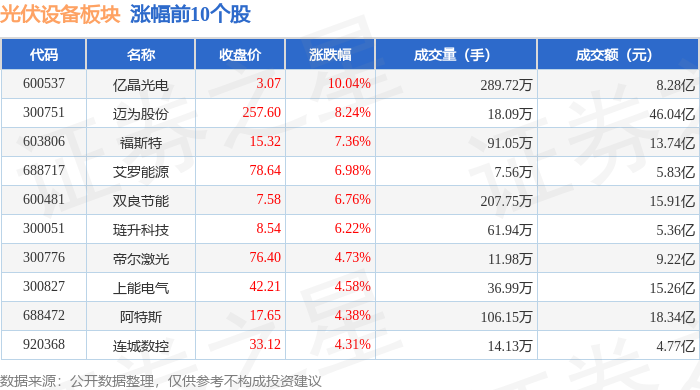
光伏设备板块1月19日涨0.55%,亿晶光电领涨,主力资金净流入9.04亿元
Zheng Xing Xing Ye Ri Bao· 2026-01-19 08:58
Core Insights - The photovoltaic equipment sector experienced a 0.55% increase on January 19, with Yichin Optoelectronics leading the gains [1] - The Shanghai Composite Index closed at 4114.0, up 0.29%, while the Shenzhen Component Index closed at 14294.05, up 0.09% [1] Stock Performance - Yichin Optoelectronics (600537) closed at 3.07, up 10.04%, with a trading volume of 2.8972 million shares and a transaction value of 828 million [1] - Maiwei Co., Ltd. (300751) closed at 257.60, up 8.24%, with a trading volume of 180,900 shares and a transaction value of 4.604 billion [1] - Foster (603806) closed at 15.32, up 7.36%, with a trading volume of 910,500 shares and a transaction value of 1.374 billion [1] - Other notable performers include Airo Energy (688717) up 6.98%, Shuangliang Energy (600481) up 6.76%, and Bansheng Technology (300051) up 6.22% [1] Capital Flow - The photovoltaic equipment sector saw a net inflow of 904 million from main funds, while retail investors experienced a net outflow of 573 million [2] - The main funds' net inflow for Sunshine Power (300274) was 598 million, while retail investors had a net outflow of 347 million [3] - Maiwei Co., Ltd. (300751) had a main fund net inflow of 425 million, but retail investors saw a net outflow of 414 million [3] - Foster (603806) recorded a main fund net inflow of 234 million, with retail investors experiencing a net outflow of 186 million [3]


白银暴涨,光伏流泪
Hua Er Jie Jian Wen· 2026-01-19 03:02
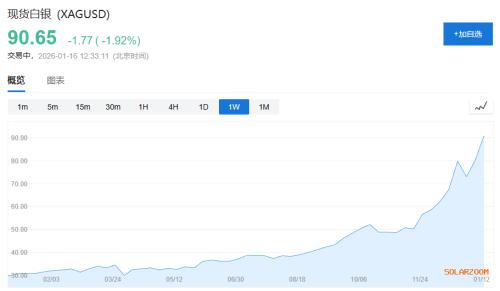
Core Insights - The cost of silver paste in photovoltaic (PV) modules has surged from 3.4% of total costs in 2023 to 29% currently, making it the largest cost component, surpassing silicon materials [1][3] - The rising silver prices have forced PV manufacturers to increase prices and accelerate plans to replace silver with cheaper materials like copper, with an expected 17% reduction in silver usage this year [1][7] Group 1: Cost Impact - A rise of 1000 yuan per kilogram in silver price increases the cost of solar cells by 0.01 yuan per watt, which is critical for the already thin profit margins in the PV industry [2] - The current silver consumption for TOPCon cells is approximately 10-13 mg/W, and if silver prices remain high, the cost from silver paste alone could reach 0.1-0.13 yuan per watt [3] Group 2: Price Adjustments - Chinese module manufacturers have raised prices by 1.4% to 3.8%, with mainstream 500W modules now priced around 400 yuan (approximately 57 USD) [3] - Leading companies like Longi Green Energy and Aiko Solar have recently increased their shipping prices, citing rising raw material costs [3] Group 3: Industry Challenges - Mid-tier companies are facing more severe challenges compared to leading firms, with some forced to halt production due to cash flow issues, financing difficulties, and inventory buildup [4][5] - A notable example includes a battery manufacturer in Hunan that ceased operations, stating there are currently no alternative solutions [6] Group 4: Supply and Demand Dynamics - The surge in silver prices is attributed to a supply-demand imbalance, with industrial demand, including solar energy, accounting for 65% of total silver demand [6] - The silver usage in the PV industry represents over 15% of global silver production, with a projected supply-demand gap of 5,000 tons by 2025 [6] Group 5: Material Substitution Efforts - Companies like Longi Green Energy are accelerating the replacement of silver with cheaper metals, with predictions that the PV industry could reduce silver usage by 17% this year [7] - Some technological routes have the potential to lower silver content to 25%, theoretically achieving a 90% reduction [7] Group 6: Risks of Substitution - The aggressive substitution strategy carries significant risks, as the stability of copper is inferior to silver, leading to potential long-term liabilities for manufacturers if panels fail before the warranty period [8] - Current substitution methods face challenges such as unstable printing of paste and suboptimal yield rates [8]




多晶硅急速遇冷:会成为下一个动力煤期货吗?
经济观察报· 2026-01-18 10:02
Core Viewpoint - The article discusses the significant decline in polysilicon futures prices entering 2026, with a year-to-date drop of 13.92% as of January 16, 2026, erasing gains since August 2025 and repeatedly falling below the critical threshold of 50,000 yuan/ton [2][4]. Market Dynamics - The trading volume and open interest for polysilicon have sharply decreased, with the weighted index's open interest falling below 90,000 contracts, only about 20% of last year's peak of 444,400 contracts [2][12]. - The recent price drop is attributed to weak supply and demand dynamics, alongside panic selling triggered by rumors of antitrust actions affecting major polysilicon producers [2][4][6]. Policy Impact - A new policy from China's Ministry of Finance and State Taxation Administration, effective April 1, 2026, will eliminate VAT export rebates for photovoltaic products, which may lead to short-term export demand but is expected to benefit the photovoltaic industry in the long run [4][10]. - In anticipation of this policy, prices for various photovoltaic products have increased, but polysilicon futures have not followed suit, indicating market disruptions [4][8]. Supply and Demand Analysis - January 2026 polysilicon production is estimated at around 107,000 tons, while demand is projected to be less than 80,000 tons, indicating a continued oversupply situation [6][10]. - The production of downstream components, such as battery cells and modules, has also decreased, further exacerbating the supply-demand imbalance [6][10]. Market Sentiment and Speculation - Market rumors regarding antitrust measures have amplified market volatility, leading to a rapid exit of long positions and contributing to the price decline [5][6]. - Analysts suggest that market participants should verify the authenticity of such rumors and consider the fundamental supply-demand conditions before making investment decisions [6][9]. Industry Challenges - The article highlights that regardless of market rumors, polysilicon prices were likely to decline due to the unsustainable price increases seen in 2025, which have not been matched by price increases in other segments of the photovoltaic supply chain [8][9]. - Companies in the downstream photovoltaic sector, such as TCL Zhonghuan, have reported significant losses due to the rising costs of polysilicon, which have not been adequately passed down the supply chain [9][10]. Regulatory Environment - The recent tightening of trading regulations by the exchange aims to curb speculative trading, which has contributed to the decline in trading volume and open interest in polysilicon futures [12][13]. - There are concerns that polysilicon futures could become marginalized, similar to the fate of coal futures, but analysts believe that the strategic importance of the photovoltaic industry will prevent this outcome [12][13].


多晶硅急速遇冷:会成为下一个动力煤期货吗?
Jing Ji Guan Cha Bao· 2026-01-18 09:25
Core Viewpoint - The recent decline in polysilicon prices and trading volumes is attributed to weak supply-demand dynamics and market rumors regarding antitrust issues, leading to panic selling among investors [1][2][4]. Group 1: Market Dynamics - As of January 16, polysilicon futures have seen a year-to-date decline of 13.92%, erasing gains since August and frequently falling below the critical threshold of 50,000 yuan/ton [1]. - The trading volume and open interest for polysilicon have significantly decreased, with open interest dropping to around 84,296 contracts, only 20% of last year's peak [9]. - The recent market sentiment has been exacerbated by rumors of antitrust actions against leading polysilicon companies, causing further panic among investors [2][3]. Group 2: Supply and Demand - The supply of polysilicon remains high, with January production estimated at around 107,000 tons, while demand is projected to be less than 80,000 tons, indicating a continued oversupply [4]. - Downstream production rates for solar cells and modules have also decreased, reflecting weak end-user demand [4]. - The overall market is experiencing a supply-demand imbalance, which is pressuring prices and leading to inventory accumulation [4]. Group 3: Policy Impact - The Chinese government announced the cancellation of VAT export rebates for photovoltaic products starting April 1, 2026, which may create short-term export demand but is expected to benefit the industry in the long run [2]. - The "anti-involution" policy aims to alleviate price competition within the photovoltaic industry, but the recent price surge in polysilicon has not been matched by increases in other segments, leading to operational pressures on downstream companies [6][7]. Group 4: Trading Regulations - The recent decline in trading volumes is partly due to the exchange implementing stricter risk control measures to curb speculative trading, which has raised transaction costs and reduced arbitrage opportunities [9][10]. - Concerns have been raised about the potential for polysilicon futures to become a "zombie product" similar to coal futures if trading continues to cool [9]. - Despite current challenges, the futures market is expected to remain relevant due to the strategic importance of the photovoltaic industry in China [10].
亿晶光电2025年预亏4.5亿元至6亿元 期末净资产或将为负
Xi Niu Cai Jing· 2026-01-18 06:06
Core Viewpoint - Yichin Photovoltaic (600537.SH) is expected to report a net loss attributable to shareholders of the parent company between 450 million to 600 million yuan for the fiscal year 2025, with a projected net asset value at the end of 2025 ranging from -68 million to -130 million yuan, which may trigger a delisting risk warning from the Shanghai Stock Exchange [2][3] Financial Performance - For the first three quarters of 2025, Yichin Photovoltaic achieved revenue of 1.556 billion yuan, a year-on-year decline of 42.58%, and reported a net profit of -214 million yuan [5] Operational Challenges - The company is facing significant operational challenges due to a structural mismatch in production capacity, leading to a persistent supply-demand imbalance and overall industry weakness, which has not allowed for a recovery in profitability [3] - The absence of a controlling shareholder and actual controller, following the judicial auction of all shares held by the former major shareholder, has adversely affected the company's credit status and financing capabilities, resulting in tightened liquidity and significant constraints on operational activities [3] Asset Impairment - In response to the decline in prices of its main business products, solar cell modules, the company has conducted impairment tests on inventory and fixed assets, leading to the recognition of asset impairment provisions that have significantly impacted its financial performance [5]
毁约式涨价!光伏组件上演“最后的疯狂”
Ge Long Hui A P P· 2026-01-17 11:23
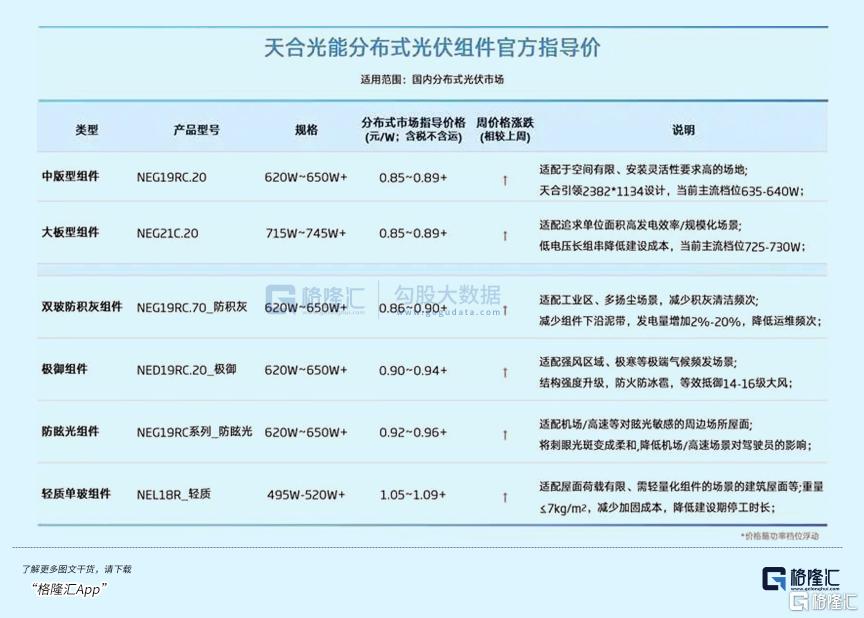
Core Viewpoint - The photovoltaic (PV) module industry is experiencing an unexpected price surge in early 2026, driven by the impending cancellation of export tax rebates and rising costs of key materials like silver and aluminum, leading to significant profit compression and potential industry-wide upheaval [1][7][19]. Price Surge and Market Dynamics - Several distributed PV investment companies have reported sudden price increases on previously agreed contracts, with one leading manufacturer raising prices from 0.73 yuan/W to 0.8 yuan/W [2]. - On January 13, Trina Solar announced a collective price increase for various distributed PV module models, with official guidance prices ranging from 0.85 to 0.89+ yuan/W [2][3]. - A total of 12 module manufacturers raised their prices this week, with increases ranging from 0.04 to 0.15 yuan/W [4]. Cost Factors - The cancellation of export tax rebates, effective April 1, 2026, is a significant catalyst for the price increases, as companies rush to fulfill orders before the policy takes effect [7][8]. - The price of silver has surged over 150% in 2025, increasing its cost share in PV modules from approximately 17% to around 30%, making it the largest cost component [10][13]. - The rising prices of aluminum and other materials have further exacerbated cost pressures, with aluminum's cost share increasing from 8-12% to 12-15% [14][16]. Industry Overcapacity and Challenges - The PV industry is facing severe overcapacity, with silicon production capacity expected to cover more than double the global demand from 2025 to 2027, while actual demand is below 600 GW [17]. - Despite the overcapacity, over 40 billion yuan is still being invested in new PV projects, worsening the supply-demand imbalance [18]. - The cancellation of export tax rebates is anticipated to trigger a brutal industry-wide clearing, with many companies lacking competitive advantages likely to exit the market [19][24]. Financial Impact and Future Outlook - The removal of export tax rebates will significantly reduce profit margins for PV companies, with estimates indicating a profit reduction of 46-51 yuan per 210R module exported [24]. - Many companies are already reporting substantial losses, with projections indicating that the entire PV silicon industry could face losses amounting to hundreds of billions in 2025 [27][28]. - The industry is expected to undergo a significant consolidation, with over 30% of inefficient capacity being eliminated, allowing leading companies with strong technology and global presence to capture over 80% of the market share [29].
毁约式涨价!光伏组件上演“最后的疯狂”
格隆汇APP· 2026-01-17 11:23
Core Viewpoint - The photovoltaic (PV) module industry is experiencing an unexpected price surge at the beginning of 2026, driven by factors such as the impending cancellation of export tax rebates and rising costs of key materials like silver and aluminum, leading to significant profit compression in the industry [2][9][18]. Price Surge and Market Dynamics - Several PV module manufacturers have announced price increases, with some companies raising prices from 0.73 yuan/W to 0.8 yuan/W, and the official guidance price for distributed PV modules now ranges from 0.85 to 0.89 yuan/W [4][6]. - A total of 12 module manufacturers raised their prices this week, with increases ranging from 0.04 to 0.15 yuan/W [6][7]. - Reports indicate that some companies are delaying deliveries and demanding price hikes, causing significant disruptions for downstream companies [7][18]. Reasons for Price Increases - The cancellation of export tax rebates is a major catalyst for the price surge, with the Ministry of Finance announcing the phased removal of VAT export rebates for PV products starting April 1, 2026 [9][10]. - The price of silver has skyrocketed, increasing from 7,600 yuan/kg at the beginning of 2025 to 23,688 yuan/kg by the end of the year, resulting in a cost increase of at least 0.16 yuan per watt for PV cells [11][13]. - The cost share of silver in PV modules has risen from approximately 17% to around 30%, surpassing silicon as the largest cost component [13]. Industry Challenges and Overcapacity - The PV industry is facing severe overcapacity, with silicon production capacity expected to cover more than double the global demand from 2025 to 2027, while actual demand is below 600 GW [19][20]. - The cancellation of export tax rebates is expected to trigger a violent market clearing in 2026, as many companies will struggle with cash flow and rising costs [21][27]. - The industry is projected to experience significant losses, with estimates suggesting that the entire PV silicon industry could face losses amounting to hundreds of billions in 2025 [28][29]. Future Outlook and Investment Strategy - The anticipated market clearing in 2026 is expected to eliminate over 30% of inefficient capacity, concentrating resources among leading companies with vertical integration and core technologies [31]. - Investors are advised to avoid high-debt, non-competitive small and medium enterprises, focusing instead on companies with stable cash flow, strong technology, and global presence [32].

亿晶光电科技股份有限公司股票交易异常波动公告
Shang Hai Zheng Quan Bao· 2026-01-16 20:51
Core Viewpoint - The stock of Yijing Optoelectronics Co., Ltd. experienced a significant abnormal fluctuation, with a cumulative decline of over 20% in closing prices over three consecutive trading days from January 14 to January 16, 2026 [2][3]. Group 1: Stock Trading Abnormal Fluctuation - The company's stock price deviation exceeded 20% over three consecutive trading days, qualifying as an abnormal trading fluctuation according to the Shanghai Stock Exchange regulations [2][3]. Group 2: Company Verification and Confirmation - The company conducted a self-examination and confirmed that its production and operational activities are normal, with no significant changes in the internal or external operating environment that would affect stock price fluctuations [4]. - The company verified with major shareholders and confirmed that there are no undisclosed significant matters affecting stock trading prices, including major asset restructuring, share issuance, or other significant transactions [5]. - No media reports or market rumors were found that could significantly impact the company's stock trading prices, and there are no related market hot concepts [6]. Group 3: Shareholder and Management Activity - The company confirmed that there were no stock trading activities by directors, senior management, or major shareholders during the period of abnormal stock price fluctuations [7]. Group 4: Trading Volume and Market Risk - As of January 16, 2026, the stock turnover rate was 2.37%, with recent turnover rates of 8.03%, 5.01%, 1.61%, and 2.37% over the last four trading days, indicating a significant decrease in the last two days [8].
亿晶光电(600537) - 亿晶光电科技股份有限公司股票交易异常波动公告
2026-01-16 11:17
证券代码:600537 证券简称:亿晶光电 公告编号:2026-004 亿晶光电科技股份有限公司 股票交易异常波动公告 本公司董事会及全体董事保证本公告内容不存在任何虚假记载、误导性陈述 或者重大遗漏,并对其内容的真实性、准确性和完整性承担法律责任。 重要内容提示: 一、股票交易异常波动的具体情况 公司股票于 2026 年 1 月 14 日、1 月 15 日和 1 月 16 日连续 3 个交易日内日 收盘价格跌幅偏离值累计超过 20%。根据《上海证券交易所交易规则》的有关规 定,属于股票交易异常波动情形。 (二)重大事项情况 经公司自查,并向公司主要股东函证(经公司自主查询,截至本公告披露日, 深圳禾勤投资实业合伙企业(有限合伙)已不是公司第一大股东,李颜涛、杨昔 青、张寿春为公司目前并列第一大股东,本次函证对象为李颜涛、杨昔青,张寿 春未取得联系),公司、公司主要股东均不存在影响公司股票交易价格异常波动 的重大事项,不存在涉及公司应披露而未披露的重大信息,包括但不限于重大资 产重组、股份发行、重大交易类事项、业务重组、股份回购、股权激励、破产重 整、重大业务合作、引进战略投资者等重大事项。 (三)媒体报道、 ...